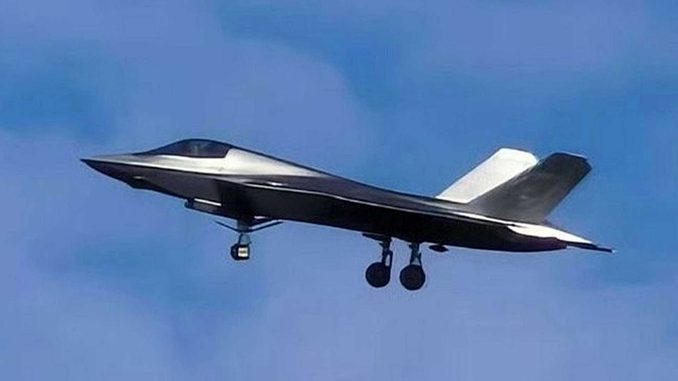
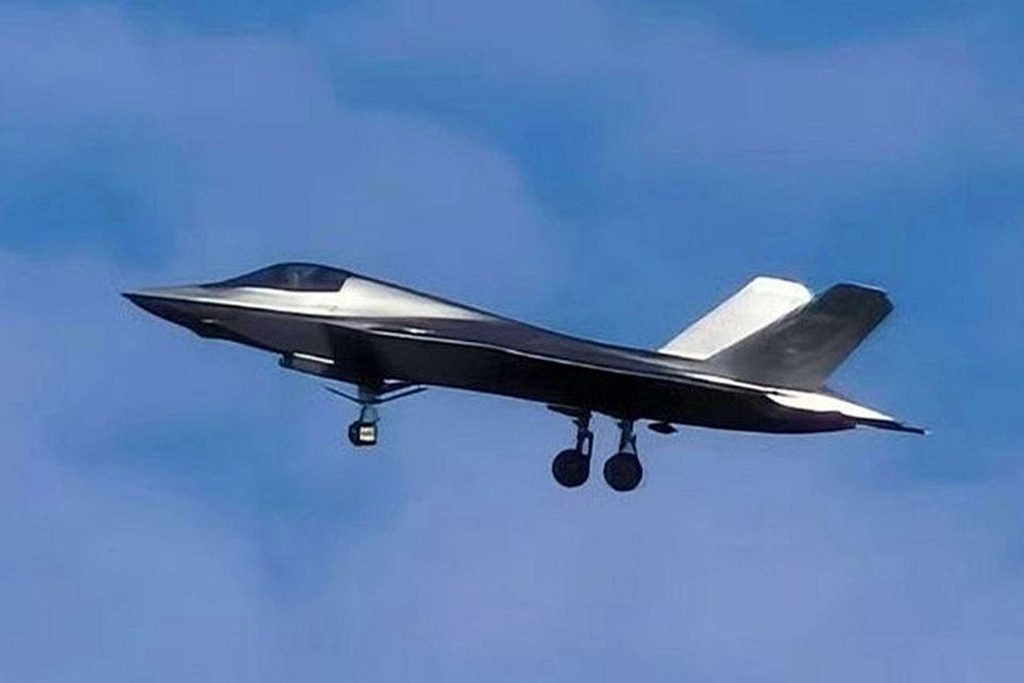
Photos show a Chinese J-35 with a silver surface. Stealth coating, infrared reduction, or a simple light effect: what we know.
In Summary
Since mid-August 2026, photographs of a Chinese naval aviation J-35 show the aircraft with an unusually shiny, almost metallic surface. No Chinese agency has confirmed the application of a new stealth coating. Therefore, the images alone do not make it possible to assert that Beijing is testing a new technology. The hypothesis is nevertheless credible because the United States has experimented, since 1993, with comparable treatments on the F-117, and later on Model 401 demonstrators, F-22s, and F-35Cs. Several functions are conceivable: reduction of the infrared signature, improvement of resistance to harsh marine environments, evolution of radar-absorbing materials, or laser-related experimentation. The shiny appearance in the visible spectrum says almost nothing about radar stealth. The true challenge is now multispectral: a stealth fighter must be difficult to detect not only on radar, but also in the infrared spectrum and by electro-optical means.
The Silver J-35 Appears Just as the Aircraft Enters a New Phase
The first photographs began circulating on Chinese social networks in mid-August 2026. They show a naval J-35 in flight with a finish that is much lighter and more reflective than the gray usually associated with stealth aircraft. Depending on the angle of the sun, certain areas of the fuselage, wings, and empennage take on an almost chromed appearance.
The image was quickly compared to American F-22s and F-35s that have borne similar experimental surfaces.
However, initial observations must remain cautious. China has not announced any new stealth coating for the J-35. Nothing makes it possible, based on compressed photographs taken from a distance, to determine the chemical or electromagnetic composition of its surface.
Chinese specialists themselves have put forward a simpler explanation: the combination of lighting, viewing angle, and digital image processing could significantly accentuate the shine of an existing coating.
The context nevertheless renders this appearance interesting.
The J-35 has become a central element of China’s new carrier-based aviation. In September 2025, the Chinese Navy officially confirmed its first electromagnetic catapult launches and arrested landings on the aircraft carrier Fujian. The ship, displacing over 80,000 metric tons at full load according to Chinese data, entered service on November 5, 2025.
The J-35 now operates alongside the J-15T and the KJ-600 airborne early warning aircraft.
An experimental surface treatment thus takes on particular significance on this aircraft. The J-35 is no longer merely a land-based prototype. It is becoming a fighter destined to spend part of its life in one of the most aggressive environments possible for an aircraft: the flight deck of an aircraft carrier.
Visible Shine Does Not Mean the J-35 Is Less Stealthy
The idea of a shiny stealth aircraft seems contradictory.
It is not necessarily so.
Visible light roughly occupies wavelengths between 400 and 700 nanometers. By contrast, an X-band fire-control radar uses wavelengths on the order of a few centimeters. Between the two, the gap reaches tens of thousands of times.
A material can therefore strongly reflect visible light while behaving entirely differently toward a radar wave.
This is a key point.
Furthermore, radar stealth never relies solely on paint. The shape of the aircraft constitutes its primary defense. The J-35 utilizes surfaces aligned at precise angles, air intakes that mask the highly reflective parts of the engine, weapons stored in internal bays, and special treatments around openings and panels.
The goal is to prevent radar energy from returning toward the transmitter.
Radar-absorbing materials, or RAM, then complement this geometry. They use different combinations of polymers, dielectric materials, conductive or magnetic particles, and resistive layers to dissipate or phase-shift a portion of the electromagnetic energy.
On the F-35, for instance, low observability results simultaneously from airframe shaping, composite materials, surface treatments, and assembly precision. Thousands of fasteners and seams must be monitored to maintain the aircraft’s stealth performance.
A very thin reflective layer can therefore perfectly well be placed over an absorbing system, provided its electrical properties have been designed not to disturb the overall performance at the targeted radar frequencies.
Conversely, a simple conductive metallic sheet placed carelessly over a stealth surface could sharply increase radar reflections.
Without knowing the composition of the J-35’s coating, no one can determine which category it falls into.
Reducing the Infrared Signature Is the Most Compelling Hypothesis
Comparison with American experiments naturally leads toward the infrared spectrum.
An aircraft is not only detectable by radar. It also radiates thermal energy.
The engines and their nozzles constitute the most obvious sources. But the fuselage itself heats up. At high speeds, aerodynamic heating increases the temperature of the leading edges, the nose, and certain areas of the airframe. The aircraft also absorbs heat from its internal systems and solar radiation.
Infrared Search and Track (IRST) sensors can search for these temperature differences without emitting any radar waves themselves.
This is particularly troublesome for a stealth aircraft.
An active radar generally reveals that it is searching for a target. An IRST can remain entirely passive. The improvement of infrared detectors, optical systems, and computer processing thus progressively increases the threat against fifth-generation aircraft.
A surface possessing low emissivity in certain infrared bands could reduce the amount of thermal energy radiated directly toward a sensor.
The physics of thermal coatings is well understood. The space industry has long used materials with separately controlled solar absorptivity and infrared emissivity. Certain metallized films can reflect a large portion of solar radiation while exhibiting precisely adjusted thermal behavior in the infrared spectrum.
Applying the principle to a fighter aircraft, however, would be far more complex.
A low-emissivity coating can reduce thermal radiation directly emitted by a surface, but it can also complicate its radiative cooling. The actual skin temperature then depends on conduction, aerodynamic convection, and various internal heat sources.
It is therefore not enough to put a mirror on an aircraft to render it invisible to infrared sensors.
It requires designing true spectral management of the signature.
The F-117 Had Already Experimented with This Idea in 1993
The first serious comparison dates back more than thirty years.
In July 1993, a development F-117A Nighthawk participated in the SENIOR SPUD program. Part of the aircraft had been coated with a highly reflective metallic treatment.
Four test flights were reportedly conducted. The F-117 flew in proximity to the NKC-135A Flying Infrared Signature Technology Aircraft, a flying laboratory specialized in measuring infrared signatures.
The documented objective was to evaluate infrared signature reduction.
The visual result was striking. The surface could appear dull under certain angles and then intensely reflect the sun under others.
The tests already demonstrated a fundamental difficulty of multispectral stealth: improving one signature can degrade another.
A treatment capable of reducing certain infrared emissions can make an aircraft far more visible in the optical spectrum when it directly reflects sunlight.
The Model 401s Relaunched Testing in the United States
In June 2020, one of two Scaled Composites Model 401 “Son of Ares” demonstrators was photographed with a surface almost entirely covered in reflective material.
The tests took place around Naval Air Weapons Station China Lake, one of the primary American centers for aeronautical systems and weapons development.
The program has never been detailed publicly.
The Model 401s nevertheless worked alongside various test platforms and several types of sensors. The observed metallic treatments also bear similarities to those that subsequently appeared on American stealth fighters.
They likely served to test the behavior of different materials across several parts of the electromagnetic spectrum.
F-22s Subsequently Received Multiple Metallic Skins
In November 2021, an F-22 based at Nellis Air Force Base appeared with a surface made up of reflective metallic panels.
A second aircraft later received a different configuration, composed of small geometric tiles forming a sort of mosaic.
The U.S. Air Force provided a deliberately limited explanation. According to the 57th Wing, it was a material demonstration aimed notably at evaluating solutions capable of improving sustainment and reducing maintenance burdens over the life cycle.
Military officials confirmed that experimental materials were being evaluated to determine if they could improve the sustainability and reliability of the F-22.
This point is important.
Stealth carries a high industrial cost.
F-22 coatings require meticulous maintenance. Humidity, temperature, abrasion, and repeated panel openings can degrade their adhesion or alter their electromagnetic behavior.
Air forces must therefore maintain specialized crews tasked with restoring low-observable surfaces.
A new, more durable coating can thus indirectly improve the operational availability of a fleet.
The F-35C Represents the Most Relevant Comparison for China
The most interesting parallel with the J-35, however, concerns the F-35C.
Both aircraft are carrier-capable stealth fighters designed to operate from aircraft carriers.
Beginning in 2022, several U.S. Navy F-35Cs were observed with reflective coatings. Some surfaces consisted of diamonds, triangles, and small metallized panels applied over the aircraft’s standard finish.
An F-35C fitted with this treatment was also photographed during carrier operations.
This naval dimension opens a second particularly credible hypothesis for the J-35: durability.
An aircraft carrier flight deck exposes jets to salt spray, high humidity, wind, jet fuel, thermal fluctuations, ultraviolet radiation, and repeated mechanical stresses.
Yet stealth coatings are sensitive to their surface condition.
Corrosion control is a direct component of low-observability maintenance on the F-35.
Photographs of an experimental American F-35C taken after intensive testing showed severely degraded reflective elements. According to reports in the specialized defense press, the treatment was notably evaluated to improve resistance to the effects of salt air, even if this explanation was never officially confirmed by the U.S. Navy.
For the J-35, this avenue deserves to be taken very seriously.
The Coating Could Fulfill Multiple Functions Simultaneously
Seeking a single function would likely be a mistake.
Modern materials allow for the engineering of surfaces possessing multiple properties.
A treatment intended for the J-35 could thus simultaneously aim to improve resistance to harsh marine conditions, stabilize the radar characteristics of the skin over time, and alter its behavior in certain infrared bands.
Another hypothesis involves lasers.
A surface capable of reflecting a high proportion of a given wavelength absorbs less energy at that frequency. In theory, this can increase its resistance to a laser or disrupt certain rangefinding and designation systems.
The United States has long studied aircraft protection against directed-energy weapons. The presence of metallic coatings on several test platforms has thus fueled speculation regarding research into laser countermeasures.
However, no public evidence directly links the J-35 to this function.
The same caution must be maintained regarding the radar hypothesis.
A new generation of more durable radar-absorbing materials would be extremely valuable. Modern stealth aircraft specifically seek to integrate absorbing properties more directly into structural materials in order to limit lengthy surface repairs.
Yet a silver photograph is not enough to demonstrate progress in this area.
Stealth Is Becoming a Multispectral Battle
The true interest of these photographs ultimately extends beyond the color of the J-35.
Early stealth aircraft were designed primarily to reduce their radar cross-section. This priority remains. But adversaries are now developing complementary assets: long-range IRSTs, passive sensor networks, radars operating across different frequency bands, infrared satellites, and data fusion from multiple platforms.
The answer consists of moving from radar stealth to multispectral low observability.
This means working on the radar, infrared, electromagnetic, and sometimes visual signatures of an aircraft, while managing its thermal footprint and electronic emissions.
China is clearly following this logic in the overall design of the J-35.
Photographs available for several years show serrated engine nozzles designed to reduce certain radar returns and better manage the rear signature. The aircraft also combines internal weapons bays, integrated electro-optical sensors, and an overall geometry engineered to reduce detectability.
Its maximum takeoff weight is generally estimated at around 30 metric tons. Its airframe was specifically navalized with reinforced landing gear, an arrestor hook, folding wings, and hardware compatible with catapult launches.
An improvement to the skin of the aircraft would thus be entirely consistent with the maturation of the program.
The Real Impact Will Depend on What Future Aircraft Show
It would be premature to present the silver J-35 as proof of a Chinese revolution in stealth materials.
Three scenarios remain credible.
The first is relatively mundane: a lighting effect amplified by photography and digital processing.
The second is intermediate: a new protective finish or production treatment simply exhibiting a different visible reflectivity.
The third is far more significant: an experimental coating intended to control radar, infrared, or thermal signatures while improving the aircraft’s durability in a marine environment.
Repetition will be the key to telling them apart.
If multiple J-35s appear with this finish, particularly during regular operations from the Fujian, the hypothesis of a new industrial standard will become much more serious.
If a single aircraft retains this appearance for a few test campaigns before returning to conventional gray, it should instead be viewed as a flying testbed.
The American precedent above all suggests not dismissing the technological hypothesis solely because the aircraft appears shiny.
F-117s, F-22s, and F-35s have genuinely tested treatments exhibiting a comparable appearance.
However, these precedents also counsel caution.
A shiny aircraft can be stealthy. A shiny aircraft is not necessarily more stealthy.
Everything depends on the targeted wavelengths, the microscopic structure of the materials, their conductivity, their emissivity, and the manner in which they are integrated into the airframe.
It is precisely for this reason that the J-35 photographed in August warrants attention.
The stealth of the next aerial conflict will no longer be decided solely by what a radar sees. It will hinge on an aircraft’s ability to control what it reflects, what it absorbs, and what it emits across several parts of the electromagnetic spectrum at once.
War Wings Daily is an independant magazine.