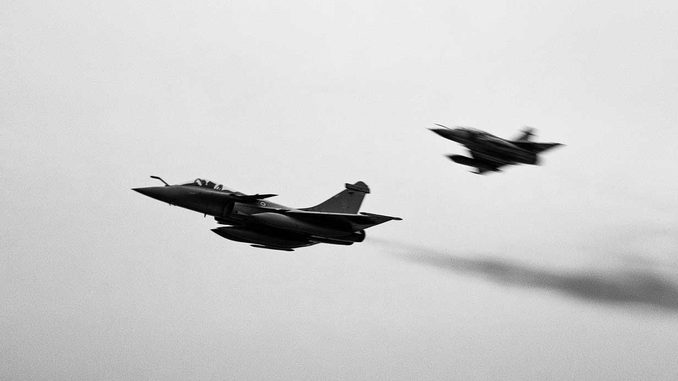
France is accelerating the Rafale F5 with a new radar, T-REX engine, electronic warfare, IVDL link, and a stealth drone to prepare for the post-FCAS era.
In Summary
France has just taken a decisive step forward in the development of the Rafale F5. On September 9, 2026, the General Directorate of Armament detailed several contracts awarded over the summer to Dassault Aviation, Thales, Safran, and MBDA, in preparation for the full launch of the standard scheduled for late 2026. The F5 is expected to be qualified around 2033. It will notably receive the RBE2-XG radar, a new version of SPECTRA, the IVDL stealth data link, a new-generation inertial navigation unit, and the M88 T-REX engine upgraded to 9 tons of thrust. Above all, the Rafale must learn to fight alongside drones and a future stealth UCAS. This evolution assumes a new strategic dimension following the halt of the Franco-German NGF. Paris now includes in its military programming the preparation of a national sixth-generation fighter, potentially with partners, but currently without structured cooperation equivalent to FCAS.
September 9 Marks a New Step, Not Yet the Full Launch
The nuance is important. On September 9, 2026, the General Directorate of Armament had not yet formally launched the full production of the F5 standard. It confirmed several contracts awarded over the summer aimed at securing key technological building blocks prior to the production launch planned for late 2026.
The contracts involve Dassault Aviation, Thales, Safran, and MBDA France. Their content demonstrates, however, that the program is now entering a much more concrete phase.
The schedule is tight. The DGA aims for qualification of the new standard around 2033, prior to its entry into service with the French Air and Space Force and subsequently the French Navy.
The Military Programming Law updated in August 2026 provides for a fleet size of 225 combat aircraft, including at least 47 Rafale aircraft at the F5 standard by 2035. It also allocates an additional 3.4 billion euros to combat aviation, a funding envelope intended notably to finance the launch of the F5 and new armaments.
The Rafale F5 is therefore no longer a distant modernization concept. Its architecture is beginning to freeze into place.
The RBE2-XG Radar Changes the Rafale’s Detection Capability
Among the equipment items now under contract is the RBE2-XG, for eXtended Generation, developed by Thales.
It will replace the RBE2 AESA currently utilized by the Rafale. The change goes beyond an increase in range. The radar will need to identify and track targets exhibiting a very low radar cross-section, thereby better addressing stealth aircraft, drones, and certain weapons.
The RBE2-XG will feature higher power and enhanced processing capabilities. The objective is notably to allow a much more extensive use of artificial intelligence algorithms and enable multiple sensors to operate cooperatively.
Furthermore, the radar must maintain the physical footprint of its predecessor. This is a major constraint. The Rafale remains an aircraft whose airframe made its initial flight as a demonstrator in 1986. It is therefore necessary to significantly increase system power without completely redesigning the platform.
This evolution directly addresses one of the challenges of the Rafale against stealth fighters: detecting low-observable targets at longer ranges and constructing a military-grade target track usable by weapons quickly enough.
SPECTRA Electronic Warfare Shifts to Fully Digital
The second major change concerns SPECTRA, developed by Thales and MBDA.
The system currently handles electromagnetic threat detection, identification, and a portion of the Rafale’s jamming and protection functions.
On the F5, SPECTRA is set to transition to a largely digital architecture. The DGA wants to improve both detection and jamming in order to keep pace with the increasing density of the electromagnetic spectrum.
The issue has become critical. Modern radars utilize more complex waveforms, rapidly switch frequencies, and can operate with brief or hard-to-locate emissions. An electronic warfare system must therefore monitor a very wide frequency band, rapidly classify the signal, and select the appropriate response.
In the air combat of the 2035 timeframe, electronic warfare will no longer be merely a defensive system. It will become a sensor and a weapon in its own right.
The IVDL Link aims to Enable Combat Under Jamming
Another disruption is less visible, but likely just as important: the Inter-Vehicle Data Link.
The IVDL is designed to provide a high-throughput, discrete, and jam-resistant link. Unlike a conventional omnidirectional transmission, the principle involves concentrating radio energy more directly toward the correspondent.
The operational benefit is considerable. A Rafale will be able to exchange greater amounts of data with other aircraft and drones while reducing the risks of detection, interception, or jamming.
Collaborative combat relies precisely on this flow of data. One platform can detect a target, a second can establish its position, and a third can execute the launch. The pilot firing the weapon no longer necessarily needs to operate their own radar.
This architecture brings the Rafale F5 closer to the concepts associated with true next-generation air combat systems.
The T-REX Engine Delivers 20% Additional Thrust
Safran Aircraft Engines has received a contract for the preliminary design phase of the M88 T-REX.
The current M88-2 provides approximately 7.5 tons of maximum thrust with afterburner. The T-REX is targeted to reach approximately 9 tons, representing a 20% increase.
This is not intended to transform the Rafale into a faster aircraft. The additional power is primarily required to offset increases in weight, equipment, electrical demand, and future weaponry.
Safran is simultaneously seeking to preserve the M88’s modular architecture and physical envelope. The objective is to avoid heavy modifications to the air intakes and airframe, which would have significantly increased development costs and timelines.
The Stealth Drone Transforms the F5 into a Combat System
Yet the most profound disruption lies alongside the Rafale.
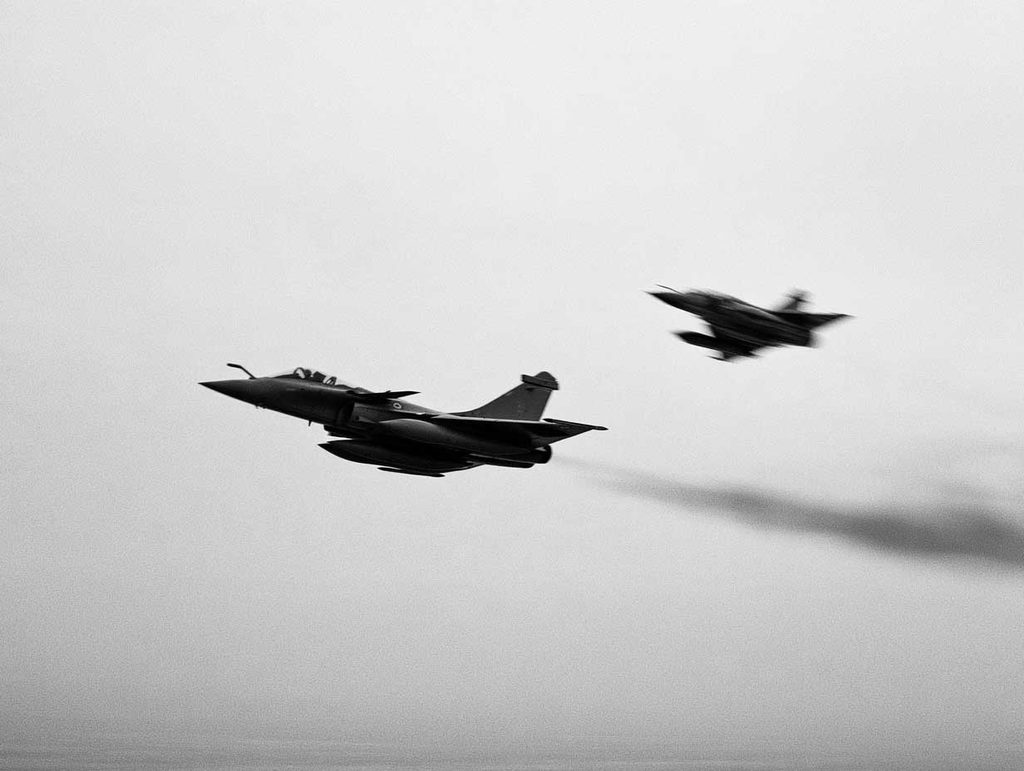
Dassault Aviation is developing a stealth combat drone, a technological heir to the nEUROn demonstrator. It must be capable of preceding the fighter aircraft into the most heavily defended airspace.
The nEUROn program has already accumulated over 170 test flights. This experience provides Dassault with a baseline in stealth, autonomy, and uncrewed systems.
The future drone will notably be able to contribute to first-entry missions, air-to-air combat, air-to-ground strikes, and the suppression of enemy air defenses. It will require modern sensors, internal payload bays, resilient connectivity, and a degree of autonomy, while retaining a human in the decision loop.
The LPM also plans for escort drones, with initial experiments as early as 2028 and an operational stealth combat drone demonstrator targeted for 2035.
The combat drone paired with the Rafale F5 constitutes much more than an additional wingman. It becomes a means of projecting sensors, weapons, and exposure to risk far ahead of the crewed aircraft.
The F5 Receives New Weapons to Penetrate Defenses
The Rafale F5 is also set to become a much more powerful strike vector.
It will be capable of deploying the ASN4G, the future nuclear missile intended to succeed the ASMPA-R. This capability accounts for a portion of France’s constraints regarding industrial sovereignty.
The updated LPM adds two major programs. The COMETE very long-range air-to-air missile is slated to begin equipping the Rafale F4 starting in 2030. The F5 will also benefit from STRATUS Rapid Strike, intended primarily for suppression of air defense missions and anti-ship warfare.
The principle is consistent: detect further away, exchange data without revealing position, designate a target across multiple platforms, and employ standoff weapons that remain beyond the reach of the enemy’s primary defenses.
The F5 Becomes the French Bridge to the Post-FCAS Era
This is where the program assumes a new dimension.
When the Rafale F5 was defined, it was intended to constitute a step toward the Future Combat Air System. Since the halt of the Franco-German NGF in 2026, this relationship has profoundly changed.
French law is now explicit. Despite the uncertainties surrounding FCAS, France intends to preserve the technologies required to produce a sixth-generation fighter capable of carrying the ASN4G and operating from the future French aircraft carrier.
Programming now includes a national sixth-generation fighter demonstrator, with the possibility of partnerships.
This distinction is essential. France does not currently possess a formal European partner to replace the NGF with a new program of equivalent scale. It can independently develop a demonstrator and several critical technologies. Designing, industrializing, and funding a complete combat system entirely alone is vastly more challenging.
Moreover, the F5 does not constitute a sixth-generation fighter. Its airframe was not designed around new-generation structural stealth. However, its sensors, networks, artificial intelligence, drones, and electronic warfare capabilities will allow France to develop a portion of the technologies necessary for the future aircraft.
This is now the true strategic function of the Rafale F5. It is no longer merely intended to extend the Rafale’s service life. It must prevent a French technological rupture between the current generation and the fighter that will succeed it after 2040.
The question will then be less about how far the Rafale can evolve, and more about determining at what point that evolution reaches the physical limits of its airframe. France has just funded the bridge. It must still decide with whom it will build the aircraft waiting on the other side.
War Wings Daily is an independant magazine.