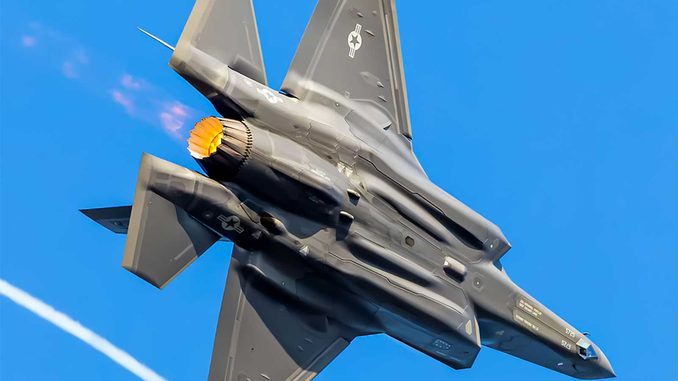
The Pentagon confirms “Six in the Bay”: the F-35 is set to expand its internal weapon bay capacity from four to six missiles by September 2030 without sacrificing stealth.
In Summary
The F-35 program is moving toward a major evolution in its air-to-air weaponry. The Modernized Selected Acquisition Report published for Fiscal Year 2027 confirms the development of “Six in the Bay” (SITB), targeting operational deployment by September 2030. The objective is straightforward: increase the internal missile payload of the F-35 from four to six—a 50% capacity boost—without resorting to wing hardpoints that compromise its low radar cross-section. This capability has historically been associated with the Sidekick adapter developed by Lockheed Martin to accommodate two additional AIM-120-class missiles inside the internal weapon bays of the F-35A and F-35C. Several recent production F-35C airframes already incorporate structural modifications preparing for this integration, though the feature is not yet operationally fielded. The strategic stakes are high: expanding the F-35’s magazine depth while preserving its fully stealthy combat configuration.
The Pentagon Formally Targets September 2030
The upgrade is no longer merely a conceptual pitch by Lockheed Martin.
The F-35 program’s Modernized Selected Acquisition Report, dated April 21, 2026, and released as part of the US FY2027 defense budget submission, explicitly lists Six in the Bay (SITB) among active development capabilities.
The official document leaves no ambiguity regarding the goal: expand internal air-to-air missile storage from four to six. The listed fielding target is September 2030.
This timeline specification is significant. While the underlying concept has circulated for years, its operational timeline was long subject to change. Lockheed Martin first explored the concept in the early 2010s, later formalizing it into the Sidekick adapter designed to house two extra missiles within the weapon bays.
The F-35 Lightning II currently accommodates four AIM-120 family missiles in a fully internal, air-to-air configuration.
Under SITB, that capacity will increase to six.
This represents a 50% increase in stealthy air-to-air firepower while adhering to the core design principle of the F-35: keeping weapons stowed inside the airframe when operating in high-threat radar environments.
Internal Weapon Bays Directly Preserve the F-35’s Stealth
Where missiles are carried is nearly as critical as how many are carried.
Conventional fighter jets typically carry most of their ordnance on external hardpoints under the wings and fuselage. While this approach simplifies carrying heavy and varied payloads, it exponentially increases radar reflections.
The F-35 was designed around a different operational logic.
Its dual internal weapon bays house primary munitions while maintaining an outer mold line optimized for low observability. The bay doors open only briefly at the moment of weapon release.
While exact radar cross-section comparisons between an internal payload and an externally loaded F-35 remain classified, basic radar physics are unequivocal: external pylons, missiles, and bombs introduce prominent reflective angles and cavities.
Six internal missiles bypass this operational compromise.
The F-35 can already carry heavier weapon loads when mission planners choose to trade away maximum stealth. This non-stealthy loadout—often referred to as “Beast Mode”—becomes viable after enemy air defense networks have been degraded.
By contrast, Six in the Bay targets the opening phases of a conflict, when low radar observability carries maximum tactical value.
The Sidekick Adapter Fits Two Extra Missiles into Tight Quarters
Gaining two extra weapon slots sounds straightforward on paper, but it presents complex engineering challenges.
As early as 2023, Lockheed Martin detailed how its Sidekick modification allows two additional AIM-120-sized missiles to be mounted on internal stations 4 and 8.
This is achieved without enlarging the external dimensions of the weapon bays. Instead, it relies on optimizing internal volume and reconfiguring the launcher rack architecture.
Adding extra missiles introduces severe structural, electrical, and software constraints.
The launcher mechanism must securely hold the weapon during high-G maneuvers, interface electronically with the aircraft’s mission computers, pass targeting data to the missile, and ensure clean ejection without striking the aircraft, bay doors, or adjacent weapons.
Separation Testing Remains Mandatory
At high Mach numbers, a missile does not simply fall away from an internal bay.
When bay doors open at supersonic or high-subsonic speeds, complex aerodynamic airflow field turbulence occurs. The missile must be forcefully ejected with precisely controlled impulse force and attitude before its rocket motor ignites.
A deviation of a few centimeters or milliseconds can alter the weapon’s initial trajectory and threaten the aircraft.
Transitioning from four to six missiles requires extensive ground vibration testing, bay door separation trials, weapon release tests, and envelope expansion across the flight regime.
This explains why possessing hardware modifications does not translate to immediate operational deployment.
Recent F-35Cs Already Feature Preliminary Structural Modifications
Nevertheless, the program has progressed beyond pure theory.
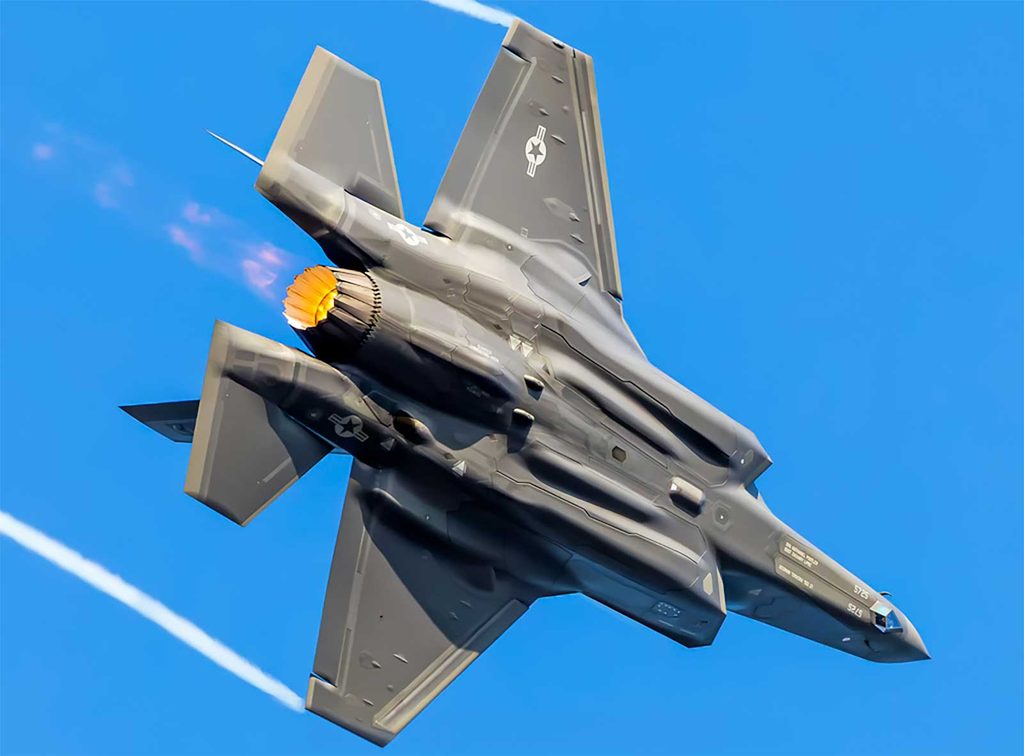
In March 2025, Naval News reported, following confirmation from the US Navy, that several Lot 15 F-35C aircraft had been delivered with bay modifications built-in to support the future Six in the Bay capability.
This confirms that a portion of the active fleet already incorporates the underlying physical provisions.
However, the operational capability itself has not yet been declared active.
This distinction is vital: an airframe can feature structural provisions for a system long before the launcher mechanisms, software code, missile variants, and flight procedures complete formal qualification.
The September 2030 schedule reflects the comprehensive qualification process required for full operational clearance.
The F-35B Represents a Far More Complex Integration Challenge
Publicly disclosed details regarding the Sidekick modification focus primarily on the US Air Force’s conventional-takeoff F-35A and the US Navy’s carrier-variant F-35C.
The short takeoff and vertical landing (STOVL) F-35B presents distinct physical constraints.
This variant features a mid-fuselage LiftFan located directly behind the cockpit to enable vertical landing capabilities. This propulsion architecture reduces the internal volume available for weapon bays.
Consequently, the F-35B’s internal weapon bays are smaller than those on the A and C models.
The FY2027 report uses the general term “F-35” when discussing Six in the Bay without publicly specifying which variants are covered. It would be premature to assume on this basis alone that all three variants will receive the six-missile capacity.
Based on technical documentation published to date, the F-35A and F-35C remain the primary beneficiaries of the Sidekick architecture.
Two Additional Missiles Provide a Significant Air-to-Air Advantage
An additional two missiles might seem like an incremental upgrade, but it expands internal magazine depth by half.
This concept of “magazine depth” is fundamental to modern aerial warfare.
A fighter pilot cannot assume a one-to-one ratio between missiles fired and targets destroyed. Targets maneuver, deploy electronic jamming, or escape the kinematic engagement envelope. Tactical doctrine may dictate firing multiple missiles at a single target to maximize kill probability.
Hypothetically, if an engagement doctrine allocates two missiles per target, a four-missile bay allows for two target engagements, whereas a six-missile bay allows for three. While actual launch doctrine depends on dynamic engagement parameters, the arithmetic demonstrates the tangible combat benefit.
Across a multi-aircraft formation, this multiplier expands dramatically.
A four-ship flight of F-35s would theoretically increase its internal missile load from 16 to 24 AMRAAMs. An eight-ship formation could carry 48 internal missiles instead of 32.
The capability upgrade extends beyond individual airframes, boosting the overall firepower density of entire flight formations.
Closing the Gap with the F-22’s Internal Capacity
This upgrade brings the F-35 closer to the internal air-to-air payload of the F-22 Raptor.
In its standard air-dominance configuration, the F-22 carries six AIM-120s in its primary ventral bay, supplemented by two AIM-9 Sidewinders in dedicated side bays.
However, SITB will not transform the F-35 into a dedicated air superiority fighter like the F-22.
The Raptor was engineered from its inception as an air-dominance platform. The F-35 is a multirole strike fighter whose bays must also accommodate heavy precision-guided bombs, anti-radiation missiles, and varied air-to-ground ordnance.
Nonetheless, expanding to six internal missiles mitigates one of the F-35’s historical limitations during purely air-to-air missions.
This evolution is relevant given high-end threat environments involving large adversary formations, uncrewed combat aerial vehicles, and incoming cruise missile salvos, where acquiring targets must be matched by having enough ready missiles to engage them.
The AIM-260 JATM Could Further Alter the Equation
The Pentagon document does not explicitly specify which missile model will arm Six in the Bay.
While the AIM-120 AMRAAM serves as the baseline missile for the Sidekick design, the F-35 will integrate new air-to-air weapons over the coming decade.
Chief among these is the AIM-260 Joint Advanced Tactical Missile (JATM), developed to give US forces a long-range air-to-air interceptor capable of outranging adversary threats.
Consequently, it is accurate to refer broadly to six internal missiles—as stated in the official report—rather than assuming the operational 2030 configuration will consist exclusively of six AIM-120Ds.
SITB is developing in parallel with broader Block 4 modernizations. The FY2027 report outlines concurrent upgrades, including enhanced electronic warfare suites, upgraded MADL and Link 16 datalinks, integration of new munitions, and modified datalink software for the AIM-120D.
Many of these upgrades depend on the new Tech Refresh 3 (TR-3) hardware and software architecture, whose developmental delays have impacted overall program schedules.
Furthermore, ongoing fleetwide operational availability issues serve as a reminder that advanced capabilities depend on maintaining a mission-capable fleet capable of employing them.
Addressing a Practical Tactical Need
Six in the Bay will not increase the F-35’s top speed or fundamentally alter its stealth characteristics. Instead, the upgrade addresses a straightforward tactical reality: a fighter can only launch the weapons it carries into the battle.
Stealth enables an aircraft to detect, track, and engage targets from advantageous positions, but exceptional sensor performance cannot offset a depleted weapon bay.
This is what makes the September 2030 target milestone significant.
Expanding internal capacity from four to six missiles enhances the F-35’s combat persistence while avoiding external weapon carriage. While a 50% increase in weapon capacity appears simple on a technical specification sheet, in high-threat contested airspace—where external carriage compromises stealth and multiple shots may be required per engagement—it directly increases the firepower an F-35 formation can project.
War Wings Daily is an independant magazine.