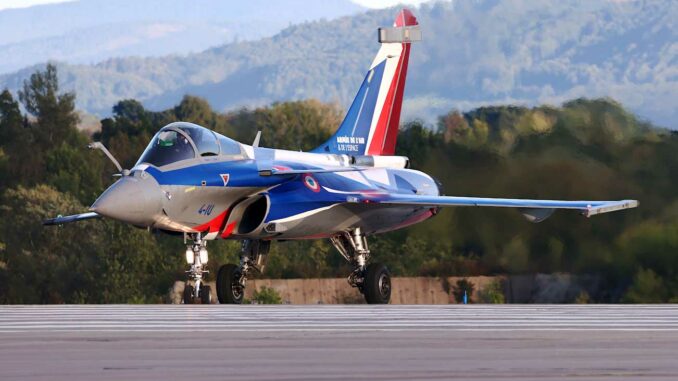
Dassault Aviation posted €4.16 billion in revenue for the first half of 2026. The Rafale dominates, while Falcon prepares for a rebound.
Executive Summary
Dassault Aviation published its first-half results on July 22, 2026, rather than July 28. The group reported adjusted revenue of €4.16 billion, up 46% year-on-year. This growth was driven almost entirely by defense and export deliveries of the Rafale. The commercial rebound for Falcon jets is real: 23 aircraft were ordered, compared to eight in the first half of 2025. Their value, however, only doubled, and Dassault has not specified how many orders were for the Falcon 10X. It would therefore be premature to attribute this entire increase to its maiden flight on June 19. The order backlog remains exceptional at €45.36 billion, though it declined slightly. Operational profitability improved, while Thales contributed a significant share of net income. The French state holds no equity stake in Dassault Aviation, yet its industrial, military, diplomatic, and technological support remains fundamental.
Official Report Corrects an Overly Simplified Initial Assessment
The first point requiring clarification is the date. Dassault Aviation released its H1 2026 financial results on July 22. July 28 does not correspond to the date on the official financial press release.
The figures are solid. Adjusted revenue reached €4.157 billion, compared to €2.847 billion a year earlier—an increase of 46%. Adjusted operating income grew from €180 million to €330 million, pushing the operating margin up from 6.3% to 7.9%.
Adjusted net income reached €496 million, up from €386 million in the first half of 2025. Under IFRS standards, net income came in at €360 million, representing a more modest increase compared to the €334 million recorded a year earlier.
These metrics reflect a company experiencing strong growth. They do not, however, imply that all divisions are expanding at the same pace, nor do they prove that the Falcon 10X has already become the group’s primary commercial engine.
The reality is clearer: export Rafale sales account for the vast majority of the acceleration.
The Rafale Provides Nearly All Revenue Growth
Defense generated €2.944 billion in revenue during the first half, compared to €1.751 billion in 2025—a 68% increase. This segment now represents 71% of group sales, up from 62% a year prior.
Falcon programs produced €1.213 billion in revenue, compared to €1.096 billion. Their growth was limited to 11%. Consequently, their share of total activity fell from 38% to 29%, despite an uptick in business jet orders.
The disparity is even more pronounced within defense itself. Export military revenue more than doubled, reaching €2.102 billion compared to €949 million in H1 2025. Military sales to France grew at a much slower pace, rising from €802 million to €842 million.
Of the €1.310 billion in additional revenue generated year-on-year, defense contributed €1.193 billion. It therefore represents approximately 91% of the growth recorded in the first half.
Dassault Aviation delivered 12 Rafales during this period: ten to foreign clients and two to France. A year earlier, the group delivered just seven, including four for export.
The company also attributes this increase to additional development and support revenue. The initial sale of an aircraft represents only a fraction of a military contract’s lifetime value. Training, spare parts, documentation, support equipment, software adaptations, and operational maintenance generate recurring revenue for years.
However, a direct comparison between Rafale and Falcon sales requires nuance. Dassault Aviation accounts for export Rafale contracts in their entirety, including the industrial shares subsequently remitted to Thales and Safran. A portion of the military revenue recognized by Dassault is therefore passed on to its partners as expenses.
The group does not publish separate operating margins for defense and business aviation. While it is clear that the Rafale dominates revenue, it cannot be proven from the published financial statements that it generates a higher margin than the Falcon line.
Drop in Total Orders Does Not Signal a Crisis
The contrast between sales and orders is striking. While revenue increased by 46%, total order intake fell by 64%.
Dassault Aviation recorded €2.878 billion in orders in H1 2026, compared to €8.075 billion a year earlier. This drop does not indicate a commercial collapse; it stems primarily from an exceptional baseline comparison.
In the first half of 2025, Dassault booked India’s order for 26 Rafale Marine fighters, which pushed military order intake to €7.172 billion. In the first half of 2026, military intake stood at €1.024 billion.
Major fighter jet orders are inherently lumpier. They can add billions of euros to the backlog in a single day and then remain quiet for several semesters. Comparing two six-month periods without factoring in these mega-contracts produces a misleading picture.
Nonetheless, the book-to-bill ratio came in at 0.69. For every euro billed, Dassault recorded only 69 cents in new orders, meaning the group consumed more of its backlog than it replenished.
The total order backlog contracted slightly from €46.596 billion at the end of 2025 to €45.359 billion as of June 30, 2026—a minor decline of 2.7%. This backlog still represents over five years of revenue based on the 2026 targets.
The situation is therefore not concerning in the short term. It simply underscores that publicly discussed prospects must not be confused with firm orders.
Negotiations regarding a potential Indian purchase of 114 Rafales remain a substantial long-term opportunity, but they are not yet included in the backlog. Similarly, the Franco-Ukrainian roadmap mentioning 16 Rafales was announced after the close of the semester and does not constitute a booked contract at this stage.
In the defense industry, a political agreement, a letter of intent, and a firm contract represent three vastly different financial realities.
The Falcon Rebound Is Real but Misattributed
Dassault Aviation logged 23 Falcon orders in the first half of 2026, compared to eight during the same period in 2025. In terms of unit volume, orders multiplied by 2.9—making the description “nearly tripled” accurate.
In terms of monetary value, the growth was less dramatic. Falcon order intake rose from €903 million to €1.854 billion, slightly more than doubling.
This variation can be attributed to the mix of aircraft models ordered, their onboard equipment, commercial terms, and revenue recognition schedules. Not all Falcons carry the same price tag: a Falcon 2000LXS, Falcon 6X, Falcon 8X, and Falcon 10X occupy distinct market segments.
The Falcon backlog grew from €4.745 billion to €5.429 billion, representing 83 aircraft compared to 73 at the end of 2025. This net gain of ten aircraft aligns with the 23 orders booked and 13 deliveries completed during the semester.
However, Dassault does not provide a breakdown of orders by model. The Falcon 10X does not account for everything just yet. Nothing in the published statements proves that the 23 orders were predominantly for this new flagship model.
Timing also dictates caution. The Falcon 10X completed its maiden flight on June 19—just eleven days before the close of the semester. Orders booked between January and June cannot reasonably be framed as a direct consequence of that flight.
The first flight undoubtedly reinforced the program’s credibility among prospective buyers by transitioning the platform from a ground concept to an active test campaign. Nevertheless, a causal link between this milestone and the tripling of orders remains unproven.
Falcon 10X Relaunches Product Line After Significant Delay
The Falcon 10X occupies a central place in Dassault Aviation’s civil future. Featuring an advertised range of 14,000 kilometers, it is designed to allow the French manufacturer to compete more aggressively against the Gulfstream G700 and Bombardier Global 7500 in the ultra-long-range business jet market.
Its maiden flight on June 19, 2026, represents a major milestone, initiating flight dynamics testing, flight control validation, systems checks, and certification prep.
However, prior delays cannot be ignored. In 2023, Dassault still indicated that initial customer deliveries of the Falcon 10X would occur in 2027. The schedule published in July 2026 now sets entry into service for 2029. The program has been pushed back to 2029, roughly two years beyond the previously communicated target.
While Dassault uses the term “re-scheduling,” for both customers and investors, it constitutes a delay. The aircraft must still accumulate extensive flight hours, receive definitive operational hardware, and secure certifications before generating revenue through customer deliveries.
Self-funded research and development expenses—primarily tied to the Falcon 10X—fell to €131 million in the first half, down from €182 million a year earlier. This €51 million reduction contributed directly to the improvement in operating margin.
This decline does not mean development is winding down. R&D spending naturally fluctuates based on test phases, hardware integration, partner contributions, and accounting rules.
The Falcon 10X thus represents both major commercial upside and execution risk. Its first flight offers reassurance, but its delay serves as a reminder that converting a new model into a profitable revenue stream is a long and capital-intensive process.
Profitability Improves, Though Less Spectacularly Than Revenue
Adjusted operating income of €330 million surged by 83%, outstripping the 46% increase in revenue. The operating margin expanded by 1.6 percentage points to reach 7.9%.
Higher military volumes improved the absorption of fixed costs, while reduced self-funded R&D expenditures provided an additional tailwind. The group also benefited from progress on export contracts with milestone-based progress payments.
An operating margin of 7.9% is solid, though not exceptional for an industrial manufacturer exposed to long development cycles, foreign exchange risks, complex certifications, and multi-decade contractual commitments.
Adjusted net income rose 29%, lagging behind operating profit growth. Net margin actually compressed from 13.6% to 11.9%, impacted by a temporary corporate tax surcharge in France. Without this tax burden, Dassault indicated that adjusted net income would have reached €570 million.
These figures should be interpreted carefully. While adjusted data is useful for period-over-period comparisons, IFRS statements offer a more standard accounting view. Under IFRS, net margin came in at 8.7%, down from 11.7% a year prior.
Thales Stake Distorts Net Income Interpretation
To understand where Dassault Aviation generates its true bottom-line earnings, one must look beyond aircraft deliveries. Thales heavily influences group net profit.
Dassault Aviation holds a 26.65% economic interest in Thales. In adjusted figures, this equity stake contributed €264 million to H1 net income—accounting for 53% of Dassault Aviation’s total adjusted net profit.
Under IFRS accounting, Thales contributed €129 million, or approximately 36% of the consolidated net income of €360 million. The divergence between these figures stems from accounting adjustments applied by Dassault to Thales’ financial reporting.
Dassault also collected €161.5 million in cash dividends from Thales in the first half. As of June 30, market valuation of this stake stood at €12.308 billion.
The company effectively generates earnings through three distinct channels: industrial margins on aircraft and services, financial income on its treasury cash reserves, and its strategic equity holding in Thales.
This final earnings driver does not appear within the €4.157 billion top-line revenue figure, yet it flows directly into net profit and underpins Dassault’s corporate valuation.
€10 Billion Cash Reserves Come With Substantial Liabilities
Dassault Aviation reported €10.099 billion in “available cash,” compared to €9.415 billion at year-end 2025. Financial debt remains negligible at €201 million, of which €185 million consists of lease liabilities.
This fortress balance sheet gives the group exceptional resilience to navigate industry cycles, self-fund programs, and support its supply chain.
However, this cash pool is not entirely unencumbered. The liquidity metric used by Dassault includes cash, cash equivalents, and current financial assets, net of certain financial liabilities. It does not simply represent uncommitted cash sitting idle in bank accounts.
The group explicitly notes that the first-half cash build was primarily driven by advance payments received from export Rafale customers. These funds are earmarked to finance aircraft, equipment, and services that must be delivered in future periods.
Customer advances on orders, net of advance payments made to suppliers, totaled €14.866 billion. Over the same period, inventories and work-in-progress increased by €756 million to reach €8.207 billion.
This working capital structure is advantageous because customers fund a significant portion of the production cycle. However, it also creates an operational obligation: Dassault must convert these advances into compliant aircraft delivered on schedule. A substantial portion of the cash position effectively backs future performance commitments.
Second Half Demands Heavy Delivery Load
Dassault reiterated its full-year guidance: approximately €8.5 billion in revenue, 28 Rafale deliveries, and 40 Falcon deliveries.
With €4.157 billion achieved in H1, the company must generate €4.343 billion in second-half billings. H2 revenue needs to exceed H1 by roughly 4%—a target that appears well within reach given the size of the backlog.
The required delivery cadence, however, is far more demanding. After delivering 12 Rafales in the first half, Dassault must hand over 16 between July and December—a 33% increase in output.
The ramp-up for Falcon is even steeper. The group delivered only 13 jets during the first six months and must hand over 27 in the second half to hit its target. The second half will need to be significantly more productive: Falcon deliveries must more than double.
A back-loaded delivery profile is common in the aerospace industry, where final customer acceptances, custom cabin completions, and certification sign-offs can shift deliveries by several weeks.
Exercise of caution remains warranted. In 2025, Dassault also targeted 40 Falcon deliveries but ultimately delivered only 37. Conversely, the group exceeded its Rafale target that year, handing over 26 jets against a forecast of 25.
The primary risk to 2026 targets lies less in revenue generation than in the industrial execution of the Falcon program.
French State Holds No Equity but Remains Pivotal Partner
A common misconception merits clarification: the French state is not a shareholder in Dassault Aviation. As of June 30, 2026, Groupe Industriel Marcel Dassault held 66.86% of the capital, Airbus held 10.65%, public float represented 21.63%, and the remainder comprised treasury shares.
Public support does not flow through direct equity ownership, unlike the structure seen in several other European defense contractors.
Nevertheless, government influence is profound. France funded the launch of the Rafale, ordered early production tranches, backed successive capability standards, and provided the operational validation that made export sales possible.
As of June 30, 2026, Dassault’s French defense backlog stood at €7.474 billion, encompassing 43 Rafales pending delivery alongside maintenance-in-operational-condition (MCO) contracts for the Rafale, Mirage 2000, ATL2, and AlphaJet.
The state also funds ongoing development of the Rafale F4 standard and risk-reduction studies for the future F5 standard, which is tied to the modernization of France’s airborne nuclear deterrent. Discussions are also underway regarding a potential flight demonstrator for a future combat aircraft.
The French Defense Procurement Agency (DGA) qualifies new standards, while French armed forces test equipment, provide operational feedback, and demonstrate the aircraft’s combat capabilities during joint exercises and overseas operations.
On export markets, the French government must approve every defense sale. It provides diplomatic support, leverages strategic relationships, negotiates intergovernmental agreements, and offers state financial guarantees when necessary.
Public backing remains indispensable, but this does not mean the French state currently serves as Dassault’s primary revenue source.
The export military backlog stands at €32.456 billion, compared to €7.474 billion for domestic defense. It represents 165 foreign Rafale orders versus 43 for France. In the first half alone, export defense generated €2.102 billion in sales, compared to €842 million from French military contracts.
The most accurate summary is that France funded, validated, and politically backed the industrial ecosystem, while international customers now supply the bulk of its economic workload.
This relationship works both ways. The report notes that the French state requested a delivery deferral for 20 Rafales originally scheduled for 2031 and 2032, pushing them back to 2033 and 2034. A single public budget decision can alter years of industrial planning.
Export orders allow Dassault and its supplier base to absorb these shifts smoothly, avoiding sharp drops in production rates and preserving critical manufacturing skills for future domestic needs.
Financial Strength Does Not Relieve Execution Pressure
Dassault Aviation’s H1 2026 financial performance is indisputably strong. Revenue expanded sharply, operating margins widened, cash reserves remained robust, and the order backlog exceeded €45 billion.
However, a thorough reading requires context.
The Rafale—not the Falcon 10X—drives immediate top-line expansion. Falcon orders nearly tripled in unit volume, but Dassault has not disclosed the breakdown by model. The Falcon 10X reached a major flight milestone while facing an approximate two-year delay against earlier guidance.
Net profit is not derived solely from aircraft manufacturing; the equity stake in Thales supplies a substantial share of net earnings. The €10 billion cash pile is real, but a major portion represents customer advances earmarked for future deliveries.
Government support remains vital, acting not as an equity holder or financial bail-out mechanism, but as a founding customer, certification authority, technology funder, and diplomatic partner.
The next test will be industrial execution. Dassault must deliver 16 Rafales and 27 Falcons in the second half of the year. Success will not be measured by prospective deals or ongoing negotiations, but by aircraft handed over, advance payments converted into recognized revenue, and firm new orders secured to replenish the backlog.
War Wings Daily is an independant magazine.