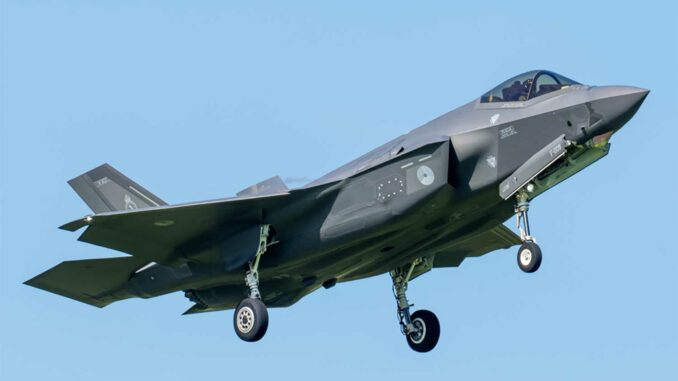
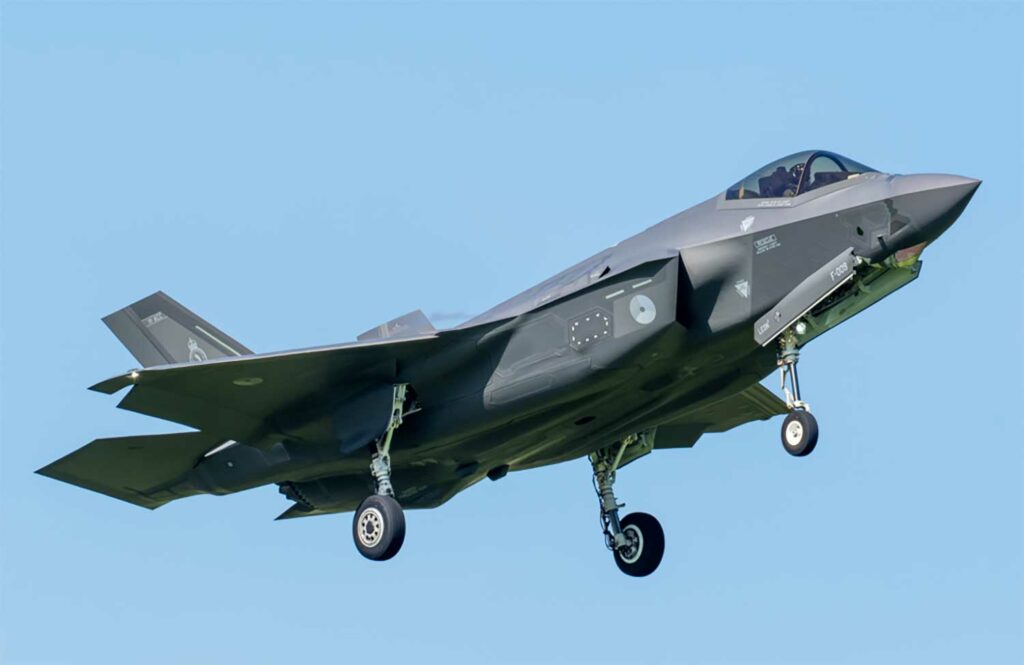
In 2025, only 1 in 4 F-35s was fully mission capable. TR-3 delays, parts shortages, life-cycle costs exceeding $2 trillion: the GAO sounds the alarm.
In Summary
A report from the Government Accountability Office (GAO) published on June 11, 2026, presents a grim assessment of the F-35 Lightning II program. In fiscal year 2025, only 24.6% of the aircraft in the U.S. fleet were capable of performing all assigned missions. The mission capable rate fell from 67% in 2021 to 44% in 2025. Software failures linked to the TR-3 modernization program—currently three years behind schedule—and a chronic shortage of spare parts are the two primary drivers of this decline. The program’s 77-year life-cycle cost has officially surpassed $2 trillion. In response, the Pentagon launched a $13.7 billion emergency recovery plan, reduced its orders by 45% for fiscal year 2026, and scaled back Block 4 from 66 to 31 priority capabilities. The most expensive program in U.S. military history is facing the most severe credibility crisis of its existence.
The Figures Indicting the Program
According to the GAO’s own findings, the F-35’s availability metrics have been in decline since 2021—and none of the variants are meeting their performance targets.
In fiscal year 2025, the full mission capable rate—the percentage of time an F-35 can perform all of its assigned missions—averaged 24.6% across the entire fleet. The Air Force’s F-35A, the simplest and least expensive of the three variants, posted a rate of 28.5%, falling far short of the military’s 65% target threshold. The Marine Corps’ F-35B and the Navy’s F-35C recorded rates below 15%. The overall mission capable rate—which measures whether an aircraft can perform at least one of its assigned missions—dropped from 67% in 2021 to 44% in 2025.
These figures are not temporary anomalies. The GAO notes that the trajectory has been downward for five years, even though the Pentagon has paid Lockheed Martin hundreds of millions of dollars in incentive fees since 2020 to improve availability—with no tangible results. “Since 2020, the F-35 fleet has not met minimum operational performance goals desired by the military services,” the report states, adding that “performance has generally declined, particularly for the Air Force’s F-35A.”
TR-3 and Block 4: A Story of Cascading Delays
Understanding the F-35’s availability crisis requires understanding TR-3. Technology Refresh 3 is a major hardware and software upgrade designed to serve as the technological foundation for Block 4—which is itself intended to transform the F-35 into a next-generation combat platform featuring new sensors, advanced electronic warfare capabilities, uncrewed collaborative aircraft integration, and new weapons.
TR-3 was originally scheduled for delivery in April 2023. It was not delivered. In July 2023, facing persistent instability in the mission processor startup software and system hardware defects, the Pentagon halted all F-35 deliveries—a suspension that lasted a full year. During that time, Lockheed Martin parked over 100 finished aircraft at its Fort Worth, Texas facilities waiting for a viable software solution.
Deliveries resumed in July 2024, but with a significant compromise. The Pentagon agreed to accept aircraft equipped with a truncated version of TR-3, designated 40R01, which delivers no actual combat capability and restricts the aircraft to training flights only. According to the 2025 Director of Operational Test & Evaluation (DOT&E) report, no F-35s in a fully operational TR-3 configuration were delivered during fiscal year 2025. Furthermore, the report characterized recent software builds as “unfit for dedicated operational testing” due to recurring stability issues.
By the end of September 2025, approximately 158 F-35s had been delivered in this restricted TR-3 state, incapable of executing high-intensity combat missions. These aircraft directly weigh down the availability metrics of the broader fleet.
Block 4 presents an even more concerning outlook. Initially planned to deliver 66 capabilities by 2026, the program is now delayed by at least five to six years and faces cost overruns of at least $6 billion over initial estimates. A 2024 Pentagon review concluded that the program would be unable to deliver the majority of Block 4 capabilities before the mid-2030s. The scope was subsequently reduced to 31 priority capabilities, with completion projected for 2031 at the earliest—five years behind the original schedule. Lockheed Martin officially acknowledged that Block 4 completion could stretch to 2032.
The Parts Shortage: A Structural, Not Temporary, Problem
The second pillar of the availability crisis is the chronic shortage of spare parts. This issue is not new; it has been documented by the GAO for years, yet remains unresolved.
The F-35’s sustainment architecture relies heavily on Lockheed Martin as the primary logistics contractor—a dependency that creates structural bottlenecks. Industrial capacity to produce and repair critical parts remains insufficient to keep pace with the growing needs of an expanding annual fleet. Extended turnaround times for depot-level component repairs directly prolong aircraft downtime.
The GAO estimates that an additional $13.7 billion will be required between now and fiscal year 2031 to address parts shortages, improve maintenance capabilities, and reduce reliance on an under-resourced supply chain. Of this total, only $2.2 billion is allocated directly to the Global Support Solution (GSS) Reset recovery plan launched by the Joint Program Office in June 2025. The remaining $11.5 billion covers the accumulated gap between what the military services budgeted for F-35 sustainment and what that sustainment actually costs. Put simply, the program has been chronically underfunded on the logistics front since its operational entry into service.
The GSS Reset aims to achieve an 80% overall mission capable rate and a 65% full mission capable rate by 2030. However, the GAO highlights that the plan lacks formal risk-management mechanisms, and Navy and Marine Corps officials have noted that competing funding priorities could limit their ability to fully fund the strategy.
The Pentagon’s Response: Cutting Orders and Trimming Scope
Faced with these compounding challenges, the Pentagon’s response has been pragmatic—and financially painful for Lockheed Martin.
For fiscal year 2026, overall F-35 procurement orders were cut by 45%, dropping from 86 to 47 aircraft. The U.S. Air Force slashed its F-35A order in half, reducing its procurement from 48 to 24 units. A portion of the freed-up funds was redirected toward the F-47 sixth-generation fighter program (formerly designated NGAD) and autonomous collaborative combat aircraft.
Since 2023, the Pentagon has also withheld $5 million per delivered aircraft due to TR-3 delays—a financial penalty partially eased in early 2025 by $1.2 million per jet in recognition of Lockheed’s progress.
Meanwhile, the program’s total acquisition cost has exceeded $485 billion—more than double its baseline estimate from 2001 and $89.5 billion higher than its 2012 baseline revision. The total 77-year life-cycle cost, covering acquisition and sustainment, officially exceeds $2 trillion. This figure, confirmed by the GAO, establishes the F-35 as the most expensive weapons program in U.S. history by a wide margin.
By comparison, the flight-hour cost of the F-35A is estimated between $34,000 and $42,000 depending on the accounting methodology used. The Pentagon’s target goal is $25,000—a figure that has never been achieved.
The Operational Paradox: Exceptional in Combat, Failing in Daily Sustainment
The primary irony of the F-35 crisis is that the aircraft delivers outstanding operational performance when properly maintained and supported.
During Operation Epic Fury against Iran in 2026, F-35s deployed in strike operations maintained high availability rates due to prioritized parts distribution and experienced maintenance teams. “The aircraft performed like no other in combat,” stated Douglas Birkey, executive director of the Mitchell Institute for Aerospace Studies. “Those airframes were properly supplied with parts, backed by seasoned maintainers, and operational readiness was made a top priority.”
This outcome highlights the underlying issue: the F-35 can achieve high availability levels, but only when resources are concentrated on a limited number of airframes. As soon as operational demands are distributed across the broader fleet, sustainment resources are stretched thin, and overall availability plummets. The remainder of the fleet experienced degraded availability rates while combat-deployed aircraft were prioritized.
What This Reveals About U.S. Acquisition Doctrine
The F-35 crisis is not an isolated industrial misstep. It is, in part, the product of an acquisition doctrine that prioritized maximum multi-role complexity from the outset.
Designing a single aircraft capable of executing air superiority, ground attack, carrier-borne naval operations, and short takeoff/vertical landing requirements for the Marine Corps—across three distinct variants with full interoperability—represented an unprecedented ambition in military aviation history. The result is an aircraft of such high technical complexity that its logistics and sustainment demands exceed current industrial capacity.
The GAO has issued 43 recommendations to the Pentagon regarding the F-35 program in recent years. The Pentagon has yet to implement 30 of them.
That final metric is perhaps the most telling. It does not indicate that the F-35 is a flawed aircraft; rather, it demonstrates that the management of the program over the past two decades has been structurally flawed. Every dollar invested in sixth-generation systems—such as the F-47, GCAP, and uncrewed autonomous aircraft—will be scrutinized through the lens of this precedent. Congressional committees that provided blank checks for the F-35 for two decades have no desire to repeat the experience.
War Wings Daily is an independant magazine.