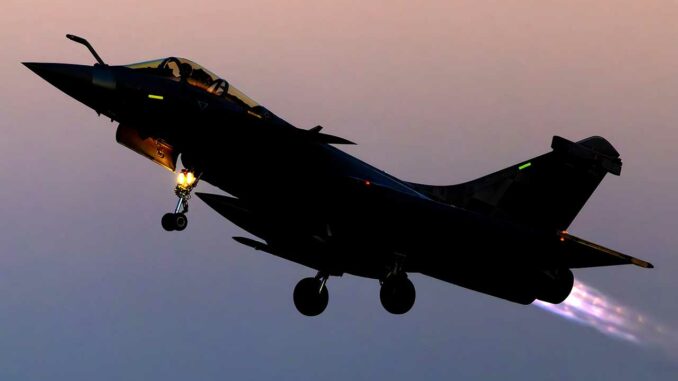
The French Air Force is demanding more Rafales before 2033. The choice between the readily available F4 and the strategic F5 exposes tensions within French defense planning.
In Summary
General Jérôme Bellanger, Chief of Staff of the French Air and Space Force, is not questioning the Rafale F5 program. On the contrary, he is urging its rapid arrival. However, his assessment is clear: if this new standard cannot be produced before 2033, France will have to order more Rafale F4s or reduce its operational ambitions. This warning comes at a time when the fleet is overstretched, missions are multiplying, and the French nuclear posture must be reinforced. The F5 will deliver a more powerful engine, a new combat system, the ASN4G hypersonic missile, and advanced integration with stealth drones. Nevertheless, waiting poses a operational capability risk. Ordering additional F4s would also be costly, as their subsequent upgrading would be complex. The cancellation of the FCAS fighter component makes this trade-off even more strategic: the Rafale must now remain credible for far longer than originally planned.
The Chief of Staff Demands Aircraft Before New Technology
General Jérôme Bellanger’s statement does not date from August. It took place on May 5, 2026, during a closed-door hearing before the Senate Committee on Foreign Affairs, Defense and Armed Forces. The official transcript was only made public in early August.
The Chief of Staff’s message is unambiguous: “I am going to need more aircraft quickly.” If the Rafale F5 cannot be produced before 2033, he argues that France must choose the F4, “unless operational contracts” assigned to the Air and Space Force are revised.
This last point is crucial. It means France has only three options: rapidly expand its fleet, accelerate the Rafale F5 program, or accept taking on fewer missions. Maintaining the status quo is not presented as a viable long-term solution.
The debate is therefore not about the technical superiority of the F5, which is undisputed. It centers on the immediate need for fleet mass. An armed force can possess an excellent aircraft and yet lack sufficient available platforms to simultaneously ensure deterrence, air defense, overseas operations, NATO commitments, and training.
The French Fleet Reaches Its Operational Limits
The Rafale is designed as an omnirole aircraft. It can perform air defense, conventional strikes, reconnaissance, anti-ship attacks, and nuclear deterrence missions. This versatility allowed France to replace several specialized fleets with a single aircraft type.
While this choice yielded logistical and operational benefits, it also created a concentration of risk. Every new mission relies on the exact same fleet.
Speaking to senators, Jérôme Bellanger acknowledged a 15% overuse of the Rafale fleet. He summarized the challenge directly: “Versatility does not equate to ubiquity.” In March 2026, during Operation Poker conducted amid high tension in the Near and Middle East, nearly 80% of France’s fighter aviation was deployed simultaneously in operations worldwide.
Such a peak does not mean that 80% of the fleet could be maintained in combat indefinitely. A portion of the aircraft must undergo inspections, repairs, upgrades, and scheduled maintenance. Other airframes are required for crew training or flight testing.
The issue is not merely accounting. Flying beyond projected operational hours accelerates the wear on flight hours, increases demand for spare parts and engines, and adds pressure on mechanics, crews, and infrastructure.
Deployments to hot, dusty environments exacerbate this wear. Engines, sensors, and cooling systems are subjected to higher strain. As a result, an aircraft listed as available on paper may become unavailable sooner than expected once its maintenance threshold is reached.
The Target of 225 Aircraft No Longer Matches Stated Ambitions
French defense planning maintains a target of 225 combat aircraft by 2035. This total is split into 185 aircraft for the Air and Space Force and 40 for the French Navy.
This force structure was established under a less demanding strategic environment. Today, it must absorb the return of high-intensity conflict, homeland defense, NATO commitments, partner nation support, and a reinforced nuclear deterrence posture.
During Admiral Nicolas Vaujour’s hearing held the following day, a senator summarized the requirement stated by Jérôme Bellanger as 230 Rafales for the Air and Space Force alone, compared to the 185 currently planned. This represents a shortfall of 45 aircraft. While not yet an official target written into military programming, it highlights the growing gap between operational commitments and the current fleet structure.
The naval aviation situation introduces additional constraints. The Navy has 41 Rafales in service against a validated requirement of 51. The earliest Rafale Marine aircraft are aging faster due to catapult launches, arrested landings, and saltwater corrosion. Their replacement will need to begin before airframes reach structural limits.
The F4 versus F5 question therefore affects both services. It also impacts the ability of the future aircraft carrier France Libre to field a sufficiently sized air wing.
The Rafale F4 Remains a Front-Line Fighter
Ordering additional Rafale F4s would not mean acquiring an outdated aircraft. The F4.1 standard was qualified in March 2023, introducing the Rafale into advanced collaborative combat capabilities.
It brings enhanced connectivity, improved cyber defense capabilities, and upgrades to the RBE2 radar, the Front Sector Optronics (FSO) system, and the Talios pod. It also enables the integration of the 1,000-kilogram AASM precision-guided bomb and improves the operational deployment of the Meteor missile.
The F4.3 standard continues this evolution, preparing new capabilities for communications, weaponry, and data processing. Development was ongoing in the first half of 2026.
The Rafale F4 can also evolve rapidly to address urgent operational needs. In 2026, the DGA (French Defense Procurement Agency) validated the integration of 68mm laser-guided rockets designed to engage drones cost-effectively. Additionally, the first supersonic test firing of the MICA NG missile from a Rafale took place on June 1, 2026.
The F4 thus represents a credible solution for building up fleet capacity prior to 2033. Its main limitation lies elsewhere: it lacks the computing architecture, engine power, and electrical capacity designed into the F5 standard.
The Rafale F5 Will Be More Than an Upgrade
Jérôme Bellanger describes the Rafale F5 as a virtually new aircraft, even stating that it should have been given a new name. This perspective reflects the scale of the expected technological leap.
The F5 will feature significantly enhanced processing power. It will need to process and fuse data originating from its own sensors, other aircraft, drones, satellites, and land or naval units.
Its role will extend beyond firing its own weapons; it will serve as a command node within a distributed combat system. The crew will be able to assign missions to multiple platforms, adjust priorities in real time, and process incoming tactical data.
This concept aligns with Manned-Unmanned Teaming (MUM-T). The manned Rafale and uncrewed drones will not merely fly in formation; they will cooperate over secure data links, share a common tactical picture, and distribute tasks dynamically.
The F5 is also set to receive upgraded sensors, enhanced electronic warfare capabilities, and weapons tailored to penetrate modern defense networks. Updated defense planning specifically includes anti-radiation (SEAD/DEAD) and anti-ship missile developments.
The T-REX Engine Becomes the Main Timeline Risk
The key element of the program is the M88 T-REX engine developed by Safran. This engine is designed to increase post-combustion thrust to approximately 9 tons while maintaining a physical footprint compatible with the Rafale airframe.
This thrust increase is necessary to offset the weight of additional avionics, electronic systems, data links, and heavier ordnance, while preserving range, altitude performance, and payload capacity.
Safran presented the T-REX at the Paris Air Show in June 2025. The propulsion upgrade was subsequently integrated into the revised military programming law. Jérôme Bellanger views this engine as the critical factor for meeting an operational entry-into-service target of 2032 or 2033.
However, the schedule remains uncertain. While the Chief of Staff cites 2032–2033, Dassault Aviation indicated in its mid-year financial report an entry into service for the F5 between 2033 and 2035. This two-year gap is significant: it corresponds precisely to the window during which the armed forces require additional airframes.
A military engine development program carries inherent technical risks. Thermal resistance, fuel consumption, component lifespan, and performance across all flight envelopes must be thoroughly validated. The T-REX will also need full qualification alongside the Rafale’s airframe, air intakes, and flight control systems.
Accelerating the program is not simply a matter of moving up an administrative deadline; development timelines must be shortened without compromising safety or operational reliability.
Stealth Drones Will Clear the Way for the Rafale
The Rafale F5 will be accompanied by an unmanned stealth combat drone leveraging technology from the nEUROn demonstrator. Dassault Aviation aims for operational readiness by 2033.
This drone will feature low radar observability, an internal weapons bay, and autonomous control functions while keeping a human in the loop. It will be capable of operating closer to adversary air defense systems than the manned Rafale.
Its operational roles will include searching for enemy radars, gathering intelligence, conducting strikes, or forcing surface-to-air systems to reveal their locations. It will also be capable of carrying electronic warfare suites.
The drone is not intended to replace a Rafale. Jérôme Bellanger explicitly rejected a one-to-one equivalence between manned and unmanned platforms. Drones offer extended reach and can accept higher operational risk, while the Rafale retains command, decision-making, and multirole execution functions.
An initial operational experiment is planned for 2028 to determine required fleet numbers, autonomy levels, and task allocation between manned and unmanned platforms.
The schedule is tight. The system must transition from a technology demonstrator to a serial-produced, logistically supported military asset integrated into the command chain. Low radar signature alone is insufficient; it requires low-observable communications, robust onboard AI, and the capacity to operate effectively under heavy electronic jamming.
The ASN4G Missile Directly Ties the F5 to Deterrence
The Rafale F5 is designed to carry the 4th Generation Air-to-Surface Nuclear Missile (ASN4G), which will progressively replace the ASMPA-R within the airborne nuclear deterrent.
The DGA awarded the missile development contract to MBDA on June 2, 2026. Entry into service is targeted for around 2035. It will be operated by both the Strategic Air Forces and the Naval Nuclear Aviation force.
The ASN4G is engineered to reach speeds exceeding Mach 5 while retaining high maneuverability to penetrate increasingly dense and sophisticated integrated air defense systems.
This mission demands exceptional levels of cybersecurity and system reliability, explaining why the F5 cannot rely on a fully open software architecture. While the military requires rapid integration of operational software updates, Dassault must guarantee absolute integrity for the platform’s nuclear control architecture—two requirements that are inherently challenging to balance.
Consequently, the F5 is not merely an upgraded fighter; it is the future vector of a core pillar of French national sovereignty. This function makes its development a top priority, even when competing directly for budget resources against immediate F4 acquisitions.
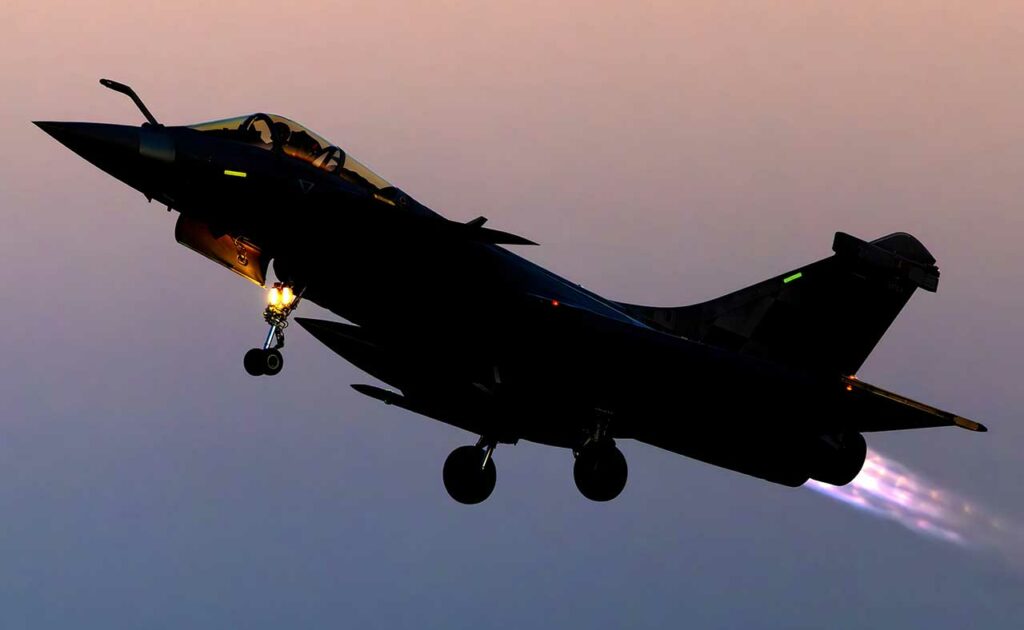
Reinforced Nuclear Posture Requires More Platforms
The debate grows more complex with France’s updated advanced deterrence posture announced in 2026. Strengthening the strategic arsenal involves more than just warhead counts.
According to Jérôme Bellanger, it mechanically necessitates a reevaluation of the required number of nuclear-capable Rafale B aircraft, escorting Rafale C fighters, and supporting aerial refueling tankers.
France currently operates 15 A330 MRTT Phénix aircraft. These assets handle aerial refueling, strategic transport, and medical evacuation. They are indispensable for long-range nuclear strike missions while simultaneously supporting conventional operations.
An expanded nuclear posture consumes multiple supporting assets for a single strike vector. Escort fighters, suppression of enemy air defense (SEAD) assets, and tankers are all required. Increasing nuclear readiness missions directly reduces the number of aircraft available for conventional commitments.
This operational reality reinforces the demand for overall fleet mass. While drones can facilitate defense penetration, they cannot replace nuclear-capable Rafales, flight crews, or supporting tanker platforms.
Delayed Deliveries Create an Accepted Capability Gap
Senate reports indicate that 22 Rafales originally scheduled for delivery in 2031 and 2032 have been deferred to 2033 and 2034 to allow for direct delivery in the F5 configuration. Dassault Aviation, however, cites a deferral of 20 aircraft in its mid-year report. This discrepancy appears to stem from differing accounting metrics, though no public document clarifies the difference.
The government’s rationale is clear: acquiring F4 airframes only to upgrade them later to F5 standards would tie up maintenance facilities and generate significant additional costs. General Bellanger himself acknowledges that the structural differences between the two versions will make retrofitting a complex task.
However, this deferral creates a distinct operational risk. Between 2031 and 2033, the existing fleet will have to absorb active operations, training demands, strategic deterrence missions, and airframe aging without receiving scheduled new deliveries.
A proposal to order F4s and later resell them to export customers was raised in the Senate. This approach would provide interim capacity without retrofitting costs, but it depends on securing an export buyer at the right time and accepting potential financial losses on resale.
Industry Cannot Instantly Ramp Up Production
The choice between F4 and F5 also faces industrial constraints. As of June 30, 2026, Dassault Aviation reported an order backlog of 208 Rafales, comprising 165 aircraft for export customers and 43 for the French armed forces.
The manufacturer delivered only two French Rafales in the first half of 2026, compared to ten for export customers. These figures do not reflect an industrial bias, but rather execution of existing contractual delivery schedules. Nonetheless, they demonstrate that the production line is heavily committed.
A new French order would not yield aircraft within a few months. Securing production slots, expanding supply chains, and adjusting subcontractor rates takes time.
The Rafale program supports over 7,000 direct and indirect jobs across France, involving hundreds of suppliers. Long-lead components present specific constraints; sudden increases in production rates risk creating bottlenecks in radar, propulsion, electronics, or weaponry manufacturing.
Consequently, the state must decide early. Waiting until 2030 to order aircraft needed by 2031 is unviable.
Cancellation of FCAS Shifts the Rafale into a Long-Term Solution
The cancellation of the FCAS-NGF (Next Generation Fighter) component fundamentally alters the strategic calculus. Dassault Aviation confirmed that the French President and German Chancellor mutually agreed to end the NGF fighter program. Discussions are underway to launch an alternative demonstrator, either independently or with new partner nations.
Not all FCAS developments are lost. Jérôme Bellanger aims to preserve key research into operational uncrewed systems and the combat cloud. Platform connectivity remains essential regardless of the future primary fighter.
Éric Trappier referred to a technological demonstrator tailored to French requirements, aimed for a potential first flight in 2031 or 2032. This date represents an industrial goal rather than an operational entry-into-service date or a contracted program.
Even if a demonstrator flies on schedule, a new fighter will require years of further development, testing, and manufacturing setup. The Rafale must therefore remain the backbone of French air power well beyond 2040.
The F5 is no longer just a bridge to FCAS; it has become a strategic necessity. This shift justifies larger investments in its engine, sensors, accompanying drones, and electronic architecture.
The Real Risk Would Be Choosing a Single Horizon
Ordering only F4s would address short-term fleet size issues but fail to solve long-term penetration capability, collaborative warfare needs, and hypersonic deterrence requirements. Relying solely on the F5 preserves technological superiority but exposes the forces to an aircraft deficit for several critical years.
A balanced combination represents a more practical approach: acquiring a limited batch of F4s to rapidly restore operational mass while safeguarding the development of the F5, the T-REX engine, and the stealth drone. The newest F4 airframes could later remain assigned to conventional missions, be selectively modernized, or be transferred to export buyers.
While this approach carries financial trade-offs, it avoids anchoring France’s entire defense strategy to an unconfirmed delivery date.
Ultimately, the debate exposes a broader structural issue: France has expanded its operational commitments, reinforced its nuclear posture, and recognized the return of high-intensity warfare, yet it retains a fighter force structure sized for a less demanding era.
The F5 will offer advanced operational capabilities, but it cannot be everywhere at once. The F4 is less ambitious technologically, but it can fly sooner. The decision is now as much an industrial and budgetary choice as a technological one. The true strength of an air force never relies solely on the performance of its best aircraft; it depends on the number of platforms it can deploy, sustain, and replace when a crisis begins.