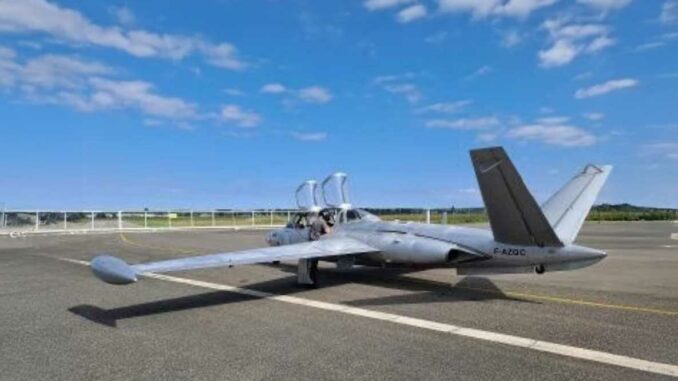
Two dead in the crash of a Fouga Magister near Fontainebleau. The investigation focuses on the first flight, maintenance, and rare parts.
In Summary
On May 11, 2026, a Fouga CM.170 Magister registered as F-AZQC crashed in Seine-et-Marne, in a wooded area near the Fontainebleau Forest, shortly after taking off from the Melun-Villaroche airfield. Both occupants were killed: an experienced pilot and a passenger who had come for a first flight. The aircraft belonged to the Fouga 480 association, dedicated to preserving this French vintage aircraft. The BEA has opened a safety investigation. Two investigators were dispatched to the scene. At this stage, no cause has been determined. The central focus is on the technical chain, the flight profile, the condition of the aircraft, the specific challenges of an older jet, and the availability of mechanical parts. The tragedy underscores a simple reality: flying a historic aircraft requires extreme rigor, as every part, every inspection, and every maintenance decision matters.
The tragedy at Chailly-en-Bière unfolded just minutes after takeoff
The accident occurred on Monday, May 11, 2026, in the middle of the afternoon. The Fouga Magister F-AZQC had taken off from the Melun-Villaroche airfield, located in Montereau-sur-le-Jard. Shortly thereafter, the aircraft crashed in a wooded area near Faÿ, a hamlet of Chailly-en-Bière, on the edge of the Fontainebleau Forest. Several witnesses reported seeing a fireball in the sky. Rescue teams then located the crash site, in part by detecting a plume of smoke.
Both people on board died. According to initial local reports, the pilot was 53 years old, had extensive experience, and had logged approximately 15,000 flight hours. The passenger, aged 52, had traveled from northern France to take a flight aboard this historic aircraft. The key point is this: this was not a simple private flight without any public context. The passenger was participating in what is described as a maiden flight or a demonstration flight aboard a former military jet.
The BEA has launched a safety investigation. Two investigators have begun their work on-site. The Air Transport Gendarmerie is also involved in the investigation. At this stage, authorities have not attributed the accident to a specific cause. It would therefore be irresponsible to claim that the crash resulted from pilot error, engine failure, or a maintenance defect. What can be said, however, is that the moment of the accident, immediately after takeoff, is a critical phase of the flight.
The aircraft is flying low, heavy with fuel, close to the ground, and has little time to correct a major incident.
The Fouga Magister was a vintage aircraft, not a modern one
The Fouga CM.170 Magister is no ordinary aircraft. It is a two-seat military training jet designed in the early 1950s. Its first flight took place in July 1952. It was delivered to the French Air Force starting in 1956. The Air and Space Museum describes it as the world’s first jet designed specifically for training. It was also used by the Patrouille de France, which explains its place in French aviation history.
Technically, the Magister is a compact aircraft with a tandem cockpit, recognizable by its V-shaped tail. It is powered by two Turboméca Marboré turbojet engines, depending on the version. The Air and Space Museum lists a thrust of 392 to 480 kg per engine, depending on the variant. The aircraft reaches approximately 725 km/h, with a service ceiling of 11,000 m and a range of about 1,000 km. These figures clearly illustrate the nature of the aircraft. We are not talking about a microlight or a light sport aircraft. We are talking about a former military jet—fast, loud, demanding—that requires specialist maintenance.
This distinction is essential. The Fouga Magister can be appreciated for its flight qualities. It can also give a sense of safety, as it is a twin-engine jet. But it remains an aircraft designed over 70 years ago. It does not meet the standards of a modern business jet, nor does it have the levels of redundancy, data logging, and support found on newer aircraft. Its safety therefore depends on a very strict three-pronged approach: the condition of the airframe, the condition of the engines, and the quality of maintenance.
The Fouga Magister maiden flight raises a question of perception
The issue of the maiden flight is central, as it touches on the relationship between aviation heritage and activities open to the public. Until recently, commercial platforms were still offering Fouga Magister flights around Paris or in the Île-de-France region, with packages lasting 30 minutes, 45-minute, or 1-hour packages. Prices ranged from over €2,300 to over €4,000 depending on duration and package. These flights were marketed as fighter jet experiences, including a briefing, equipment, a passenger seat, and sometimes supervised flight controls.
This type of activity is not trivial. The word “maiden flight” may give a gentle, almost touristy impression. In reality, a flight in a Fouga Magister is a complex aeronautical experience. The passenger boards an old military jet capable of flying at several hundred kilometers per hour. They may experience G-forces, hear loud engine noise, wear specialized equipment, and operate in an environment very different from commercial aviation.
French regulations govern thrill flights. The aircraft used must have a valid airworthiness certificate recognized by France. They must be operated within the limits associated with that certificate. The flight profile must be compatible with the flight envelope and the limitations of the manual. Pilots must have the required qualifications, notably a license with the privileges of a commercial pilot for this type of activity.
This does not eliminate the risk. It provides a framework.
The real debate is therefore not whether these flights should exist or not. It is more nuanced. Does the public truly understand the difference between a light aircraft introductory flight and a flight in a former military jet? Is the information provided before the flight clear enough? Is the line between heritage experience, commercial activity, and thrill-seeking flights always clear to the passenger?
Maintenance of the Fouga Magister relies on a rare and specialized supply chain
The availability of mechanical parts is one of the most sensitive issues for vintage aircraft. Several hundred Fouga Magisters were produced in France and under license, but production ceased long ago. Turboméca Marboré engines are no longer standard industrial products. Airframes, landing gear, canopies, controls, fuel systems, instruments, hydraulic components, and structural elements now fall within a limited ecosystem.
In France, older aircraft of historical interest may qualify for the Restricted Airworthiness Certificate for Vintage Aircraft, or CNRAC. This framework exists specifically to allow older aircraft to fly for the purpose of preserving heritage. The aircraft in question are often registered as F-AYxx or F-AZxx, which corresponds to the registration F-AZQC. The CNRAC framework also stipulates that modifications necessary for reasons of parts availability or safety must be approved by official authorities.
This regulatory provision speaks volumes. It acknowledges that the issue of parts is not merely theoretical. On a vintage aircraft, certain original parts are no longer manufactured. It is sometimes necessary to locate stockpiles, dismantle donor airframes, have components repaired by specialized workshops, rebuild certain parts according to blueprints, or replace certain equipment with approved alternatives. This requires documentation, traceability, and a very high level of technical expertise.
The risk isn’t just the failure of a visible part. It can be more subtle: metal fatigue, aging hoses, corrosion, cracks, leaks, aging fuel lines, engine component weakness, or the quality of a previous repair. An aircraft may be “up to date” administratively yet remain a machine that demands constant vigilance, as every flight places demands on rare components.
The older twin-engine jet does not offer the same margin as a contemporary aircraft
The Fouga Magister is often described as a pleasant aircraft to fly. Its twin-engine configuration was designed for training. Since the engines are positioned close to the centerline, a single engine failure creates less asymmetry than on some twin-engine propeller aircraft or wider jets. On paper, this is an advantage.
But we must remain realistic. The Marboré turbojet engines are of an older design. Their performance, instrumentation, and safety margins are not those of a modern turbofan. In-flight monitoring relies heavily on the pilot and the available instruments. The response to an anomaly during takeoff must be made in a matter of seconds. At low altitude, even a highly experienced pilot may run out of space if the failure occurs under unfavorable conditions.
The question of a bird strike, a fuel leak, an engine failure, a control system issue, or a human factor can only be determined after an investigation. Witnesses describe a fireball. This is a dramatic detail, but it is not technical evidence. A flame could result from an impact, an in-flight fire, a fuel issue, or a more complex sequence of events. The BEA’s job is precisely to reconstruct the timeline, analyze the debris, impact marks, engines, controls, maintenance records, and witness accounts.
One point is also worth noting: older aircraft do not always have flight recorders comparable to those on commercial airliners. The investigation may therefore rely more heavily on physical evidence, any available video footage, radio communications, radar data, and technical documentation. This makes the analysis longer and sometimes less straightforward.
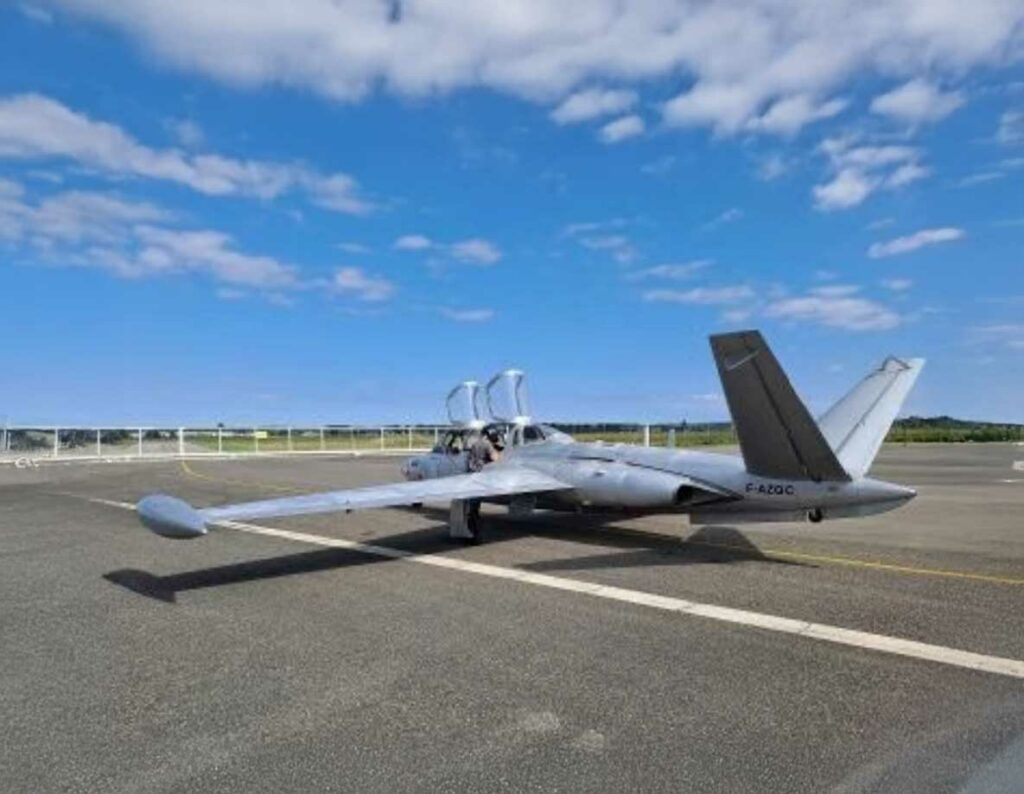
The F-AZQC case goes beyond the single accident in Seine-et-Marne
The crash of the Fouga Magister F-AZQC goes beyond a local news item. It touches on a broader issue: how to keep historic aviation alive without trivializing the risk. France has a strong aviation culture. Associations restore, maintain, and display rare aircraft. This work has real value. Without these organizations, many aircraft would end up grounded, dismantled, or forgotten.
But flying a vintage aircraft is nothing like displaying one in a museum. Flight transforms heritage into an operational activity. It introduces fuel, speed, weather, human decisions, passengers, maintenance, and responsibilities. It is no longer just about memory. It is about aviation operations.
The Fouga 480 association presented itself as an organization dedicated to preserving vintage aircraft in Melun-Villaroche. Its website highlighted the Fouga Magister number 480, registration F-AZQC. Locally published reports indicate that it organized 30-minute introductory flights and demonstrations, particularly in the context of aviation events. This does not mean the activity was illegal. It means the investigation must examine not only the immediate cause of the crash, but also the entire context of the flight: preparation, weather, maintenance, documentation, passenger, type of activity, authorizations, and the aircraft’s technical condition.
The issue of mechanical parts must be raised without accusation
Questioning the availability of parts for a Fouga Magister is not the same as accusing the association, the pilot, or the mechanics. It is a legitimate question. It must even be asked frankly. A vintage aircraft is a living system, but it relies on an industrial base that is defunct or severely diminished. Mass production no longer exists. Engine manufacturers, suppliers, workshops, tooling, and inventories are no longer what they were in the 1960s.
On a Fouga Magister, areas of concern may include the Marboré engines, fuel systems, hydraulic systems, landing gear, flight controls, canopies, instruments, and airframe structural components. The challenge is not merely finding a part.
You also have to prove that it is acceptable, that it meets the technical specifications, that it can be installed, that it has been inspected, and that its history is known. In aviation, a part without traceability can become unusable, even if it appears to be in good physical condition.
The CNRAC provides a framework tailored to vintage aircraft, but it does not change the laws of physics. Metal ages. Seals dry out. Engines accumulate cycles. Vibrations cause structural fatigue. Fuel systems do not tolerate approximations. The scarcity of parts increases dependence on specialists. It sometimes prolongs downtime. It can also create economic or emotional pressure to keep a rare aircraft flying. This is precisely where regulatory and technical discipline must remain objective.
Caution is warranted until the BEA report
At this stage, the only solid fact is this: a Fouga Magister F-AZQC took off from Melun-Villaroche on May 11, 2026, crashed near Chailly-en-Bière, and caused the deaths of its two occupants. The aircraft was associated with an aviation preservation organization. The passenger was on a first-time flight. The pilot was highly experienced. Maintenance records were reported to be up to date, and the weather had been cleared before takeoff. The BEA is investigating.
The rest must be handled with rigor. An aviation accident is rarely the result of a single cause. It can stem from a chain of events: technical failure, human reaction, environment, altitude, speed, maintenance, aircraft condition, procedure, or external factors. A highly experienced pilot does not make an accident impossible. A well-maintained aircraft does not make a failure impossible. Favorable weather does not eliminate the risk. A compliant part can still break. That is the reality of aviation.
This crash therefore imposes a twofold requirement. The first is the respect owed to the victims and their loved ones. The second is technical clarity. Flights in historic aircraft are fascinating because they provide access to a rare, noisy, physical, and history-laden form of aviation. But this emotion must never obscure the mechanics. The Fouga Magister is a flying heritage. A flying heritage must first and foremost remain a safe aircraft, documented, inspected, and operated with a sufficient margin of safety. The investigation will determine whether this margin was compromised, and why.
Sources
BEA, statement on the opening of a safety investigation following the fatal accident involving the Fouga Magister F-AZQC in Chailly-en-Bière, May 11, 2026.
Aerobuzz, “Crash of a Fouga Magister near Melun,” May 12, 2026.
Le Parisien, “Shock and a flurry of questions following the crash of a Fouga Magister in the Fontainebleau Forest,” May 12, 2026.
Ministry of Ecological Transition, “Collectible Aircraft – CNRAC.”
Légifrance, decree of February 8, 2012, relating in particular to thrill flights.
Air and Space Museum, entry “Fouga CM170R Magister.”
Fouga 480, official website of the association based at the Melun-Villaroche airfield.
Sport Découverte, Fouga Magister flight offer in Melun-Villaroche.
Adrenactive, introductory flight offer in a Fouga Magister fighter jet near Paris.
War Wings Daily is an independant magazine.