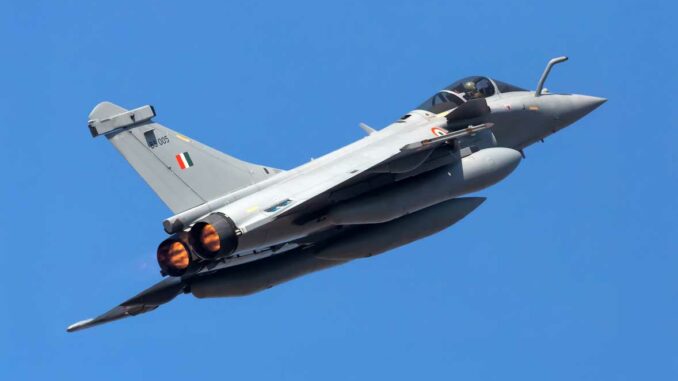
India wants 114 more Rafales but is demanding greater technology transfer. Paris is protecting its codes. The contract has turned into a strategic standoff.
Summary
India is negotiating the potential purchase of 114 additional Rafales for its MRFA (Multi-Role Fighter Aircraft) program to bolster an Indian Air Force weakened by the retirement of legacy aircraft and the growing power of China and Pakistan. The deal seemed favorable to Dassault Aviation following the 36 Rafales already delivered to India and the order of 26 Rafale Marine jets in 2025. However, discussions are hardening. New Delhi is demanding massive local production, technology transfers, a high Indian industrial share, and, above all, access to technical interfaces that would allow it to integrate its own weapons without depending on Paris. France accepts local assembly, offsets, and certain industrial cooperations. However, it refuses to hand over the source codes for its most sensitive systems, such as SPECTRA, the RBE2 AESA radar, or the mission computers. The deadlock was predictable. India wants to buy an aircraft, but it also wants to reduce its dependency.
The Indian Rafale Contract Has Become Much More Than a Plane Purchase
The MRFA file is not a simple military order. It is one of the largest combat aircraft contracts currently under discussion globally. India is looking to acquire up to 114 Dassault Rafales to complement the 36 aircraft already delivered to the Indian Air Force. The figures mentioned vary by source, but they generally sit between 30 and 40 billion euros—approximately 32 to 43 billion dollars—depending on assumptions regarding scope, maintenance, weaponry, and local production.
The operational logic is clear. The Indian Air Force is short on aircraft. Its theoretical goal remains around 42 fighter squadrons, but its actual strength has dropped much lower, to around 29 to 31 squadrons depending on the period and aircraft retirements. The MiG-21s have left the stage. The Jaguars and Mirage 2000s are aging. The MiG-29s must be modernized or replaced. The Tejas Mk1A is arriving, but slower than expected, particularly due to engine delivery difficulties.
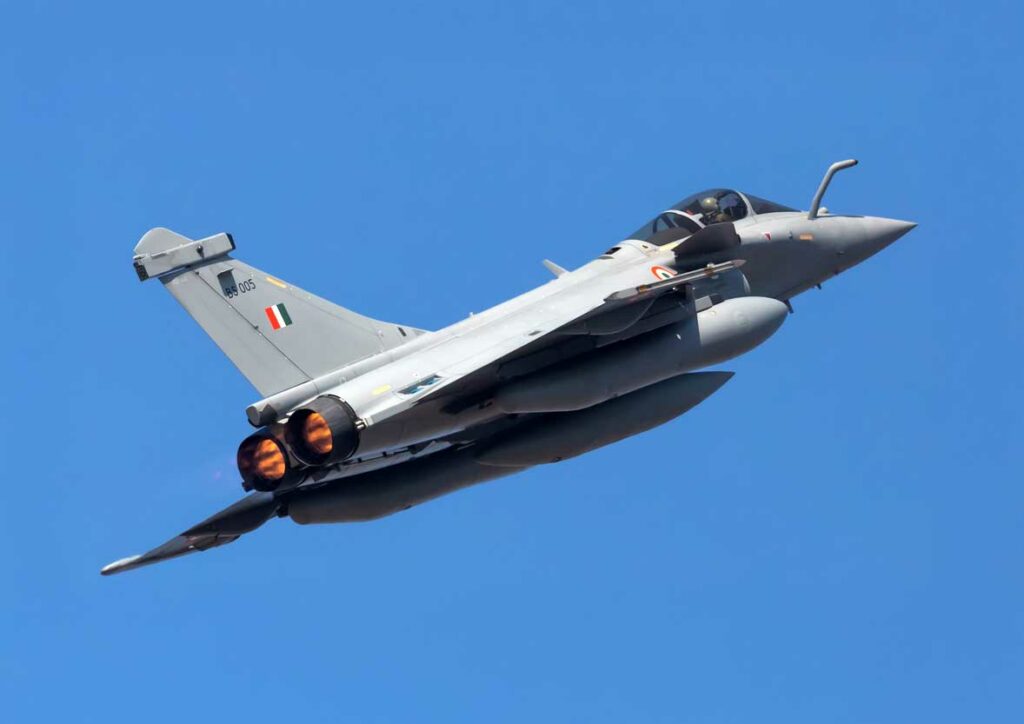
In this context, the Rafale has an obvious advantage. India already knows it. The 36 Rafales purchased in 2016 have been delivered and integrated at the Ambala and Hasimara bases. The aircraft brings a combination appreciated by New Delhi: AESA radar, Meteor missile, SCALP cruise missile, a potential Indian nuclear capability adapted to its doctrine, advanced electronic warfare, and strong versatility across air-to-air, air-to-ground, and maritime roles.
The order for 26 Rafale Marine jets signed in April 2025 further strengthened the French position. The Indian Navy is to operate them from the aircraft carriers INS Vikrant and INS Vikramaditya, with 22 single-seaters and 4 two-seaters. For Dassault, India is therefore already a major client. For New Delhi, France is a more flexible partner than the United States and less compromised than Russia. But the new MRFA order changes the scale. At 114 aircraft, India no longer just wants to buy. It wants to master.
The MRFA Program Reveals India’s New Requirements
India is not negotiating the MRFA as it negotiated the 36 Rafales in 2016. The first contract addressed an urgent capacity gap. New Delhi wanted to quickly fill an operational void facing China and Pakistan. It was a direct government-to-government purchase, with aircraft delivered from France. Technology transfer was limited. Offsets existed, but India did not acquire a full production capability or deep control over the aircraft’s software architecture.
The current case is different. The Indian government wants to place the contract within the framework of Make in India and Atmanirbhar Bharat, the policy of national self-reliance. Discussions focus on a scheme where approximately 18 aircraft would be delivered in fly-away condition from France, while 90 to 96 aircraft would be manufactured, assembled, or heavily industrialized in India. The indigenization rates mentioned vary by source and production phase, but New Delhi is targeting a progressive increase in local content.
This requirement is not limited to job creation. It aims to build an industrial base. India wants to produce parts, train technicians, create supply chains, develop maintenance skills, and reduce critical dependencies. Tata Advanced Systems and Dassault Aviation already signed production transfer agreements in 2025 to manufacture Rafale fuselages in India. This is a strong signal. For the first time, Rafale fuselages are to be manufactured outside of France.
But assembly is no longer enough. New Delhi also wants the capacity to evolve. A modern combat aircraft is not just a frame and two engines. It is a software, electronic, and industrial system. India wants to be able to keep this aircraft relevant for thirty or forty years without asking for French authorization for every major modification. This is where the deadlock begins.
The Hard Point: Interfaces, Codes, and Integration Autonomy
The core of the tension concerns access to technical data allowing for the modification of the aircraft. In the Indian specialized press, the debate is often summarized by the formula “No ICD, no deal.” ICD stands for Interface Control Document. This document describes the interfaces between systems. It explains how a weapon, a sensor, or a piece of equipment communicates with the aircraft, its mission computer, and its display systems.
For India, access to ICDs is essential. New Delhi wants to integrate its own armaments. This includes the Astra air-to-air missile, Rudram anti-radiation missiles, certain Indian guided munitions, and, in the longer term, systems like the BrahMos-NG if technical integration becomes realistic. Without sufficient access to interfaces, India remains dependent on Dassault, Thales, MBDA, or other French suppliers to modify the aircraft. This is expensive, time-consuming, and limits operational sovereignty.
Two things must be distinguished. Access to interfaces is not the same as the full transfer of source codes. A country can receive sufficient integration data to connect certain weapons without obtaining the full code for the radar, electronic warfare, or mission computer. It is likely toward this middle ground that discussions are attempting to converge.
France, for its part, logically refuses to hand over the source codes for the most sensitive systems. Elements cited in the press include the SPECTRA electronic warfare suite, the Thales RBE2 AESA radar, and the mission computers. These building blocks represent the core value of the Rafale. Transferring them completely would mean exposing decades of industrial know-how, potential vulnerabilities, and technologies also used by French forces.
Paris can accept a controlled opening. It can authorize gateways, APIs, documented interfaces, and supervised integrations. But delivering the software heart would be another matter. No major country easily grants this type of access. The United States does not do it with the F-35. Russia sometimes promises more flexibility, but the quality of the actual transfer and industrial reliability pose other problems.
The Rafale Concentrates Technological Value That Paris Won’t Cede
The French position is not merely commercial. It is strategic. The Rafale is one of the few modern combat aircraft entirely mastered by a European country. It embodies French military autonomy. Its SPECTRA suite, its AESA radar, its mission architecture, its data links, its firing modes, and its software form a coherent whole. It is precisely this coherence that gives the aircraft its value.
SPECTRA is particularly sensitive. This electronic warfare suite is used to detect, locate, jam, and foil radar or missile threats. It directly contributes to the aircraft’s survivability. Transferring its source code would amount to handing over information on the system’s detection, processing, and reaction logic. For an aircraft also intended for French forces, the risk is obvious.
The RBE2 AESA radar follows the same logic. A modern radar is not just an antenna. Its value lies in the processing modes, beam management, resistance to jamming, detection of weak targets, simultaneous tracking, and emission discretion. This is information that manufacturers fiercely protect.
The mission computer is even more central. It orchestrates the whole. It receives sensor data, manages weapons, processes tactical information, and presents the situation to the pilot. Granting deep access to this architecture could allow for sovereign integrations. But it could also create risks of security, error, industrial leakage, or uncontrolled modification.
France is therefore not being naive in refusing certain demands. It is defending its strategic capital. The real question is whether Paris sufficiently anticipated the hardness of the Indian position. On this point, the answer is more nuanced.
The Deadlock Was Predictable Since the Failure of the MMRCA
This crisis is not new. It has a history. Before the 36-Rafale contract signed in 2016, India had launched the MMRCA program to buy 126 aircraft. The Rafale was selected in 2012 after a long and complex competition. But negotiations eventually bogged down. The points of friction included licensed production by Hindustan Aeronautics Limited, industrial responsibilities, costs, quality guarantees, and technology transfer.
The 36-aircraft contract bypassed this deadlock. It allowed India to quickly receive high-performance aircraft. It also allowed France to save a major strategic relationship. But it did not resolve the fundamental question: India does not want to remain a simple buyer of Western aircraft. It wants to become a producer, an integrator, and a modifier.
The MRFA therefore reopens exactly the file that the 2016 contract had set aside. The difference is that India is even firmer today. Since 2016, New Delhi has accelerated its self-reliance policy. It has developed Astra, Rudram, SAAW munitions, the Tejas, the AMCA, local radars, and a more ambitious missile industry. It has also observed the effects of the war in Ukraine on Russian supply chains. Dependency on a foreign supplier is no longer just a budgetary problem. It is a strategic risk.
The situation was therefore predictable. It was even inevitable. A contract for 114 Rafales could not be a repeat of the 36-aircraft contract. The volume, the price, and the lifespan of the program demanded a much deeper negotiation.
Was France Naive Toward Indian Ambitions?
To say France was naive would be too simple. Paris perfectly understands the Indian acquisition culture. Defense negotiations with New Delhi are long, hard, and often unpredictable. French industrialists know that India demands technology transfer, offsets, local content, and flexibility. They lived it with the Mirage 2000, the Scorpène submarines, the Rafale, and other programs.
But France may have underestimated the political magnitude of the Indian shift. For a long time, Paris could present itself as the most flexible Western partner. France is not the United States. It imposes fewer political constraints. It does not have the same extraterritoriality regime. It knows how to adapt its equipment to Indian needs. This long constituted a major advantage.
This advantage still exists. But it is no longer enough. India does not just want a more flexible supplier. It wants an autonomous margin of action. It wants to be able to integrate its weapons, modify its planes, and sustain its fleet over the long term. It wants to avoid “vendor lock-in”—the state of being trapped with a single supplier for updates, weaponry, and heavy maintenance.
France was not naive on principle. It may have been too optimistic about the ability to contain Indian demands within a classic framework: local production, offsets, maintenance, training, but protection of the software core. Yet India wants to move the border. It is not just asking to manufacture. It is asking to understand and control.
This does not mean New Delhi will get everything. In this type of negotiation, maximum demands also serve as leverage. India might give up on the full source code while obtaining expanded interfaces, supervised integration rights, and stronger participation for its industrialists. The standoff could therefore be a method, not a breakdown.
Indian Alternatives Also Serve as Pressure on Paris
India is letting the idea linger that it could look elsewhere. The Russian Su-57 is often mentioned in the press as an alternative offering more generous technology transfer. This threat must be taken seriously, but not overestimated.
The Su-57 has clear weaknesses. Its production remains limited. Its operational experience is difficult to evaluate. The war in Ukraine has weakened the image of the Russian military industry. Sanctions complicate components, financing, and timelines. India had already left the FGFA program derived from the Su-57 due to disagreements over performance, cost, and transfers. Returning massively to this option would be politically possible but technically risky.
The American F-35 is another theoretical option, but it remains very complicated. India still uses a lot of Russian equipment, including the S-400 system. Washington would not easily deliver such a sensitive aircraft into such a hybrid defense ecosystem. Furthermore, the F-35 would offer even less integration freedom than the Rafale.
The Gripen E, the Eurofighter Typhoon, or the F-21 derived from the F-16 remain competitive options, but none combine existing Indian experience, strategic compatibility with France, already integrated weaponry, and operational credibility as well as the Rafale. India’s true alternative is perhaps less another foreign aircraft than it is time: buying fewer, extending fleets, accelerating the Tejas Mk2 and AMCA, or mixing solutions.
This is why Paris maintains a strong position. The Rafale remains probably the best compromise for India. But New Delhi knows this too. It is therefore using this position to get more.
The Deal Could Still Succeed on a Technical Compromise
The current deadlock does not mean the contract is dead. Major defense contracts often go through phases of tension. The sums are enormous. Industrial interests are contradictory. Public or semi-public statements sometimes serve to influence the negotiation.
A realistic compromise could rest on several levels. First, significant local production with a progressive ramp-up. Second, a real industrial transfer regarding structures, maintenance, certain equipment, and assembly. Third, a controlled opening of interfaces to allow for the integration of selected Indian weapons. Finally, a Franco-Indian validation mechanism for sensitive modifications.
This compromise would not fully satisfy Indian sovereignists. It would not give Paris absolute protection either. But it could work. India would get more than it did in 2016. France would preserve its most critical building blocks. Dassault would secure a historic order. The Indian Air Force would receive an aircraft it has already mastered without waiting ten or fifteen years for a national program still in development.
The timeline remains delicate, however. Even if the contract were signed soon, the first fly-away deliveries would take several years. The aircraft assembled in India would arrive even later. The MRFA therefore does not resolve the immediate crisis of the Indian squadrons. It prepares for the 2030s.
This is where the negotiation becomes urgent. The longer the file drags on, the more the Indian Air Force ages. The longer it drags, the more the AMCA and Tejas Mk2 become political arguments. The longer it drags, the higher the costs rise.
The Rafale Finds Itself at the Center of an Indian Doctrinal Shift
The standoff over the Rafale says something deeper about India. New Delhi no longer accepts the old model: buying foreign platforms and then depending on the supplier for their evolution. This model was tolerated for a long time because operational urgency dominated. It is becoming less acceptable in an India that wants to become an industrial power.
France must therefore adjust its approach. It cannot sell 114 Rafales like it would sell a classic export fleet. India wants a sovereignty partnership. But France cannot strip itself of its most sensitive technologies either. The contract is located exactly on this border.
The case is not just a commercial negotiation. It is a test of maturity for the Franco-Indian relationship. If the two countries find a balance, they can build one of the most important aeronautical partnerships of the next twenty years. If the discussions fail, the message will be brutal: even between strategic partners, technological sovereignty has its limits.
France was not naive in protecting its codes. It would be naive if it believed that India will accept limited autonomy for much longer. The Rafale remains the best-placed aircraft. But it will only win this contract if Paris understands that New Delhi is no longer just buying fighter jets. It is buying the ability to no longer depend entirely on those who sell them.
War Wings Daily is an independant magazine.