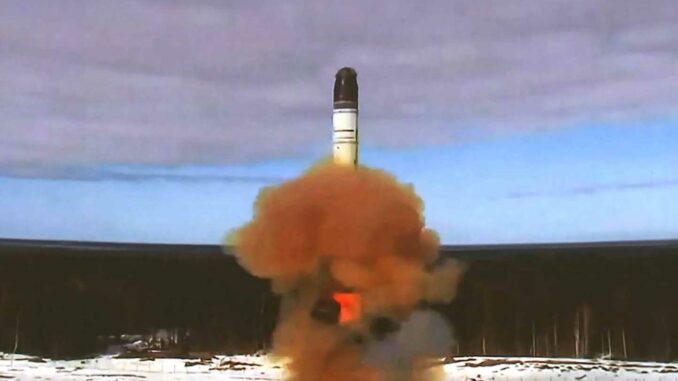
Russia is reportedly preparing a new test of the Sarmat nuclear missile around May 9—a move positioned between a show of force and an admission of fragility.
In Summary
Russia appears to be preparing a new test firing of its RS-28 Sarmat intercontinental ballistic missile, often dubbed “Satan II” in Western media. Aviation notices, zone restrictions, and alerts around the Kura test range in Kamchatka suggest a launch window centered around May 9, the highly symbolic date of Victory Day. This timing is deliberate. The Kremlin seeks to demonstrate that its nuclear deterrence remains credible, even as the Sarmat program has been plagued by delays, failures, and incidents for several years. The missile is intended to replace the aging Soviet-era R-36M2 Voevoda. It is designed to carry multiple nuclear warheads or even Avangard hypersonic glide vehicles. Yet, behind the image of an “absolute weapon,” the program remains fragile. A successful new test would bolster Moscow’s narrative; another failure would be a major embarrassment for the Russian strategic industry.
The New Sarmat Test Follows a Highly Calculated Sequence
Russia seems to have chosen a window that is as much political as it is technical. Aerial and maritime restrictions observed in early May 2026 point toward potential intercontinental missile activity between the Dombarovsky site in the Orenburg region and the Kura range in Kamchatka. This corridor corresponds to a classic Russian test-firing logic: launching from the west or center of the country, with the test payloads impacting at very long range in the Russian Far East.
Authorities in Kamchatka have warned residents of missile tests in the Kura area between May 6 and May 10, 2026. They have also prohibited the presence of civilians and vehicles in the affected zones. While such measures do not prove a Sarmat launch on their own, they align with a preparatory sequence. Notices to Airmen (NOTAMs) have also reportedly been published to steer aircraft away from several danger zones.
The May 9 window draws particular attention. In Russia, Victory Day is not a simple commemoration; it is the heart of Vladimir Putin‘s political narrative. The Russian leadership uses it to celebrate the Soviet victory over Nazi Germany. Since the invasion of Ukraine, this date has also served to link the Soviet past, military power, and the current war. A nuclear missile test around this date would be anything but incidental.
Moscow wants to show that Russia remains a strategic power capable of threatening any adversary. However, this demonstration comes in a context that is less comfortable than it appears. The Sarmat has already suffered several setbacks. The Kremlin is not just trying to impress the West; it is also trying to prove that its own program is not stalled.
The RS-28 Sarmat Missile Must Replace a Aging Pillar of the Russian Arsenal
The RS-28 Sarmat is a silo-based, heavy intercontinental ballistic missile (ICBM). Its role is to replace the R-36M2 Voevoda, known in NATO nomenclature as the SS-18 Satan. The latter remains one of the most powerful missiles inherited from the Soviet Union, but it is aging. Russia, therefore, had to develop a successor capable of preserving the credibility of its land-based nuclear component.
The Sarmat measures approximately 35 meters in length. Its launch mass exceeds 208 tons, and its announced range reaches about 18,000 kilometers. These figures place it in the category of “super-heavy” intercontinental missiles. It is not a mobile missile like the RS-24 Yars, nor is it a compact system designed for dispersal. It is a massive, silo-based weapon designed to carry a very heavy payload across planetary distances.
Its payload is generally estimated at around 10 tons. According to available public data, it could carry up to 10 heavy nuclear warheads, or even more lighter ones, depending on the configuration. Some sources suggest up to 16 independently targetable reentry vehicles (MIRVs). The Sarmat is also reportedly capable of carrying Avangard hypersonic glide vehicles, designed to maneuver in the upper layers of the atmosphere to complicate interception.
This capability explains its nickname as an “apocalypse missile.” This is not a tactical weapon; the Sarmat is designed for strategic nuclear warfare. Its objective is not to strike a battlefield, but to threaten command centers, strategic bases, silos, major military infrastructures, and the cities of a major adversary. It is a weapon of total deterrence.
Sarmat Technology Bets on Mass, Range, and Saturation
The Sarmat relies on an old but still formidable logic: power through mass. A heavy liquid-fueled missile can carry a larger payload than a solid-propellant missile of comparable size. This is one of the advantages of large Russian ICBMs. They offer a high payload capacity, allowing for a combination of nuclear warheads, decoys, penetration aids, and maneuvering systems.
An ICBM functions in several phases. The first is the boost phase, where engines successively ignite to project the missile out of the atmosphere. The second is the ballistic phase, during which the post-boost vehicle releases the payloads. The third is atmospheric reentry, when the nuclear warheads descend toward their targets at very high speeds.
The Sarmat is designed to complicate missile defense, first through its range. Vladimir Putin claimed in 2018 that the missile could strike via the North Pole or the South Pole. This idea is primarily aimed at the United States. American missile defense systems are historically oriented toward certain probable trajectories. A missile capable of varying its routes forces the adversary to monitor more axes.
Furthermore, the Sarmat can saturate defenses. A missile that releases multiple independent warheads forces the adversary to intercept several objects rather than just one. If decoys and countermeasures are added, the equation becomes even more difficult. The defender must distinguish real payloads from false ones and then engage each threat within a very short timeframe.
Finally, the potential addition of Avangard changes the nature of the problem. A hypersonic glider does not follow a simple ballistic trajectory; it can maneuver after reentering the atmosphere. This maneuverability reduces the predictability of its path, theoretically complicating interception. In practice, real-world effectiveness depends on many parameters: precision, thermal resistance, guidance, communications, and the reliability of the carrier.
The Program Accumulates Delays and Failures
Russian rhetoric presents the Sarmat as an inescapable weapon. The reality of the program is harsher. The missile was initially supposed to enter service much earlier, and Moscow has repeatedly announced ambitious deadlines that have not been met.
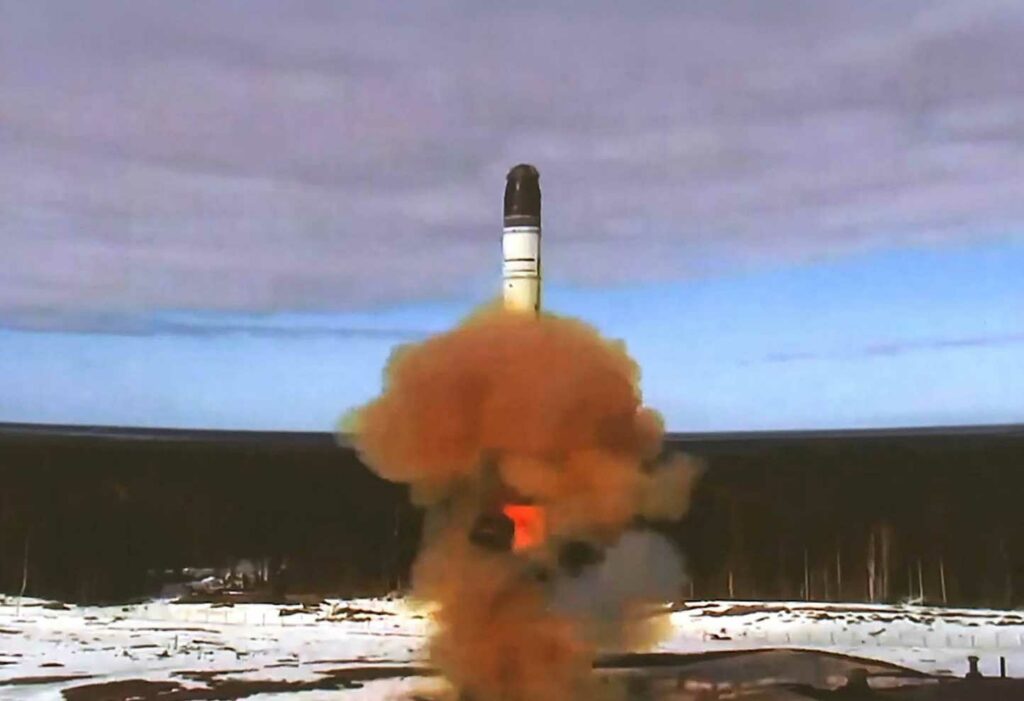
The first known complete firing presented as successful took place in April 2022 from Plesetsk. This launch allowed the Kremlin to display a success at the beginning of the war in Ukraine. But since then, the program has followed a complicated trajectory. Tests have reportedly been postponed or canceled. A September 2024 test ended in a major failure at Plesetsk; satellite images showed a crater approximately 60 to 70 meters wide and damage around the silo. Another incident in November 2025 was associated by several analysts with a possible failed test in the Dombarovsky region.
These failures are not surprising given the system’s complexity. A liquid-fueled missile exceeding 200 tons imposes extreme constraints. One must manage fueling, pressurization, silo ejection, engine ignition, initial stability, stage separation, and guidance. A failure at the start of flight can destroy the missile and heavily damage the infrastructure.
The Sarmat appears particularly vulnerable in this initial phase. Specialized analyses suggest possible difficulties related to engines, fuel lines, silo ejection, or the missile’s stability just after launch. These are heavy mechanical and structural problems that cannot be fixed with a simple software adjustment; they involve propulsion, industrial integration, and test procedures.
The program also suffers from a strained industrial context. Western sanctions, the demands of the war in Ukraine, loss of expertise, and production difficulties complicate major Russian defense programs. While Russia retains a powerful missile industry, the Sarmat shows that this industry is not invulnerable.
The Symbolism of May 9 Transforms a Technical Test into a Political Message
The choice of a window near May 9 follows a communication logic. In Russia, Victory Day is a moment for staging the state. The Kremlin uses it to tell a story of continuity between the Red Army, Soviet power, and modern Russia. The message is simple: Russia conquered yesterday, it resists today, and it will remain invincible tomorrow.
A Sarmat test around this date would add a nuclear layer to this narrative. Russia would be telling its citizens that its arsenal remains modern. It would be telling NATO that Russian deterrence is not a Soviet relic. It would also be telling Ukraine that the conventional war is taking place under a permanent nuclear shadow.
But this timing is risky. A successful demonstration can fuel propaganda, but a visible failure can have the opposite effect. The Sarmat is not a discreet missile. An intercontinental test requires restrictions, navigation notices, impact zones, and international monitoring. Western satellites observe the sites, analysts follow NOTAMs, and commercial imagery often allows for the identification of damage. Russia can control its internal discourse, but it no longer fully controls external observation.
This is what makes this sequence interesting. Moscow wants to use May 9 to project an image of mastery. Yet, the mere fact of having to re-test the Sarmat underlines that the program has not reached the promised level of maturity. The show of force thus contains an element of admission.
The Sarmat’s Military Goal: To Bypass and Overwhelm Adversary Defenses
The fundamental objective of the Sarmat is to guarantee a second-strike capability. In nuclear doctrine, a power must be able to respond even after suffering a first strike. This is the heart of deterrence. If an adversary believes they can destroy your nuclear forces on the ground before they are used, your deterrence becomes less credible. A heavy missile, hardened in a silo and endowed with a large payload capacity, serves to prevent this calculation.
The Sarmat must also respond to American missile defenses. Russia has long claimed that U.S. missile shields threaten the strategic balance. Washington responds that these systems primarily target limited threats, such as North Korea or Iran. Moscow does not accept this argument. The Sarmat is thus presented as a response to any attempt to neutralize Russia’s nuclear force.
Its ability to carry multiple warheads and decoys aims to saturate defenses. Even if part of the payload were intercepted, others could get through. This is a brutal but central logic in nuclear deterrence. The weapon does not need to be used to be effective; it must convince the adversary that its use would be catastrophic.
The missile also serves to preserve Great Power status. Russia already possesses many nuclear vectors: Yars mobile missiles, Bulava submarine-launched missiles, strategic bombers, cruise missiles, and newer systems. The Sarmat is therefore not indispensable on its own, but it represents the continuity of the heavy segment of Russian deterrence. Its prolonged failure would be a negative industrial and political signal.
The Expected Test Reveals Both Russia’s Strength and Fragility
A successful new test would give Moscow an immediate communication tool. The Kremlin could show launch footage, speak of nuclear modernization, and insist on the West’s inability to contain Russia. This would have an internal effect and an external one, especially at a time when the war in Ukraine remains the focus of relations between Moscow and the West.
However, a successful firing should not be confused with robust entry into service. A strategic missile must be mass-produced, deployed, maintained, integrated into command procedures, and tested over time. It must be reliable, not just spectacular. A single launch is not enough to erase years of delays and incidents.
Conversely, another failure would be heavy. It would confirm that the Sarmat remains a difficult program and would weaken the credibility of past announcements. It would give Western analysts a new argument regarding the limits of Russian industry. It would not destroy Moscow’s nuclear deterrence, as that remains broad and diversified, but it would strike at a symbol.
Russia still knows how to produce dangerous weapons and use nuclear force as a political instrument. But the Sarmat reveals a less flattering reality: grand announcements are not enough to make a 208-ton machine, loaded with toxic propellants and complex guidance systems, work perfectly. Propaganda can precede technology, but it cannot replace it indefinitely.
The Sarmat Remains a Weapon of Fear Before Being a Proven Weapon
The Sarmat is designed to inspire fear; that is its function. Its range, mass, multiple warheads, and potential association with Avangard make it an instrument of strategic pressure. It aims to remind adversaries that Russia can strike their territory even at very long range. it also aims to maintain the idea that Russian nuclear modernization is progressing despite the war, sanctions, and industrial difficulties.
But the timing chosen around May 9 reveals a paradox. The more Moscow feels the need to stage the Sarmat, the more it shows that this missile has not yet produced the expected operational normalcy. A truly mature system does not need to be sold as a symbolic revenge at every political window; it is simply deployed, integrated, and credible.
The upcoming test, should it occur, will be observed for two reasons. Military officials will look at the trajectory, stage separation, impact zone, and signs of success. Diplomats will look at the message sent by Moscow. Industrialists will look at Russia’s ability to stabilize a program long presented as decisive.
May 9 gives the Sarmat a stage. It does not automatically give it credibility. That will depend on a colder reality: the missile must fly, repeat its performance, enter service, and remain reliable. In nuclear deterrence, image matters—but reliability matters more.
War Wings Daily is an independant magazine.