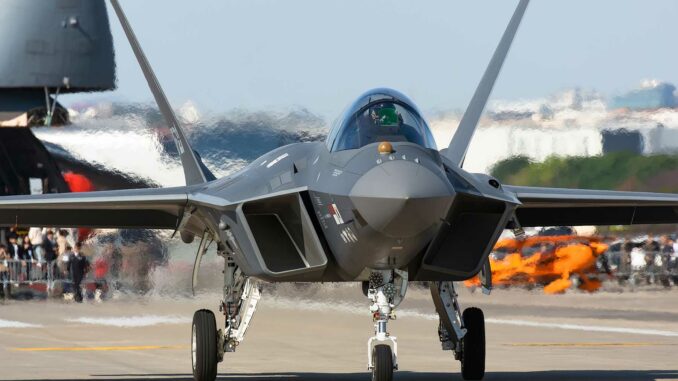
The KF-21 Boramae receives its green light for combat. Seoul validates its national fighter and is already targeting the export market to compete with the Rafale, the F-16, and the Gripen.
In Summary
On May 7, 2026, the KF-21 Boramae received its final combat readiness certification from the Defense Acquisition Program Administration (DAPA), the South Korean agency responsible for arms programs. This validation concludes an intensive testing phase: approximately 1,600 flights and nearly 13,000 test conditions were verified since the rollout of the first prototype. The green light applies to Block I, which focuses on air-to-air missions. Deliveries to the Republic of Korea Air Force are scheduled to begin in the second half of 2026, with a target of 40 Block I aircraft by 2028, followed by an additional 80 more versatile aircraft by 2032. For Seoul, the stakes extend beyond national defense; the KF-21 is becoming an industrial showcase. It may appeal to countries seeking a modern aircraft that is less politically restrictive than the F-35, newer than the F-16, and less expensive than a heavy European fighter.
Seoul’s Green Light Changes the Status of the KF-21 Boramae
The final certification received by the KF-21 Boramae on May 7, 2026, is not a mere administrative formality. It signifies that the South Korean fighter jet is now deemed capable of conducting real combat missions in its initial operational configuration. For a program launched to replace aging aircraft and reduce Seoul’s technological dependence, this is a major threshold.
The KF-21 is no longer just a successful prototype or an industrial promise. It has become a weapons system ready to enter the inventory of the Republic of Korea Air Force. The nuance is important: many aviation programs can fly, but fewer pass the tests for endurance, avionics integration, live firing, mid-air refueling, and operational compliance.
The timeline is also telling. The first prototype was unveiled in April 2021, with the maiden flight taking place in July 2022. The program then moved through a rapid succession of trials to reach approximately 1,600 flights. DAPA also cited the verification of around 13,000 test conditions. These trials covered essential areas: flight behavior, maneuvers, armament integration, radar, sensors, structure, aerial refueling, and systems security.
This certification applies to Block I. It is important to note that the KF-21 certified in May 2026 is not yet the fully multirole fighter Seoul aims to achieve eventually. Its primary mission is air-to-air—interception, air defense, and combat against other aircraft. Broader air-to-ground and anti-ship capabilities are expected to arrive with Block II. It is therefore a solid, yet progressive, operational start.
Block I Provides South Korea with a Credible Air-to-Air Fighter
The KF-21 Block I is primarily designed as an air superiority and air defense fighter. Its immediate role is to replace parts of the aging fleets, specifically the F-4 Phantom II and F-5 Tiger II, which belong to a different technological era. While these aircraft have served well, they no longer meet the requirements of an airspace saturated with modern radar, long-range missiles, and electronic warfare.
The choice of Block I is pragmatic. Seoul did not wait for every capability to be ready before putting the aircraft into service. They are starting with the core of the requirement: intercept, detect, engage, and survive. This is a classic method in major defense programs, allowing for the delivery of initial units, pilot training, the establishment of maintenance protocols, and the correction of weaknesses while preparing subsequent blocks.
The announced plan projects 40 KF-21 Block I units to be delivered by 2028. Following this, 80 additional aircraft with expanded capabilities—including air-to-ground and air-to-sea—are set to follow, reaching a total of 120 aircraft by 2032. This volume is significant; it creates a national industrial base, provides visibility for Korea Aerospace Industries (KAI), and allows for a reduction in unit costs over time.
Militarily, the KF-21 arrives in a very tense environment. North Korea is developing ballistic missiles, drones, nuclear capabilities, and various strike means. China is rapidly modernizing its aviation, and Japan is also bolstering its aerial capabilities. In this region, a modern national fighter is not an abstract symbol; it is a tool for sovereignty, deterrence, and operational continuity.
The South Korean Fighter Targets the 4.5 Generation Market
The KF-21 is often described as a 4.5 generation fighter. This category is not a legal classification but rather designates an aircraft more advanced than classic fourth-generation fighters, though one that does not possess all the characteristics of a fifth-generation stealth aircraft like the F-35.
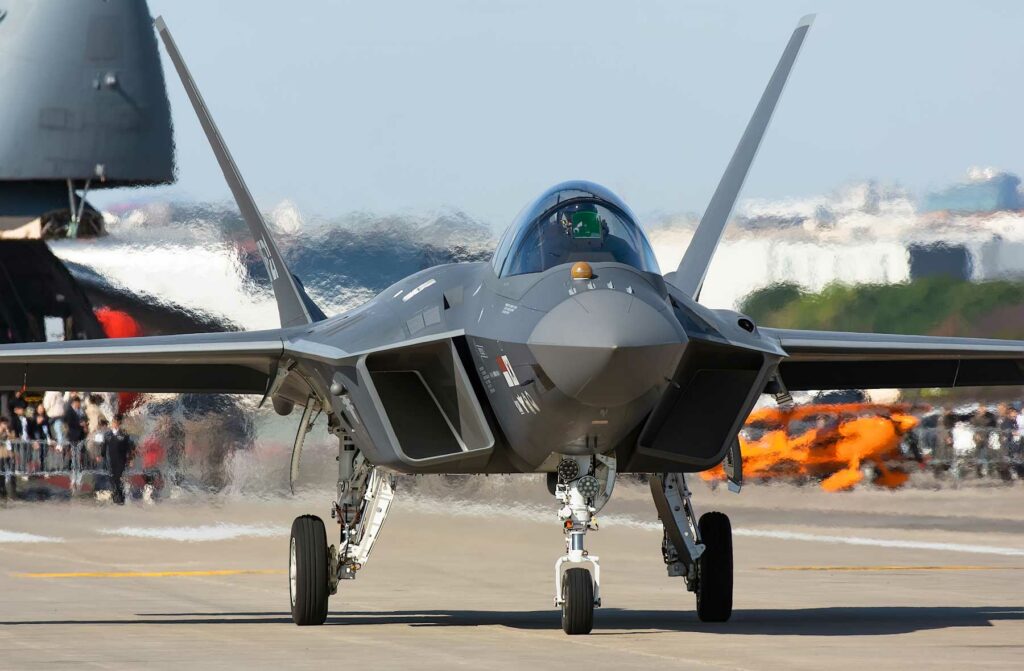
In concrete terms, the KF-21 adopts an airframe shaped to reduce its radar signature. It features modern avionics, an AESA radar, integrated sensors, and digital architecture. However, in its initial configuration, it lacks a true internal weapons bay for carrying armaments in a fully stealthy mode. Its missiles are carried on external or semi-recessed hardpoints, which increases its radar signature compared to an F-35 in stealth configuration.
This limitation is not a minor detail. It prevents the KF-21 from being presented as a direct equivalent to the F-35. It is more accurate to compare it to aircraft like the Rafale, the Eurofighter Typhoon, the Gripen E, or modern versions of the F-16. Its advantage lies elsewhere: a brand-new airframe, an architecture designed from the start for evolution, a national industrial base, and a path toward more discreet versions.
The future Block III, sometimes associated with stealthier ambitions, could reinforce this trajectory. But in 2026, precision is necessary: the KF-21 Block I is a modern, fast, connected, and credible fighter. It is not yet a pure stealth aircraft. This honesty is important as it determines its export market. It will not only seek to compete with the F-35; it will primarily aim to attract countries that want a modern aircraft without fully entering the American political, software, and logistical ecosystem of the F-35.
Performance Places the KF-21 in a Highly Competitive Category
The KF-21 measures approximately 16.9 meters in length with a wingspan of about 11.2 meters. Its maximum takeoff weight is generally cited around 25,400 to 25,600 kg, with a payload capacity of approximately 7,700 kg. It is powered by two General Electric F414-GE-400K engines, a well-known engine family already associated with the F/A-18E/F Super Hornet and the Gripen E/F.
The announced maximum speed is around Mach 1.8. Under standard conditions, this corresponds to an order of magnitude greater than 2,200 km/h, depending on altitude and atmospheric conditions. The combat radius varies significantly based on load, fuel tanks, and mission profile. Public data suggests a ferry range of about 2,900 km and an operational radius of near 1,000 km in certain configurations.
The AESA radar is one of the central components. An active electronically scanned array radar allows for tracking multiple targets, better resistance to jamming, and faster switching between modes. On a modern fighter, this is more than just radar; it is the heart of detection, tracking, and beyond-visual-range engagement. Available sources suggest a detection range of 150 to 200 km depending on conditions, with simultaneous tracking of multiple targets.
Regarding air-to-air armament, the choice of European Meteor and IRIS-T missiles is strategic. The Meteor provides long-range combat capability beyond direct sight. It is renowned for its ramjet engine, which allows it to maintain energy longer than a conventionally propelled missile. The IRIS-T covers close-quarters combat with high maneuverability. This choice reduces immediate dependence on American weaponry, even if the future integration of other missiles remains possible.
The Program Grants Seoul a Rare Industrial Autonomy
The KF-21 is first and foremost a military aircraft, but it is also a major national industrial project. South Korea has not just bought a fighter; it has learned to design, test, produce, and certify a complex combat platform. Few countries truly master this entire chain. Many assemble or modernize; very few develop a modern fighter jet from a national architecture.
Korea Aerospace Industries acts as the lead integrator. DAPA manages the acquisition, while the Agency for Defense Development contributed the technological building blocks. Hanwha Systems, LIG Nex1, and other local players are involved in sensors, radar, electronic warfare, and subsystems. This structure creates an ecosystem. This is often what countries wanting to develop their own fighter lack: not just a factory, but a coherent chain of design offices, testing facilities, software, subcontractors, and maintenance.
However, the program maintains some dependencies. The F414 engines remain tied to American technology, and certain critical blocks may be subject to export regulations. This is a key point for international sales. A client might like the KF-21, but a sale will also depend on authorizations related to foreign components. Seoul is aware of this; one of the goals for future versions is to increase the local share to sell more freely.
This constraint does not negate the achievement, but rather nuances it. In 2026, no country builds a modern combat aircraft alone without external dependence. Even major powers utilize international supply chains. The real question is the degree of control. With the KF-21, South Korea clearly increases that control.
Potential Clients Seek an Alternative to the F-35 and Rafale
The operational green light for the KF-21 changes its commercial value. A country rarely buys an aircraft that has not yet passed its critical milestones. The final certification gives KAI a simple argument: the aircraft is no longer just in development; it is beginning its entry into service.
Several countries may be interested. Indonesia remains the most obvious case, even if its participation in the program has faced financial and political tensions. Jakarta has been a partner in the KF-21, but its payments were delayed and then renegotiated. The country could still see the aircraft as a long-term option, especially if it wants to diversify its suppliers among France, the United States, Turkey, Russia, and South Korea.
The Philippines represents another logical profile. Manila is modernizing its forces in the face of Chinese pressure in the South China Sea. The country has already used South Korean FA-50s. This relationship could facilitate a move up to a heavier fighter. For the Philippines, the KF-21 would offer a more credible air-to-air capability without relying solely on the F-16 or more expensive European aircraft.
Poland is also a market to watch. Warsaw is already buying South Korean equipment in several areas, including K2 tanks, K9 howitzers, and FA-50s. While the country chose the F-35, it is also looking for volume, availability, and a broader industrial base. The KF-21 could be of interest in the medium term if Seoul offers serious industrial cooperation.
The United Arab Emirates might look at the KF-21 for another reason. Abu Dhabi likes to diversify its suppliers and invest in technological partnerships. The country is not just looking for planes; it seeks transfers, industrial participation, and greater autonomy. The KF-21 could fit this logic if Seoul accepts advanced cooperation.
Saudi Arabia, Malaysia, Egypt, and Peru are also possible candidates. Each has its own constraints: Riyadh wants to develop its defense industry; Kuala Lumpur has long sought to modernize its combat aviation with a controlled budget; Cairo wants to diversify its sources; Lima is studying several options to renew its fleet. In all these cases, the KF-21 can present itself as a compromise: modern, evolvable, less politically locked than some American aircraft, but younger and less proven than its direct competitors.
The Main Obstacle Remains Operational Confidence
The KF-21 now has certification, but it does not yet have the experience of a Rafale, an F-16, or a Eurofighter. This is its main commercial handicap. An export client does not just look at the technical specifications; they look at accumulated flight hours, availability rates, maintenance costs, pilot training, part reliability, and feedback from real-world conditions.
The Rafale has been combat-proven. The F-16 has an immense global base. The Gripen E benefits from the image of an aircraft designed for air forces demanding controlled costs. The F-35 offers real stealth, highly advanced data fusion, and an influential network of users. Against them, the KF-21 must prove it can do more than just a successful launch.
Its advantage is its trajectory. The aircraft arrives at a time when many countries must replace aging fleets. F-5s, MiG-29s, F-4s, Mirage 2000s, and early F-16s will not last forever. However, not everyone can buy the F-35, not everyone wants Russian hardware, and not everyone can afford the full costs of a high-end European aircraft. The KF-21 can therefore find its place in a real commercial space.
South Korea has already proven it can export quickly and effectively. Its tanks, howitzers, armored vehicles, FA-50 trainer jets, and naval systems have gained credibility. The KF-21 could benefit from this momentum. But a combat fighter is a more sensitive product than a self-propelled gun or a light aircraft; it engages a country’s aerial sovereignty for thirty or forty years.
The KF-21 Opens a New Phase for South Korean Power
The certification of the KF-21 Boramae does not mean that South Korea immediately joins the closed circle of major military aeronautical powers. It means something more precise: Seoul has made the transition from ambition to entry into service. That in itself is considerable.
Block I provides an initial air-to-air capability. Block II will have to prove versatility. Future versions will need to strengthen stealth, drone integration, data links, electronic warfare, and local weaponry. That is where the program will truly be judged. A good aircraft in 2026 must remain relevant in 2036. The challenge, then, is not just to deliver the first units, but to create a platform that evolves quickly.
For foreign clients, the question will be simple: is the KF-21 a credible alternative to established fighters, or just a well-presented South Korean promise? The certification on May 7, 2026, provides the first part of the answer. The aircraft flies, fires, refuels, passes its tests, and enters operational planning. It now remains to demonstrate its robustness in the squadron.
South Korea has just won an industrial battle. The market will decide if it also wins a commercial battle. In the world of combat aircraft, trust cannot be decreed; it is built aircraft by aircraft, contract by contract, mission after mission.
War Wings Daily is an independant magazine.