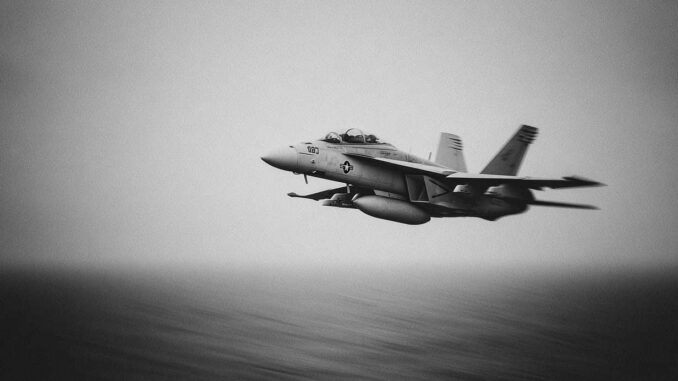
An American F/A-18 Super Hornet has immobilized the Iranian tanker Hasna. A limited strike, but one heavy with consequences in the Gulf of Oman.
In Summary
On May 6, 2026, a F/A-18E/F Super Hornet of the U.S. Navy, launched from the USS Abraham Lincoln, fired several 20 mm rounds at the rudder of the Iranian tanker M/T Hasna in the Gulf of Oman. According to U.S. Central Command, the vessel had ignored repeated warnings while attempting to reach an Iranian port despite an American blockade. The fire did not target the cargo, the hull, or the tanker’s sensitive installations. It targeted the ship’s maneuvering capability in order to prevent it from continuing its course. The incident marks a sharp increase in pressure between Washington and Tehran. It also demonstrates a rare use of the Super Hornet: not as an air superiority or conventional attack aircraft, but as a tool of maritime coercion. The military effect is limited. The political effect, however, is considerable.
The strike against the Hasna marks a rupture in the Gulf of Oman
The central fact is simple. An American carrier-based fighter jet opened fire on an Iranian tanker. This is not a trivial incident. Even if the fire was calibrated, even if the target was the rudder, even if the stated objective was immobilization rather than destruction, the act crosses a threshold.
The M/T Hasna, described as an unladen Iranian tanker, was sailing in the Gulf of Oman toward an Iranian port. U.S. Central Command claims the vessel ignored several warnings. The operational order therefore consisted of stopping the ship without causing an explosion, an oil spill, or loss of human life. The tactical choice fell on the rudder. This is logical. On a tanker, the steering gear is one of the points that allows for neutralizing movement without directly hitting the tanks, the bridge, or the machinery.
The F/A-18E/F Super Hornet used in the operation came from the USS Abraham Lincoln, a Nimitz-class nuclear aircraft carrier. This detail matters. It means the action was not an isolated patrol, but part of a complete naval deployment. A carrier strike group can monitor, intercept, control airspace, project aircraft, and maintain a prolonged presence. In the Gulf of Oman, this capability gives the United States a direct means of pressure over maritime flows linked to Iran.
The American phrasing is important. Washington speaks of a ship attempting to violate a blockade imposed on Iranian ports. Tehran may see it as an attack on a civilian vessel flying the Iranian flag. The difference in vocabulary is not secondary. It already structures the diplomatic battle. For the United States, it is a measure of maritime coercion. For Iran, it can be presented as an aggression against its economic sovereignty.
The Super Hornet was used as a tool of maritime coercion
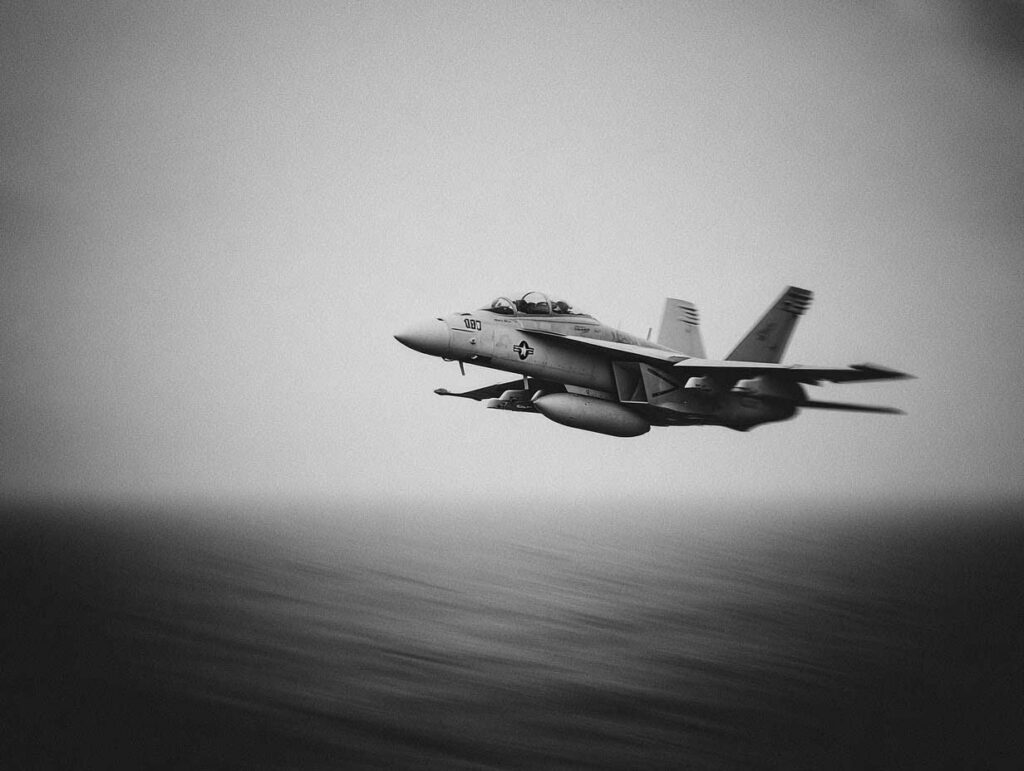
The F/A-18E/F Super Hornet is a multirole carrier-based aircraft. It serves for air defense, ground attack, naval force support, and precision strikes. Its speed exceeds Mach 1.6. Its combat radius depends on configuration, fuel tanks, and mission profile. It can carry air-to-air missiles, guided bombs, anti-ship missiles, or external fuel tanks.
In the case of the Hasna, the weapon used was not a missile. It was the onboard 20 mm cannon. The Super Hornet is equipped with an M61A2 Vulcan, a six-barrel rotary cannon. This weapon can fire approximately 6,000 rounds per minute. In practice, the pilot does not fire for a full minute. He triggers short bursts. A few shells are enough if the pass is stable and the target is correctly identified.
The choice of the cannon is revealing. An anti-ship missile would have been disproportionate. A guided bomb could have destroyed the ship. A strike on the machinery would have increased the risk of fire. Cannon fire allows for a more limited action. It remains dangerous, but it offers a form of tactical precision against an exposed part of the vessel.
The rudder is a difficult target. It is located at the rear of the ship, at or near the waterline depending on the design and load state. To damage it, the pilot must perform a pass at a precise angle. The expected effects are not always immediate. A ship of over 300 meters does not stop like a car. It maintains its inertia. It can continue on its momentum for a certain distance. The objective is therefore not just to break a part. It is to make continuing the route impossible or too risky.
This type of action also shows the versatility of the Super Hornet. The aircraft can conduct an armed maritime policing mission. It can intimidate, signal, strike lightly, and then withdraw. But this versatility has a political price. When a combat aircraft fires on a tanker, the message transcends the immediate military objective.
The American blockade seeks to transform economic pressure into physical constraint
A maritime blockade is a heavy measure. It does not just consist of announcing sanctions. It imposes material control over maritime routes. Ships are monitored. Some are ordered to change course. Others may be boarded, escorted, or immobilized. In this case, the Hasna allegedly attempted to continue its route despite warnings.
The Strait of Hormuz and the Gulf of Oman concentrate a major portion of global energy trade. The Strait of Hormuz connects the Persian Gulf to the Arabian Sea. Its usable width is limited by shipping lanes. Several hydrocarbon-exporting countries depend on this area. A military crisis there thus weighs on oil prices, maritime insurance, transport times, and shipowners’ decisions.
The American blockade aims to prevent ships from entering or leaving Iranian ports. Its objective is economic, but its method is military. This is what makes the situation unstable. A financial sanction often leaves room for circumvention. A blockade reduces this margin through force. It creates direct points of contact between aircraft, warships, tankers, and Iranian forces.
In this logic, the immobilization of the Hasna serves as an example. It shows that Washington is not content with just monitoring. The United States is ready to use force to make the blockade credible. An unenforced blockade quickly becomes a weak signal. A blockade enforced by live fire becomes a risk of escalation.
The legal question is sensitive. A blockade can be recognized in the context of an armed conflict, but it must respect strict rules. It must not cause disproportionate damage to civilians. It must be announced, effective, and applied non-arbitrarily. Here, the political qualification of the operation will be contested. Washington will speak of maritime control. Tehran will likely speak of a hostile act against its trade.
The limited strike reduces material risk but increases strategic risk
Militarily, the strike against the rudder seems calculated. It avoids the destruction of the tanker. It limits the risk of massive pollution. It also reduces the risk of killing the crew. This is likely why the 20 mm cannon was preferred over more powerful weapons.
But a limited operation can produce a non-limited strategic effect. By striking an Iranian vessel, the United States touches an economic symbol. Oil remains at the center of Iranian power, its external revenues, and its ability to resist sanctions. An immobilized tanker in the Gulf of Oman thus becomes a message addressed to Tehran, but also to insurers, shippers, captains, and states in the region.
The immediate effect is deterrent. Vessels linked to Iran now know that the blockade can be enforced by force. This may reduce passage attempts. It may also push some ships to turn off their automatic identification systems, change routes, or use intermediaries. In maritime trade, pressure does not always eliminate flows. It makes them more opaque.
The other effect is military. Iran can respond in several ways: harassment of American ships, use of drones, fast boat attacks, cyber operations, pressure on commercial vessels, or coastal missile demonstrations. Iranian forces do not need to sink an American ship to create a crisis. It is enough to make navigation more dangerous.
This is where the incident becomes serious. The Super Hornet strike is not a battle. It is a signal. But in the Gulf, signals can be misread. A pilot, a ship commander, or a coastal unit can interpret a maneuver as a direct threat. Military density increases the risk of error.
The Hasna transforms the crisis into a credibility test for Washington
For Washington, the stake is credibility. An announced blockade must be enforced. If a ship violates it without consequence, others will follow. If the response is too brutal, the United States may lose the support of already cautious allies. The action against the Hasna thus attempts to hold a narrow line: show force without provoking a spectacular destruction.
This logic corresponds to a form of graduated coercion. One warns. One monitors. One intercepts. One neutralizes. One avoids, as much as possible, the lethal strike. This method allows the United States to claim that they are controlling the escalation. But it does not guarantee that Iran will accept this interpretation.
The role of the USS Abraham Lincoln is also political. An aircraft carrier is never a simple military tool. It is an armed embassy. Its presence signals that Washington wants to have rapid options. It also signals that the maritime theater has become a priority. In a crisis with Iran, the aircraft carrier serves to reassure certain Gulf partners, but it can also worry those who dread an open war.
The Super Hornet, in this framework, becomes the visible instrument of political decision. It did not just hit a rudder. It gave a concrete reality to the blockade. This is precisely what makes the operation effective in the short term and dangerous in the medium term.
The oil market looks less at the ship than at the risk of a chain reaction
The Hasna was not, according to initial available information, the ship upon which the global market alone depends. The problem is not its volume. The problem is the location, the method, and the precedent.
The Gulf of Oman is one of the gateways to the Strait of Hormuz. When an American air force fires on a tanker in this area, markets do not just look at the immobilized ship. They evaluate the probability of a chain reaction. Will there be Iranian reprisals? Will insurers raise their premiums? Will shipowners slow down certain transits? Will Gulf countries limit the use of their bases? Can American diplomacy avoid an expansion of the crisis?
The cost of such tension can be seen even before a barrel is actually missing. Risk premiums rise. Routes are re-evaluated. Operators protect themselves. The price of oil integrates a portion of fear. This is often how crises in the Gulf act on the global economy: less by immediate disruption than by the anticipation of a disruption.
For Iran, the stake is also internal. A tanker struck by the United States can fuel a discourse of resistance. The Iranian power can present the episode as a humiliation to be avenged. But a response that is too strong would risk aggravating the blockade and justifying further American strikes. Tehran must therefore arbitrate between the image of firmness and the real cost of an escalation.
The aftermath will depend on the political control of the military
The Hasna incident shows one thing clearly: the crisis is no longer just diplomatic. It is now playing out in operational actions. A radio warning ignored, a route maintained, a 20 mm burst, a destroyed rudder. This is how a political decision becomes a military scene.
The Super Hornet strike likely fulfilled its immediate objective. The tanker was stopped. The blockade was made credible. No public evidence suggests, at this stage, a complete destruction of the ship. But the episode opens a riskier phase. It gives Iran a motive for retaliation. It exposes American forces to asymmetric actions. It places regional allies before an uncomfortable choice: support Washington, call for restraint, or seek to keep their distance.
The real question is therefore not whether the Super Hornet could neutralize the Hasna. It could. The real question is whether Washington can prevent this demonstration of force from becoming the first link in a much larger chain. In the Gulf of Oman, American military superiority is real. But the political mastery of escalation remains much more fragile.
War Wings Daily is an independant magazine.