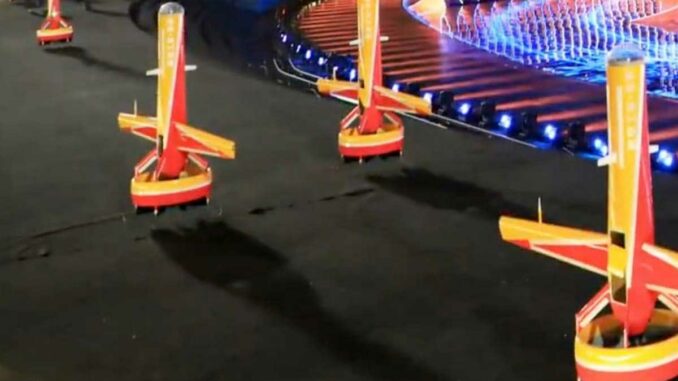
AVIC presents Yunying, a tail-sitter VTOL drone with a ducted turbine, very similar to Shield AI’s V-BAT. Innovation, imitation, and ISR challenges.
Summary
The Chinese group AVIC Chengdu Aircraft Industry Group has unveiled a new VTOL drone called Yunying, or “Cloud Shadow.” Its silhouette is striking: a tail-sitter with a ducted fan, very similar to the American V-BAT from Shield AI. The announcement is not just a trade show stunt. It targets a segment in high demand: drones capable of taking off vertically from a roof, ship deck, or rough terrain, then flying like an airplane to maintain endurance and carry sensors. On the American side, the V-BAT claims long endurance, integration designed for cluttered environments, and advanced maritime use. On the Chinese side, Yunying appears to be a “ready-to-use” response to similar needs, in a context where China is accelerating its development of tactical drones and networked operations. The controversial question is simple: is this a logical convergence of design, or industrial copying? At this stage, there is no public evidence of espionage. But the resemblance is strong enough to reignite a recurring debate: the speed of Chinese industrialization and its relationship to intellectual property in defense technologies.
The key fact and what China is showcasing
The signal is deliberately public. Yunying was shown during Lunar New Year celebrations and reported in Chinese and specialized media, with a narrative of modernity and “teaming” (cooperation between drones and platforms). The message is twofold.
First, AVIC wants to demonstrate that it can produce compact, exportable drones that are compatible with modern operating modes: vertical takeoff, rapid deployment, and ISR missions beyond those of a simple quadcopter. Second, China is suggesting a level of maturity: the object presented looks less like an academic prototype and more like an industrializable platform.
Some information is already circulating about its dimensions and architecture: a wingspan of around 2.6 m and a height of around 1.8 m have been suggested in Chinese publications relayed online, with mention of an optronic ball combining visible and infrared. These details still need to be confirmed by an official technical data sheet, but they give an idea of the positioning: a light tactical drone, not a large MALE.
The tail-sitter concept and the logic of the ducted turbine
A tail-sitter drone lands “on its tail” to take off and land vertically, then tilts into horizontal flight. This compromise has a simple objective: to achieve the flexibility of a helicopter without sacrificing the aerodynamic efficiency of an airplane.
The choice of a ducted turbine (a fan in a duct) meets three operational constraints.
The first is safety and footprint. A ducted rotor reduces the risk of contact and facilitates operations in confined spaces, on a crowded deck or on a roof.
The second is wind and blast resistance. Ducted systems can offer more stable landing behavior, although this depends heavily on autopilot and control laws.
The third is integration. The duct can serve as a structure, protect the propulsion system, and provide cleaner attachment points for antennas, data links, and payloads.
This is not a new idea. Work on tail-sitters has been going on for decades, and the technical literature clearly describes the challenges of vertical-horizontal transition, which is the real sticking point: complex airflows, variable aerodynamic moments, and a narrower stability window than a conventional multirotor must be managed.
The V-BAT model and what made it successful
The V-BAT has a clear lineage. The program was originally developed by Martin UAV, then integrated into Shield AI’s portfolio after acquisition. Shield AI’s industrial interest is clear: combine an efficient VTOL airframe with a software autonomy brick and sell a complete system, from the drone to mission control.
Several figures stand out in the announced performance specifications, explaining why this format is so appealing.
- Announced endurance: up to 13+ hours depending on configuration, with a heavy fuel engine and a promise of ISR persistence.
- Maximum claimed payload: up to 40 lb (18.1 kg).
- Landing footprint: an area of approximately 4.6 m × 4.6 m (15 ft × 15 ft) is often cited for landing, which is consistent with maritime use.
The V-BAT is also marketed as a platform designed for degraded environments: GNSS jamming, contested communications, and the need to maintain ISR loops despite electronic warfare. This is a sales pitch, but also a point of doctrine: when satellite navigation is disrupted, a drone must maintain flight, preserve its links, and continue to produce actionable intelligence.
Finally, Shield AI highlights observation payloads and software, including an AI-assisted optical sensor for wide-area detection at sea and on land. This “maritime ISR” focus is central: a drone capable of taking off from a small deck and surveying large areas is of interest to both coast guards and navies.
Yunying vs. V-BAT comparison: what is visible and what is missing
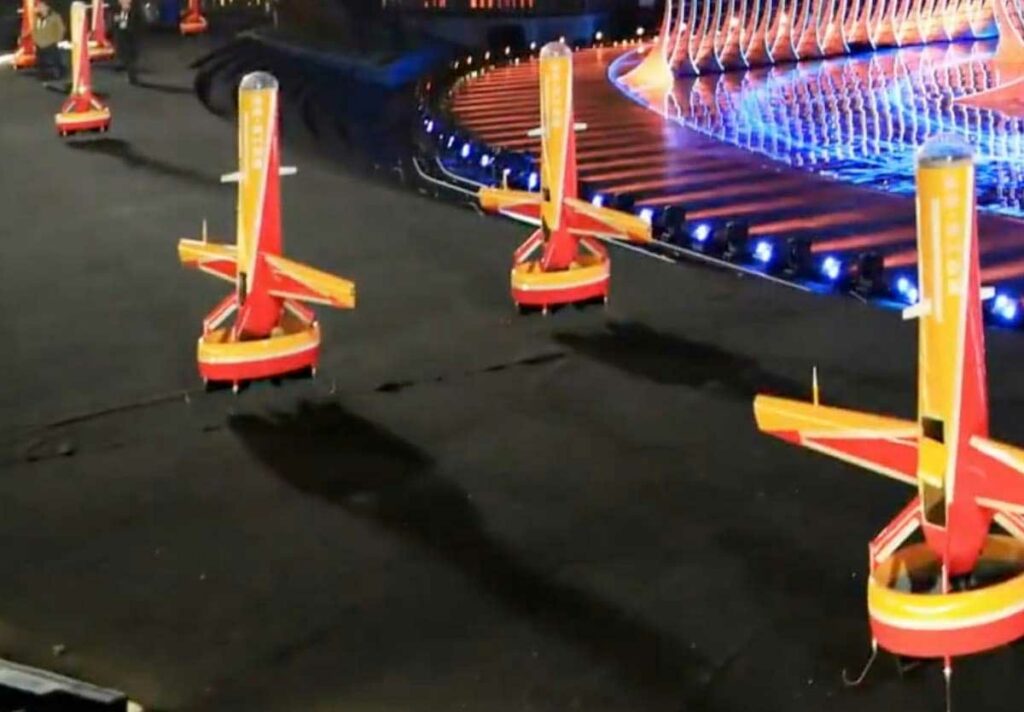
In the available images, the resemblance lies in very specific markers: rear duct, wing and fuselage silhouette, tail-sitter logic, and integration of an optronic ball under the nose. This is precisely what fuels the imitation lawsuit.
On the other hand, many key elements are not public for Yunying: engine, endurance, ceiling, data links, resistance to jamming, and above all, the software ecosystem. Two drones may look alike but differ greatly in what really matters in operation.
The points to check in order to evaluate “Chinese performance” are concrete:
- Actual endurance with payload and in windy conditions.
- The quality of the vertical-horizontal transition, which determines safety of use at sea.
- Resistance to jamming and the ability to operate without stable GNSS.
- Links beyond line of sight, or at least a robust long-range line-of-sight link.
- Maintainability: time to restore service, parts, and tolerance to minor damage.
Without this data, we are faced with a demonstration of form rather than substance.
The question of copying, and what we can say without speculating
It is tempting to say “copy” because the resemblance is striking. But to be honest, we need to distinguish between three scenarios.
The first is engineering convergence. When a problem is well defined (take off vertically, fly for a long time, land in a small space), certain architectures are inevitable. The tail-sitter with a duct is a good compromise for a given class of mass and payload. In this case, the resemblance is partly logical.
The second is reverse engineering. This is not necessarily espionage. A system that is observed, analyzed, and then replicated with internal differences can produce a visual clone. In defense, this is common and difficult to prove without legal or technical evidence.
The third is the acquisition of non-public information. Here, we are talking about industrial espionage. Today, there is no documented public evidence to suggest that Yunying is the result of data theft related to Shield AI. The public debate is based mainly on image comparisons and the reputation of a Chinese ecosystem capable of “shortening the cycle” by aggressively drawing inspiration from existing designs.
The most solid position is therefore as follows: the resemblance fuels a rational suspicion of imitation, but there is no evidence of theft or illegal transfer.
Possible uses and the “espionage” aspect in the operational sense
Even without industrial espionage, a drone like Yunying is by nature a tool for espionage in the military sense: observation, designation, possible eavesdropping, and intelligence gathering.
This format is particularly useful for:
- Monitoring maritime approaches and straits, as it can take off from small vessels.
- Reinforcing tactical reconnaissance around an advanced base without a runway.
- Supporting ground forces in areas where helicopters are too exposed.
- Extending an ISR bubble for the benefit of a fire control system, providing the “video that decides.”
For China, the potential gain is obvious: multiplying aerial sensors around areas of friction, particularly at sea, while reducing dependence on larger, more visible platforms.
The real differentiator: software and electronic warfare
Where the discussion gets serious is not aerodynamics. It is the ability to survive in a contested environment.
A modern tactical drone must:
- Maintain flight despite GNSS jamming
- maintain a command link or switch to safe autonomous modes
- produce actionable observation despite interference
- integrate with a command network and effectors
This is precisely where Shield AI seeks to distinguish itself: onboard autonomy, mission management, integration with mobile command systems, and a promise of ISR continuity under electronic pressure.
For Yunying, the subject is open. China has made significant progress in sensors, data links, and AI. But real effectiveness cannot be judged on a stand. It is judged on the stability of algorithms, resistance to jammed environments, and the quality of the “complete system”: drone, ground station, links, maintenance, doctrine.
Industrial and strategic implications
If Yunying becomes an exportable product, it will target a specific market: countries that want long-endurance VTOL without depending on a Western supplier, or that want to diversify their supply chains.
For AVIC, the interest is threefold:
- to complete a portfolio of tactical drones by adding a maritime and “expeditionary” segment
- accelerating the industrialization of an architecture that has already been validated elsewhere
- offering a relatively low-cost alternative, provided that credible performance levels are maintained
For Western manufacturers, the challenge is clear: if a silhouette and a concept become “commoditized,” the value shifts to software, certification, and proof of operational use.
The most useful interpretation at this stage
Yunying is a signal, not yet a revolution. It signals that China wants a tail-sitter type tactical VTOL capability, in a niche where the V-BAT has already taken a visible place. The resemblance is strong enough to fuel a lawsuit for imitation, and this lawsuit has political interest.
But readers should keep a simple filter in mind: without robust public figures, “Chinese performance” remains a hypothesis. The real question is whether Yunying is a showcase clone or a complete system capable of operating sustainably at sea, under jamming, with a reliable supply chain and communications.
If China publishes solid data (endurance, payload, range, electronic warfare resistance), the issue will cease to be a debate about images. It will become a debate about capabilities. And that is where the gap, or convergence, will really be seen.
Sources
Aviation Week Network, “AVIC Publicly Unveils ‘Cloud Shadow’ VTOL Uncrewed Aircraft,” February 20, 2026.
Defense Blog, “Chinese AVIC reveals U.S.-made V-BAT copy drone,” February 18, 2026.
DefenseMirror, “Did China Copy Shield AI’s VTOL Drone?”, February 2026.
Shield AI, “V-BAT” product page (specifications, endurance, payload, footprint).
Shield AI, press release “Shield AI Signs Definitive Agreement to Acquire Martin UAV”, July 28, 2021.
Canadian Defense Review, “Cover Story Team V-BAT…,” December 27, 2023.
People’s Daily (publication shared on social media), dimensions and sensors mentioned for Yunying.
War Wings Daily is an independant magazine.