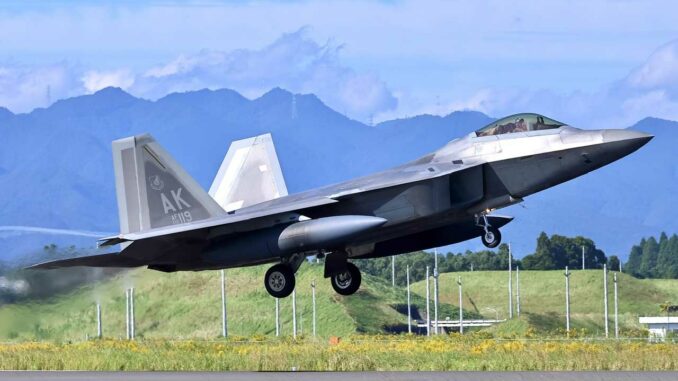
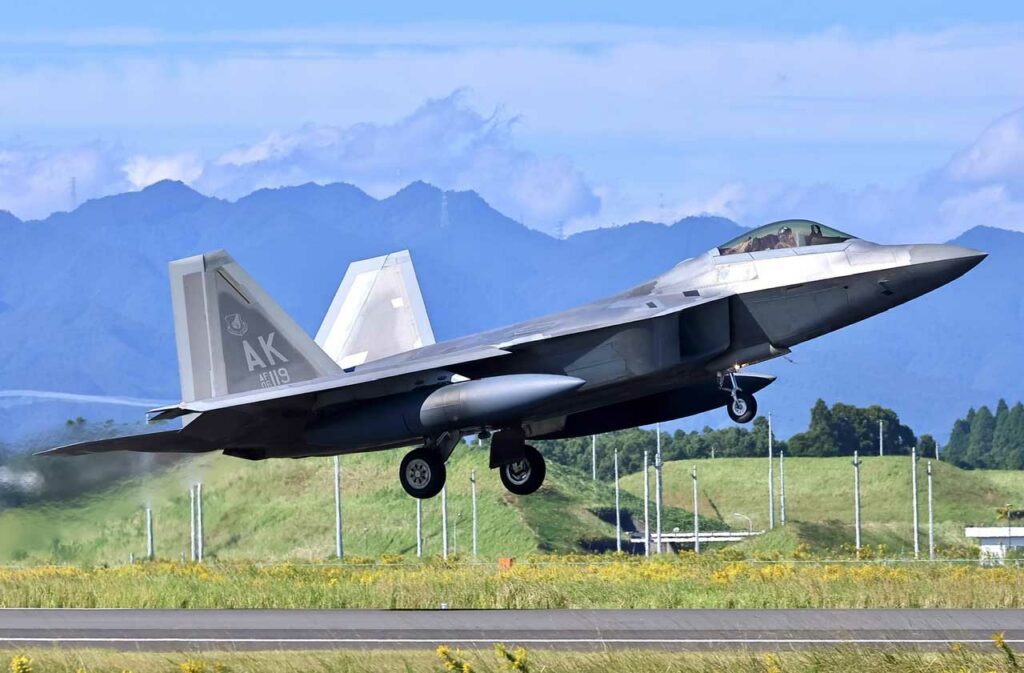
The F-22 sometimes flies with Luneburg lenses. Why make a stealth aircraft visible, and what this says about civilian radar, security, and secrecy.
In summary
The nickname comes from two small protrusions attached under certain F-22s: Luneburg lenses, which are removable radar reflectors. The idea seems absurd. Why “break” the stealth of an aircraft designed to be difficult to detect? In reality, these devices serve two very specific purposes. First, safety and control: they make the aircraft more detectable by so-called “primary” radars and simplify ground tracking during exercises, training, and certain flights in controlled airspace. Second, secrecy: they also artificially “standardize” the radar signature seen from the outside, to prevent observers from measuring the aircraft’s true RCS. This does not mean that the F-22 would be “invisible” to all civil air traffic control. Military aircraft also use transponders, notably Mode S/IFF transponders, which are used by secondary radars. But stealth greatly reduces the echo on primary radar, and procedures may require more comfortable marking, especially when the objective is training and incident prevention.
The useful myth behind “Mickey Mouse ears”
The most common explanation is simple: without these “ears,” civilian controllers would be unable to see the F-22, thus creating a risk of collision. This version is partly true, but it is incomplete.
In the real world, air traffic control relies on several layers. Primary radar detects an object by its echo. Secondary radar interrogates a transponder and displays a “cooperative” target with a code, altitude, and sometimes an identity. A fighter jet is therefore not doomed to be a ghost: it can be tracked via transponder, military links, separation procedures, and secondary radar.
So why add a reflector? Because safety is not just a question of “can we see the aircraft?” It is also a question of robustness and simplicity: making the trace clearer on primary radar, facilitating the management of dense traffic, enabling realistic training without activating certain emissions, and reducing the coordination burden when several organizations (military and civilian) share the same sky. And there is another, more political reason: not to let stealth be “measured” for free.
The Luneburg lens and its non-magical principle
A Luneburg lens is an object with a gradual (gradient) refractive index that has a remarkable property: it focuses the electromagnetic energy it receives onto a specific point. If part of its surface is metallized, the lens is transformed into a radar retroreflector. In concrete terms, it reflects a significant portion of the energy received back to the source, i.e., to the radar antenna that illuminates the target.
It is the same principle as a reflector on a bicycle, but in microwaves. The difference is that a Luneburg lens can be effective over a wide angle and provide a stable radar response, whereas a simple reflector can be very dependent on orientation.
The result is intentional: on primary radar, the aircraft “ceases” to be a discrete target and becomes a clear, usable, easy-to-track point.
Mounting on the F-22 and what we actually see
On the F-22, these devices are usually mounted under the fuselage, often in pairs. Visually, this gives the appearance of two symmetrical bumps, hence the nickname “Mickey Mouse ears.” This is not a permanent gadget: it is removable and is used precisely when the mission does not require maximum stealth.
One point must be emphasized: the goal is not to make the aircraft “non-stealth.” The goal is to give it a known and deliberate signature, much like putting a highly legible license plate on a car that usually drives without one.
The difference between radar visibility and operational traceability
Much of the confusion stems from a mix-up between three concepts.
Primary radar visibility
Primary radar depends on echo. A stealth aircraft seeks to reduce this echo through its shape (geometry), materials, surface treatments, and angle management. The F-22 was designed for this purpose. Without a reflector, primary radar may detect later, with greater difficulty, or with a less stable trace, depending on the frequency band, distance, weather, environment, and signal processing.
Secondary radar visibility
Secondary radar depends on cooperation. A transponder responds. This is very effective in peacetime, but it requires configuration, authorization, and instructions consistent with the mission. A stealth aircraft can therefore be “visible” to civil control via SSR, even if its primary echo is discreet.
Strategic discretion
Finally, there is what the adversary can learn. It is one thing to be tracked by civil control. It is another to allow a foreign actor, voluntarily or otherwise, to collect data on the true signature and its variations (angles, loads, maneuvers). In this regard, the Luneburg lens also acts as a mask.
The less obvious reason: protecting the true radar signature
This is the argument often put forward by specialists: the lens is not only there to be seen, it also prevents others from deducing the reality.
A stealth aircraft does not have a single signature. Its radar signature varies depending on the angle, frequency, configuration, cleanliness level, and surface details. In real-world conditions, listening sensors and test radars can accumulate data. Even without “piercing” the stealth, algorithms can be improved, models calibrated, or regimes where the signature increases identified.
By adding a standard radar reflector, the observer is forced to see a target dominated by that reflector. The measurement becomes less useful for estimating the aircraft’s true RCS. This logic is all the more relevant when deployed in Europe or near areas where foreign sensors can observe, even in peacetime.
Let’s be frank: in a world where everything is measured, not giving away data for free is already a form of superiority.
The link with air safety: what is true and what is exaggerated
To say that “without a lens, the F-22 is invisible and that is dangerous” is too simplistic.
What is true:
- Stealth reduces the echo on primary radar.
- Operations in controlled airspace are easier if the aircraft is also a good primary target.
- Training, especially with controllers and mixed resources, benefits from a stable radar trace.
What is exaggerated:
- Imagining that civilian controllers “cannot” see an F-22. Transponders exist, and traffic separation is based on multiple procedures and systems.
- Reducing the issue to a single “anti-collision” cause. The logic of secrecy and signature standardization is at least as central.
The reality is a compromise. Air safety does not tolerate gray areas. If a simple measure improves the safety margin and the quality of tracking, it is adopted, especially in peacetime.
Other aircraft concerned: the F-35, the F-117, and stealth practices
The F-22 is not alone. Photos and public feedback describe the use of Luneburg lenses or other “RCS enhancers” on several stealth aircraft, including the F-35. The principle is the same: deliberately increasing radar visibility in certain contexts, or masking the actual signature.
There are also other types of solutions:
- passive reflectors of different shapes,
- active devices (less common) that re-emit a signal to simulate a given signature,
- and, of course, the use of the transponder in cooperative mode.
What sets the Luneburg lens apart is its ability to provide a stable, effective response with relatively little impact on flight performance. It is therefore practical: it can be mounted and removed without affecting the stealth core.
The limitations and side effects that are often overlooked
Making a stealth aircraft more visible is not without consequences.
First, it changes the observation profile. An equipped F-22 becomes more detectable to radars that would otherwise have a less comfortable detection range. In training, this is acceptable. In tense situations, it is a constraint.
Second, there is the issue of misleading standardization. A reflector gives an “artificial” signature, but not necessarily a “realistic” one compared to a non-stealth fighter. This may be useful for security, but less useful for accurately simulating an adversary.
Finally, there is the discipline factor. The real operational benefit of stealth is being able to choose when to “reveal” it and when to keep it. Luneburg lenses remind us of a simple rule: stealth is not a permanent state, it is a resource that must be managed.
The lesson behind the “ears” anecdote
The anecdote is popular because it humanizes a technical subject. But it says something broader.
Stealth is a military advantage, not a permanent posture. In peacetime, an aircraft must be integrated into an air traffic system, training, procedures, and diplomatic constraints. It must also protect its secrets from technical curiosity.
Luneburg lenses are therefore symbolic: even the stealthiest aircraft can choose to be visible, because security and secrecy can sometimes be managed with very simple solutions. And this is perhaps the most important lesson: in modern combat aviation, logistical and procedural details are just as important as miracle materials.
Sources
- Wikipedia, “Luneburg lens,” Radar reflector section (accessed 2026)
- Business Insider, “This Strange F-35 Modification Kills Its Stealth” (May 5, 2017)
- The Aviationist, article on the use or absence of radar reflectors on F-35s in training exercises (November 20, 2022)
- AnalogIC Tips, “FAQ on Luneburg lens to increase radar signature” (August 14, 2023)
- MDPI Applied Sciences, article mentioning the use of Luneburg balls on F-22/F-35 as scatterers (2022)
- Aviation Stack Exchange, questions/answers on RCS enhancers and the Luneburg lens principle (2020–2021)
- The Aviation Geek Club, article on Luneburg lenses and their use in making stealth aircraft visible (November 2, 2024)
War Wings Daily is an independant magazine.