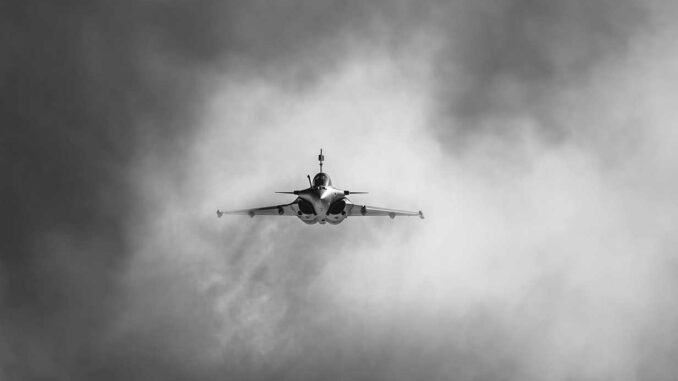
First PESA, then AESA, the Rafale’s RBE2 radar is at the heart of its tactical superiority. Operation, signal processing, modes, and real combat effectiveness.
Summary
The RBE2 is one of the sensors that has made the Dassault Rafale a true multi-role aircraft, and not just another versatile fighter. Its initial version, with a PESA antenna, provided electronic scanning and multi-mode management. Its RBE2 AESA version, which entered operational service in 2012, added greater beam agility, better resistance to jamming, superior reliability, and much greater growth capacity. This radar is not just about “range.” Its real value lies elsewhere: it detects, tracks, classifies, maps, and can quickly switch between air-to-air, air-to-ground, and air-to-surface functions within the same mission. Public documents confirm its ability to track multiple air targets, generate 2D and 3D maps in real time, support automatic terrain-following flight, and remain operational in severe jamming environments. However, the exact details of its waveforms, algorithms, and maximum performance remain, logically, classified.
The Rafale’s radar is not just a detector, it is a tactical conductor
Let’s start with a simple point. A modern fighter radar is no longer just used to “see far.” It is used to build a tactical situation that can be exploited in a matter of seconds. This is exactly the role of the RBE2 Rafale. Dassault explains that its AESA version improves detection and tracking in a multi-target environment thanks to the agility of its beam and the speed of its calculations. This vocabulary is not just marketing talk: it means that the radar moves very quickly from one area to another, devotes antenna time where the threat requires it, and then updates tracks without waiting for the slow cycle of a mechanical radar.
This is also what gives the Rafale its truly multi-role character. A Thales technical document from the AESA era puts it bluntly: all radar functions can be operated during the same flight, with rapid switching between air defense, low-altitude penetration, strike, and anti-ship attack. This point is crucial. The radar is not designed for a single role. It is designed to support an aircraft that can switch from air-to-air patrol to precision strike, then to maritime detection, without changing platforms.
The internal operation of the RBE2 is based primarily on electronic scanning
The basic principle of the RBE2 is publicly known: it is an X-band radar with electronic scanning. The difference between PESA and AESA is essential. The PESA version uses a central transmitter, then distributes the energy to the antenna by shifting the phase to direct the beam. The AESA version replaces this logic with an active antenna composed of numerous transceiver modules. In short, PESA already scans very quickly. AESA does so with greater flexibility, robustness, and finer beam control.
The Thales technical document on the AESA RBE2 describes several revealing components: transceiver modules, coherent generation in the X band, wide bandwidth, full monopulse, programmable signal processor, tracking calculation, high-resolution mapping generation, and ECCM processing. Even if the precise parameters remain classified, this architecture already says a lot. This is a radar designed to detect, discriminate, track, and resist countermeasures, not just to “paint” a target.
Signal processing
The RBE2’s signal processing is not documented line by line in the public domain, and it would be dishonest to claim otherwise. However, the published information allows us to reconstruct the general outline. The radar emits a coherent waveform, receives the returns, and then processes them via its processor to separate noise, fixed echoes, useful returns, and disturbed signals. Thales’ explicit mention of ECCM processing shows that the system is designed to operate under jamming and to maintain a usable track despite attempts at electronic degradation.
The mention of full monopulse also indicates a capacity for fine and rapid angular measurement on a single pulse, which improves location accuracy and tracking stability. In other words, the radar does not simply detect a presence. It must provide a track that is clean enough to enable tactical identification, guidance, prioritization, and, if necessary, firing. This is where the RBE2 differs from older, simpler search radars.
The difference between PESA and AESA changes the way we fight
Let’s be clear: the RBE2 PESA was a real leap forward for France, but the RBE2 AESA has changed the tactical value of the whole system. Dassault points out that the Rafale was the first operational European fighter aircraft equipped with an AESA radar, with the first delivery to the French Ministry of Defense in October 2012. This switch to active antenna brings concrete gains: better beam agility, more robust tracking of multiple targets, better jamming resistance, greater reliability, and superior upgrade potential.
PESA was already very effective, particularly thanks to its rapid electronic scanning. However, its central transmitter logic imposed constraints that AESA reduces. With an active antenna, the partial loss of modules does not suddenly immobilize the radar function. Reliability is increased. Beam management flexibility also increases. Above all, AESA paves the way more easily for varied waveforms, better emission discretion, and advanced mapping and tracking modes. The 2006 Thales document emphasizes the very high reliability of the T/R modules and the agility provided by active scanning.
The most tangible benefit for the user is not always visible on a sales sheet. This benefit is the ability to do more, faster, in the same amount of tactical time. A radar that changes modes faster, keeps tracks out of the immediate search volume, and continues to provide a consistent picture of the situation gives the pilot a real advantage.
This is what Dassault summarizes when it talks about targets tracked within or outside the search domain. This phrase may seem innocuous, but in combat, it is anything but.
Multi-target tracking is one of the real strengths of the RBE2
Public sources do not provide a single official number of targets tracked simultaneously for all versions and modes. It is therefore important to avoid definitive figures taken out of context. What is public, however, is clear: both Dassault and Thales refer to detection and tracking of multiple air targets, both air-to-air and in severe jamming environments. Thales also mentions automatic sorting and classification of tracked targets, as well as tracks independent of the search volume. This reflects an advanced track while scan logic: the radar can continue to search while maintaining already established tracks.
This is what allows the Rafale to avoid “blinding” itself when switching from one target to another. On a modern fighter jet, the issue is not just about locking onto a target. The question is maintaining overall consistency: nearby threats, distant threats, primary objective, secondary opportunity, escape route, and sometimes coordination with other aircraft via data link. A radar that can sort and prioritize multiple tracks greatly reduces the mental load on the crew and improves the responsiveness of the weapons system.
The French Senate has published a useful, albeit partial, benchmark: in its 2020 report, it states that the RBE2 AESA with active antenna can engage air targets “around a hundred kilometers” away under the F3R standard associated with the Meteor missile. This is not an absolute “universal” range. It is an institutional, public order of magnitude that reminds us of one thing above all: the radar was designed to remain consistent with a modern BVR missile, not to artificially limit the Rafale’s range.
Air-to-air and air-to-ground modes are at the heart of the multi-role concept
The RBE2 is not only interesting because it tracks aircraft. It is formidable because it can change its logic. In air-to-air mode, Dassault emphasizes the detection and tracking of multiple targets, both above and below, even in poor weather and under jamming. This is not a minor detail. Look-up/look-down remains a fundamental requirement for a fighter that must intercept both high-altitude targets and aircraft flying close to the ground.
In air-to-ground mode, the same radar can generate high-resolution 2D maps in real time for navigation, detection, identification, and designation of ground targets. Dassault also mentions real-time generation of 3D maps for terrain tracking over unmapped areas and in blind conditions. This is one of the most striking points in the public documents: the radar is not only an air combat sensor, it is also used for low penetration, navigation, and strike preparation.
The 2006 Thales document summarizes this operational sequence logic with rare candor: air defense, low-altitude penetration, updating of the target area situation en route, high-resolution SAR-type imaging for designation, then detection and multi-tracking in anti-ship attacks. This does not mean that all functions are running at full intensity all the time.
It means that the radar can switch very quickly and handle several tactical requirements simultaneously on the same sortie. This is one of the foundations of the “multi-role” Rafale as it was sold and then used.
Air-to-surface and sea mode
The maritime domain is often underestimated. However, Dassault explicitly mentions the detection and tracking of multiple naval targets. Again, it is not just a matter of “seeing a ship.” It is a matter of building a surface situation, distinguishing contacts, preparing an anti-ship attack, or securing a coastal area. In an aircraft that can carry the AM39 Exocet according to the relevant standards, this is not a secondary function. It is an operational component consistent with the mission.
The actual performance of the RBE2 is measured less by its raw range than by its effectiveness in mission
With the RBE2, there is a strong temptation to reduce the whole subject to a range figure. This would be a mistake. Radar performance depends on the target, its altitude, its signature, the environment, interference, the mode used, and the desired level of discretion. Manufacturers therefore logically avoid publishing a single figure, and they are right to do so. What is publicly demonstrated, on the other hand, is more useful: compatibility with Meteor, multi-target tracking, maintaining tracks outside the search volume, real-time 2D/3D mapping, terrain tracking capability, and use in highly contested environments.
This is also why the debate over whether RBE2 is better or worse than a competing radar is often misguided. A radar never acts alone. On the Rafale, it works with the FSO, data fusion, the SPECTRA suite, data link, and mission architecture. The tactical value comes from the whole. The radar provides active detection and mapping. The other sensors can supplement, confirm, discretize, or remain passive when discretion becomes a priority. The result is a more robust tactical picture.
Combat evidence exists, but it must be interpreted correctly
We must remain rigorous. There are no publicly available reports detailing “such and such an RBE2 lock, such and such a track, such and such a shot” with all the radar data. Exact performance in actual combat remains classified. However, the Rafale’s campaigns provide a solid indication of the credibility of the weapons system. Dassault points out that French Rafales carried out numerous combat missions in Afghanistan between 2006 and 2011, then in Libya in 2011, before Mali, Iraq, and Syria. In Libya, the aircraft performed the full range of tasks for which it was designed: air superiority, precision strikes, tactical reconnaissance, and strike coordination.
This alone does not “prove” a radar range figure. However, it does validate something else that is more important: the consistency of the sensor in a platform that is actually in use. A radar that could not handle the operational load, or that proved fragile in the sequence of modes, would quickly have revealed its limitations in this type of campaign. However, the Rafale has built its reputation precisely on this ability to switch from one mission to another in real conflicts, with good survivability and high tactical flexibility.
What the RBE2 says about the Rafale of today and tomorrow
The RBE2 AESA is not just an improvement on the PESA. It is the component that has consolidated the Rafale’s position in modern BVR combat and in the simultaneous use of air-to-air, air-to-ground, and air-to-surface functions. Public documents state it quite clearly: agile beam, fast computation, multi-target tracking, real-time mapping, terrain tracking, jamming resistance, and compatibility with long-range weapons such as the Meteor. It is not a “spectacular” radar in a brochure. It is a radar designed to save tactical time.
The most honest point to remember is this: the RBE2 does not reveal all its secrets, and that’s normal. The precise algorithms, full performance and real margins in electronic warfare are not public. But what is public is enough to understand its place. The Rafale does not owe its credibility to a single missile or a single sales pitch. It also owes it to a radar capable of tracking several battles at the same time: those in the sky, on the ground, at sea, and the more discreet battle of decision-making speed.
Sources
Dassault Aviation, Detect and pursue, official Rafale page.
Dassault Aviation, RAFALE Press Release, Paris Air Show 2023.
Dassault Aviation, Rafale file UK, 2015.
Thales, AESA RBE2 Radar brochure, June 2006.
French Senate, Information Report No. 642, July 15, 2020.
War Wings Daily is an independant magazine.