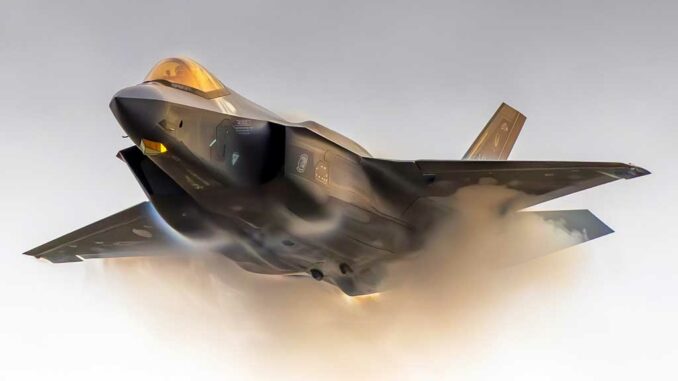
The US Air Force is accelerating its collaborative combat drones and testing AI on F-35s. This shift is changing the mass, speed of decision-making, and electronic warfare.
In summary
The US Air Force is moving fast, but it is important to be clear: it is not switching to an “all-drone” approach in the literal sense. It is switching to a mixed force, where manned aircraft pilot the tactical unit and collaborative combat drones add mass, sensors, jamming, and, in the future, firepower. At the end of February 2026, the USAF confirmed that it wants to choose the winning tandem for its Collaborative Combat Aircraft program before the end of the year: the drone airframe, but also the autonomy software that will make it a true wingman. At the same time, Lockheed Martin demonstrated AI on the F-35 that can identify ambiguous radar emissions more quickly. This is not yet a widespread deployment across the fleet. It is a successful flight test. But the signal is clear: American air superiority is becoming as much a question of software, data, and industrial pace as it is of aerodynamic performance.
The false myth of “all drones”
The slogan is convenient, but it is misleading. The USAF is not replacing its fighters with drones. It is redesigning the distribution of risk. Manned aircraft retain the functions of tactical command, political decision-making, and legal responsibility. Drones, on the other hand, are taking on an increasing share of dirty, dense, and repetitive missions: capturing, saturating, deceiving, escorting, and even firing. This is exactly what the CCA program is all about: unmanned, jet-powered aircraft designed to operate with existing or future fighter jets in a contested environment. The Congressional Research Service points out that these aircraft are designed for air-to-air, air-to-ground, electronic warfare, targeting, and ISR missions. The idea is not to eliminate the pilot. The idea is to increase their range and multiply their options.
This distinction changes everything. Public debate still refers to the “loyal wingman” as a gadget. In reality, the USAF now treats the autonomous wingman drone as a structural building block of air superiority. On February 25, 2026, Colonel Timothy Helfrich confirmed that the Air Force would make its choice for Increment 1 by the end of 2026. And that choice will not only be about an aircraft. It will also be about the software brain that enables that aircraft to perform combat tasks with limited human supervision. This is the heart of the change: the competition is no longer just between airframes. It is between autonomy architectures.
The choice of the airframe-software duo
The USAF has already named its first two prototypes: YFQ-42A at General Atomics and YFQ-44A at Anduril. The “Y” stands for prototype, the “F” for fighter mission, and the ‘Q’ for unmanned. This detail is not cosmetic. In March 2025, the Air Force emphasized that this was the first true designation of an “unmanned fighter” in its history.
In other words, Washington is no longer talking about a simple auxiliary drone. It is talking about a new family of combat aircraft.
The other shift is less visible but more profound. On February 12, 2026, the Air Force explained that it was deploying its A-GRA (Autonomy Government Reference Architecture), an open architecture owned by the government, on several platforms. The goal is clear: to break vendor lock-in. In this scheme, autonomy software is no longer tied to a single manufacturer. The USAF can theoretically plug better algorithms into any compatible platform. This is a major shift in procurement. It brings combat aviation closer to the software model: common standards, rapid updates, and ongoing competition between suppliers. The two software finalists mentioned by the Air Force are RTX Collins and Shield AI, already engaged in semi-autonomous flights with General Atomics and Anduril platforms.
Combat mass becomes a budget issue again
For thirty years, American combat aviation has gained in quality and lost in volume. This is the central paradox. Aircraft are better, but too expensive, too complex, and too slow to produce to be deployed in sufficient numbers against a major adversary. This is precisely where autonomous winged drones come in handy. The CRS notes that US officials have described CCAs as aircraft costing about one-third the price of a manned fighter. The service also mentioned a theoretical plan for 1,000 AADs, based on two drones for approximately 500 advanced combat aircraft. For Increment 1, the Air Force was already planning for more than 100 aircraft over five years. The message is clear: mass production becomes affordable again if we accept that part of that mass will be unmanned.
The budget figures confirm that the program is moving beyond the demonstration stage, without yet reaching full industrial scale. For fiscal year 2026, the Air Force has identified $804.4 million for the CCA, including $126.4 million in discretionary funding and $678 million in mandatory funding already included in the trajectory. Compared to the Department of the Air Force’s overall 2026 budget of $249.5 billion, this remains a modest fraction. But it would be a mistake to judge the program solely on its current accounting weight. The CCA is not yet the heaviest line item. It is already one of the most revealing, as it sets the model for future acquisition: more modularity, more cadence, more acceptable attrition.
The operational logic of the collaborative combat drone
The USAF is no longer content to talk about concepts. It is moving on to concrete tests. On February 23, 2026, it announced the start of a new test phase: weapons integration and captive carry tests with inert ammunition. These are not yet live-fire tests. The aim is to validate the safety, structural integrity, aerodynamics, and compatibility between the aircraft and its external loads. Put more simply, the tests are designed to determine whether the drone can carry weapons properly before considering actual tactical use. This stage is less spectacular than a first flight, but much more important in terms of moving from prototype to credible combat system.
It is also important to note a major political point: the Air Force specifies that a human retains authority over the decision to fire.
This statement is not just for show. It responds to legal constraints, political acceptability, and the real limits of current autonomy. We are therefore a long way from the fantasy of a totally free “killer robot.” The American approach is more cold and serious: delegate navigation, coordination, certain tactical priorities, and sensor management, but keep human control over lethal engagement. This is human-machine teaming, not an abdication of command.
The F-35 becomes a software node before being a simple fighter
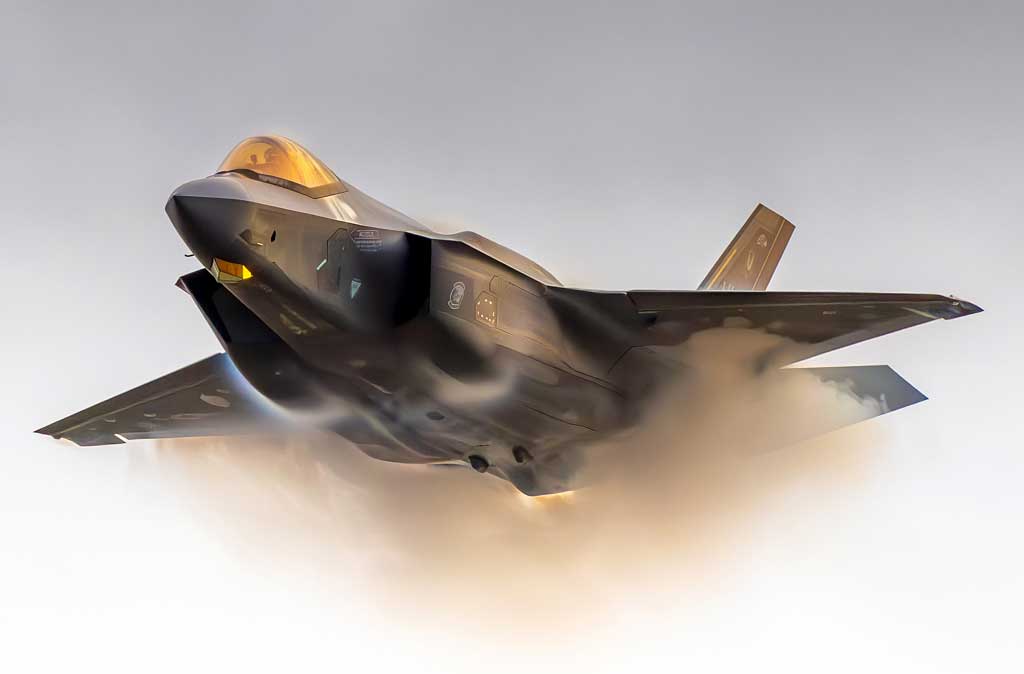
The second strong signal comes from the F-35. Here again, we must be precise. Lockheed Martin has not announced operational generalization across the entire fleet. On February 23, 2026, the company announced a successful flight test of an AI-enhanced Combat ID capability integrated into the F-35’s information fusion system as part of Project Overwatch. According to Lockheed, this is the first time that a tactical AI model has been used in flight to generate independent identification displayed to the pilot. This is significant. It means that the F-35 is no longer just aggregating sensors; it is beginning to produce a more advanced first layer of algorithmic interpretation directly in the tactical loop.
The technical detail is even more interesting than the announcement. During the test conducted at Nellis, the model resolved identification ambiguities between transmitters. In short, it helped to distinguish complex radio frequency signatures more quickly, where several radars, modes, or behaviors could appear similar. Lockheed also points out that its engineers were able to label new transmitters, retrain the model in a matter of minutes, and reload the model for the next flight in the same mission planning cycle. This pace is the real issue. Superiority no longer depends solely on the sensor. It depends on how quickly the aircraft learns between sorties.
The rise of more cognitive electronic warfare
Until now, when an aircraft encountered an unknown or misclassified transmission, the correction chain involved collecting, analyzing, and then updating threat libraries. This process still exists. But the value of Project Overwatch is to speed up the initial interpretation, thereby reducing the pilot’s mental latency. This is exactly what Lockheed summarized: helping the pilot understand the threat more quickly, because in combat he does not have time to synthesize all the data on his own. The F-35 thus becomes less of a “fighter” in the traditional sense and more of a real-time processing node, capable of transforming confusing signals into actionable leads more quickly.
This point deserves clarification. We are not yet talking about AI that decides on its own to open fire. We are talking about AI that classifies, prioritizes, and accelerates identification. This is already huge. In electronic warfare, a few seconds gained can mean the difference between an aircraft bypassing a ground-to-air bubble and an aircraft entering a firing zone. So it’s not just about lethality. It’s about speed of understanding. And that’s often what determines who survives.
Doctrine now closely follows technology
This shift is not improvised. In April 2025, the US Air Force published Air Force Doctrine Note 25-1 on artificial intelligence. The text formalizes the integration of AI into the service’s missions and emphasizes two ideas: AI as a force multiplier, and the maintenance of a responsible and humane framework for its use. This doctrine does not make the pilot a relic. It makes him the supervisor of a denser, faster, and more distributed system. This is exactly what we see today with the CCA + F-35 tandem: on the one hand, external platforms that increase mass; on the other, a manned fighter that is still gaining value as a center of decision-making and fusion.
There is a clear strategic coherence here. CCAs extend the sensor and effects front. The F-35 increases the quality of combat reading. One provides depth and acceptable attrition. The other compresses decision time. Together, they paint a picture of combat aviation where the raw performance of the aircraft still counts, but where the decisive advantage is shifting towards software, open architectures, mission data, and rapid reprogramming capabilities. It’s less glamorous than a new speed record. It’s much more decisive.
The real breakthrough is industrial before it is tactical
The most important point to make is this: if the USAF succeeds, it will not only have added a drone and AI to its aircraft. It will have changed the way it buys air warfare. The open A-GRA architecture, the separation between airframe and software, autonomy testing on competing platforms, and the ability to update models between flights all push in the same direction: breaking out of the traditional, cumbersome, and locked cycle of large programs. The goal is no longer just to deliver an excellent aircraft every fifteen years. The goal is to deliver a scalable digital airbase, where behaviors, threat libraries, and tactics are continuously improved.
This is also why the F-35 is taking on a new dimension. According to Lockheed Martin, the global fleet now exceeds 1,300 aircraft in service, spread across 12 operating nations. If a capability from Project Overwatch ever follows an official integration path, the leverage would be immense. A software improvement validated on an already widely deployed platform can produce more operational effect than a new, still marginal prototype. That’s why the February 2026 test matters so much: it heralds less an AI gadget than a method of software ramp-up on an already massive fleet.
The next battle will be fought over software confidence
What is happening today in the USAF is not a simplistic shift towards “all drones.” It is more radical than that. It is a shift towards combat aviation where the airframe becomes a platform, where software becomes a weapon, and where the speed of adaptation is almost as important as engine thrust. If the choice of Increment 1 is finalized before the end of 2026, this year will mark a point of no return for Collaborative Combat Aircraft. And if projects such as Project Overwatch follow a credible integration trajectory, the F-35 will cease to be perceived solely as a stealth fighter.
It will increasingly establish itself as the nerve center of a distributed combat network. The question is no longer whether AI will enter the cockpit. It already has. The real question is how quickly the institution, the industry, and the crews will be able to trust it without losing control.
Sources
U.S. Air Force, Air Force validates open architecture, expands Collaborative Combat Aircraft ecosystem, February 12, 2026
U.S. Air Force, Collaborative Combat Aircraft program progresses through deliberate weapons integration testing, February 23, 2026
U.S. Air Force, Air Force designates two Mission Design Series for collaborative combat aircraft, March 3, 2025
FlightGlobal, US Air Force confirms autonomous fighter decision coming this year, February 26, 2026
Congressional Research Service, U.S. Air Force Collaborative Combat Aircraft (IF12740), updated November 28, 2025
Department of the Air Force, President’s Budget Request FY26
Lockheed Martin / F35.com, Lockheed Martin Applying AI to Enhance F-35 Combat Identification System, February 23, 2026
Defense News, Lockheed debuts AI on F-35 fighter jet to identify targets, February 24, 2026
Breaking Defense, Lockheed test-flies F-35 with artificial intelligence to quickly ID unknown contacts, February 23, 2026
The War Zone, AI Is Now Helping The F-35 Spot Enemy Air Defenses, February 24, 2026
Air Force Doctrine, AFDN 25-1 Artificial Intelligence, published April 8, 2025
War Wings Daily is an independant magazine.