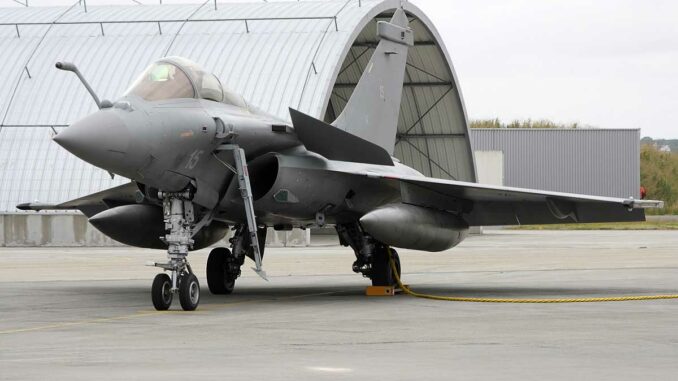
The Rafale F5 will not be just another standard aircraft: it is set to become a network hub, pilot combat drones, and carry the ASN4G.
In summary
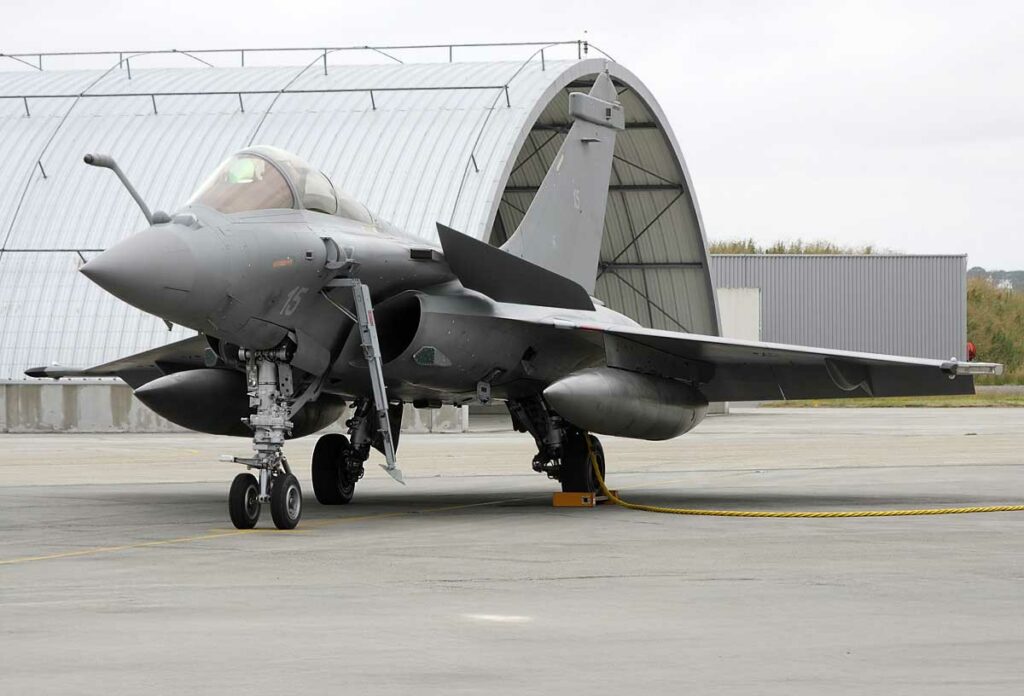
The Rafale F5 marks a change in nature. Until now, the Rafale was already a very complete multi-role combat aircraft. With the F5 standard, expected around 2030, it is set to become something else: a collaborative combat platform capable of coordinating an environment of sensors, weapons, and drones, while remaining at the heart of French nuclear deterrence with the future ASN4G missile, scheduled for 2035. This is as much a doctrinal shift as it is an industrial one. France is not just looking to modernize an aircraft. It is seeking to preserve its strategic autonomy at a time when the SCAF program is stalling, tensions with Airbus are escalating, and Europe is brutally rediscovering the price of military dependence. In this context, Dassault Aviation is moving forward with a simple logic: maintain the present with the Rafale, prepare for the future with the F5, and establish itself as the key architect of a possible European combat system.
The Rafale changes its role in air warfare
The Rafale F5 is not a minor update. It is a generational leap within an aircraft already in service. The French gamble is clear: instead of waiting for a future system that is still politically blocked, it is necessary to strengthen an existing aircraft that is industrially mastered, exported, supported, and known to the forces.
The Rafale, in its previous standards, has already demonstrated its versatility. It performs air superiority, ground strike, reconnaissance, electronic warfare, and buddy-buddy refueling missions in its Marine version, and participates in the airborne component of deterrence. This “multi-role” logic remains intact. But the F5 adds a new dimension: the Rafale becomes a flying tactical decision center.
The Ministry of the Armed Forces and Dassault explain the same thing, each in their own words: the F5 must manage a collaborative combat bubble. In other words, the pilot no longer simply flies the aircraft and fires its weapons. They will have to supervise remote effectors, receive and merge more data, make faster decisions, and conduct distributed action. The challenge is not just firepower. It is the ability to survive and make decisions in a space saturated with sensors, jamming, long-range missiles, and drones.
It is also a response to a brutal reality: in contemporary conflicts, isolated aircraft are becoming more vulnerable. Value is shifting toward networking, data fusion, deception, decoy, and distributed mass. The Rafale F5 is designed for this type of warfare, not to replay the air campaigns of the 1990s.
The combat drone to accompany the Rafale F5
The visible heart of this transformation is the combat drone launched in October 2024 to complement the F5 standard. The project builds on the legacy of the nEUROn demonstrator, a European program led by Dassault Aviation. This is a strategic point. Dassault is not starting from scratch. The company is reactivating technological capital accumulated over more than twenty years in stealth, unmanned architectures, and collaborative combat.
The future drone is not presented as a gadget or a simple “loyal wingman” for communication. It must be complementary to the Rafale. The elements already known point in the same direction: stealth, controlled autonomy, humans in the loop, cargo capacity, versatility, and the ability to evolve with the threat.
Let’s be honest: talking about “swarms of drones” can be confusing. We sometimes imagine dozens of small, inexpensive devices launched like stray ammunition. That’s not exactly the point here. The Rafale F5 seems to be more geared towards coordinating a set of combat drones and connected effectors of different levels, some of which will be expensive, stealthy, and reusable. The word “swarm” describes a distributed action logic. It does not necessarily mean a cheap swarm.
This nuance is important. In French doctrine, manned aircraft are not replaced by a blind mass of drones. Instead, a system is built in which the pilot remains the decision-maker, and the drone opens the way, jams, collects information, exposes itself to threats, and even strikes first. The Rafale then becomes the conductor of a dispersed air combat group.
This is a way of recreating mass without increasing the number of crews. It is also a way of penetrating denser integrated defenses. Faced with multi-layer radars, long-range surface-to-air missiles, and fighters supported by distributed sensors, sending a single aircraft, even an excellent one, no longer makes the same sense as it did in the past.
The ASN4G missile puts the nuclear component back at the center
The other breakthrough of the F5 is nuclear. The future ASN4G missile is set to succeed the ASMPA-R in the French airborne component. President Emmanuel Macron confirmed in March 2025 that France was aiming for a hypersonic missile by 2035. Here again, the issue is not simply a technical replacement. It touches on the very heart of deterrence credibility.
The logic behind France’s airborne component is well known: it must offer a visible, flexible capability that can be recalled at a certain point in the mission and is politically distinct from the oceanic component. For this component to remain credible, it needs a vector capable of penetrating increasingly tough defenses. This is the whole purpose of the ASN4G.
Publicly available information describes a hypersonic missile carried by the Rafale F5, developed with significant involvement from MBDA and ONERA. ONERA highlights the expected benefits of hypervelocity: increased range, higher flight altitude, more difficult interception, and enhanced maneuverability. The organization also points out that its testing facilities cover ranges up to approximately Mach 7.5 for certain test benches and beyond Mach 10 in certain wind tunnels. This does not prove the exact final performance of the missile, but it does show the level of technological challenge involved.
Politically, the message is clear:
France wants its airborne component to remain penetrative in the years 2035-2060. And it wants to do so with a national vector, carried by a national aircraft. The Rafale F5 + ASN4G combination is therefore becoming a marker of strategic autonomy.
The decision to transform Luxeuil into a major nuclear base is in line with this. In March 2025, Emmanuel Macron announced an investment of around €1.5 billion to modernize the base, which will eventually house the Rafale F5s and their ASN4G missiles. This is not a minor detail of regional planning. It is a strategic decision.
Dassault locks in the present to influence the future
Dassault Aviation is playing a much bigger game here than simply selling an additional standard. The company is seeking to prove three things.
First, that it knows how to deliver. In 2025, Dassault delivered 26 Rafales, compared to 21 the previous year, and plans to deliver 28 in 2026. Its order book reached €46.6 billion at the end of 2025, with 220 Rafale aircraft in the backlog. In a Europe that is talking about rearmament again but is hampered by industrial sluggishness, this production capacity is almost as valuable as the technology itself.
Secondly, it knows how to design a complete system. Dassault’s discourse on the nEUROn is not nostalgic. It serves to reiterate a constant thesis: European cooperation works when there is a clear architect, clear responsibility, a schedule that is adhered to, and an identified engineering authority. In other words, Dassault advocates a Europe of guided cooperation, not a Europe of industrial dilution.
Finally, it can offer a credible sovereign solution if the SCAF gets bogged down. This is where the Rafale F5 takes on its full political significance. The more powerful, connected, nuclear-capable, and collaborative the F5 becomes, the more strategic assurance it gives France. This assurance reduces dependence on a future program that is still contested.
The SCAF reveals the real conflict between Paris and Berlin
The debate surrounding the SCAF is often presented as a quarrel between industrialists. This is too simplistic. The conflict is industrial, doctrinal, and political.
The program, launched in 2017, aims to develop a new-generation air combat system between France, Germany, and Spain. On paper, the idea makes sense: pool costs, build a European standard, combine manned aircraft, drones, and cloud combat. In reality, the program remains undermined by governance, burden sharing, intellectual property, and the central issue of leadership.
Éric Trappier further hardened his tone in early March 2026, declaring that the project was “dead” if Airbus refused to cooperate according to a clear division of responsibilities. The statement is brutal, but it tells the truth about the issue: Dassault refuses to accept multi-headed leadership on the combat aircraft itself. The company is demanding the role of real, not symbolic, prime contractor.
Why this hard line? Because, from the French point of view, the SCAF’s NGF cannot be a bureaucratic compromise. France wants a naval aircraft, potentially linked to nuclear missions, designed in the tradition of expeditionary and autonomous use. Germany does not have the same relationship with deterrence, the same onboard requirements, or the same culture of sovereignty over combat aircraft.
These differences are not minor details. They shape the specifications.
The crux of the problem is therefore simple: Paris wants a warplane designed by a single architect. Berlin wants more shared governance, consistent with its industrial and political culture. Between the two, Airbus is defending its position. Dassault is defending its rank. And the schedule is slipping.
The Rafale F5 becomes France’s argument in European defense
In this standoff, the Rafale F5 is not a temporary solution. It is an argument of power. France is essentially saying: we are continuing to work on the European future, but we are keeping a national tool that is robust enough to avoid delays, weak compromises, or renunciations.
It is also a way for Dassault to position itself as the leading French player in an expanded European system. The message to partners is clear: France is not coming empty-handed. It is bringing a mature, exported, nuclear-capable fighter jet that can evolve beyond 2060, will soon be connected to a combat drone, and is part of a broader vision of collaborative combat.
This stance may annoy some partners. Nevertheless, it remains consistent. In European history, major programs rarely succeed when no one accepts that an industrialist should be responsible for the overall architecture. Dassault is therefore seeking to transform the operational success of the Rafale into political legitimacy for the future system.
The gamble is not without risk. If the SCAF really breaks down, Europe’s air defense will appear more fragmented than ever, between the Rafale F5, the modernized Eurofighter, the American F-35, and the GCAP program led by the United Kingdom, Italy, and Japan. But from the French point of view, the opposite risk is worse: financing a collective program without controlling its central logic.
France’s choice combines autonomy, credibility, and leverage
What the Rafale F5 reveals, in essence, is a truth that many European capitals are belatedly rediscovering: military sovereignty cannot be decreed in speeches. It is built through industrial chains, doctrinal choices, and sometimes tough political decisions.
With the F5, France is updating its flagship fighter jet to make it a network hub, a carrier for the future ASN4G nuclear missile, and a tactical command post capable of integrating combat drones. At the same time, it is strengthening Dassault’s position in the European balance of power.
The signal sent is twofold. Externally, it says that France wants to remain a full-fledged air power, including in the nuclear sphere. To its partners, it says that European defense will not be achieved against the reality of skills and responsibilities.
The real issue is therefore not just whether the Rafale F5 will be more connected, smarter or more stealthy in its ecosystem. The real issue is who will design the architecture of European air combat in the future. In this field, Dassault is no longer asking for a place. It is imposing it.
War Wings Daily is an independant magazine.