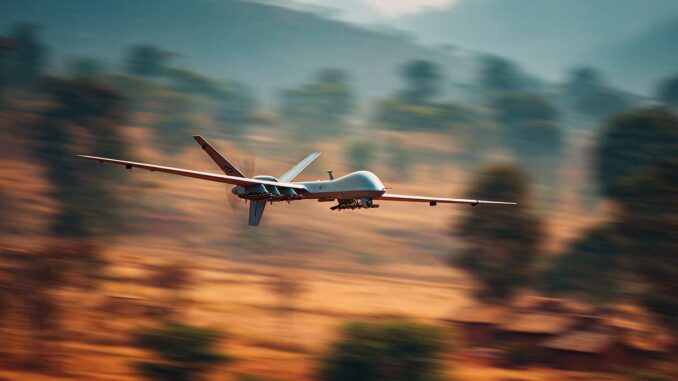
In the Sahel and beyond, African armies are buying Turkish and Chinese drones. Although cheaper than fighter jets, they are creating a new dependency.
In summary
The shift is real, but it needs to be described accurately. Not all African air forces are abandoning manned aircraft. They are weighing up their options. In countries most exposed to guerrilla warfare, especially in the Sahel, armed drones have become the fastest tool to purchase, the simplest to deploy, and the least politically risky compared to modern fighter jets. The continent has accelerated rapidly: according to the Africa Center for Strategic Studies, at least 31 African countries have acquired thousands of drones, with at least 15 bilateral agreements per year since 2020. Turkey has become the leading supplier by number of agreements, ahead of China. But the tactical gain masks a strategic cost. These fleets depend on a foreign supplier for parts, sensors, ground stations, training, sometimes beyond-the-horizon links, and often software integration. The real issue is therefore not just the purchase. It is the ability to keep these drones flying, to arm them, to repair them, and to operate them without remaining dependent on external support.
The shift is already visible in African arsenals
The movement is now continental. The Africa Center for Strategic Studies estimates that the military proliferation of drones in Africa is accelerating significantly: at least 31 countries have acquired military drones, and acquisitions have been increasing at a steady pace since 2020. The same report highlights that Turkey has become the continent’s leading supplier with 32 agreements, including 28 since 2021, while China follows with 27 agreements. This simple balance of power already explains a lot: Turkish and Chinese offerings are available, exportable, and politically less restrictive than Western offerings.
But we need to correct an overly simplistic idea: Africa is not uniformly “replacing” its aircraft with drones. It is segmenting. In counterinsurgency conflicts, drones offer a much more affordable surveillance and strike capability than a modern fighter squadron. On the other hand, large air forces continue to purchase manned aircraft. The case of Nigeria clearly illustrates this: Abuja is still waiting for Chinese Wing Loong II drones, while having received 12 A-29 Super Tucanos in 2021 and launching the acquisition of 24 Italian M-346s in 2024. In other words, drones do not always replace aircraft; they primarily replace the lack of affordable air power.
Countries that are really investing in armed drones
The heart of the shift is in the Sahel. Mali, Burkina Faso, Niger, and Chad have all strengthened their unmanned capabilities in recent years, with an increasingly clear preference for Turkish equipment. The Megatrends Afrika report notes that Chad acquired its first Turkish combat drones in mid-2023. Open sources identified by Drone Wars and other observers show that Mali has been operating Bayraktar TB2s since 2022-2023, that Burkina Faso has been using TB2s since 2022 and then received Bayraktar Akıncıs in 2024, and that Niger received TB2s as early as 2022.
These are no longer symbolic purchases. These are operational fleets integrated into the conduct of operations.
The movement extends far beyond the Sahel. Nigeria is one of the continent’s largest purchasers in terms of number of acquisitions, with Chinese and then Turkish drones. Ethiopia has used a mix of imported platforms, including Wing Loong I, TB2, and, according to several open sources, Iranian Mohajer drones. Morocco has purchased Turkish TB2s after already being associated with Chinese drones from the Wing Loong family. The Africa Center for Strategic Studies ranks Nigeria, Algeria, Ethiopia, and Morocco among the leading African buyers in terms of acquisition volume. This shows that the phenomenon is not limited to the Sahel; it is continental, with different uses depending on the front.
The Sahel case is more political than it appears
In the Sahel, these purchases are not only used to strike armed groups. They also serve to display a renewed sovereignty after the decline of Western partnerships. Armed drones give juntas a national strike capability that is visible, media-friendly, and less dependent on a direct foreign presence on the ground. This is one of the reasons why it has become as much a political symbol as a military tool. But this display of sovereignty remains partial, because an imported drone is only sovereign as long as the supply chain keeps up.
Drones gaining ground in African conflicts
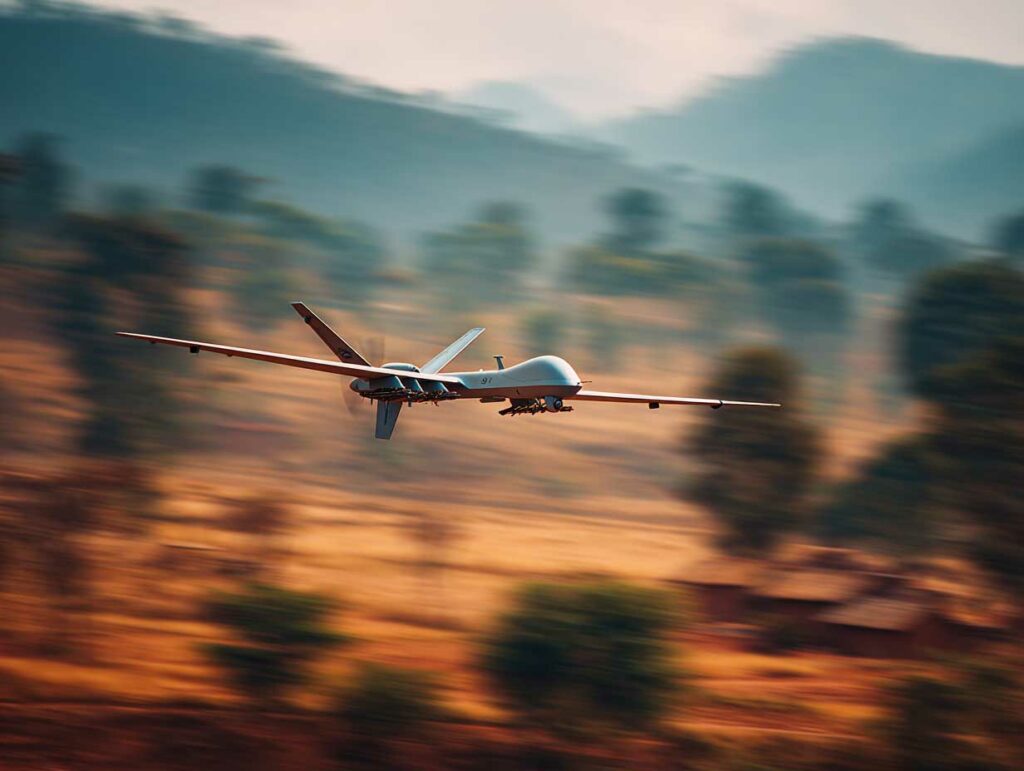
The most widespread model today is the Bayraktar TB2. The Africa Center for Strategic Studies describes it as the most popular combat drone on the continent. It is an endurance MALE, capable of staying in flight for more than 20 hours, with an architecture sold as a complete system: aircraft, ground stations, video terminals, support, and training. This point is crucial. You are not just buying an aircraft. You are buying a proprietary ecosystem. Megatrends Afrika also points out that a TB2 can operate within a communication radius of up to approximately 150 kilometers in its conventional mode, making it particularly suitable for close-range warfare and strikes from forward bases.
Above that, the Turkish range is gaining momentum with the Akıncı. Baykar announces an endurance of 24 hours or more for this drone, a LOS & BLOS architecture, and an operational range of 6,000 kilometers, with a ceiling of 40,000 feet, or approximately 12,200 meters. This changes the equation for states that want to strike further, higher, and with a greater payload. This is precisely why Mali and Burkina Faso sought to upgrade after the TB2s.
On the Chinese side, the CH-4 and Wing Loong families remain the export benchmarks. According to the US Army’s ODIN, the CH-4B can carry six weapons and a payload of approximately 250 to 345 kilograms. The Drone Wars report states that in satellite mode, its range can extend up to 1,500 kilometers.
The Wing Loong II can carry up to 480 kilograms of payload, with satellite control that can extend its range to 2,000 kilometers. These figures do not just mean “strike further.” Above all, they mean “strike further if the communication chain follows.” And that is where dependence begins.
The economic calculation remains overwhelmingly favorable to drones
The success of low-cost drones is not based on a myth. It is based on budgetary orders of magnitude. The Nigerian contract for 12 A-29 Super Tucanos, with bombs, rockets, and support, cost $593 million. In Morocco, the possible US sale of 25 F-16 Block 72s and their extensive package of radars, weapons, support, and training was valued at $3.787 billion. At the other end of the spectrum, the Moroccan deal reported by Shephard for 13 TB2s was valued at $70 million. These contracts are not strictly comparable line by line. But the order of magnitude is clear: the entry ticket for an armed drone capability remains much lower than that for a modern fighter fleet.
This is precisely what appeals to states facing diffuse threats. For armed surveillance, pursuit of convoys, opportunistic strikes, and constant pressure on a home front, an armed drone costs less to purchase, requires less infrastructure than a fighter squadron, exposes fewer pilots, and can stay in the air longer. In a war against groups traveling in pickup trucks in open areas, this advantage is very real.
But this calculation has a limit. Drones do not occupy the ground. The Africa Center for Strategic Studies and Megatrends Afrika agree on this point: against scattered, mobile insurgents who blend into the terrain or the population, drones can prevent visible concentrations, but they cannot impose a political or territorial victory on their own. They provide a tactical advantage. They are no substitute for infantry, human intelligence, or territorial administration.
Technological dependence is real, but it is not uniform
The first level of dependence is maintenance. The agreements cited by Reuters between Turkey, Ethiopia, and Morocco included guarantees on spare parts and training. The Africa Center for Strategic Studies points out that a TB2 package includes control stations, video terminals, and support equipment, with months of training required. This means that a customer army depends on the supplier not only to purchase, but also to maintain the fleet. If parts are delayed, sensors fail, or updates slow down, availability quickly drops.
The second level of dependence concerns sensors and components. In 2023, Reuters revealed that Western companies had supplied critical components for Turkish drones, including optronic sensors. In 2024, Reuters also revealed that Baykar was still seeking to further internalize its supply chain, with the Akıncı then using Ukrainian engines.
If the supplier itself is not fully autonomous, the African customer is even less so. This dependency is therefore nested: the purchasing country depends on the seller, who sometimes depends on foreign subcontractors.
The third level is that of satellite data and beyond-the-horizon links. Here, we must avoid slogans. Satellite dependence is not absolute for all missions. A TB2 used at short or medium range from an advanced base can operate using a conventional link, which limits the need for permanent SATCOM. On the other hand, as soon as we move on to more ambitious profiles—long distance, permanence over very large areas, beyond visual line of sight piloting—BLOS architectures become crucial. And here, control of the link, protocols, terminals, and sometimes relays creates a much clearer dependence on the supplier or a third-party partner.
The problem of “satellite data” is often misrepresented
Africa’s real shortcoming is not just the lack of a national military satellite. Megatrends Afrika notes in particular that, in many African conflicts, government forces identify their targets without having robust access to special intelligence, electromagnetic intelligence, or satellite intelligence. The weakness is therefore broader: it is not just transmission. It is the entire targeting chain. A drone can see. It does not necessarily understand what it sees well enough if the upstream intelligence is weak, if the analysis is poor, or if the verification procedure is sloppy.
This is also why dependence is not just a technical problem. It is a doctrinal problem. An army that depends on one vendor for the aircraft, another for ammunition, another for connectivity, and which does not have complete control over its own target identification chain, has firepower but not complete strategic autonomy.
Dependence is a real problem, but not an automatic condemnation
Let’s be frank: yes, technological dependence is a serious problem. An imported fleet can be grounded by a parts shortage, a sensor failure, a training delay, a software blockage, or an incident in the support chain. It can also lose its value if the adversary acquires jamming capabilities, air defense capabilities, or its own drones. Megatrends Afrika points out that the advantage of MALE drones quickly disappears when access to drones and countermeasures becomes more symmetrical.
But no, this is not necessarily a short-term problem for Sahelian states. For close-range strikes in open areas against adversaries with poor air defense capabilities, the tactical gain is immediate. This is exactly what the uses recorded in Africa show: drones are particularly effective against visible forces with little cover and long supply lines. They are therefore a rational choice, even in situations of dependence, as long as the priority is to quickly regain surveillance and strike capabilities.
The real question is what happens next. The Africa Center for Strategic Studies notes that nine African countries now produce military drones and account for about 12% of the African market. This is still modest, but it changes the debate.
Dependence is not inevitable. It can be reduced through local maintenance centers, assembly, national training, the integration of domestic ammunition, and even partial production. However, it is still necessary to invest in the ecosystem, not just in showcase purchases.
The real test begins after purchase
Africa is not experiencing a simple military fad. It is experiencing accelerated dronization of its conflicts. Turkish and Chinese drones have become popular because they fulfill a simple equation: strike faster, monitor longer, pay less than with modern fighter aircraft, and display visible national capability. On this point, they win. But the story does not end at the moment of delivery. That is when it begins.
A country that buys a drone without a support chain, without a solid targeting doctrine, without local repair capabilities, without secure communications, and without a plan to build internal expertise, is not buying autonomy. It is buying armed dependence. Conversely, those who use these systems as a stepping stone to a more robust industrial and operational base can turn them into a real force multiplier. The low-cost drone is therefore neither a magic wand nor an absolute trap. It is an effective shortcut, but only for those who know that a shortcut is not a destination.
Sources
Africa Center for Strategic Studies, Military Drone Proliferation Marks Destabilizing Shift in Africa’s Armed Conflicts, April 21, 2025.
Megatrends Afrika / SWP, The Myth of the Gamechanger: Drones and Military Power in Africa, March 2025.
Reuters, Turkey expands armed drone sales to Ethiopia and Morocco, October 14, 2021.
Reuters, Nigeria receives first six light attack planes from United States, July 22, 2021.
Reuters, Nigerian air force expands fleet with 34 Italian jets, helicopters, October 14, 2024.
Reuters, Western firms have supplied critical components for Turkish drones, October 10, 2023.
Reuters, Turkish drone maker Baykar to invest $300 million to develop jet engine, October 24, 2024.
Defense Security Cooperation Agency, Morocco – F-16 Block 72 New Purchase, March 25, 2019.
Baykar, Bayraktar TB2 and Bayraktar Akıncı technical data sheets, accessed via indexed extracts.
Drone Wars UK, Death on Delivery, March 2025.
War Wings Daily is an independant magazine.