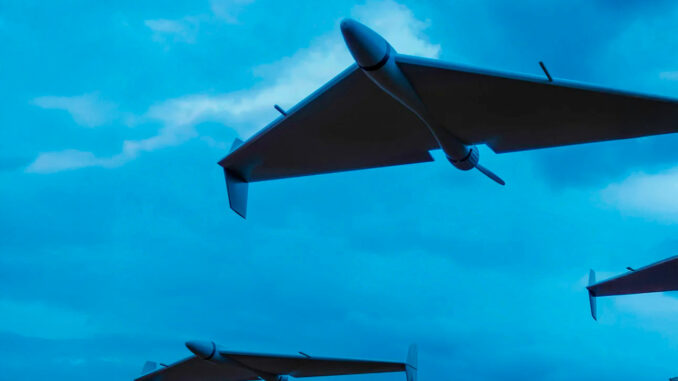
U.S. Central Command (CENTCOM) launches its first squadron of one-way attack drones, symbolizing a strategic shift toward low-cost drone warfare.
Summary
On December 3, 2025, CENTCOM announced the creation of Task Force Scorpion Strike (TFSS), the first US unit entirely dedicated to one-way attack drones in the Middle East. This squadron deploys drones called Low-cost Unmanned Combat Attack System (LUCAS), designed for autonomous kamikaze missions. Each aircraft costs around $35,000. These platforms are inspired by Iranian Shahed-136 drones, but adapted by the US industry to offer a rapid, scalable, and inexpensive strike capability. The goal is clear: to balance forces in the face of asymmetric threats, respond to regional instability, and provide US forces with an immediate deterrent—while marking a doctrinal shift toward drone saturation.
The recent development of drone warfare, the shortcomings of traditional systems, the reduced cost of flying munitions, and tactical urgency explain this paradigm shift. But the strategy raises ethical, operational, and geopolitical questions for the region.
The dawn of a new era for attack drones
On December 3, 2025, CENTCOM formalized the establishment of TFSS, shortly after an order from Secretary of War Pete Hegseth demanded the accelerated acquisition and deployment of affordable drone systems for US forces.
The unique feature of this force lies in its concept: a squadron of disposable, autonomous, one-way attack drones that are ready for rapid deployment. The unit brings together personnel from Special Operations Command Central (SOCCENT), the Air Force, the Army, and the team in charge of unmanned systems. It functions as an operational test bed capable of projecting low-cost, mass strikes with little infrastructure.
CENTCOM officials are presenting this as a turning point: a shift from heavy, costly, and time-consuming aviation to an agile, modular, rapidly deployable force. As Admiral Brad Cooper, commander of CENTCOM, stated, the goal is to “put innovation at the service of deterrence.”
The LUCAS drone: characteristics, origin, cost
The system deployed is called LUCAS – Low-cost Unmanned Combat Attack System. These drones were developed by the American company SpektreWorks, based in Arizona, from the reverse engineering of a captured drone, the Iranian Shahed-136.
Among the technical specifications: a wingspan of approximately 8 feet (≈ 2.4 m), a simple architecture, the ability to operate autonomously, sufficient endurance for long-range strikes, and compatibility with various launch modes—catapults, rocket launchers, mobile land platforms, or vehicles. This allows them to be deployed even in the absence of traditional airport infrastructure.
The unit cost is modest: ≈ $35,000 per drone, according to a US official.
CENTCOM did not specify the exact number of units deployed, stating only that it had “a sufficient number to ensure a significant level of capability.”
Tactical and strategic interest in the Middle East
Responding to hybrid and asymmetric threats
The choice of low-cost disposable drones responds to a strategic reality: in recent conflicts—particularly in Ukraine and Yemen—kamikaze drones such as the Shahed have proven effective in saturating defenses and striking mobile or static targets, often without the need for heavy infrastructure.
For the United States, which maintains a military presence in many Middle Eastern countries (Iraq, Syria, the Gulf, etc.), having a tool capable of striking quickly, discreetly, and at low cost is a major tactical advantage. The LUCAS drone allows the US to act without exposing piloted assets, to increase the number of strikes, and to respond efficiently to emerging threats—militias, armed groups, asymmetric threats.
Deterrence and political leverage
The TFSS announcement also has a clear political component: it is intended to show that the United States now has the capacity for rapid, scalable, and economical retaliation, which is presented as a message of deterrence to hostile actors, particularly groups supported by rival states or militias aligned with regional powers.
Furthermore, by substituting disposable drones for expensive fighter jets, the US military can maintain more flexible budgets, limit human casualties, and retain a flexible posture — which is an asset in an unstable geopolitical context.
The real cost and suppliers: what we know
The development of LUCAS was led by SpektreWorks. The drone is derived from a captured model (Shahed-136), designed to be inexpensive, simple, and easily producible.
At around $35,000 per unit, these drones are much cheaper than the usual MQ-9 type drones or piloted aircraft.
The overall budget allocated to the force has not been disclosed in detail. The command simply states that the format is “scalable”: the modular design and low dependence on infrastructure allow the number of units deployed to be adjusted as needed.
That said, the gamble is clear: limited investment, rapid production, massive use. The logic is to prioritize quantity and speed over the longevity of a system.
How this changes the Middle East theater
The Middle East has long been a playground for drones of all kinds: spies, kamikazes, flying munitions, etc. The arrival of a US squadron of kamikaze drones redefines the balance of power and changes the very nature of deterrence.
US forces can now react faster, strike without warning, and neutralize targets with fewer logistical constraints. They give themselves a degree of flexibility that neither conventional observation drones nor traditional air strikes could offer.
Moreover, it sends a strong signal to allies and adversaries alike: the United States does not intend merely to defend itself against drones, it intends to dominate them. This could prompt other powers or regional actors to accelerate their own drone programs.
Finally, this type of capability could serve as a model elsewhere: other theaters of operations (Indo-Pacific, Africa, etc.) could see the implementation of similar structures, multiplying “kamikaze squadrons” designed to project American power with responsiveness and controlled costs.

The limitations and risks of massive use of “disposable” drones
The use of “one-way” drones poses several problems. First, their massive use can lead to inaccurate strikes, especially if their range, sensors, or targeting capabilities are limited. Reliable target identification in urban environments or densely populated areas remains a challenge.
Second, political and media acceptance of a disposable weapon—designed for single use—can raise ethical questions, particularly in the event of collateral damage.
Militarily, maintaining a credible force with disposable drones requires constant production, well-organized logistics flows, ammunition reloading capabilities, control and maintenance systems—even if these drones are designed as “consumables.”
Finally, this shift could trigger a new drone race in the region, with rival countries seeking to develop their own fleets of kamikaze drones, increasing the risk of escalation.
A profound doctrinal transformation of aerial warfare
The activation of TFSS likely marks a lasting turning point in US military strategy. For decades, the US military relied on expensive, piloted or high-end drone platforms to ensure air superiority, precision strikes, or surveillance.
The LUCAS and TFSS model now favors quantity, speed, modularity, and accessibility of deployment. This approach reflects a logic in which saturation, attrition, surprise, and flexibility are more important than stealth or longevity.
This change is part of a global trend toward the proliferation of drones around the world—conflict in Ukraine, asymmetric warfare, and the spread of technology. By officially adopting a kamikaze squadron, the United States recognizes that modern warfare requires new, more adaptable, and more economical tools.
LUCAS drones are not just low-cost flying munitions: they represent a break with traditional thinking about warfare. By focusing on mass, speed, and modularity, TFSS could reshape future conflicts. But this strategy is not without danger: tactical uncertainties, ethical issues, and the risk of regional escalation make it a risky but fascinating gamble.
Sources
– DefenseScoop: article on CENTCOM’s creation of Task Force Scorpion Strike and the deployment of the first squadron of American kamikaze drones.
– The Aviationist: analysis of the operational use of LUCAS drones and their technical relationship to the Iranian Shahed-136.
– Stars and Stripes: report on CENTCOM’s official announcement and the objectives of this new concept of a one-way attack drone squadron.
– Axios: detailed article on the industrial origin of LUCAS drones, their estimated cost, and their role in the new American doctrine.
– Anadolu Agency (AA): dispatch on CENTCOM’s public announcement and the strategic motivations for deployment in the Middle East.
– Defence Industry Europe: analysis of the budgetary framework, the rapid ramp-up objective, and the industrial model chosen for drone production.
– Army Recognition: breakdown of the Task Force’s structure, its launch capabilities, and its integration with US special forces.
– The Defense Post: article on the geopolitical context, the rise of asymmetric threats, and the challenge of deterrence in the region.
– L’Orient-Le-Jour: insight into the unit cost of drones and comparison with Iranian systems.
– Wikipedia (Shahed-136): basic technical data used to contextualize the initial design from which the LUCAS drones were developed.
War Wings Daily is an independant magazine.