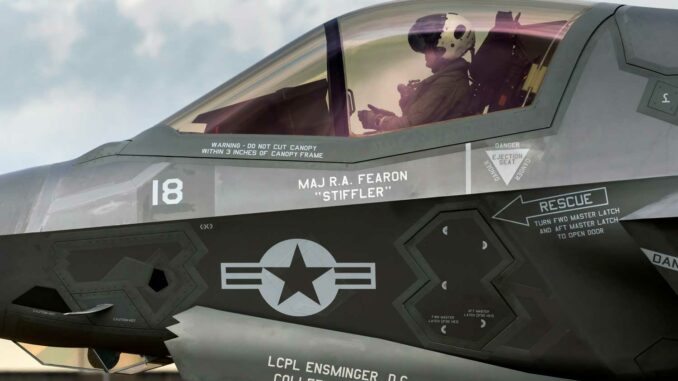
GaN, jamming, SAR, fusion, and drones: why the APG-81/APG-85 radar transforms the F-35 into a Block 4 combat hub.
In summary
The F-35’s radar is no longer just a sensor. It has become a versatile tool used to detect, identify, map, protect, and sometimes disrupt. In 2026, the transition from AN/APG-81 to AN/APG-85 crystallizes this evolution. The change in material, from GaAs to GaN, is not an industrial detail. It modifies the available power, thermal management, and margin for new modes. At the same time, the software architecture supported by TR-3 and Block 4 gives “breathing room” to signal processing and data fusion. The result can be seen in five areas: effective range, the ability to operate in a jamming environment, the quality of ground radar images, the automation of sensor fusion, and integration into distributed combat with drones. The key message is clear: this radar is as important for survivability as it is for lethality, because it helps the F-35 see, decide, and act faster than the enemy.
The F-35’s radar: a sensor turned combat system
A modern fighter radar operates in the X band. In simple terms, it transmits and receives very short waves, which are suitable for tracking airborne targets and imaging the ground. On the F-35, the idea was never to “put a radar on” and then add options. The aircraft was designed around a coherent whole. The radar is natively connected to mission computers, electronic warfare, and data links.
That’s why the notion of a nerve center is not just an empty phrase. A radar mode is not just an image on a screen. It’s a decision about energy management, discretion, threat priorities, and information sharing.
In 2026, the transition to AN/APG-85 will be part of a larger package. The F-35 is evolving with Technology Refresh 3 (TR-3) and Block 4. The challenge is simple to articulate: more computing power and more memory to run more demanding algorithms, more modes, and more automation. Public figures are circulating about the ambition of TR-3: up to 37 times more processing power and 20 times more memory compared to TR-2, according to reports in the press and program tracking documents. That doesn’t tell the whole story. But it explains why “radar improvements” are possible without changing the aircraft from top to bottom.
The transition from GaAs to GaN: a thermal and energy breakthrough
The change in material is the most concrete basis for this. GaAs has dominated a generation of AESA radars. GaN, on the other hand, is taking over as soon as we look for more power, more efficiency, and better temperature resistance.
The gain in useful power is not just a marketing figure
GaN accepts higher power densities. It also supports higher operating voltages. In other words, for the same size, you can push harder. Or, for the same performance, you can reduce size and power consumption.
This is not a minor detail. In a fighter jet, every watt counts. And every degree counts. Cooling is a structural constraint, just like stealth or internal fuel.
Industrial and technical sources summarize the advantage well: GaN offers much higher power density than GaAs, allowing more RF power to be produced with more compact components. This gain often translates into better radar performance at a given distance, or better operation in demanding modes, without reaching a thermal limit too quickly.
The operational benefit is the margin
Radar does not only “see” further because it emits more. It sees better because it can modulate its waveform, vary its frequencies, increase refresh rates, and maintain a good signal-to-noise ratio in difficult conditions. GaN provides the margin for this.
This margin has three very practical effects:
- improved ability to detect targets with a small radar cross section, which are therefore more discreet;
- improved resistance to jamming, because the radar can change its parameters more quickly and more extensively;
- ability to maintain power-hungry modes, such as detailed ground imaging, without thermal “choking.”
The sticking point is heat and energy management
We need to be clear-headed. More available power creates a temptation: to push modes harder, for longer. This can increase power consumption and cooling load. GaN does not eliminate the thermal problem. It pushes the limit. And pushing the limit is only worthwhile if the energy-cooling chain can keep up.
This is also why the TR-3 modernization and aircraft upgrades are linked. A radar does not exist in isolation. It exists within an architecture.
Integrated electronic warfare, when AESA becomes a non-kinetic weapon
Modern AESA radar is not just a transmitter for “locking onto a target.” It is an antenna composed of numerous modules, capable of directing very narrow beams very quickly and changing waveforms in real time. This agility is a direct asset for electronic warfare.
The principle of interleaving, the real difference
A classic weakness of older radars is the sequence. You detect, then track, then map, then return. This requires visible trade-offs. AESA allows functions to be interleaved, sharing antenna time and energy in a much more flexible way.
In the case of the F-35 radar, Northrop Grumman explicitly describes the AN/APG-81 as capable of acting as an electronic warfare “aperture,” with protection, attack, and support functions. This is the important point: the radar can help degrade an enemy system while continuing to feed the tactical situation.
Jamming: what it means in practical terms
Effective jamming is not about “frying” an enemy radar. This idea is widely held, but it is misleading. The goal is more often to reduce the enemy’s effective range, disrupt tracking, degrade identification capabilities, or force the enemy to change frequency and mode.
AESA radar helps because it can:
- point a narrow beam at a hostile transmitter;
- adapt the modulation to be more disruptive;
- quickly vary the parameters to complicate the enemy’s countermeasures.
In a saturated environment, what matters is timing. Disrupt at the right moment, during a window when the adversary must make a decision. This is where radar-electronic warfare integration becomes a force multiplier.
Electronic protection, often less visible but vital
Protection capabilities are resistance to jamming. Here too, the subject is less spectacular, but decisive. A radar that maintains tracking quality despite enemy jammers retains the ability to engage. Northrop Grumman points out that the electronic warfare dimension of the APG-81 has been officially recognized, notably through a DoD award for a significant advance in electronic protection.
SAR radar mapping, imaging that works when the sky is closed
SAR mapping is one of the functions that best illustrates the leap forward made by modern AESA systems. The principle is well known: the aircraft’s movement is used to synthesize a virtual “large antenna.” This provides a detailed image of the ground, day or night, and often through cloud cover or smoke.
The difference between seeing and identifying
A SAR image is not a photograph. But it can approach identification capability when the resolution is sufficient, especially for structured objects (vehicles, buildings, runways, facilities). In public documents, Northrop Grumman highlights an “ultra-high resolution” SAR mode on the APG-81. Precise figures are rarely published for combat aircraft. But open work on SAR shows that with bandwidths of several hundred MHz, resolutions of the order of a meter, or even sub-meter, are achievable in certain modes, depending on geometry and processing.
The useful point for the reader is simple. Better resolution changes the use. We move from “I know there is something there” to “I can distinguish shapes and volumes,” and therefore sort priorities and guide a strike.
Refresh rate, the real issue with Block 4
A very detailed SAR map that arrives too late is of less value. The major gain from modernization is therefore often in processing time, not just in the sensor.
With TR-3 and Block 4 software, the aircraft has a wider calculation margin. This increases the speed of image generation and refresh, and makes the imagery more usable in dynamic situations. In real combat, a few seconds can be enough to miss an opportunity or strike the wrong target.
All-weather robustness: a less glamorous but concrete advantage
This is also the most rational benefit. When optronics are hampered by clouds or smoke, radar imaging remains usable. This does not replace optronics. It provides a backup, and sometimes a primary means, depending on the scenario.
Sensor fusion, when radar ceases to be just one source among many
The F-35’s sensor fusion has become a benchmark. It explains why, on this aircraft, the radar is considered “more” than just a radar. It is not just a question of raw performance. It is a question of integration and decision-making ergonomics.
The single track principle, from the pilot’s perspective
The pilot should not have to manage a list of sensors. He should manage a situation. That is the purpose of fusion: to present a consolidated track, derived from multiple sources, and to maintain that track even if one source degrades or goes down.
In the F-35 architecture, the radar is combined with the EOTS optronics under the nose and with the DAS, a set of six infrared sensors providing coverage around the aircraft. All of this is processed by the mission systems to provide a coherent tactical picture.
The practical result is very simple: a single icon, a single priority, a single tactical “object.” It’s less spectacular than an announced range. But that’s what saves time.
The subtle interplay between transmission and stealth
An active radar transmits. Transmission can be detected. Stealth is not disappearance. It is the reduction of signatures and control of exposure.
The F-35 manages this in several ways. First, waveforms and modes that reduce the probability of interception. Second, the ability to temporarily go silent on radar, while continuing to track via other sensors, when possible.
Let’s be honest. Fusion does not create magic. It creates continuity of information when conditions allow. Infrared has its limitations. Radio frequency has its limitations. But the whole is more robust than an isolated sensor.
The most concrete benefit is the reduction in cognitive load
In high-intensity combat, saturation comes quickly. Multiple threats, jamming, communications, rules of engagement, fuel, navigation. Fusion limits micro-decisions. It automates the initial sorting. It helps to keep human decision-making focused on the essentials, instead of drowning in source management.
The role of combat node, when the aircraft distributes its vision to drones
The underlying trend is toward distributed combat. An aircraft “sees,” but above all, it shares. And it orchestrates. This is the idea of the F-35 as a quarterback, strongly promoted by Lockheed Martin.
You mention the piloting of winged drones. In 2026, the subject needs to be properly framed. The control and integration capabilities of Collaborative Combat Aircraft (CCA) drones are being extensively tested in advanced simulations. The US Navy has reported on demonstrations in the Joint Simulation Environment, where F-35 pilots controlled several CCAs via tablet-type interfaces to test combined tactics and missions.
The role of radar in this scenario is to feed into decision-making
It would be an exaggeration to say that “radar controls drones” in the strict sense. What is credible, and consistent with aircraft architecture, is more interesting: radar feeds into the tactical situation, fusion builds an image, and the mission system shares targeting and situational data with partners, human or otherwise.
In a mixed patrol, the drone can act as a scout, exposing itself more, or position itself to complete a radar geometry. The F-35 can then exploit this information without being the most advanced point.
Directional link, a key point of survivability
Data sharing is only useful if it is discreet and resilient. On the F-35, the link most associated with this use is MADL, described as a link with a low probability of interception and detection, and highly directional in several analyses and specialized articles. The idea is to limit electromagnetic exposure while exchanging richer data volumes than via older links.
This is where radar regains an indirect but central role. The more the aircraft shares a high-quality tactical image, the more it can distribute tasks. And the more options it can keep: limited emissions, repositioning, or remote engagement.
Promise and constraint, two simultaneous realities
The promise is clear: a piloted aircraft can orchestrate multiple effectors. It can focus human judgment on tactics, while unmanned platforms perform repetitive or risky tasks.
The constraint is just as clear: reliable networks, controlled rules of engagement, and high cyber and electromagnetic robustness are required. Distributed combat, if poorly protected, becomes an attack surface. And a blinded “quarterback” becomes an isolated aircraft once again.
The reality behind the five innovations: what they really change
These five innovations are not independent. They reinforce each other.
GaN provides energy and thermal headroom. This headroom supports more aggressive modes, including electronic warfare and imaging. TR-3 and Block 4 provide the computing headroom to exploit these modes and fuse data faster. The fusion makes these gains usable by a pilot without overload. Finally, discrete links make it possible to transform this local superiority into collective superiority by feeding other platforms.
It is also important to note what this does not change, or not yet. Even an excellent radar cannot override physics. Range depends on the target, the environment, and countermeasures. The exact performance will remain largely classified. And large-scale drone piloting remains a work in progress, even if demonstrations are accelerating.
The most honest conclusion is therefore as follows: the F-35’s radar, especially in its transition to the APG-85, illustrates a shift. Sensors are no longer being modernized to “see further.” Systems are being modernized to make decisions faster, remain discreet for longer, and coordinate more actors. This is an evolution in doctrine as much as in technology.
Sources
Northrop Grumman – AN/APG-81 Active Electronically Scanned Array (AESA)
Northrop Grumman (press release) – Developing the Next Generation Radar for the F-35 (AN/APG-85)
Lockheed Martin (F-35.com) – Block 4 Capabilities Sharpen the F-35’s Edge
Lockheed Martin (F-35.com) – Outsight In: F-35 Sensor Fusion in Focus
U.S. Air Force Materiel Command – F-35 conducts first flight with TR-3
U.S. GAO – F-35 Joint Strike Fighter, GAO-25-107632 (September 2025)
Bloomberg Government – TR-3 multipliers (processing/memory) reported via GAO coverage
Air & Space Forces Magazine – TR-3 as enabler for Block 4
Congressional Research Service – F-35 Lightning II: Background and Issues for Congress (R48304)
The War Zone (TWZ) – F-35 Will Get New Radar Under Massive Upgrade Initiative (APG-85)
FlightGlobal – US Navy begins developing tactics incorporating Collaborative Combat Aircraft with F-35 in JSE (January 2026)
The Defense Post – F-35 controls Collaborative Combat Aircraft in simulation (January 2026)
Lockheed Martin – How the F-35 Connects the Battlespace
Lockheed Martin – F-35: The Quarterback of Piloted and Drone Teaming
NASA Earthdata – Synthetic Aperture Radar (SAR) basics
Qorvo – X-Band Radar: GaN & GaAs beamforming
Mouser – RF Power: GaN Moves In for the Kill
War Wings Daily is an independant magazine.