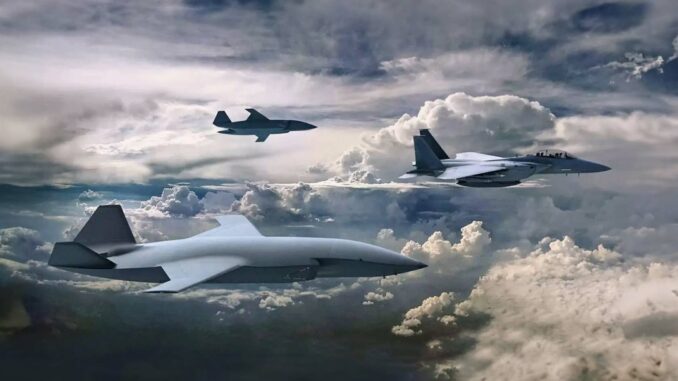
Collaborative Combat Aircraft are changing the equation: swarms, onboard AI, networked combat. Why the USAF is accelerating and what Europe risks.
In summary
Collaborative Combat Aircraft (CCA) promise to transform aerial warfare by combining a manned aircraft with several drones capable of exploring, jamming, or striking. The goal is not to replace the pilot, but to multiply tactical effects at a lower cost than a modern fighter jet. The logic is dictated by the attrition observed in Ukraine: systems lost en masse, communications degraded by jamming, and constant pressure on stocks. CCAs must therefore operate within networked air combat architectures while surviving in contested environments, sometimes without stable links. The real breakthrough is “agent-based” AI: software capable of making quick decisions at the edge of the network, with distributed sensors in air combat and data fusion in the air combat environment. One central question remains: produce in large numbers, accept losses, and frame autonomy to remain militarily effective and politically tenable.
The shift to team-based air warfare
The figure of the lone pilot, dominating “clean” airspace, has become a thing of the past. Recent conflicts show the opposite: skies saturated with drones, sensors, decoys, jamming, and surface-to-air threats. The result is brutal: air superiority is no longer “declared,” it is won minute by minute, with consumable resources.
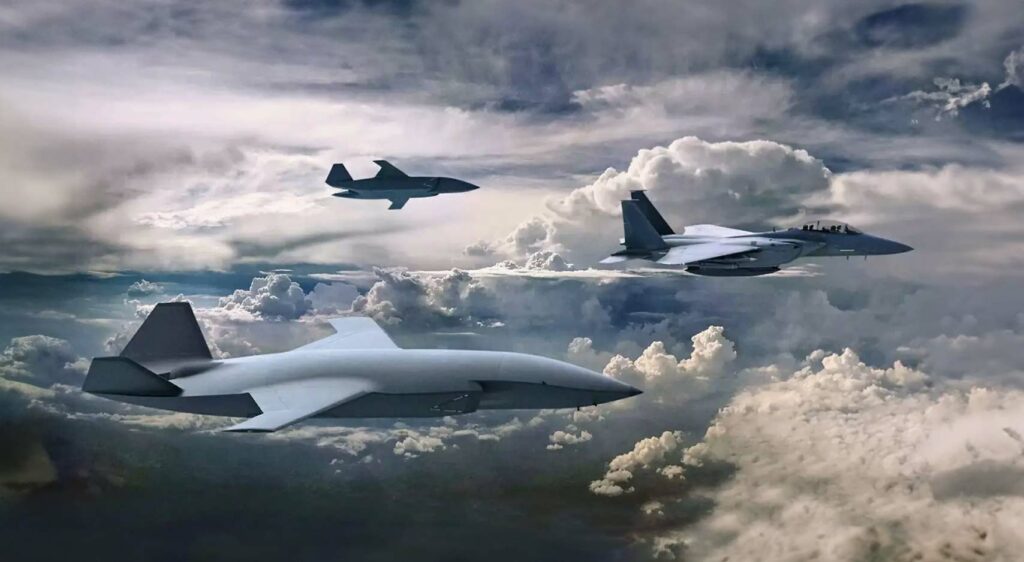
This is exactly the idea behind the Collaborative Combat Aircraft concept. A fifth-generation manned aircraft, such as the F-35, retains its role as a tactical command platform, reference sensor, and human decision-maker. Around it, drones are assigned tasks that we hesitate to entrust to a pilot: opening the way in an area covered by surface-to-air missiles, turning on an auxiliary radar, attracting enemy fire, or confirming a target at close range.
This approach shifts the center of gravity. We are moving from “very expensive, very rare, very precious” aviation to hybrid aviation, where mass is rebuilt by unmanned platforms. The Americans sum this up as “affordable mass.” The formula is appealing, but it requires discipline: accepting that part of the fleet will be lost and designing the entire system around this reality.
The clearest lesson from Ukraine: attrition has become normal again
In Ukraine, drone warfare is industrial. The figures vary depending on the source, but the order of magnitude is stable: we are talking about millions of units produced or purchased in a year, and a rate of consumption that would have seemed absurd ten years ago. Public analyses indicate that Ukraine has gone from producing around 800,000 drones in 2023 to nearly 2 million in 2024, with a target of several million in 2025. At the same time, reports describe days when enemy surveillance relies on hundreds, even more than a thousand, reconnaissance drone orbits.
This observation has a direct implication for fighter aviation. A modern fighter is expensive, slow to produce, and its loss is strategic. However, contested conflicts push in the opposite direction: multiply sorties, disperse, lose platforms, and continue regardless. If you only line up a handful of “jewel” aircraft, you are basing your strategy on a fragile stockpile. This is precisely the “frank” argument that drives the CCA: if system attrition is structural, you need systems designed to be lost.
This is where the discourse on manned aircraft becomes uncomfortable. Yes, an F-35 or a future 6th generation fighter is a major tool. But modern warfare shows that it is not enough, because the adversary does not allow you a clean duel. It imposes exhaustion, jamming, and saturation.
The concrete definition of a CCA, far from slogans
A CCA is not “a drone with missiles.” It is a building block of a collaborative air combat system. To be useful, it must meet four very concrete requirements.
The mission must be modular
The same model must be able to be configured as a scout, a jammer, a communications relay, an ammunition carrier, or a decoy. This modularity reduces the number of variants to be maintained and speeds up production. In the vocabulary of manufacturers, this becomes a “family” logic, with a common core and mission kits.
The signature must be consistent with the use
There is no need for a drone to be as stealthy as a manned fighter if its main role is to consume the enemy’s defenses. On the other hand, if you ask it to “look” into a ground-to-air bubble, it needs at least some survivability: a discreet profile, electronic warfare, optimized trajectories, and collective tactics.
The link must be resilient, but not indispensable
In an ideal world, the pilot controls everything. In the real world, the enemy jams the signal. The drone must therefore be able to “continue” a simple task when the link is degraded, then recalibrate when the connection is restored. This is the logic of resilience in collaborative combat systems applied to command and control.
The cost must remain politically acceptable
Public estimates associated with the US program suggest a unit cost of around $25 to $30 million for a CCA. That’s a lot for a drone, but it’s also a fraction of the cost of a modern fighter jet, and above all, a level at which the purchase of hundreds of units becomes conceivable again.
The American industrial reality: producing 1,000 drones is not just a slogan
The US Air Force is no longer hiding its target scale: at least 1,000 collaborative combat drones. The reasoning is simple: if you want two drones per advanced manned aircraft, you quickly reach four-digit volumes. And the US Air Force has already set a trajectory: a competitive production decision around fiscal year 2026, and operational capability before the end of the decade.
This timeline is revealing. It means that the CCA is being treated as a structuring program, not as a demonstration. It also indicates a willingness to take risks: industrialization is being accepted even as autonomy technology continues to evolve. But there is a logic behind this gamble: autonomy is never “finished.” Waiting for perfection means giving up on volume.
Manufacturers are positioning themselves as platform and software makers. Several publicly exhibited projects show jet-powered “wingman” drones designed to accompany fighter jets. The interest is not only in the airframe. It is in the ability to integrate mission software, align with open standards, and enter a rapid production chain.
The real breakthrough: AI that makes decisions at the edge of the network
The most sensitive and decisive issue is tactical autonomy. The public debate often misses the point by pitting “humans” against “machines.” The operational question is more specific: what happens when communication is interrupted and the threat evolves in seconds?
So-called “agentic” AI aims to respond to this scenario. It is not limited to flying the aircraft. It must manage a mission under constraints: avoiding defenses, choosing a route, prioritizing a sensor, proposing an action, and sometimes executing it if the window is too short.
This requires three things.
Validated tactical behaviors, not demonstrations
In the lab, AI wins quickly. In combat, AI must be predictable, tested, and robust against decoys. An adversary will seek to deceive sensors, cause classification errors, or push the system to consume its mission too early. Useful autonomy is therefore that which resists tricks, not that which shines in simulation.
Graduated autonomy
In practice, most CCAs will start with limited levels of autonomy: navigation, formation maintenance, deconfliction, route execution, and sensor management. Then, gradually, more “decisional” functions will appear, particularly for surviving in a jammed environment. This is the heart of human-machine integration in air combat: humans maintain the intent, while machines manage execution under constraints.
Governance of “fire” that remains tenable
This is the political crux of the matter. Even if a drone can technically select and engage a target, the question is when and how to authorize it. US officials insist on appropriate levels of human judgment in the use of force. This line does not prevent highly autonomous systems, but it does impose safeguards, rules of engagement, and traceability.
Collaborative combat in practice: what CCA must bring to the pilot
The success of CCA will depend on simple, measurable, useful effects. Here are the most credible ones in the short and medium term.
Reconnaissance and targeting with distributed sensors
Drones can spread out and look from multiple angles, reducing blind spots. With distributed sensors in air combat, you get a richer picture: one drone detects, another confirms, and a manned aircraft correlates. The value then comes from data fusion in an air combat environment: transforming fragments into a firing solution.
Electronic warfare as an “attritable” mission
Sending a jammer close to a defense is risky. With a CCA, it’s a logical mission: it can disrupt, force the adversary to transmit, reveal radars, and survive long enough to give the group the advantage. In this logic, losing the drone is part of the calculation.
Carrying weapons to restore magazine depth
A fighter is limited by its payload, especially if it wants to remain discreet. Drones can act as “missile trucks” or ammunition carriers, providing firing depth. This enhances collaborative air combat capabilities without increasing the number of manned aircraft.
Relaying and redundancy of communications
In contested environments, links are cut. A drone can serve as a temporary relay, a mobile node, or a fallback solution. This is one of the most concrete aspects of secure collaborative air-to-air communications.
The structural weak point: the network will be attacked, so we must know how to fight “offline”
The promise of CCAs is based on networked air combat architectures. But we must be clear-headed: the adversary will seek to break the network before breaking the platforms. Jamming, cyber attacks, decoys, relay destruction, GPS denial: all of these have already been observed, to varying degrees.
The consequence is simple: a credible CCA system must be designed to degrade cleanly. This means:
- limited but robust autonomous modes in the event of a shutdown;
- rejoin, return, and security procedures;
- trust and authentication mechanisms to prevent the injection of false orders;
- a software architecture that isolates critical functions.
If these elements are neglected, CCA becomes a risk multiplier. A hacked or misled drone is not only “lost,” it can contaminate the group.
Europe’s place: the risk of missing the boat
Europe is also working on collaborative combat, particularly through visions of systems of systems, where manned aircraft cooperate with drones or “remote carriers.” However, the timelines are longer, and industrial rivalries are slowing down progress. This is a strategic problem: the value of the CCA comes from volume, and volume comes from a clear political decision, a common standard, and mass production.
If Europe sticks to a model of “few units, highly sophisticated, very expensive,” it risks an operational gap. The result could be paradoxical: having good platforms, but not enough endurance or mass to sustain a long and contested conflict.
Let’s be frank: the battle is not only technological. It is industrial and doctrinal. It requires doctrines for the use of collaborative combat aircraft that accept loss, experimentation, and rapid software update cycles.
Difficult choices to be made now
CCA is not an automatic given. It requires trade-offs.
The choice between sophistication and quantity
The more complex you make the drone, the closer it gets to a manned aircraft in terms of cost and time. You then lose the advantage of an expendable platform. The discipline consists of setting a “minimum viable” standard and accepting that it is imperfect.
The choice between centralization and local autonomy
Centralizing everything on the manned aircraft is reassuring, but fragile in the face of jamming. Delegating everything to the drone is tactically appealing, but politically explosive. The balance lies in supervised autonomous functions and a human who validates the intention.
The choice of software openness
A closed system sometimes provides better protection, but evolves more slowly. However, the adversary learns quickly. Without standards and rapid updates, the fleet becomes frozen. The military Collaborative Combat Aircraft programs that will succeed are those capable of absorbing software developments as quickly as the adversary changes its countermeasures.
The question that remains: who controls violence when the machine goes faster?
CCAs will make air warfare faster and more distributed. They can also make escalation easier, because losing a drone weighs less than losing a pilot. This reality will not disappear with good press releases.
The line in the sand is this: if we restrict autonomy too much, we lose the advantage in a cluttered environment. If we give too much freedom, we take a political, legal, and moral risk that could kill the program. The credible solution is pragmatic: build tested, traceable systems with clear rules of engagement and graduated autonomy depending on the mission.
What is certain is that the window is closing. Countries that are now industrializing will have fleets, pilots trained in human-drone team air operations, and feedback. The others will have concepts.
Sources
- Congressional Research Service, “U.S. Air Force Collaborative Combat Aircraft (CCA).”
- U.S. Air Force, “Air Force exercises two Collaborative Combat Aircraft option awards” (April 24, 2024).
- Air & Space Forces Magazine, Frank Kendall on NGAD and 1,000 CCAs (March 7, 2023).
- Anduril, press release on USAF CCA selection (April 23, 2024) and YFQ-44A flight tests (October 30, 2025).
- General Atomics, “Gambit Series” presentation and 2025 communications on Gambit / YFQ-42A.
- CRS, “DOD Replicator Initiative: Background and Issues…” and DIU “The Replicator Initiative.”
- Reuters, winged drones and CCA dynamics at the 2025 Paris Airshow (June 19, 2025).
- CSIS, “The Russia-Ukraine Drone War…” (May 28, 2025).
- RUSI, report on tactical dynamics and drone volumes (PDF, 2025).
- OSW, “Game of drones: production and use of Ukrainian UAVs” (October 14, 2025).
- DoD Directive 3000.09 “Autonomy in Weapon Systems” (January 25, 2023) and CRS “U.S. Policy on Lethal Autonomous Weapon Systems”.
War Wings Daily is an independant magazine.