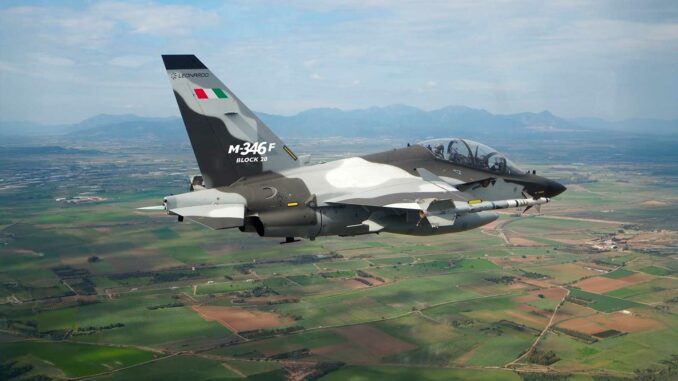
Austria orders 12 M-346 F Block 20 aircraft from Leonardo for air policing and advanced training, opting for a modern, proven multi-role solution.
Summary
On December 17, 2025, Austria formalized its order for 12 M-346 F Block 20 multi-role aircraft from Italian manufacturer Leonardo. This decision marks a milestone for the Luftstreitkräfte, which needed to replace the Saab 105 aircraft withdrawn from service and fill a critical capability gap. The M-346, in this light combat version, combines AESA radar, Link 16 data link, and avionics architecture similar to modern fighters, while keeping acquisition and operating costs low. Vienna has opted for a versatile aircraft capable of performing air policing, advanced pilot training, and armed surveillance missions. This contract reflects a pragmatic approach to air defense, adapted to Austria’s neutrality, national budgetary constraints, and an increasingly tense European security environment.
The strategic context of an expected decision
Since the gradual withdrawal of the Saab 105s, Austria has found itself in a delicate situation. These aircraft, which entered service in the 1970s, performed an essential hybrid role: advanced training, airspace surveillance, and secondary defense missions. Their withdrawal left a gap that the Austrian Eurofighter Typhoons could not fill on their own, due to their high operating costs and limited availability.
The Luftstreitkräfte therefore needed an intermediate aircraft. Not an additional heavy fighter, but a platform capable of covering daily missions, ensuring a credible presence, and maintaining pilot skills. In this context, the M-346 F Block 20 emerged as a coherent solution, already proven by other European air forces.
Choosing the M-346 over the alternatives
Several options were considered. Some were based on armed turboprop aircraft, which were less expensive but insufficient for jet-powered air policing. Others considered more powerful light combat aircraft, but these were often more expensive and complex to integrate.
The choice of the M-346 reflects a desire for balance. The aircraft is based on a recognized advanced training platform already in use by Italy, Poland, and Israel. Its F version, dedicated to light combat, offers real operational credibility without falling into the category of heavy multi-role fighters.
For Austria, this compromise is strategic. It allows for the strengthening of national capabilities without compromising the budgetary framework or defense doctrine.
The technical capabilities of the M-346 F Block 20
The M-346 F Block 20 features modernized avionics and an open architecture. The integration of AESA radar represents a major leap forward in capabilities. This type of radar allows for the simultaneous detection of multiple air and ground targets, with better resistance to jamming and reduced maintenance compared to mechanical radars.
The presence of the Link 16 data link is equally decisive. It enables the exchange of tactical information in real time with other aircraft, command centers, or allied air defense assets. For a country like Austria, this interoperability is essential during exercises or coordinated missions with European partners.
In terms of performance, the M-346 is powered by two turbojet engines, enabling it to reach approximately 1,050 km/h (570 knots). Its operational ceiling exceeds 13,700 m (45,000 ft), which is sufficient for surveillance and rapid interception missions in national airspace.
An aircraft designed for air policing
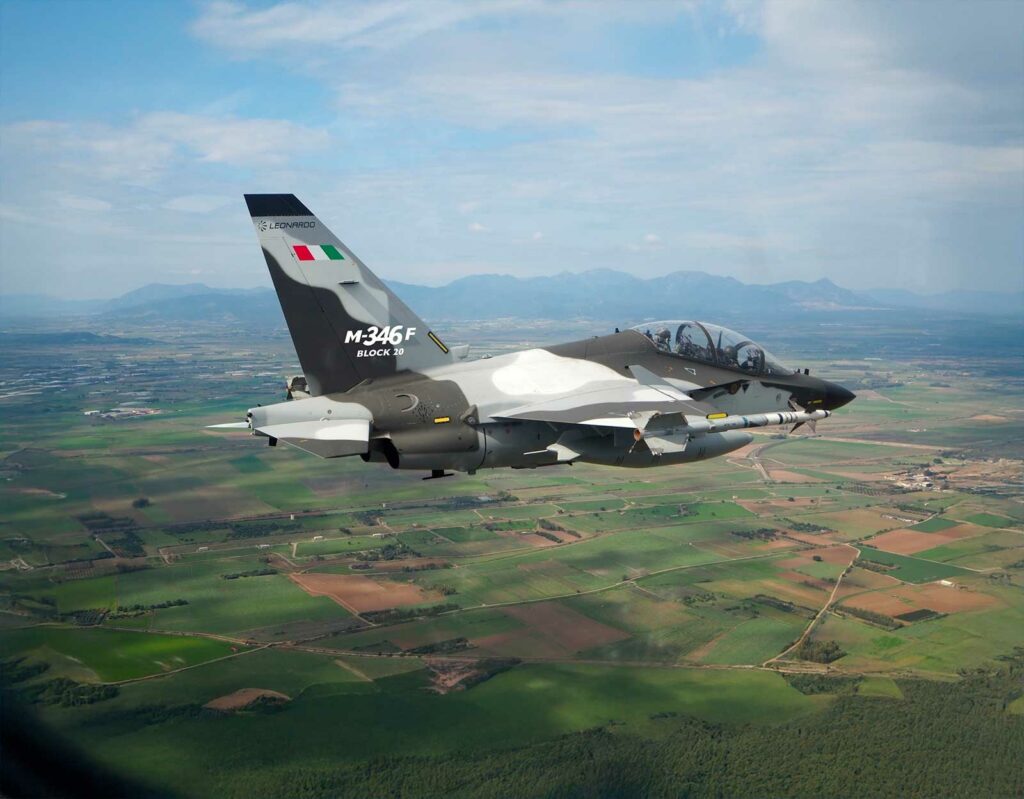
Air policing is a core mission for the Luftstreitkräfte. It involves identifying civilian aircraft in distress, monitoring airspace, and being able to intervene quickly. The M-346 F Block 20 is perfectly suited to this role.
Its AESA radar enables early detection. Its maneuverability and speed are sufficient to intercept civil aircraft or slow-moving aircraft. Above all, its operating cost is much lower than that of a heavy fighter. Estimates suggest an hourly cost of less than €10,000, compared to tens of thousands for a Eurofighter.
This rationalization is essential. It allows heavy combat aircraft to be reserved for missions where they are truly indispensable.
A credible advanced training tool
The other pillar of the program is advanced training. The M-346 is designed to prepare pilots for modern combat aircraft. Its digital cockpit, multifunction displays, and onboard simulation systems faithfully reproduce the environment of a recent-generation fighter.
For Austria, this means a more gradual and economical increase in skills. Pilots can acquire advanced tactical reflexes without unnecessarily consuming flight hours on the Eurofighter. This logic is shared by several European air forces facing the same constraints.
Budget and cost control
Although the exact amount of the contract has not been officially disclosed, estimates put the total budget at between €900 million and €1.1 billion, including aircraft, initial logistical support, training, and associated infrastructure.
In relation to the capabilities acquired, this budget remains moderate. It is part of a long-term strategy aimed at stabilizing expenditure while modernizing resources. The M-346 also offers predictable maintenance costs, a key argument for a country whose budget margins are closely monitored.
Integration into the Luftstreitkräfte
The M-346 F Block 20s will be integrated gradually starting in 2027. They will be based at sites already used by the Austrian Air Force, limiting heavy investment in infrastructure. The training of mechanics and pilots will be based in part on feedback from Italy.
Ultimately, these aircraft will form an intermediate pillar between ground surveillance assets and Eurofighters. They will enable more precise management of fleet availability and better distribution of missions.
A political and industrial signal
Beyond the military aspect, this contract sends a clear political message. Austria confirms its commitment to maintaining a credible air defense capability, despite its neutral status. It also demonstrates its willingness to cooperate with the European defense industry by choosing an Italian manufacturer rather than a non-European solution.
For Leonardo, this success strengthens the M-346’s position in the light combat aircraft market. It confirms the relevance of a long-underestimated segment, between pure training and multi-role fighter aircraft.
A pragmatic evolution of Austrian air defense
The acquisition of the M-346 F Block 20 does not transform Austria into a major air power. That is not the objective. It reflects a realistic approach, based on the balance between threats, missions, and resources. In a European context marked by renewed air tensions, this decision appears less like a choice of prestige than a measure of strategic consistency.
The Luftstreitkräfte is thus equipping itself with a modern, versatile, and sustainable tool. An aircraft capable of doing a lot, without claiming to do everything. This is precisely what makes this choice relevant in the long term.
Sources
- Institutional press releases from Leonardo
- Official statements from the Austrian Ministry of Defense
- Public data on the M-346 program and its versions
- Specialized analyses of European military aviation
- Austrian parliamentary reports on defense budgets
War Wings Daily is an independant magazine.