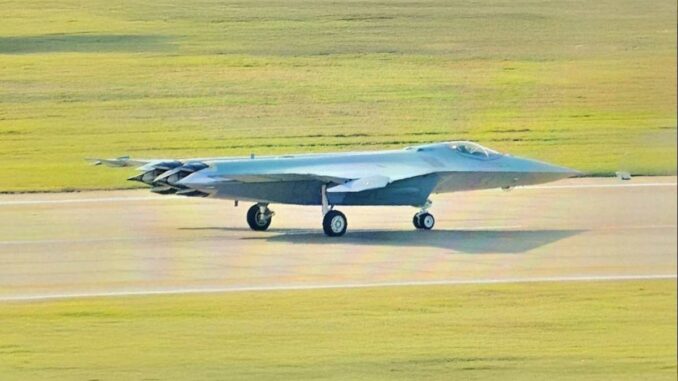
Satellite images reveal J-36 and J-50 stealth prototypes at a PLAAF base, suggesting that China could match the US in next-generation fighter jets by 2028.
Satellite images analyzed in early March 2026 revealed massive infrastructure and stealth prototypes identified as J-36 and J-50 at a base attributed to the PLAAF. These revelations fuel estimates that China could have a combined fleet of 5th and 6th generation fighters comparable to that of the United States by 2028. The images show large hangars, suitable for large-wing aircraft, and airframes with advanced stealth features. Beijing has not officially confirmed these designations. However, the industrial momentum and production pace of the J-20 suggest a tangible acceleration. The air balance in the Indo-Pacific could evolve faster than expected.
Satellite revelation and prototype identification
High-resolution commercial satellite images released in early 2026 show an aeronautical complex with unusually large hangars. Some buildings are over 70 meters long. These dimensions suggest that they are designed to accommodate large-wing aircraft or aircraft with unconventional architecture.
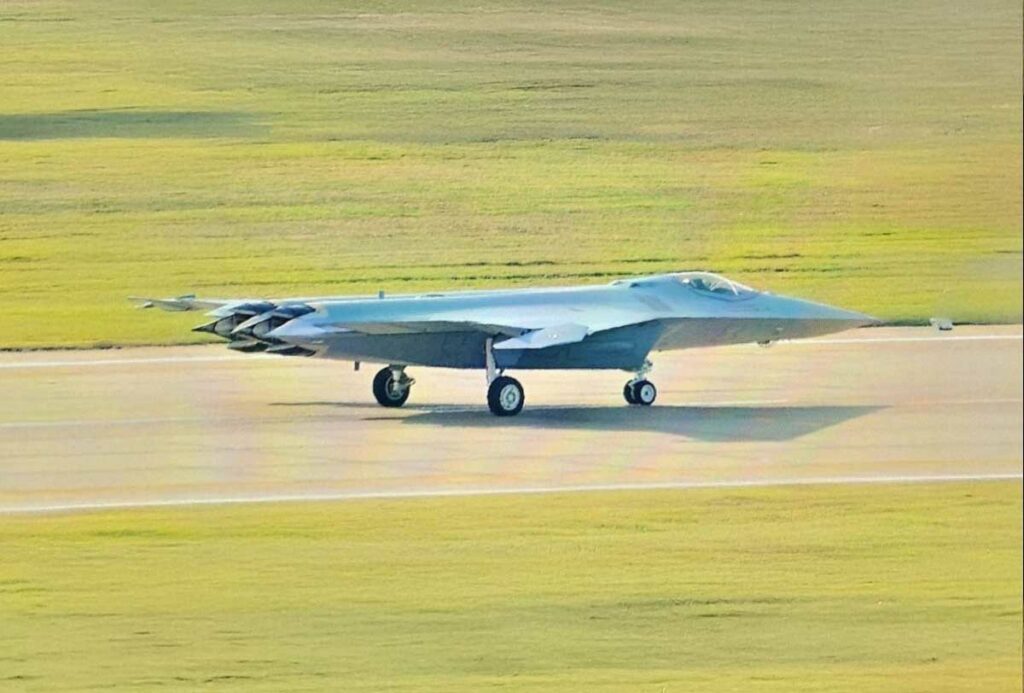
Analysts have identified two distinct types of stealth airframes, provisionally designated J-36 and J-50. These designations have not been confirmed by Beijing, but they have been circulating in specialist circles for several months.
The shapes observed suggest configurations without conventional vertical tailplanes. The apparent absence of fins suggests an increased focus on reducing radar signature. The air intakes appear to be integrated into the airframe, probably to conceal the compressors from frontal radar.
The massive hangars indicate a structured program. These are not isolated prototypes. The scale of the infrastructure suggests that testing is at an advanced stage.
Strategic significance for the PLAAF
The PLAAF has already integrated a significant number of 5th generation J-20 fighters. Western estimates suggest that more than 200 units are in service. The annual production rate is believed to be between 30 and 50 aircraft.
If China continues at this pace while developing a 6th generation aircraft, it could have a critical mass of modern fighters by 2028.
Projections suggest potential numerical parity with the United States in terms of 5th and 6th generation fighters in the Indo-Pacific region. This assumption is based on the rapid growth of Chinese industrial capabilities and the already significant number of J-20s.
The issue is not just about numbers. It is also about systems integration. A 6th generation fighter is not defined solely by its stealth capabilities. It incorporates fused sensors, collaborative combat capabilities, and advanced data links.
The technical definition of 6th generation
The term 6th generation is not standardized. However, there is consensus in strategic circles on several characteristics.
These are aircraft with increased stealth across multiple spectrums. They incorporate AESA radars based on gallium nitride semiconductors. They have enhanced onboard electronic warfare capabilities.
The 6th generation also includes the ability to control accompanying drones. These “loyal wingmen” act as force multipliers. The United States is developing this concept as part of the NGAD program.
While the J-36 and J-50 prototypes fit this definition, China is seeking to anticipate the next technological breakthrough rather than catch up.
The dimensions seen in the images suggest aircraft that are potentially larger than the J-20. This could indicate increased range or the integration of larger weapons bays.
Comparison with US capabilities
The United States currently operates the F-22 and F-35 as its main fifth-generation fighters. The NGAD program aims to introduce a new platform in the 2030s.
The US fleet of 5th generation fighters exceeds 800 aircraft if we include the F-35s of the US Air Force, US Navy, and Marine Corps. However, geographical distribution limits concentration in the Indo-Pacific.
China concentrates most of its forces in its regional theater. This proximity reduces deployment times and increases local density.
Analysts who anticipate parity by 2028 base their predictions on two factors. On the one hand, the continued production of the J-20. On the other hand, the potential early entry into service of a 6th generation fighter.
Caution is needed. Satellite images reveal prototypes. They do not prove immediate operational capability.
Industrial scale and massive hangars
The hangars that have been identified are particularly revealing. Their size exceeds that seen at some traditional bases. This suggests large-scale aircraft or flying wing architecture.
China has demonstrated its ability to rapidly build military infrastructure. Shipyards are one example. The aerospace industry is following a similar dynamic.
The production of the J-20 relies on a robust industrial chain, including the WS-15 engine, now announced as operational. If these engines are used in 6th generation prototypes, this confirms increased technical maturity.
The massive infrastructure also indicates a desire to protect these programs. The aircraft appear to be permanently sheltered, limiting exposure to satellites.
The potential impact on regional air power balance
The Indo-Pacific remains the main theater of strategic rivalry. Taiwan, the South China Sea, and Japan are points of tension.
If China achieves numerical parity in new-generation fighters by 2028, the deterrence balance will shift. The ability to challenge long-range airspace will become more credible.
However, technology alone does not guarantee superiority. Pilot training, operational experience, and joint integration play a decisive role.
The United States benefits from strong regional alliances. Japan and Australia are also investing in modern platforms. The dynamic is not limited to a bilateral duel.
Uncertainties surrounding the J-36 and J-50 designations
The designations J-36 and J-50 remain speculative. Beijing maintains minimal communication about its most advanced programs.
The prototypes observed could be technology demonstrators. It is possible that several configurations are being tested simultaneously.
China has already demonstrated its ability to surprise. The J-20 made its first public flight in 2011, before entering service a few years later.
The satellite revelation does not mean that the operational schedule is imminent. However, it does indicate that the testing phase is tangible.
Projection towards 2028 and possible scenarios
The 2028 horizon comes up regularly in analyses. It corresponds to a sensitive strategic window in the region.
If China has a combined fleet of 5th and 6th generation fighters equivalent in number to that of the United States in the area, the balance of power will become more complex.
It will not be a matter of automatic domination. It will be a more contested balance.
The satellite images from March 2026 send a strong signal. They confirm that technological competition is not slowing down. It is accelerating.
The central issue is not just the number of aircraft. It concerns the ability to integrate these platforms into a coherent system of sensors, satellites, and long-range missiles. This is where strategic credibility will be at stake.
War Wings Daily is an independant magazine.