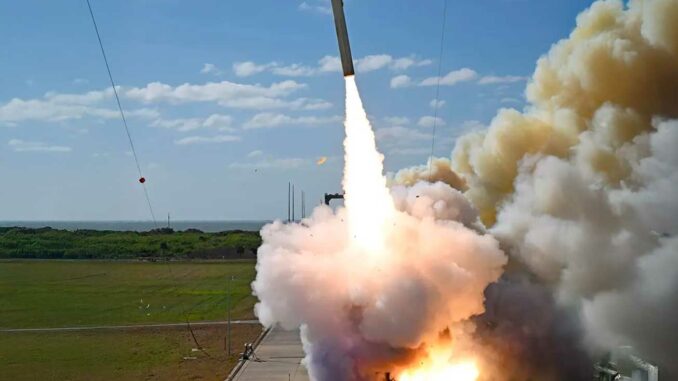
The Dark Eagle hypersonic missile reveals its key features. Range, payload, and strategic uses are reshaping American strike capabilities.
Summary
The Dark Eagle program, officially designated Long Range Hypersonic Weapon (LRHW), marks a real break with the American arsenal. Long shrouded in mystery, this land-based hypersonic weapon is beginning to reveal concrete details, particularly regarding its range and warhead, following recent statements made during an official visit to Redstone Arsenal. Dark Eagle is based on a rocket-launched hypersonic glider concept, capable of flying at over Mach 5 while maneuvering unpredictably in the atmosphere. Its purpose is clear: to quickly strike critical, heavily protected, and time-sensitive targets. Unlike conventional ballistic missiles, Dark Eagle confuses detection and interception logic. With a range now estimated at several thousand kilometers and a deliberately reduced warhead, the system favors precision, speed, and strategic effect over mass destruction. It is the first American hypersonic system intended for actual operational deployment.
The strategic context of the Dark Eagle program
A belated but determined response to the hypersonic race
For more than a decade, the United States has watched its strategic competitors gain ground in the field of hypersonic weapons. Russia has made numerous announcements about Avangard and Kinzhal. China has tested and then integrated the DF-17 with a hypersonic glider. Faced with these developments, Washington has long favored traditional deterrence and overall conventional superiority.
The Dark Eagle program was born out of this observation: the lack of an operational hypersonic capability weakened American credibility in a high-intensity conflict scenario. The goal is not to symbolically catch up, but to meet a specific military need: to quickly neutralize key targets before an adversary can react or disperse its resources.
Unlike other exploratory programs, Dark Eagle was designed from the outset as a deployable system, integrated into the ground command chain, with a tight schedule. This pragmatism explains why it is now the first American hypersonic system close to actual use in units.
Hypersonic glider technology explained simply
A concept different from conventional ballistic missiles
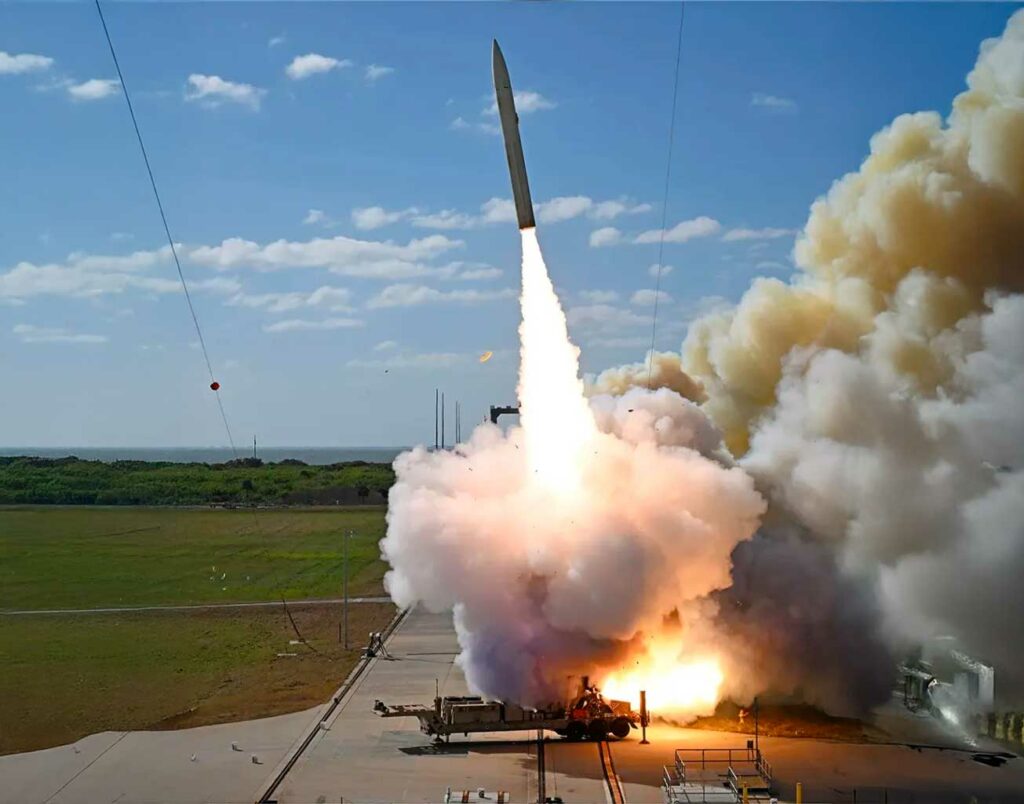
Dark Eagle is not a missile in the traditional sense. It is a boost-glide system. In concrete terms, a towed ground launcher deploys a solid-fuel booster missile. The latter accelerates the glider to a very high altitude before separating from it.
Once released, the hypersonic glider plunges into the upper layers of the atmosphere and begins a non-ballistic trajectory. It flies at speeds exceeding Mach 5, or more than 6,000 kilometers per hour, while performing lateral and vertical maneuvers.
This phase is key to the system. Unlike a ballistic warhead, whose trajectory is largely predictable after the propulsion phase, the hypersonic glider remains maneuverable. This drastically complicates the work of radars, trajectory calculators, and interceptors.
In practice, this reduces the adversary’s warning time to a few minutes, while increasing the probability of penetration against existing missile defenses.
Actual range now better understood
Finally credible figures
One of the most debated points about Dark Eagle was its range. Initial estimates suggested a distance of more than 2,700 kilometers (approximately 1,700 miles), a threshold that corresponds to the constraints of previous treaties on land-based missiles.
Recent information indicates that the effective range is indeed in this order of magnitude, or even slightly beyond, depending on the mission profile. Such a distance allows strikes to be launched from secure rear areas without immediately exposing the launching forces.
On a strategic level, this means that deployment in Europe or the Western Pacific would allow key areas to be covered in depth. Air bases, command centers, long-range radars, and air defense batteries are all potential targets.
It is important to emphasize one key point: range here is not synonymous with intercontinental nuclear deterrence. Dark Eagle is designed for high-value conventional strikes, where speed and surprise take precedence over explosive mass.
A deliberately reduced payload
Why a small payload is a strategic choice
One of the striking revelations concerns the military payload of the Dark Eagle glider. Contrary to what one might imagine, it is relatively compact. This choice is not a technological constraint, but a doctrinal decision.
At Mach 5 and beyond, kinetic energy becomes a major destructive factor. For example, an object weighing a few hundred kilograms traveling at over 6,000 kilometers per hour releases energy comparable to several hundred kilograms of conventional explosives, even without an additional payload.
The small payload has several advantages. First, it reduces the risk of confusion with a nuclear strike. Second, it improves accuracy and limits collateral damage. Finally, it reinforces the political credibility of the weapon: Dark Eagle is designed to be used, not just brandished.
This point is central. The United States is seeking a rapid, non-nuclear strike capability capable of neutralizing a strategic target without crossing the threshold of massive escalation.
Targeted targets and operational use
A tool against defenses and nerve centers
Dark Eagle is explicitly designed to strike highly defended targets. Examples cited by military officials include integrated air defense systems, command and control centers, and strategic sensors.
In modern conflict, these elements constitute the adversary’s nervous system. Neutralizing them quickly disrupts the entire military chain. Hypersonic speed makes it possible to act before these targets are moved, camouflaged, or further protected.
Unlike cruise missiles, which can be intercepted or jammed, Dark Eagle relies on an extremely short time window. Between detection and impact, the adversary has few credible options.
This makes it a conventional first-strike tool, in the military sense of the term, without aiming for global destruction.
Real innovation in the face of current limitations
What Dark Eagle changes, and what it doesn’t change
It would be an exaggeration to present Dark Eagle as a miracle weapon. The system remains expensive, complex, and ill-suited to mass strikes. Its role is not to replace aviation or cruise missiles, but to fill a specific capability gap.
The innovation lies in the combination of three factors: hypersonic speed, atmospheric maneuverability, and mobile ground launch. Few current systems combine these characteristics in an operational manner.
However, Dark Eagle does not solve everything. It does not eliminate the need for accurate, real-time intelligence. It does not negate future advances in hypersonic defenses. And it raises serious questions about strategic stability, particularly because of the difficulty of distinguishing between a conventional strike and a nuclear strike in the first few minutes.
Global strategic implications
A more unstable but more deterrent balance
The entry into service of Dark Eagle changes the strategic equation. It strengthens the US’s ability to strike quickly without resorting to nuclear weapons. But it also increases the pressure on adversaries’ warning systems.
In a crisis environment, a detected launch can be interpreted pessimistically. This ambiguity is inherent in hypersonic weapons. It forces states to review their response doctrines and decision thresholds.
For US allies, Dark Eagle represents a guarantee of increased military credibility. For potential adversaries, it imposes new, costly, and technically complex defensive investments.
What Dark Eagle really reveals
Dark Eagle is not just a new weapon. It is symptomatic of a strategic shift. The United States now accepts the idea that speed and precision can, in some cases, replace mass and brute force. This development makes potential conflicts faster, more compressed in time, and therefore more difficult to control.
The real question is not whether Dark Eagle will be used, but how its mere existence will influence adversaries’ calculations. In a world where a few minutes can decide the outcome of a crisis, hypersonic weapons become less of a weapon and more of a permanent pressure factor.
Sources
Official U.S. Army communications on the Long Range Hypersonic Weapon
Public statements during the visit to Redstone Arsenal
Congressional Research Service reports on hypersonic weapons
Department of Defense analyses on rapid conventional strike
Specialized publications on boost-glide technologies
War Wings Daily is an independant magazine.