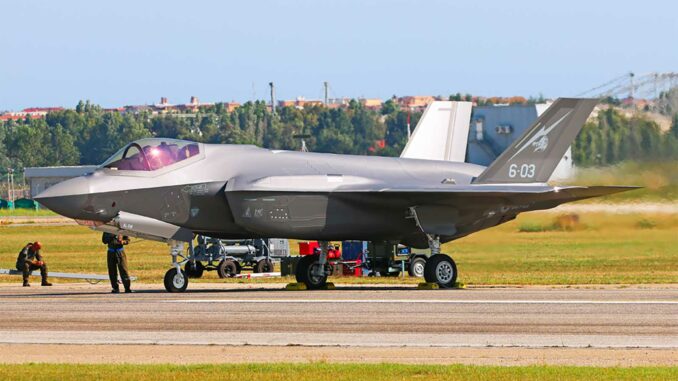
Why the F-35’s availability rate will plateau at around 50% in 2025. Engine, parts, software: technical analysis of a long-standing problem.
Summary
In 2025, several official audits confirm an embarrassing reality for the F-35 Lightning II program: some fleets have an operational availability rate of around 50%, far below the initial targets. This weakness cannot be explained by a single cause, but rather by an accumulation of structural constraints. The heart of the problem lies with the F135 engine, which is facing shortages, overly long maintenance cycles, and delays in its modernization. Added to this are strained logistics, parts cannibalization practices, and a complex software architecture that is regularly affected by anomalies. The support system, designed to be centralized and predictive, has not delivered on its promises on a global scale. The most problematic issue remains uncertainty: there is currently no reliable timeline for anticipating a lasting stabilization of the supply chain. The F-35 thus remains a technologically dominant aircraft, but structurally fragile in terms of availability.
The F-35’s availability rate as a strategic indicator
Operational availability, often referred to as Mission Capable Rate, measures the proportion of aircraft capable of performing at least one given mission at a given moment. For the F-35, the initial targets set by the Pentagon were for a rate of over 70%, with a long-term ambition of around 80% for mature fleets.
In 2025, however, several US and allied fleets are operating at between 50% and 55%, according to internal audits and parliamentary reports. This level is worrying, not because it is low at a given moment, but because it persists despite more than fifteen years of gradual commissioning.
From a military perspective, low availability does not only mean fewer aircraft in flight. It also means increased pressure on available airframes, accelerated crew fatigue, and reduced deterrent credibility in periods of heightened tension.
The F135 engine as the central breaking point
The F135 engine, developed by Pratt & Whitney, is currently the main factor limiting the availability of the F-35. This turbojet engine, the most powerful ever installed on a Western fighter jet, exceeds 190 kN of thrust (approximately 43,000 pounds) in afterburner mode.
Its power and compactness come at a cost. High internal temperatures and mechanical stresses accelerate the wear and tear of certain critical components. As a result, maintenance cycles are shorter than expected, and visits to the workshop are more frequent.
Starting in 2022, stocks of replacement engines have become insufficient. In 2025, several hundred F-35s are partially grounded due to a lack of available engines. The average time to return to service after engine removal sometimes exceeds six to nine months, a figure incompatible with a fleet that is supposed to be on permanent alert.
Delays in engine modernization and their knock-on effects
The F135 modernization program, designed to support future developments of the F-35, notably the Block 4 standard, has fallen behind schedule. This modernization was intended to improve thermal management, durability, and electrical power generation.
In the meantime, existing engines are operating beyond their initial margins, particularly to power more energy-intensive sensors. This situation creates a vicious circle: the more capacity increases, the more the engine suffers, and the more availability drops.
The problem is exacerbated by limited industrial capacity. Heavy maintenance lines can only handle a limited number of engines at a time. Even with increased budgets, the time factor remains incompressible.
Chronic shortage of spare parts
Beyond the engine, the availability of the F-35 is hampered by a persistent shortage of spare parts. The program relies on a global supply chain, with suppliers spread across several continents.
This architecture, designed to optimize long-term costs, has proven fragile in the face of shocks.
Pandemics, geopolitical tensions, raw material inflation, and competing industrial priorities have disrupted flows.
In practice, some critical parts have delivery times of more than 200 days, well beyond military aviation standards. Every aircraft grounded for a minor part becomes a stress multiplier for the entire fleet.
Cannibalization as a symptom, not a solution
Faced with shortages, many air forces resort to cannibalizing parts, which involves removing components from one grounded aircraft to keep another in the air.
This practice saves flight hours in the short term, but it worsens the overall situation. Each cannibalized aircraft becomes more difficult to return to service, and the maintenance burden increases mechanically.
Audits in 2025 show that some US bases use this method almost systematically. This choice reflects not so much poor management as a lack of credible alternatives within the imposed operational deadlines.
The limits of the integrated logistics support system
The F-35 was designed around a centralized support system, initially known as ALIS, then replaced by ODIN. The goal was to predict breakdowns, optimize inventory, and reduce maintenance costs.
In practice, these systems suffered from bugs, incomplete data, and slow processing. Parts were sometimes ordered too late or sent to the wrong bases, despite theoretical availability in the network.
This dependence on digital technology has created rigidity. Whereas older fleets rely on short supply chains and local inventories, the F-35 remains dependent on a cumbersome architecture that is difficult to adapt in a crisis situation.
The importance of software in operational availability
The F-35 is first and foremost a flying software platform. Each software update aims to improve sensors, weapons, data fusion, and connectivity. But each upgrade also introduces new risks.
In 2024 and 2025, several fleets reported software anomalies affecting availability. Some versions required urgent fixes, temporarily grounding aircraft that were otherwise in good mechanical condition.
The paradox is clear: software is the strength of the F-35, but also a source of unpredictability. Unlike a physical part, a bug can ground an entire fleet without warning.
Different availability depending on the variant
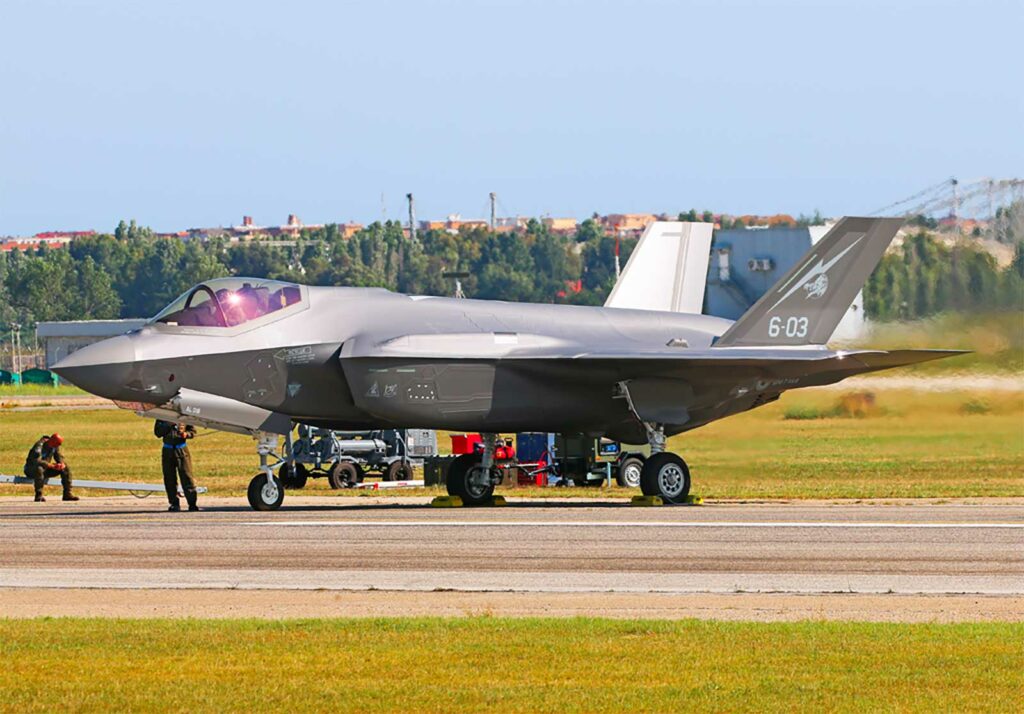
The situation is not uniform between the F-35A, F-35B, and F-35C variants. The short takeoff and vertical landing version, the F-35B, has historically had the lowest availability rates due to its mechanical complexity.
The naval version, the F-35C, which is operated from aircraft carriers, suffers from specific constraints related to the marine environment. The F-35A, the conventional version, remains the easiest to maintain, but is not immune to engine and logistical problems.
This disparity complicates the overall management of the program, as solutions that are effective for one variant are not always transferable to others.
Reactions from user air forces
Faced with this situation, several air forces have adjusted their rhetoric. The tone is no longer one of promise, but of risk management. Chiefs of staff publicly acknowledge that the availability of the F-35 will remain below targets for several more years.
Some armies are investing in complementary capabilities to compensate. Others are extending the use of older fleets in order to preserve the F-35’s potential for critical missions.
This pragmatism reflects a growing awareness that the F-35 cannot be evaluated solely on the basis of its performance, but also on its operational sustainability.
Why no one can predict a rapid improvement
The key question remains the timeline. When will the availability of the F-35 improve in a sustainable way? The honest answer is simple: no one knows for sure.
Stabilization depends on several independent variables. The ramp-up of engine maintenance. The resolution of industrial bottlenecks. The maturity of logistics systems. And discipline in managing software upgrades.
Each of these variables can improve. But their simultaneous alignment remains uncertain. It is this fluid nature that makes the problem so difficult to solve.
What the availability crisis really reveals
The F-35 is not a technological failure. It fulfills its missions and offers a real operational advantage. But it reveals the limitations of an industrial and logistical model pushed to the extreme.
Low availability is no accident. It is the price of accepted complexity combined with global industrial dependence. The question, therefore, is not whether the F-35 is a good aircraft, but whether it is sustainable on a large scale, over several decades, in an environment of constant tension.
Sources
– Government Accountability Office reports on F-35 availability.
– U.S. Department of Defense audits, fiscal years 2024-2025.
– Official communications from Lockheed Martin and Pratt & Whitney on the F135.
War Wings Daily is an independant magazine.