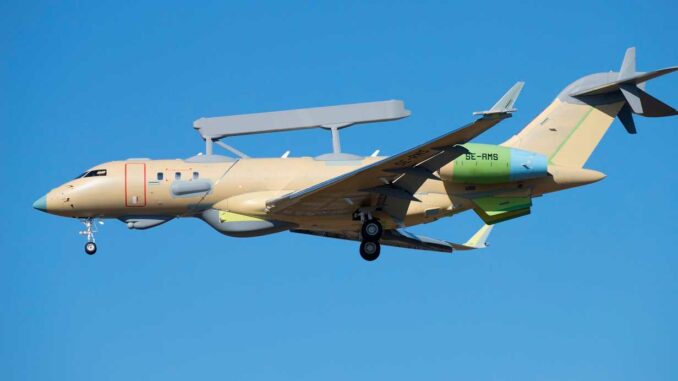
Two Saab GlobalEye aircraft will replace the E-3F Sentry: a choice based on capability and industry, and a full-scale test for the French Kill-web.
In summary
The Ministry of the Armed Forces has formalized the purchase of two Saab GlobalEye surveillance and command aircraft, via the DGA, to replace the Air and Space Force’s E-3F Sentry AWACS. The contract is worth 12.3 billion kronor (approximately 1.1 billion euros) and includes an option for two additional aircraft. Deliveries are scheduled for 2029-2032, while the E-3F fleet, which entered service in the early 1990s, is due to be withdrawn by 2035. Beyond replacing an aging and costly-to-maintain platform, the challenge is to transform the French collaborative combat network: bringing a modern multi-domain sensor into the decision-making loop, sharing reliable leads, and accelerating the “detect-decide-act” chain within the Kill-web. It is a structural but demanding decision.
The decision to replace a critical tool that has become fragile
AWACS are not a “plus.” They are force multipliers. They create the aerial picture, orchestrate air policing, streamline the use of fighters, and give depth to command. When this building block cracks, everything else loses coherence.
France has four E-3F Sentry aircraft. On paper, this is a sufficient fleet to cover training, permanent security posture, and deployments. In reality, a fleet of four aging aircraft is vulnerable to three very concrete realities: structural wear and tear, avionics obsolescence, and industrial availability of parts. An aircraft of this generation is not “tired” in an abstract sense: it requires long periods of downtime, more extensive checks, and maintenance costs that skyrocket as the industrial base shrinks.
The decision to replace these aircraft is therefore not just a purchase. It is a measure of operational continuity. Waiting would have come at a price: capacity gaps and increased dependence on allied resources, at a time when France is calling for greater autonomy in decision-making and action.
The choice of a GlobalEye and what the platform really brings
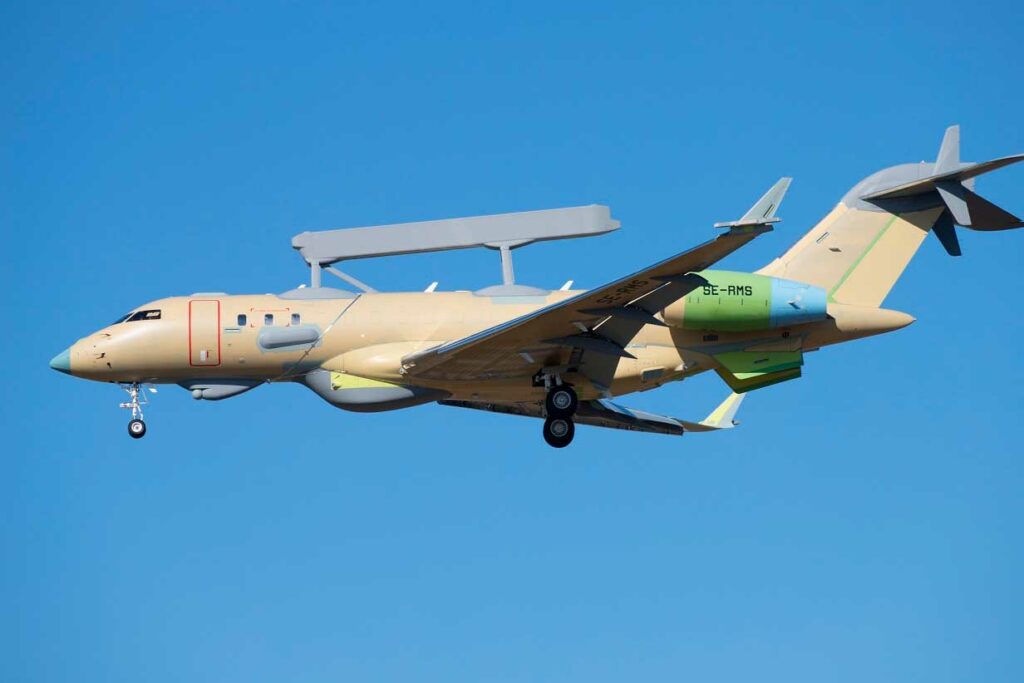
The GlobalEye is not a “classic” AWACS in the 1980s sense. It is designed as a multi-sensor surveillance platform, with a logic of data fusion and immediate sharing. It is based on a Bombardier Global 6000/6500 business jet, which is more economical and discreet than a large aircraft derived from an airliner.
Sensors and multi-domain logic
At the heart of the system is the Erieye ER radar, an AESA mounted on top of the fuselage. The ranges published by the manufacturer and repeated by several sources are around 550 km (or approximately 600 km depending on configurations and targets). This range is not a magic wand: it depends on altitude, target signature, clutter, weather, and emission rules. But it gives an idea of the generational leap in detection and tracking capability.
The promise lies elsewhere: GlobalEye aims to detect and identify objects in the air, at sea, and on land, then provide this “ready-to-use” information to command. In a context where threats are more varied (drones, cruise missiles, mixed raids, saturation), the value of an AEW&C system is measured by its ability to sort quickly, correlate accurately, and disseminate at the right level.
Endurance and operational tempo
Another order of magnitude often cited is an endurance of about 11 hours. This is crucial, because a command aircraft is primarily used to maintain endurance. The question is not “can it see far?”, but “can it see for a long time, with what crew, at what pace, and with what level of fatigue?”
In practice, this endurance facilitates extended patrols and reduces pressure on the fleet, provided that crew organization and technical support are calibrated.
However, with only two aircraft in the first tranche, careful management is required in terms of training, skills maintenance, availability, and reserves for unforeseen events.
The 2029 schedule and the risk zone between two fleets
The contract announces a delivery window between 2029 and 2032. This is consistent with a program of conversion, integration, training, and qualification. But it is also a schedule that requires the E-3Fs to be kept in service until the end, without any reduction in capacity.
However, France has already committed to providing long-term support for the E-3Fs until their planned withdrawal. This clearly indicates one thing: the period between 2026 and 2030 will be a challenging transition. It will be necessary to simultaneously maintain an old fleet, prepare a new fleet, and ensure that the transition does not compromise operational availability.
This is where the option of two additional aircraft carries political weight. With two GlobalEyes, France is replacing one capability, but not the “structural” equivalent of four E-3Fs in terms of resilience and cadence, especially if external commitments increase. If the ultimate goal is to cover all the missions currently performed by the AWACS fleet, the decision will have to be made early, before the issue becomes a matter of forced arbitration.
The transformation of the Kill-web as a real project, not just a slogan
The purchase of a command aircraft is only worthwhile if it can fuel and accelerate collaborative combat. France talks about the Kill-web, which refers to an architecture: distributed sensors, robust networks, fusion, and faster decision loops.
To be frank, integrating a major sensor such as GlobalEye into the Kill-web is more difficult than purchasing the aircraft. The main risk is not the aircraft, it is the integration.
Connectivity and track sharing requirements
GlobalEye must be able to share a tactical situation, inject tracks, receive data from other sensors, and redistribute it to effectors. This requires data links, gateways, standards, cybersecurity, and rules of engagement that avoid cacophony.
In real life, “real-time sharing” faces constraints in terms of bandwidth, latency, prioritization, encryption, and interoperability. Each partner, each army, and each system has its own habits and limitations. The benefits exist, but they must be earned.
Command and doctrine of use
A modern AEW&C aircraft is not just a flying radar. It is an airborne command post. This implies a clear doctrine: who decides, who authorizes engagement, what delegation, what rules of coordination with fighters, ground-to-air defense, naval assets, and ground centers.
If the Kill-web aims to shorten the “detection-engagement” chain, a cultural change will have to be accepted: more confidence in multi-sensor fusion, more automation of repetitive tasks, and strict discipline on data quality. Without this, speed comes at the price of errors.
The industrial and political implications of Sweden’s choice
The contract is estimated at around €1.1 billion. It also includes ground elements, training, and support. This is an important point: AEW&C is not a “cell + radar” purchase, it is an ecosystem.
The choice of a non-American system also sends a signal. It strengthens a European axis (France–Sweden) on a critical capability, while maintaining NATO interoperability. This can be interpreted as a quest for capability autonomy without breaking alliances.
There is also a sensitive, often implicit issue: the “system of systems” air base.
When a sensor becomes central, the issue of data sovereignty, software updates, supply chain security, and control over developments becomes strategic. GlobalEye is a modern system, and therefore software-intensive. This imposes contractual requirements from the outset on maintenance and control over developments.
Expected operational effects in the face of current threats
The context of 2025-2026 is not that of the end of the Cold War. Air forces face more numerous, less predictable, and sometimes less costly threats from the adversary (drones, loitering munitions, cruise missiles). In this landscape, an AEW&C must excel in three tasks.
First, early detection: spotting what is flying low, small, and sometimes in swarms. Next, saturation management: prioritizing and distributing the response, rather than “seeing everything” without knowing what to do. Finally, multi-environment coordination: linking ground-to-air bubbles, fighter patrols, and naval sensors.
The GlobalEye is designed for this logic. But its ultimate effectiveness will depend on how France integrates it into its combat architecture: Rafale, ground-to-air defense, command, space assets, and electromagnetic intelligence. A powerful, isolated sensor remains just a sensor. A connected sensor becomes a capability.
The question that remains open: are two aircraft enough?
The order for two aircraft is a start. It secures the transition and materializes a choice. But it does not solve everything.
If the ambition is to eventually replace the four E-3Fs, then the decision on the option will have to follow quickly. Otherwise, France risks a difficult equation: a more modern system, but a critical mass too small to absorb unavailability, peaks in activity, and external commitments.
The challenge is clear: modernize quickly, integrate well, and truly transform collaborative combat. If Kill-web remains just a word, the aircraft will be underutilized. If Kill-web becomes a mastered architecture, GlobalEye could become one of the most useful pillars of French air power by 2030.
Sources
- Reuters, “Saab wins order from France for two GlobalEye surveillance planes,” December 30, 2025.
- Saab, “Saab receives GlobalEye order from France,” December 30, 2025.
- Le Monde (with AFP), “France orders two GlobalEye surveillance aircraft…,” December 30, 2025.
- Air & Cosmos, “Early warning: France orders two GlobalEye aircraft,” December 30, 2025.
- Ministry of the Armed Forces, Press Room (reference to the press release on the GlobalEye order), December 31, 2025.
- Le Journal de l’Aviation, “MCO: The E-3Fs… will remain with AFI KLM E&M until they are replaced,” December 1, 2025.
- AeroBuzz, “France orders two Saab GlobalEye aircraft,” December 31, 2025.
War Wings Daily is an independant magazine.