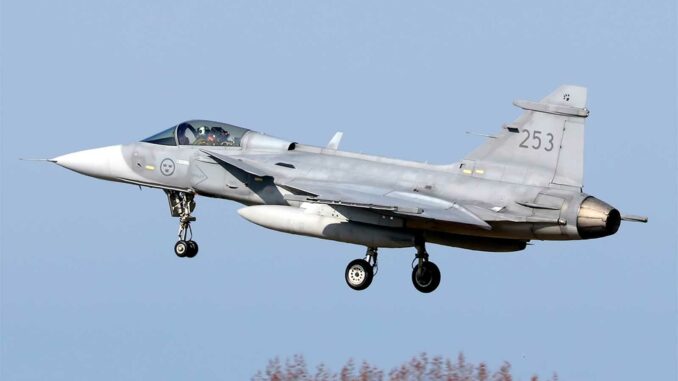
Saab proposes to assemble 72 Gripen aircraft in Canada and add six GlobalEye aircraft, focusing on employment, sovereignty, and the Arctic posture vis-à-vis the United States.
In summary
On January 19, Saab put a proposal back on the table that directly targets a Canadian nerve: industrial independence. The Swedish offer promises to assemble 72 Gripen E/F aircraft in Canada and add six GlobalEye aircraft to strengthen air surveillance and combat management. The message is clear: Ottawa can modernize its air defense while keeping a greater share of the value on its territory, rather than relying exclusively on a U.S. supplier. This approach comes at a sensitive time. Canada has already agreed to purchase 88 F-35s to replace its CF-18s, but the program has been criticized for its cost overruns and tight schedule. Saab is therefore exploiting a political window of opportunity by proposing a “sovereignist” plan that industrializes the fleet and promises greater support autonomy. For Ottawa, the offer is attractive on paper, as it addresses employment, maintenance, and the NORAD posture in the Arctic. For Saab, it is a rare opportunity to penetrate a market dominated by Washington.
The Swedish offer targets a Canadian weak spot
Canada has no shortage of allies. What it lacks is room for maneuver. Its defense is caught between a vast geography and a budget that must finance several priorities at once: fighter jets, surveillance, submarines, artillery, cyber, and a presence in the Far North.
Against this backdrop, Saab has chosen an aggressive strategy: not just selling an aircraft, but a complete industrial trajectory. The principle put forward is simple: a country never fully “owns” a modern fleet if it does not control its support chain, critical parts, and ramp-up capacity in the event of a crisis.
This is precisely where the Swedish offer aims to score points, promising local assembly and direct benefits. The addition of a long-range air surveillance component, via the GlobalEye, reinforces the military coherence of the package.
Saab’s strategy, designed to be both a political and military lever
Saab is not competing with the F-35 on stealth. The contest would be uneven. Saab is playing on three levers that appeal to governments.
The argument of industrial sovereignty
The defense industry is an increasingly political issue in Canada. The idea of excessive dependence on the United States is gaining ground, especially when trade relations become more difficult or unpredictable.
Proposing to assemble a fighter fleet locally means promising an immediate return: jobs, skills, subcontracting, and above all, a start to control over heavy maintenance.
The implicit goal is to transform military spending into a national economic project. Saab is pushing precisely where the debates on the F-35 are most sensitive.
The cost of ownership argument
An aircraft can be competitive at purchase but ruinous over 30 years. In the case of the F-35, Canada is facing inflation announced by its own institutions.
The Parliamentary Budget Office has estimated a total life-cycle cost of approximately C$73.9 billion in 2023, including C$19.8 billion for acquisition and C$53.8 billion for operation and support. This is the item that dwarfs everything else. Saab knows that this is a credible angle of attack: a simpler, lighter aircraft that is more easily industrialized locally may appear to be a rational choice for a “mass” fleet.
The GlobalEye “package” argument
The GlobalEye is not a gadget. It is a multiplier. A country with advanced surveillance aircraft gains in detection, coordination, and control of its airspace. For a vast territory, this is a direct advantage.
Saab therefore offers a complete solution: fighter + early warning. It is also a way of saying, “You will not be solely dependent on American sensors and architectures.”
The concrete reasons that make the offer attractive to Ottawa
Canada does not need a fighter aircraft just to “be like everyone else.” It has to respond to very specific missions.
An air posture dictated by distance
Canada must monitor and defend an airspace covering millions of square kilometers. Pressure is mounting with the return of strategic competition in the North. Patrols, interceptions, permanent presence, and response capability are more important than technological perfection.
In this context, an available, sustainable, and well-connected fleet may carry more weight than an ultra-sophisticated aircraft that is costly to fly.
The central role of NORAD and the Far North
The North American defense architecture relies on sensors, procedures, and continuous coordination. A fighter jet is not only used for combat. It is used to identify, intercept, constrain, and deter.
Surveillance and coordination are therefore essential. This is where GlobalEye makes sense: it enhances detection and provides a high-altitude relay, useful for operations over isolated, maritime, or polar areas.
A national industry to be strengthened rather than compensated
Canada already has a solid aerospace base. It knows how to produce, maintain, and integrate. But the question is the actual value captured from a large fleet.
Assembling 72 fighters locally also means structuring maintenance capacity, training teams, creating inventories, and building resilience. This addresses a recurring concern: what happens if the American supply chain becomes saturated or if deliveries are delayed?
Budgets in the background and the fragility of the F-35 program
Saab’s offer comes at a delicate time for the Canadian program.
Canada plans to purchase 88 F-35s. The government presents this project as central to honoring its defense commitments and replacing an aging fleet. But the public debate has intensified.
In June 2025, a report relayed by Reuters cited an increase of at least 45% in the estimated cost of the program, now projected to be between 27.7 and 33.2 billion Canadian dollars, compared to 19 billion at the time of the initial announcement. This increase is attributed to currency, infrastructure, and delays. The same source notes that Canada has committed financially to the first aircraft, while launching a review. Deliveries are expected between 2026 and 2032.
This context creates an opportunity. When a program becomes politically costly, a “local industrialization” alternative can be appealing, even if it does not completely replace the initial need.
Gripen versus F-35: a question of role rather than prestige
Gripen will not beat the F-35 on stealth. That is not the issue. The question is rather: what does Canada really need, and at what price?
A mixed fleet may seem logical on paper
The idea of a “mix” exists: keep an F-35 component for the most demanding missions and add a fleet of Gripens for sovereignty and interception tasks.
But this logic has a hidden cost: two fleets, two supply chains, two training programs, two inventories, two maintenance pipelines. The operational gain may be real, but the complexity quickly explodes.
Gripen targets everyday missions
Gripen is designed to be operable, quick to get back online, and suited to environments where availability matters. For interceptions, patrols, alerts, and exercises, it’s a profile that appeals to budgets.
The F-35 aims for integrated high intensity
The F-35 is a sensor and data fusion system as important as an aircraft. It is designed to penetrate heavily defended environments, share information, and act as a combat node. It is in a different value category, and therefore comes with a different price tag.
Ottawa must therefore decide whether to prioritize maximum qualitative superiority or preserve a sustainable mass capability.
Potential gains for Saab in a symbolic market
For Saab, Canada is an exceptional target.
A strategic showcase
Winning in Canada would be a demonstration of credibility in NATO and North America. It is a showcase for other customers: if Ottawa considers the offer reliable, other countries may follow suit.
Access to a rich industrial ecosystem
Canada has the skills, infrastructure, and subcontractors capable of supporting production, even if only partial. For Saab, this reduces industrial risk and increases the chances of securing internal political support for the project.
A blow to American hegemony
Even if Ottawa keeps the F-35, introducing a Swedish fighter into the mix would already be a symbolic victory. It would mean that Canada is diversifying and negotiating differently. For Saab, this is a major boost to its image and positioning.
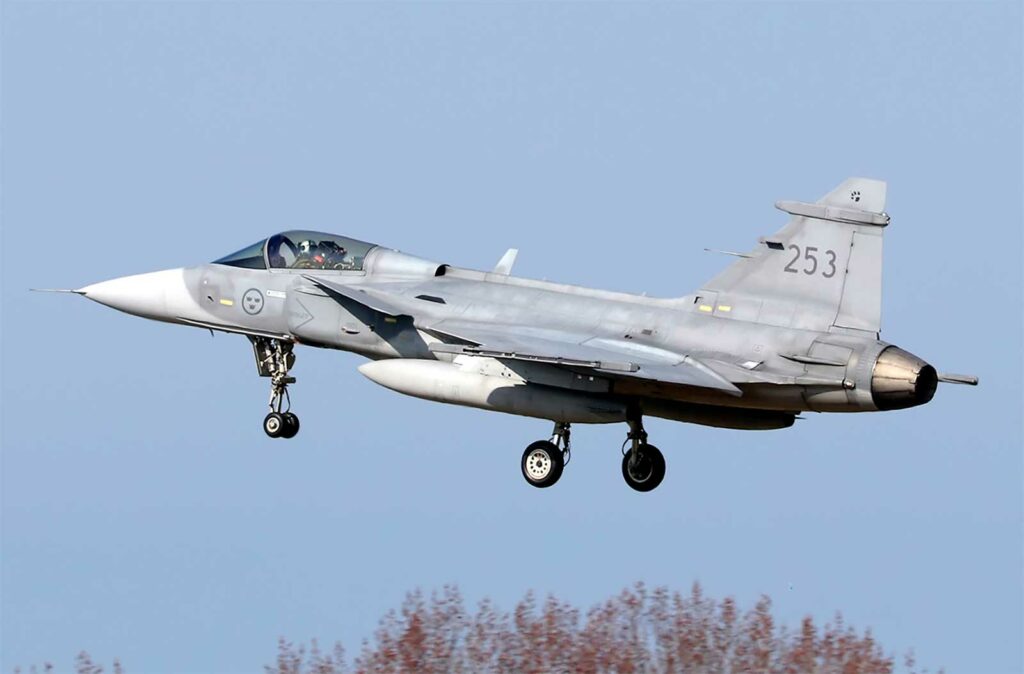
The limitations and gray areas of the Swedish proposal
We must also be honest: an offer may be attractive, yet difficult to turn into a contract.
Indirect dependence via certain components
The Gripen E is based on an American engine (F414). This means dependencies on licenses and authorizations. In a context of sovereignty, this is a point that needs to be addressed, not circumvented.
The risk of a highly polarized political debate
Canada is caught between its historic alliance with Washington and the temptation to diversify. An “anti-American” decision would be politically explosive. Saab must therefore convince without giving the impression of a break.
The credibility of the industrial schedule
Assembling in Canada is ambitious. It involves investment, engineering, transfers, and certifications. If the schedule becomes too long, the availability argument loses its force.
What Canada is really testing with this offer
Behind the announcement, the issue goes beyond Saab and the Gripen. Canada is testing an idea: can it regain control of its air defense without cutting itself off from its essential ally?
The Swedish offer presents Ottawa with a choice of models.
- A model of total American integration, highly efficient but highly dependent
- A more diversified, more industrial model, more controllable within the territory
This debate is rarely posed so directly. Saab is forcing it to exist by linking fighter jets, surveillance, and jobs.
And that may be the most interesting thing: this proposal acts as a constraint of truth. It forces Canada to quantify, compare, and say what it really wants to protect: its borders, its industry, or the coherence of a strategic bloc.
An open endgame, but already a powerful signal
Even if the offer is not successful, Saab has already gained something: putting sovereignty back at the center of the Canadian aviation debate.
The Gripen is not just sold as an aircraft. It is sold as a way to avoid dependence on a single supplier. At a time when security is once again becoming central, this promise carries real weight.
One simple but decisive question remains: Does Ottawa want to buy a solution, or buy a relationship?
Sources
Opex360 – “Saab proposes to assemble 72 Gripen E/F and 6 GlobalEye aircraft in Canada,” January 19, 2026
Canada.ca – Future Fighter Capability Project (purchase of 88 fighter jets)
Reuters – Cost of Canada’s new US-made fighter jet fleet set to rise, June 10, 2025
Reuters – Canada PM Carney says review of F-35 jet order…, June 25, 2025
Parliamentary Budget Officer – The Life Cycle Cost of Canada’s F-35 Program, November 2, 2023
Defense News – Canada faces dense defense-acquisition docket as F-35 review looms, May 16, 2025
Reuters – Saab wins order from France for two GlobalEye surveillance planes, December 30, 2025
War Wings Daily is an independant magazine.