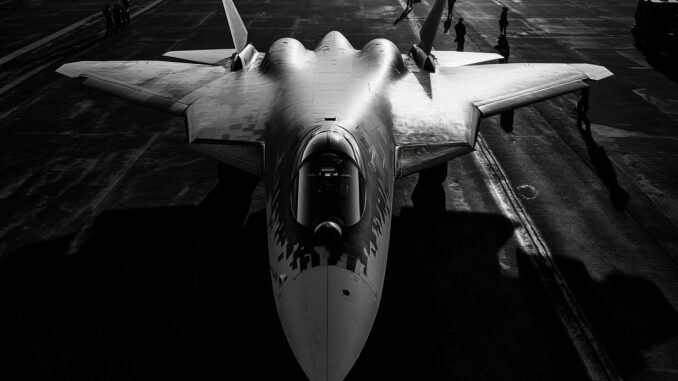
Amid Russian confirmations, leaks, and uncertainties, Algeria appears to be becoming the first export customer for the Su-57 Felon—but the deal raises major political and strategic risks.
Summary
Since late 2024, speculation has gradually grown that Algeria has placed an order for the Russian Sukhoi Su-57 stealth fighter (export version “Su-57E” / “Felon”). Leaked documents attributed to the Russian conglomerate Rostec refer to an agreement for a dozen aircraft, and in early November 2025, the first units were delivered to a foreign customer — widely identified as Algeria. This purchase is part of a long tradition of military cooperation with Russia and responds to modernization needs. However, doubts remain about the operational maturity of the Su-57, while the acquisition could expose Algiers to sanctions under the US Countering America’s Adversaries Through Sanctions Act (CAATSA). The choice opens a new chapter in Algerian air strategy, while raising questions of international policy and credibility.
The export version of the Su-57 and the emergence of a foreign customer
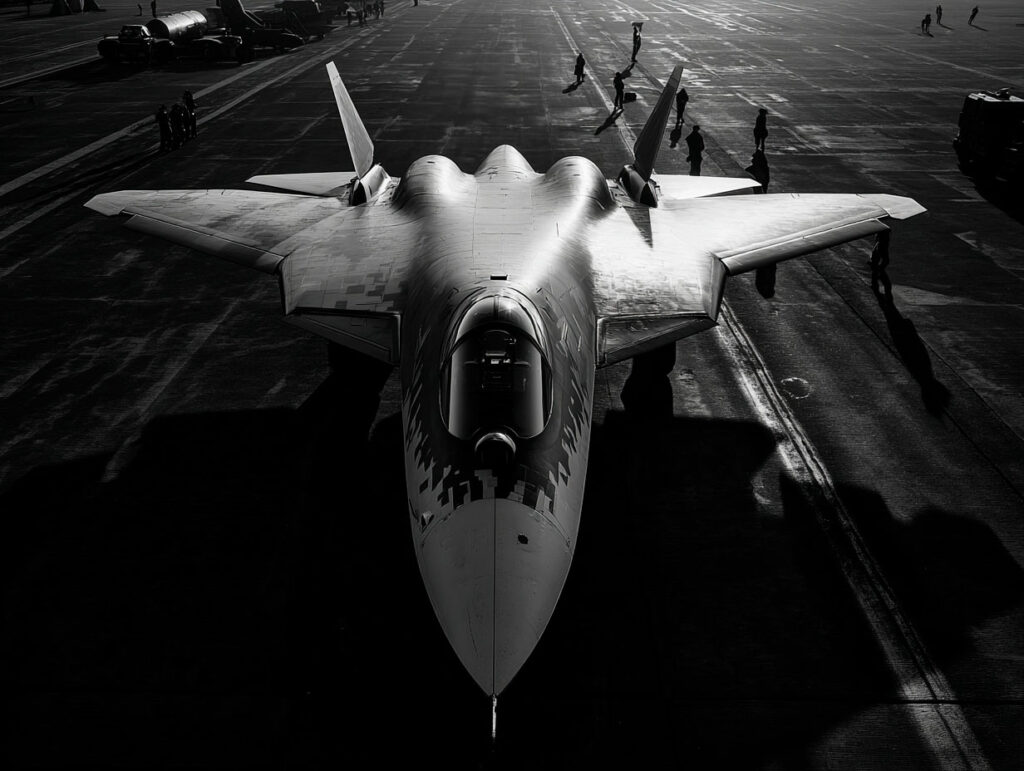
The Su-57 is a fifth-generation Russian fighter jet, stealthy, twin-engine, designed for air superiority, interception, air-to-ground or naval strike missions, with internal bays for missiles and weapons.
For a long time, no export contract had been officially confirmed. In November 2024, the Russian arms agency claimed to have signed an export order for the Su-57E, without naming the customer country.
In 2025, several converging clues reinforced the idea that the potential buyer was Algeria: leaked internal Rostec documents, made public, mentioned a country code corresponding to Algeria, recent orders for Su-57Es and Su-34s for Algiers, and a logistics component providing for maintenance hubs outside Russia.
At the 2025 Dubai Airshow, Russian manufacturer United Aircraft Corporation (UAC) announced the delivery of two Su-57Es to a “foreign customer.” No name was officially mentioned.
Specialized media, advocates, and observers quickly identified Algeria as the likely customer, making it the first non-Russian operator to own this stealth aircraft.
Algiers’ motivations for acquiring Russian fighters
A history of cooperation and a fleet already largely Russian
Algeria has maintained close ties with Russia for decades in the field of armaments. Its combat aviation already uses a significant number of modern Russian aircraft: Sukhoi Su-30MKA, Mikoyan MiG-29, bombers, helicopters, air defense systems, etc.
This choice guarantees Algiers logistical consistency, shared standards, and long-standing experience in the maintenance and servicing of Russian equipment.
A need for modernization in the face of regional developments
The arrival of the Su-57E would enable Algeria to close a perceived technological gap, particularly in relation to neighbors likely to acquire Western fighters or other modern equipment. According to analysts, the acquisition of stealth fighters represents a “technological compromise” to make up for a handicap in regional air supremacy.
With a fifth-generation multi-role aircraft, the Algerian Air Force would gain versatility—interception, air superiority, ground strike, or anti-ship strike—while modernizing the country’s strategic capabilities in the air.
A strategic choice of diversification and autonomy
The purchase of the Su-57E is part of a policy whereby Algeria aims to maintain strategic autonomy without depending on Western suppliers who impose political conditions. Russia’s long-standing and solid cooperation offers guarantees of continuity. The use of “non-NATO” suppliers also allows Algiers to preserve a certain degree of diplomatic freedom in a complex international context.
Uncertainties and doubts about the reliability of the Su-57
Despite its modern features, the Su-57 raises questions among the international community and military experts.
The number of units produced remains very limited: only a few dozen have been delivered to Russia, in addition to these first export units.
Delays, defects, and previous incidents have marred its development: a pre-production aircraft crashed during a test flight in 2019, and a Su-57 was reportedly damaged in 2024 by an enemy drone during the conflict in Ukraine.
Western analysts believe that, despite potentially superior maneuverability compared to some competing platforms, the Su-57 lags behind in terms of avionics, systems integration, software maturity, and the availability of AESA sensors.
Thus, despite the announcement of deliveries, uncertainties remain about the full operational capability of the exported Su-57s—and Algeria may discover limitations in real-world conditions when it comes to using them.
International implications and the risk of CAATSA sanctions
Algeria’s purchase of high-level Russian military equipment places it in a sensitive area in terms of international relations. In particular, the US CAATSA law provides for sanctions against countries that acquire major Russian weapons. Several observers believe that this type of acquisition could expose Algiers to coercive measures from the United States.
The sale of Su-57s to an African country that is heavily dependent on external financing and international trade could complicate Algeria’s diplomatic and trade relations with Western partners. It is a gamble: achieving regional military superiority without compromising other strategic or economic interests.
Furthermore, the publication of leaked documents referring to payments in rubles, yuan, or euros, and an international logistics network to circumvent financial restrictions, suggests that the parties are anticipating precisely these risks.
What the acquisition of the Su-57 reveals about Algeria’s strategic posture
The choice of the Su-57E confirms that Algiers intends to modernize and expand its military capabilities, while asserting its status as a regional power. This type of aircraft represents a technological leap forward, not only for the air force, but also for Algeria’s strategic image.
However, the gamble is twofold: on the one hand, Algeria risks ending up with an aircraft that is still in the consolidation phase, whose real operational effectiveness remains to be proven. On the other, it exposes itself to diplomatic and financial risks. By agreeing to integrate the Su-57, Algiers is clearly signaling its orientation towards Moscow, which may isolate it from nations that favor partnerships with the West.
While the delivery of the first two Su-57Es marks a turning point, the exact number of aircraft, their configurations, their actual use, and their impact on the Maghreb’s air balance remain to be seen. This deal could redraw the strategic map of the Maghreb—but it could also turn into a major challenge for the Algerian army if expectations are not met by actual performance.
What happens next will largely depend on Algiers’ ability to integrate these aircraft, maintain them, and manage the diplomatic fallout. The Su-57E could become the symbol of a new era for Algerian aviation—or a bold gamble with uncertain consequences.
Sources:
– RFI, “Russia has delivered the first two Su-57E fighters to Algeria” (November 2025)
– Meta-Defense, “Algeria confirms order for Su-57E” (February 2025)
– United24Media / United Aircraft Corporation, announcement of first Su-57E export (November 2025)
– Opex360, leak of Rostec documents and Algerian orders (October 2025)
– AviaNews, timeline of Su-57 deliveries to Algeria (2025)
– Wikipedia (Su-57), technical specifications, number and production history
– Jeune Afrique, Maghreb context and arms race (September 2025)
War Wings Daily is an independant magazine.