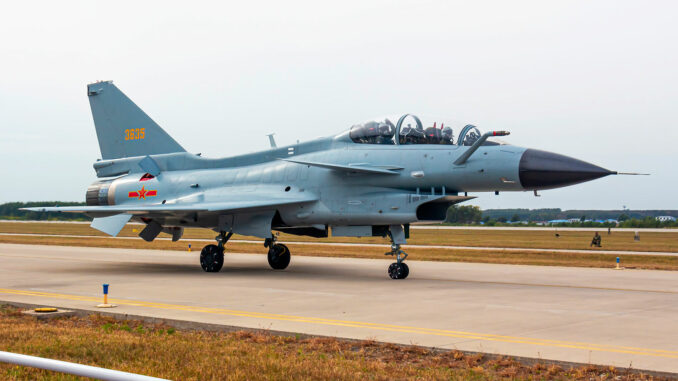
With the $9 billion deal for 42 J-10C fighters, Indonesia is breaking with Western engines and changing the strategic landscape of the region.
Summary
The Chengdu J-10C officially joins the Indonesian fleet, with a $9 billion contract for 42 aircraft, the first major acquisition outside the West. This choice responds to the partial obsolescence of the F-16s and Su-27/Su-30s of the Tentara Nasional Indonesia Angkatan Udara (TNI-AU), while diversifying Jakarta’s suppliers. The J-10C, a 4.5th generation aircraft with AESA radar and long-range missiles (PL-15), combines efficiency with moderate cost. Geopolitically, the agreement strengthens Indonesia-China ties and illustrates a multi-vector defense strategy, playing on the balance between the West, Moscow, Ankara, Seoul, and Beijing. However, this new impetus comes with challenges in terms of interoperability, logistics, and regional reactions.
Announcement of a strategic shift for Indonesian aviation
On December 8, 2025, Indonesia confirmed a $9 billion commitment to purchase 42 Chengdu J-10Cs. The Minister of Finance approved the budget, while the Minister of Defense stated that the aircraft would “soon be flying over Jakarta.”
This agreement marks a turning point. It is the first time that Jakarta has purchased a large number of “non-Western” fighter jets. Until now, the TNI-AU has relied on a diverse fleet inherited from the Cold War era: F-16s (United States), Su-27s/Su-30s (Russia), and Hawks (United Kingdom).
Alongside the purchase of 42 Dassault Rafales (contract in 2022, deliveries starting in 2026) and a commitment to 48 Turkish TAI Kaan aircraft, the J-10C is part of a strategy to diversify equipment sources.
The objective is clear: to rapidly modernize the air force to replace aging aircraft, while maintaining geopolitical flexibility.
The J-10C: a versatile 4.5ᵉ generation fighter
The J-10C is currently one of the most modern “non-stealth” fighters on the market. Designed by the Chengdu Aircraft Industry Group, it combines a WS-10B engine, an active electronically scanned array (AESA) radar, modern avionics, and the ability to carry long-range air-to-air missiles such as the PL-15 missile.
This single-engine delta-canard fighter offers good maneuverability, sufficient range to cover Indonesia’s vast expanses, and operational versatility—air superiority, interception, territorial defense, and intervention in large and dispersed areas.
This acquisition fills a gap: the F-16s are aging, maintenance of the Russian Sukhois is subject to logistical and diplomatic constraints, and delivery times for the Rafale or future Kaan are long. The J-10C therefore offers a rapid increase in capability, with an estimated unit cost that is more moderate than that of many Western fighters.

Motivations: pragmatism, timing, and strategic independence
Urgent modernization
The current fleet was showing signs of wear and tear. Logistical constraints on the Su-27/Su-30, the age limits of the F-16s, and uncertainty surrounding other programs made upgrading a matter of urgency. The J-10C offers a quick solution.
A controlled budget
The cost of the program—$9 billion for 42 aircraft—remains competitive by international standards. For a developing country, the compromise between performance and price was a decisive factor.
Diversification of foreign partners
By combining Western (Rafale), Turkish (Kaan), Korean (KF-21 via cooperation), and Chinese purchases, Indonesia is maximizing its strategic flexibility. This pluralistic choice underscores a desire for strict non-alignment, while promoting autonomy.
Regional geopolitical pressures
Faced with growing tensions in the South China Sea, the geographical dispersion of the islands, and territorial claims—particularly around the Natuna Islands—Jakarta needs a rapid and credible response capability. The J-10C is part of this deterrent strategy.
Geopolitical and strategic issues
The entry of the J-10C into the TNI-AU significantly changes the air landscape in Southeast Asia. The first consequence is a strengthening of military ties between Indonesia and China. The purchase could pave the way for broader cooperation—training, maintenance, education, and technology transfers.
Second, the agreement sends a strong signal to regional powers. By acquiring a modern Chinese aircraft, Indonesia is demonstrating its ability to rely on multiple suppliers, without exclusive dependence on Washington, Moscow, or Brussels.
This diversification may complicate strategic calculations in the region. For neighboring states—notably the Philippines, Vietnam, and Australia—Jakarta’s growing air power could prompt them to reassess their own defense capabilities.
Furthermore, the choice of the J-10C highlights the growing ambitions of the Chinese defense industry. The successful export of a 4.5-generation fighter jet to a key country such as Indonesia reinforces the credibility of Chinese military products on the international market.
Challenges ahead for implementation and interoperability
This bold choice nevertheless comes with significant challenges. The TNI-AU will have to manage an extremely heterogeneous fleet—J-10Cs, Rafales, Kaans, old Sukhois, and F-16s—which poses problems in terms of training, maintenance, logistics, and standardization.
Operational integration, the spare parts supply chain, pilot and technician training, and weapons compatibility all require sustained effort.
Another challenge concerns diplomatic perceptions. Some traditional partners may view this military rapprochement with China as a strategic shift, which could complicate future agreements with NATO or Western countries.
Finally, it will be necessary to observe the actual reliability of the J-10C in export service: availability, maintenance, logistical support, and performance in real conditions. These are crucial factors in judging the long-term success of this acquisition.
A pragmatic choice that could redraw the regional balance
Indonesia’s acquisition of the J-10C illustrates a pragmatic and thoughtful turning point, rather than a mere impulse. Faced with an aging fleet and growing threats, Jakarta has opted for a quick, affordable, and sufficiently effective solution.
Against the backdrop of Sino-American rivalry in the South China Sea, this decision could strengthen Indonesia’s position without definitively tying it to one side or the other.
Ultimately, the TNI-AU’s ability to manage a diverse fleet, master logistics, and maintain operational consistency will be decisive. If these challenges are met, Jakarta could offer a model of flexible and resilient modernization.
This strategic gamble on a Chinese aircraft—the J-10C—could well redraw the lines of air power in the region.
Sources
– AP News, article on Indonesia’s confirmation of the purchase of 42 J-10Cs (December 2025).
– FlightGlobal, analysis of the progress of negotiations between Indonesia and China regarding the J-10C.
– Asia Times, technical report on the J-10C and its relevance to the TNI-AU.
– The Diplomat, geopolitical analysis of Indonesia’s military diversification strategy.
– AeroTime, article detailing the combination of the Rafale, Kaan, and J-10C programs within the TNI-AU.
– Global Defense Corp, analysis of the regional implications of Indonesia’s choice in favor of the J-10C.
– Defence Security Asia, study on Indonesia’s motivations and the estimated cost of $9 billion.
– The Aviationist, technical data sheet and feedback on the J-10C and its positioning vis-à-vis Western fighters.
– TS2 Tech, geopolitical commentary on the global impact of the Indo-Chinese contract.
War Wings Daily is an independant magazine.