
Arctic climate, cold weather start-up, hidden costs: is the F-35 a good choice for northern countries or a very expensive technological gamble?
In summary
The F-35 Lightning II is gradually establishing itself as the standard fighter jet for many northern countries: Norway, Denmark, Finland, and soon Canada. This fifth-generation stealth fighter jet has been tested in Alaska and Norway on icy runways and in polar conditions, with generally positive feedback on its performance in cold weather. But this operational success comes at a price: high maintenance costs, heavy infrastructure, the need for heated hangars, complex support software, not to mention an hourly flight cost that far exceeds that of 4th generation fighters. For the Nordic air forces, the F-35 brings real informational and stealth superiority, but also locks budgets in place for decades. The question is therefore not only whether the F-35 works in cold weather, but whether the Nordic countries can sustainably afford its maintenance and financing model.
The context: a stealth fighter jet adopted by the North
In just a few years, the F-35 Lightning II has become the symbol of the 5th generation Western fighter jet. Designed by Lockheed Martin, it combines stealth, data fusion, and multi-role capability (air-to-air, air-to-ground, ISR). The F-35A variants are already in service in Norway and Denmark, have been selected by Finland, and are due to arrive in Canada by 2030.
For the Nordic countries, this fighter jet is not simply a replacement for the F-16 or F/A-18. It is designed to be the central hub of a combat system: NATO interoperability, real-time data sharing, and the ability to operate near Russia and over sensitive areas (Barents Sea, North Atlantic, Arctic).
The contracts are massive:
- Norway has ordered 52 F-35As.
- Denmark has ordered 27.
- Finland is buying 64 as part of the HX program.
With a unit cost of around $80 to $90 million per aircraft (excluding the engine), we are talking about national programs worth more than €8 to €10 billion each, including weapons, simulators, and infrastructure. For countries with populations of 5 to 10 million, this is a heavy and long-term commitment.
The reality of F-35 operations in cold weather
Tests in Alaska, Norway, and Finland
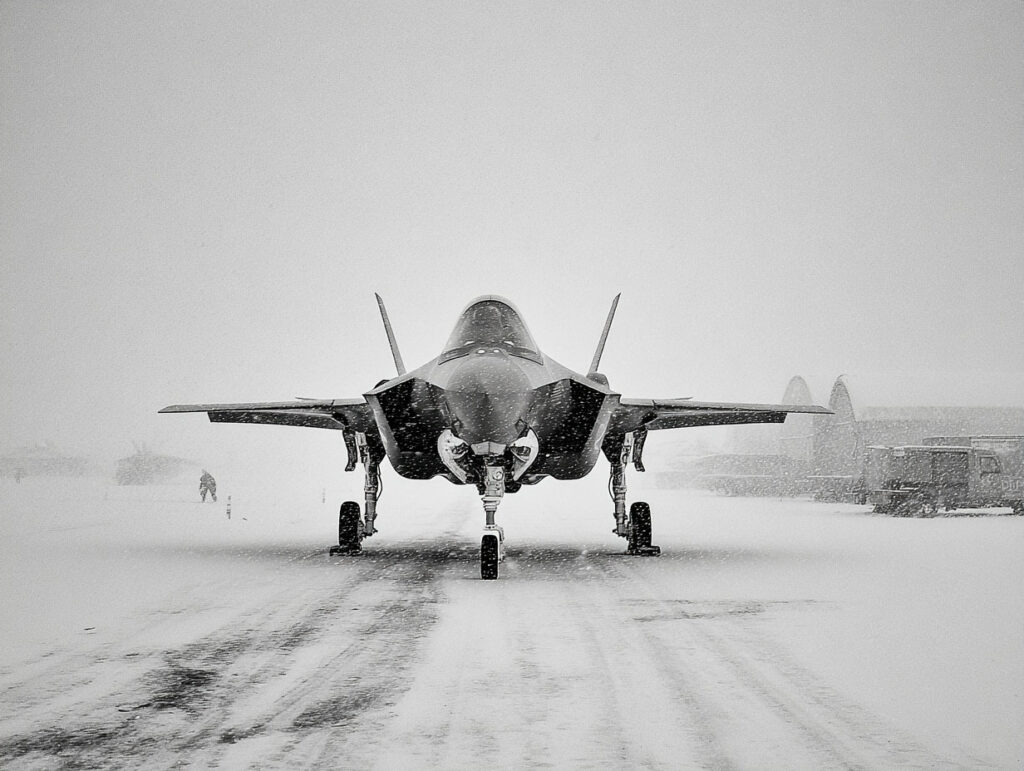
To determine whether the F-35 is suitable for operations in cold weather, we must first look at the tests and deployments. The aircraft was tested at Eielson Air Force Base in Alaska, particularly for takeoffs and landings on icy runways and to validate the performance of the systems in an Arctic environment.
The Royal Norwegian Air Force insisted on developing a specific parachute brake, housed in a pod behind the tail fin, to ensure safe landings on short, slippery runways. This parachute experienced reliability issues early on, but the Norwegian military now considers the F-35 to perform better than the F-16 on snow-covered runways, with increased stability during takeoff and landing.
The exercises in Finland go even further. F-35s have already operated from converted national roads as part of dispersion exercises, a key concept for a country that plans to use sections of highway as emergency runways. Seeing an F-35 land on a 30-meter-wide strip of asphalt surrounded by forest and snow shows that the aircraft can be integrated into a Nordic doctrine of dispersed bases.
The impact of cold weather on start-up
Extreme cold (-20°C or below) affects all aircraft: fuel and lubricant viscosity, batteries, hydraulics, sensors. The F-35 is no exception to these constraints. Initial tests revealed sensor or battery anomalies when the aircraft was left outside for long periods without power.
In practical terms, starting up an F-35 from a cold aircraft takes longer than for a simpler fighter jet. The aircraft must be supplied with external power, temperatures must be stabilized, a large number of electronic systems must be launched and checked, inertial units must be aligned, and the sensor network must be checked. Whereas an F-16 could be airborne very quickly using more basic procedures, the F-35 requires a more structured sequence, with more self-tests and diagnostics.
Northern countries compensate by adapting their procedures:
- Aircraft stored in hardened shelters, sometimes heated.
- Electric preheating of systems before scramble.
- Larger runway crews to quickly clear snow, de-ice, and connect ground support equipment.
The result is paradoxical: once launched, the F-35 offers excellent situational awareness and unmatched survivability, but the price to pay is a more cumbersome upstream organization and less “rustic” flexibility than a Gripen or F-16, which are capable of operating more easily from basic facilities.
The F-35 and the specific requirements of the Nordic countries
Infrastructure and maintenance constraints
The question is not only “does the F-35 fly in the cold?” but “at what cost in terms of infrastructure and maintenance?”
Nordic countries are investing heavily in:
- Hardened hangars capable of housing all aircraft.
- Air-conditioned workshops for F-35 maintenance and stealth treatment.
- New maneuvering and ammunition storage areas adapted to US safety standards.
Stealth requires specific coatings and panels. These are more robust than on earlier stealth generations, but remain sensitive to thermal shocks, mechanical de-icing, or improvised maintenance operations on the tarmac in the middle of winter. This is why Nordic forces tend to limit heavy outdoor operations and concentrate maintenance in controlled hangars.
This approach is compatible with well-equipped bases but complicates the idea of extreme dispersion “à la suédoise,” where aircraft are refueled and armed on a road with limited resources. Tests on Finnish roads show that the F-35 can operate there on an ad hoc basis, but not necessarily be maintained there on a routine basis.
Flight cost per hour and maintenance budget
The budgetary issue is central. The flight cost per hour of the F-35A is generally estimated at between $35,000 and $45,000 (approximately €32,000 to €41,000) depending on the methodology used. Recent analyses suggest around $42,000 per hour for the A version, with an annual operating cost of more than €5 million per aircraft.
For a fleet of 52 aircraft, as in Norway, this potentially represents more than €250 million per year just to maintain a reasonable number of flight hours, not including infrastructure, ammunition, and software updates.
The cold weather adds layers of indirect costs:
- Systematic snow removal and de-icing.
- Increased fuel consumption for taxiing, heating, and ground testing.
- More frequent preventive maintenance on certain components exposed to freezing temperatures.
For a country like Finland, which plans to acquire a fleet of 64 F-35s, the defense budget will have to absorb a very heavy cost line over several decades, at the risk of crushing other priorities (drones, ground-to-air defense, navy, precision munitions). The Nordic countries have high GDPs, but their armies remain small: every major investment decision has an immediate impact.
The operational relevance of the F-35 for the Nordic countries
Concrete military advantages
Despite these constraints, it would be dishonest to downplay the operational advantages of the F-35 for the Nordic countries.
Compared to a 4th generation fighter, the aircraft offers:
- Stealth capabilities that make it difficult to detect by Russian radars deployed on the Kola Peninsula or around the Barents Sea.
- Data fusion capabilities that allow the pilot to see, in summary, the situation over several hundred kilometers.
- Natural NATO interoperability: Norwegian, Danish, or Finnish F-35s can share runways, coordinate their missions, and integrate with American or British F-35s.
In a crisis scenario beyond the Arctic Circle, a small number of F-35s can provide a much more accurate picture of the air and naval situation than a larger fleet of conventional fighters. For countries that have neither a large number of AWACS aircraft nor a large fleet, this informational superiority is a major force multiplier.
Strategic limitations and risks
But this superiority has a downside. By concentrating a huge proportion of their air power on a single type of stealth fighter jet, the Nordic countries become dependent on an American logistics and software chain:
- Centralized software updates.
- Access to critical parts controlled by the manufacturer.
- Operating costs largely decided in Washington and Fort Worth.
In the event of a prolonged crisis or industrial tensions, this dependence could raise questions about sovereignty. Finland and Norway are trying to limit the risk by developing national maintenance capabilities for structural components, but the overall architecture remains under the control of the F-35 program.
There is also a more subtle risk: that of a “fleet too expensive to fly.” If operating costs remain high, governments may be tempted to reduce flight hours to stay within budget. In the long term, this can erode the level of pilot training and reduce true operational availability, despite official figures that appear acceptable.
The real question: ideal aircraft or conscious compromise?
For a northern country, acquiring the F-35 means buying an aircraft, a doctrine, and a dependency. On the one hand, the system works in cold weather, has been tested in Alaska, Norway, and Finland, and integrates well into NATO architectures. Operational feedback from Nordic forces is fairly positive on its performance in Arctic climates.
On the other hand, this aircraft does not tolerate half measures. It requires dedicated infrastructure, a high level of technical expertise, and maintenance budgets that remain stable over several decades. For countries willing to take on this burden, the F-35 is relevant and consistent with a high-level collective defense strategy.
For those hoping for a simple, robust, inexpensive, and highly flexible fighter capable of operating in harsh conditions on snow-covered roads and field bases, the F-35 is not the ideal solution. It is a cutting-edge tool, designed for an environment rich in sensors, data, and alliances.
The honest answer is therefore nuanced: the F-35 is a good aircraft for northern countries that are willing to pay the full price, both financially and industrially. For others, it looks more like a risky strategic gamble than an operational certainty.
Sources
– Air Force Times, “F-35 fighter jet undergoes equipment testing at Alaska base,” October 14, 2017.
– Defense News, “Norway’s F-35s have a problem with a unique piece of gear,” October 11, 2019 (Norwegian drag chute and cold weather performance).
– Lockheed Martin, official F-35 Lightning II fact sheets and press releases on the Finnish selection and operations in Norway.
– The War Zone / The Drive, “Here’s How Finland Justified Its Decision To Buy 64 F-35 Stealth Fighters,” December 10, 2021 (analysis of the HX program).
– Defense News, “Finland picks the F-35 as its next fighter,” December 10, 2021.
– Air Force News / U.S. Air Force, press releases on BAANA exercises in Finland and F-35 landings on roads.
– FlyAJetFighter.com, “The real cost of an hour of flight time for the F-35A,” April 23, 2025 (detailed analysis of operating costs).
– Business Insider, “Israel targeted Iran’s nuclear program with F-35I Adir stealth fighter jets that cost $44,000 per hour to fly,” June 13, 2025.
– Congressional Budget Office (CBO), 2025 report on F-35 support costs and availability.
War Wings Daily is an independant magazine.