
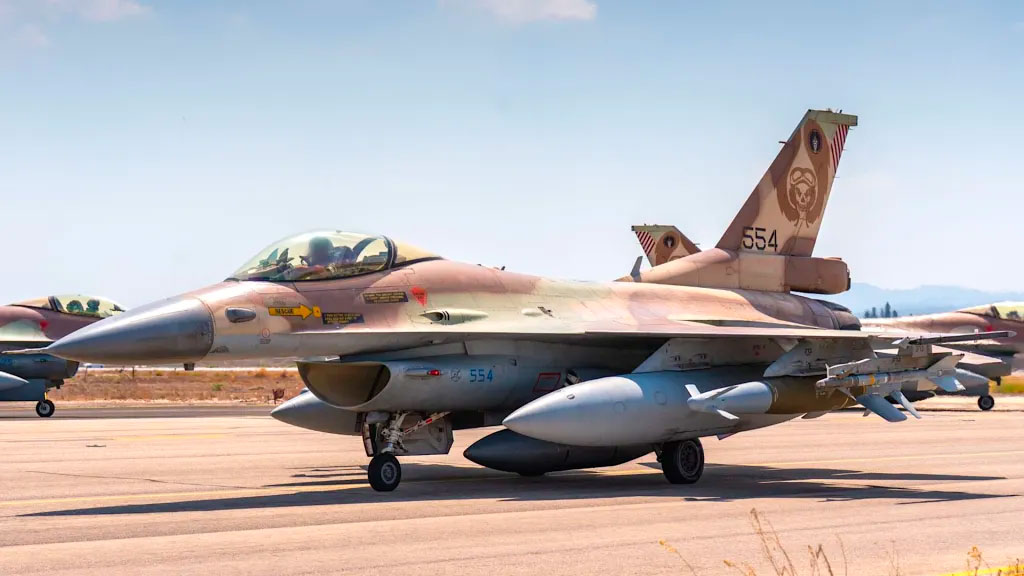
Israel has reportedly adapted the AIM-9M Sidewinder missile to intercept Shahed drones. This is a strategic conversion of old weapons in response to the threat of kamikaze drones.
Summary
According to an article in The War Zone based on a report by the Foreign Policy Research Institute (FPRI), Israel has modified the infrared seeker on its AIM-9M Sidewinder missiles to make them more effective against Shahed-136 kamikaze drones. These Iranian drones, which are slow, discreet, and fly at low altitude, caused difficulties for US and allied forces during the massive attack on Israel in April 2024. Pilots quickly realized that the modern AIM-9X was the most reliable weapon against these targets, while the AIM-9M performed poorly in this role. Israel has therefore reportedly chosen to “recycle” its AIM-9Ms by adapting their seeker—probably through software and sensor modifications—to better distinguish low-radiation targets flying close to the ground. This solution makes use of a considerable stockpile of relatively inexpensive missiles, while strengthening anti-drone defense. The technology is not being shared at this time, but could be of interest to users such as Ukraine, which already employs the AIM-9M from its F-16s.
The conversion of a Cold War missile to counter kamikaze drones
The information comes from an article in The War Zone based on an FPRI report on lessons learned from Israel’s defense during the Iranian raid on April 13-14, 2024. In this attack, more than 200 drones and missiles—including many kamikaze drones—were launched against Israeli territory, mobilizing a multinational air defense system.
At the heart of this analysis is an observation made by American crews: against these slow, low-flying drones, the AIM-9X missile proved to be the best tool, while the AIM-9M Sidewinder “did not perform well” in this role. The X, equipped with a latest-generation imaging infrared seeker, sees further, discriminates targets better, and accepts high firing angles, making it easier to engage low-visibility drones.
The problem is that stocks of AIM-9X are limited and each missile costs several hundred thousand dollars, while the US still has thousands of AIM-9Ms, produced since the 1980s, at a historical unit cost of around $70,000 (in dollars at the time). Israel therefore appears to have made a pragmatic choice: to adapt the older AIM-9M into a dedicated anti-drone weapon, rather than systematically depleting its stocks of AIM-9X.
The FPRI report clearly states that the Israeli Air Force has “modified the AIM-9M seeker and used it with considerable success” against long-range drones, while specifying that the Israelis have not shared this technology, “not even with the United States.” The details of the changes therefore remain secret, but the operational context and the physics of infrared guidance allow us to deduce the main principles.
The limitations of the AIM-9M against Shahed drones
The AIM-9M Sidewinder is an evolution of the AIM-9L, itself the first “all-aspect” Sidewinder. It retains a classic architecture: a 2.89 m long missile weighing approximately 86 kg, equipped with a solid propellant motor and a 9.4 kg ring warhead. Its cooled infrared seeker detects thermal contrasts (typically the nozzle of a jet engine or the heated surfaces of a fast-flying aircraft) and guides the missile to the point of impact.
This target profile is ideal for a combat aircraft, whose jet engine produces an intense thermal signature that stands out clearly against the sky. However, it is poorly suited to a propeller-driven drone, powered by a small piston engine, flying slowly at low altitude.
The Shahed-136, approximately 3.5 m long with a wingspan of 2.5 m, weighs nearly 200 kg and carries a warhead estimated at 40–50 kg. It flies at around 185 km/h, at typical altitudes of 60 to 4,000 m, with a range of 1,000 to 2,500 km depending on the source. Its delta wing airframe, pusher propeller engine, and lack of highly heated surfaces make it difficult to distinguish from a warm ground background—especially over a desert.
The FPRI report describes this difficulty very well: drones “fly at roughly the speed of a fast-moving vehicle” and, when they follow roads, they blend in with traffic on radar. Pilots must therefore rely on onboard electro-optical and infrared sensors (Sniper-type pods) to distinguish between a car and a drone in an environment saturated with echoes.
For an unmodified AIM-9M, there are two major problems:
- The drone’s thermal signature is weak, dominated by a small engine and propeller, making it difficult to distinguish from heated ground or other sources of interference.
- Flying at very low altitude creates a lot of background “clutter”: the seeker must sort through a cold or warm target above a hot background, instead of tracking a bright jet in a cold sky.
American crews engaged in the defense of Israel therefore logically found that the AIM-9M was less reliable than the AIM-9X, whose imaging seeker processes contrasts and shapes more finely. Israel, which has extensive operational experience with drones and a large fleet of air-to-air missiles, had every interest in correcting these weaknesses.
How seekers work and what can be changed
Although Israel keeps the exact nature of the modifications secret, the technical avenues are relatively clear.
The AIM-9M seeker is based on an infrared sensor coupled with signal processing electronics that apply filters, thresholds, and tracking algorithms. By adjusting these parameters, the missile can be adapted to other types of targets without necessarily changing the mechanics of the sensor.
Several areas for improvement are plausible:
- Sensitivity adjustment: increase the sensitivity of the detector and adjust the detection thresholds to capture the much weaker thermal signature of a propeller-driven drone.
- Look-down background filters: optimize algorithms to better extract a small heat source above a terrestrial background, taking into account the typical speed and trajectory of a drone.
- Expanded tracking window: Adapt guidance laws for slow targets with modest acceleration, rather than the maneuvering profiles of a supersonic fighter jet.
- Proximity fuse: drawing inspiration from American work on modernized FIM-92 Stinger missiles, to which new proximity radar sensors have been added to optimize the explosion against drones, rather than aircraft.
The FPRI report also suggests that the term “seeker” could refer to a broader set of modifications affecting the sensor, processing, and fuse. Some of these could be purely software-based, downloaded into the onboard electronics, which would allow large stocks of missiles to be quickly reconfigured.
Operationally, these modified AIM-9Ms would be integrated into a larger system: onboard radars, targeting pods, data links, and even initial targeting by F-35s equipped with AESA radars, as described by the FPRI for Israeli tactics. The missile is then only the final link in a chain of detection, identification, and firing optimized against drones.
The challenges of cost, stockpiles, and international distribution
One of the main advantages of this conversion is its cost-effectiveness. An AIM-9M cost the US Air Force around $68,600 in the mid-1980s, whereas a modern AIM-9X now costs over $400,000 each, according to US budget documents.
In contrast, a Shahed kamikaze drone is a low-cost system: some estimates put production costs at between $30,000 and $80,000 for the Russian Geran-2 variants. The purely economic ratio is therefore not favorable if each drone is destroyed by a missile costing several times its price. But in a crisis situation, the priority remains to protect critical infrastructure, even if it means accepting an unfavorable exchange.
The AIM-9M has two advantages:
- It already exists in large quantities, with more than 11,000 units produced for this version alone.
- It is largely amortized and, for many, nearing the end of its operational life. Adapting them into anti-drone weapons extends their usefulness instead of scrapping them.
This approach is of direct interest to countries such as Ukraine, which is receiving F-16s equipped with AIM-9Ms and AIM-120 AMRAAMs and is facing repeated salvos of Shahed drones or derivatives. Being able to quickly modify AIM-9Ms that have already been delivered—or are yet to be delivered—into anti-drone configurations would be an immediate force multiplier, without having to wait for the financing and delivery of additional AIM-9X batches.
The FPRI is also advocating for Israeli technology to be shared with allies, highlighting the persistent vulnerability of many European forces to low-cost drones. This is as much an industrial issue as it is a political one: standardizing modernization kits for older missiles, defining common doctrines of use, and integrating these solutions into multi-layered defense architectures.
The place of “recycled” missiles in anti-drone defense
Modified AIM-9Ms are just one element of an increasingly diverse anti-drone landscape. The same report mentions the growing use of 70 mm guided rockets, such as the APKWS II in the FALCO version, adapted for air-to-air firing against drones and subsonic cruise missiles. These rockets, whose guidance module costs between $15,000 and $20,000, offer a large magazine capacity at a lower cost, but at the price of significant tactical constraints: the target must be illuminated by laser throughout the flight.
This gives rise to a hierarchical anti-drone defense architecture:
- Very inexpensive weapons (cannons, programmable ammunition, interceptor drones) for light, short-range drones.
- Guided rockets or compact surface-to-air missiles for intermediate targets.
- Converted air-to-air missiles, such as the modified AIM-9M, to give F-16 patrols and other fighters a robust capability against more distant or numerous threats.
Israel’s modifications to the AIM-9M are part of this logic: exploiting existing equipment, reducing the marginal cost of interception, and avoiding the use of rarer strategic ammunition, while adapting to a threat that is exploding in volume.
The rise of drones requires rapid innovation
By adapting a missile designed in the 1970s to shoot down jet fighters, Israel is showing that it is possible to reconfigure “old” weapons for drone warfare, provided that sensors, software, and system integration are mastered. Kamikaze drones such as the Shahed-136 have demonstrated their ability to overwhelm defenses, strike from a distance, and weigh on the psychology of populations, at a cost well below that of a cruise missile.
The real question is no longer whether these threats will become widespread—they already are—but how quickly air and ground forces will be able to adapt their arsenals. Between new dedicated weapons and “ingenious DIY” modifications to existing systems, armies must constantly balance time, cost, and effectiveness.
Israel’s modifications to the AIM-9M Sidewinder are probably just a taste of what we will see in the coming years: reprogrammed missiles, rockets recycled into interceptors, AI-controlled cannons, and even directed energy weapons integrated into existing platforms. It remains to be seen whether this capability will remain a discreet advantage of a few players, or whether it will quickly be shared, particularly with countries such as Ukraine, which are currently on the front line of the drone war.
Sources
- Joseph Trevithick, “Israel Modified AIM-9M Sidewinder Missile Seekers To Better Target Drones: Report,” The War Zone, November 15, 2025.
- Aaron Stein, “Drones and Mass Salvo Attacks: Lessons Learned from the American Defense of Israel,” Foreign Policy Research Institute, November 2025.
- Technical data sheet “AIM-9 Sidewinder,” US Air Force and open documentation.
- Technical analyses on the Shahed-136 and variants, OSMP and other open sources.
- Cost and industrialization data for AIM-9 and AIM-9X missiles in specialized literature and US budget documents.
War Wings Daily is an independant magazine.