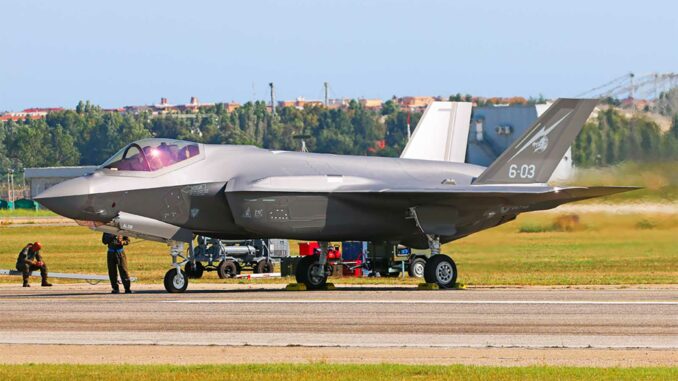
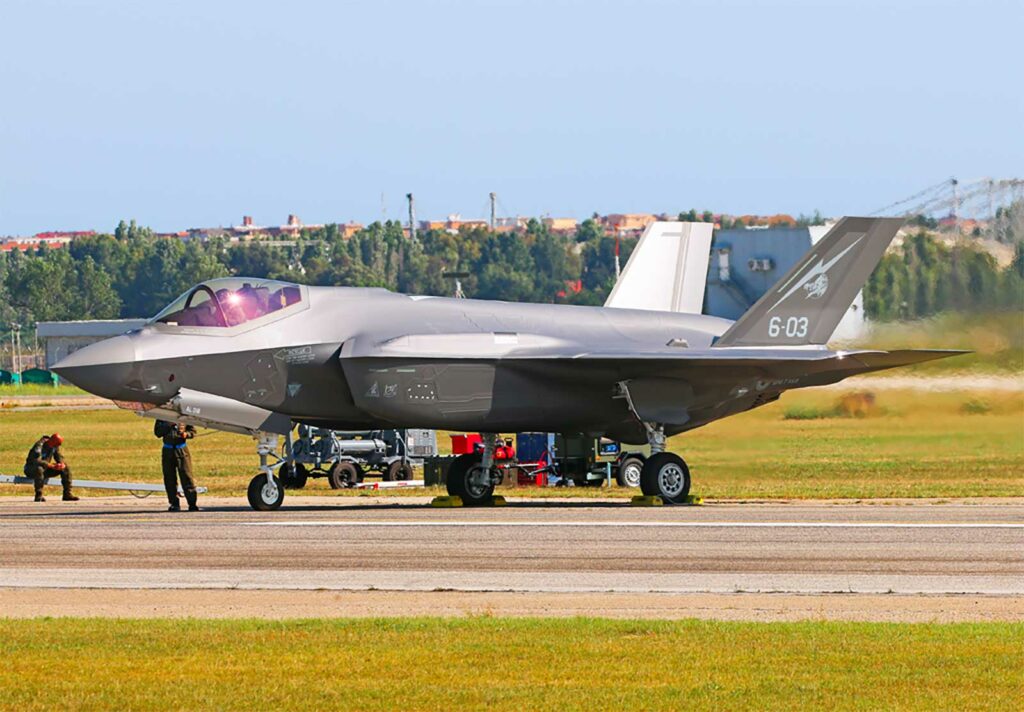
Italy is opening the first F-35 school outside the US in Trapani-Birgi. This industrial, strategic, and budgetary decision says a lot about NATO.
In summary
Italy has officially announced the expansion of the Sicilian base at Trapani-Birgi as the first F-35 training school located outside the United States. The project, led by the Joint Program Office and Lockheed Martin, is expected to be initially operational by the end of 2028 and fully operational by the summer of 2029, with a public investment of €112.6 million. This sends a twofold message. For Washington, it relieves pressure on the American training ecosystem, while ensuring that allies’ doctrine and technology are aligned with an aircraft that is highly dependent on American standards, software, and procedures. For Rome, it is a lever for status within NATO, a way to capitalize on its industrial role in the F-35 program (assembly, maintenance, support) and to capture sustainable financial flows related to training. Geopolitically, Europe gains a local training capacity, but not complete autonomy: the value chain remains structured by the United States.
The game-changing fact and timeline
The information is now official: Italy has designated the Trapani-Birgi base in Sicily to host the first international F-35 pilot training center located outside US territory. The Italian Ministry of Defense has set a precise timetable: initial ground training capacity is expected by December 2028, followed by the completion of a “Lightning Training Center” around July 2029. The announced investment cost is €112.6 million, financed by Italian taxpayers, with at least two “Full Mission” simulators planned for the first phase.
This detail is important: we are not talking about a simple classroom building or a temporary detachment. We are talking about a lasting hub in the global F-35 training architecture, which is currently largely concentrated in the United States. In other words, Rome is not just getting a symbolic label, but a structuring function: to train, standardize, qualify, and thus influence the way allied air forces will fly, fight, and maintain their fleets for decades to come.
The operational logic behind the Sicilian choice
Trapani-Birgi is not just a dot on a map. The base is located in the central Mediterranean, at the crossroads of air and sea routes that are important to the Alliance: southern flank, surveillance, deterrence, projection towards the Balkans, the Levant, and North Africa. This geographical depth facilitates the reception of European trainees without transatlantic travel, reduces logistical friction, and allows training to be based on realistic scenarios in the Euro-Mediterranean theater.
American interests behind a school “outside the US”
At first glance, the United States is “offshoring” a capability. In reality, it is exporting it under control. The project is explicitly supervised by the Joint Program Office and Lockheed Martin, which means that standards, technical governance, sensitive information security, and doctrinal alignment will remain closely tied to the American center of gravity.
Let’s be honest: the F-35 is not an aircraft that can be easily “nationalized.” It is a weapons system, with software dependencies, update cycles, security requirements (protected facilities, “Special Access” procedures in certain segments), and a culture of standardization that promotes interoperability… but reduces the space for sovereign improvisation.
Decongesting an overloaded training program
European dynamics also explain the decision. F-35 fleets are expanding in Europe, and training is a bottleneck. The United States already trains allied pilots at sites such as Luke AFB, and the increase in volumes is creating mechanical tension: more aircraft ordered means more crews to qualify, more instructors, more simulator hours, and more flight slots.
By opening a center in Europe, Washington gains breathing room: part of the demand shifts to an allied hub, while remaining within the framework of the program. It is a form of outsourcing that does not resemble a loss of control, but rather an optimization of the system.
Maintaining an alliance “lock”
There is also a political aspect. When an air force trains its pilots on a system, with methods, simulators, syllabi, and evaluations calibrated to an American standard, it becomes structurally compatible with the US Air Force and US Navy. This compatibility is a real military advantage, but it is also a mechanism for strategic alignment. A Europe that flies F-35s according to a common standard is a Europe that plans more easily with the United States and finds it more difficult to deviate from its ecosystem.
The Italian benefits: status, influence, and recurring revenue
For Rome, the stakes go beyond training. Obtaining the first F-35 center outside the US means gaining the role of “pivotal country”: one that welcomes, certifies, and hosts allied nations and becomes an almost mandatory step in the build-up of European fleets.
The internal and external political message
Internally, the €112.6 million investment can be justified as an expense that generates sustainable activity: jobs, infrastructure, military and industrial attractiveness, and local benefits in Sicily. Externally, it is a demonstration of reliability in the eyes of allies: Italy is not content to simply buy aircraft, it supports the Alliance with shared capabilities.
Backing from the Italian industrial complex for the F-35
Italy is not coming to the program empty-handed. It already has a European industrial presence around the F-35, notably through the Cameri ecosystem (regional assembly and maintenance for certain European customers, depending on configurations). A training school completes the picture: after the aircraft and support, crew qualification becomes the third pillar. And this pillar is often the one that brings in regular revenue, as a training center operates on the basis of promotions, requalifications, conversions, and upgrades.
Consistency with Italy’s trajectory towards a larger fleet
The timing also fits with Italy’s budget trajectory. Italy has confirmed an increase to a total fleet of 115 F-35s, via an additional order announced at €7 billion for 25 additional aircraft, with an associated armament and modernization effort in the planning. Training more “at home” and in Europe then becomes a practical necessity, not a luxury.
What this says about Euro-American geopolitics
The event can be interpreted in two ways, both of which are true.
The “more capable Europe” interpretation
Yes, Europe is gaining a concrete capability: less logistical dependence on the United States for training, more resilience in the event of transatlantic tension, and a faster ramp-up of European squadrons. This is particularly noticeable when delivery schedules are accelerating and air forces need to generate crews at the right pace.
This logic brings to mind a point that is often overlooked: aircraft are useless without qualified pilots, and qualified pilots are produced on an industrial training line. Creating a European hub means investing in real combat capability, not in window dressing.
The “organized dependence” interpretation
But let’s not kid ourselves:
this is not a “European” school in the sovereign sense. The technical framework, program governance, and safety requirements remain deeply American. Europe is getting a site, not complete control of the black box. This is the typical F-35 compromise: we are buying performance and interoperability at the price of an assumed dependence on part of the chain.
In the current context, it is also a pragmatic response to strategic uncertainty. Rather than fantasizing about immediate autonomy, Europeans are building room for maneuver where possible: training, maintenance, stocks, infrastructure. Trapani-Birgi fits perfectly into this logic of “capacity without disruption.”
Budgetary and capacity implications to watch
The announced investment (€112.6 million) seems modest for a fighter program, but we must look beyond the initial budget line.
Entry costs and operating costs
Two “Full Mission” simulators, secure facilities, IT systems, teams of instructors, maintenance of simulation equipment, and ongoing compliance with program standards: all of this creates recurring costs. The implicit economic model is therefore based on welcoming foreign students and billing for training services. If European demand follows the expected curve, the center can become a profitable asset in terms of influence and activity. If demand contracts (delays, budgetary trade-offs, order reductions), there is a risk of financing an underutilized infrastructure.
Competition from other European hubs
Europe is also seeing the emergence of other training programs (on other aircraft and in other fields). Trapani-Birgi will have to demonstrate clear value: capacity, availability, quality, and seamless integration with existing training programs. Italy already has recognized experience in advanced training through structures such as the International Flight Training School. The challenge will be to connect these programs intelligently: to train faster, better, and without duplication.
Factors that will determine the success or failure of the project
Success will not depend on political rhetoric. It will depend on very concrete factors.
The credibility of the industrial schedule
Late 2028 for initial capacity, summer 2029 for a complete center: this is ambitious. Military infrastructure programs are rarely on schedule, especially when they involve high security requirements and complex industrial interfaces. The first test of credibility will therefore be meeting the milestones.
The ability to attract European customers
To become a true hub, Trapani-Birgi will have to attract user nations, not just “be available.” This will require agreements, training quotas, access priorities, and coordination with Italian national needs. An international center that only hosts a few symbolic promotions will not change the game. A center that regularly supplies European fleets will.
The question of operational sovereignty
Sooner or later, the debate will return in a simple form: who controls what in the event of a major political crisis? Even if the school is in Italy, the F-35 ecosystem remains subject to authorizations, updates, and security rules. Europe is not emancipating itself; it is providing itself with a buffer. This is useful, but it is not a break with the past.
The end of an American exception and the beginning of a European test
Trapani-Birgi breaks an exclusivity: F-35 training will no longer be exclusively “at Uncle Sam’s.” This is a practical turning point for the Alliance and a positioning victory for Rome.
But it is also a test of maturity for Europe: creating a capability is not enough; it must be operated, exported, and protected.
If the center meets its targets and attracts trainees, Italy will consolidate a lasting role in the Western military architecture. If the project slips, becomes bogged down in bureaucracy, or lacks customers, it will become a costly symbol. And behind this verdict lies a broader question: can Europe build concrete capabilities around an American system without simply relying on it?
Sources
- Defense News, January 8, 2026, “Italy names Sicily air base as first F-35 pilot school outside US.”
- EDR Magazine, January 7, 2026, “Italian MoD launches activities for the international F-35 training center at Trapani-Birgi.”
- The Aviationist, January 7, 2026, “Italy Approves First Multinational F-35 Pilot Training Center Outside The U.S.”
- Defense News, September 17, 2024, “Italy to buy 25 extra F-35 fighter jets under new budget.”
- Reuters, September 24, 2024, Italy defense budget plans (F-35, Eurofighter, trajectory).
- Luke AFB (USAF), May 1, 2025, “Allies and Partners Day 2025” (role of the training center).
- Leonardo, “International Flight Training School (IFTS)” (context of advanced training in Italy).
War Wings Daily is an independant magazine.