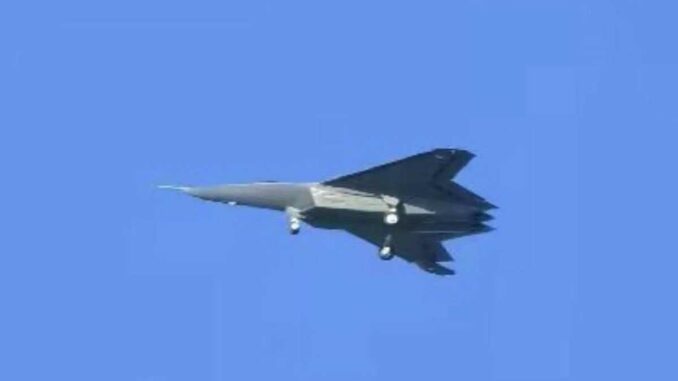
The Chinese J-36 and J-50 reveal a clear ambition: to strike farther, operate combat drones, and compete with the U.S. NGAD.
In summary
The images and analyses circulating over the past few days regarding the Chinese J-36 and J-50 programs confirm a key point: Beijing is no longer content with simply improving the J-20; it is already preparing for the next step. The two aircraft—unofficial designations used by analysts—appear to belong to a new family of heavy stealth fighters, larger than the J-20, without a conventional tail, and likely designed to operate in a network with accompanying drones. The most credible observations point to a very large, three-engine J-36 and a more compact ** J-50**, which is more compact, also stealthy, and tailless. This duo suggests a clear strategy: to extend range, increase internal payload, improve survivability, and prepare for collaborative combat. For China, the stakes go beyond technology. The goal is to increase pressure on Taiwan, complicate U.S. access to the first and second island chains, and provide a political response to the *NGAD* program and the future U.S. F-47.
The message conveyed by recent images is more political than spectacular
First, we must be clear about what we know and what we do not know. Beijing has not released an official technical specification for the J-36 or the J-50. The names themselves are unofficial designations, used by specialized observers to distinguish between two advanced prototypes that first appeared in late 2024 and were subsequently seen in other images and videos. What has changed with recently published analyses—particularly based on satellite imagery and new ground-level views—is that the existence of *two distinct programs * is no longer seriously disputed. China is not testing a single next-generation fighter concept. It is testing at least two.
This point is crucial. The United States has long set the tone with the NGAD, conceived as a family of systems combining a piloted aircraft, distributed sensors, and combat drones. Now, however, China gives the impression of moving forward in parallel, with an approach that is less transparent but potentially faster in certain areas. When two heavy, stealthy, and highly unconventional prototypes appear almost simultaneously, it generally means that an entire industrial ecosystem has already been working upstream on materials, air intakes, propulsion, thermal management, internal bays, and network architecture.
This is no longer conceptual exploration. It is maturation.
The J-36 appears designed to fly far, carry heavy loads, and survive in contested airspace
The J-36, attributed to the Chengdu Aircraft Corporation, is the more impressive of the two. Analyses based on satellite imagery from August 2025 suggest a wingspan of approximately 19.8 meters and a length close to 18.9 meters—significantly larger than a conventional fighter from the Flanker family and the dimensions generally seen on current Chinese tactical aircraft. Its configuration is even more intriguing: a very wide planform, no visible vertical stabilizer, significant internal volume, and, above all, the likely presence of three engines.
Why does this choice of size and propulsion matter so much? First, because a larger aircraft can carry more fuel. This paves the way for increased range, and thus longer patrols, deeper penetrations, and less reliance on in-flight refueling. Second, because a large fuselage allows for larger internal bays. However, a stealth aircraft only truly maintains its radar stealth if it carries its weapons internally. Finally, more volume also means more space for avionics, electronic warfare, cooling systems, and potentially a two-person crew if this assumption is confirmed by certain images.
We must therefore stop viewing the J-36 as merely a “new fighter.” Everything indicates that it could be a heavy carrier of air superiority and strike capability, designed to open up a theater of operations, manage remote effectors, and remain in the combat bubble longer. This corresponds exactly to what the major powers are seeking today: not an isolated aircraft, but a central node in a distributed air combat system.
The J-50 appears more compact, but it complements the system rather than competing with it
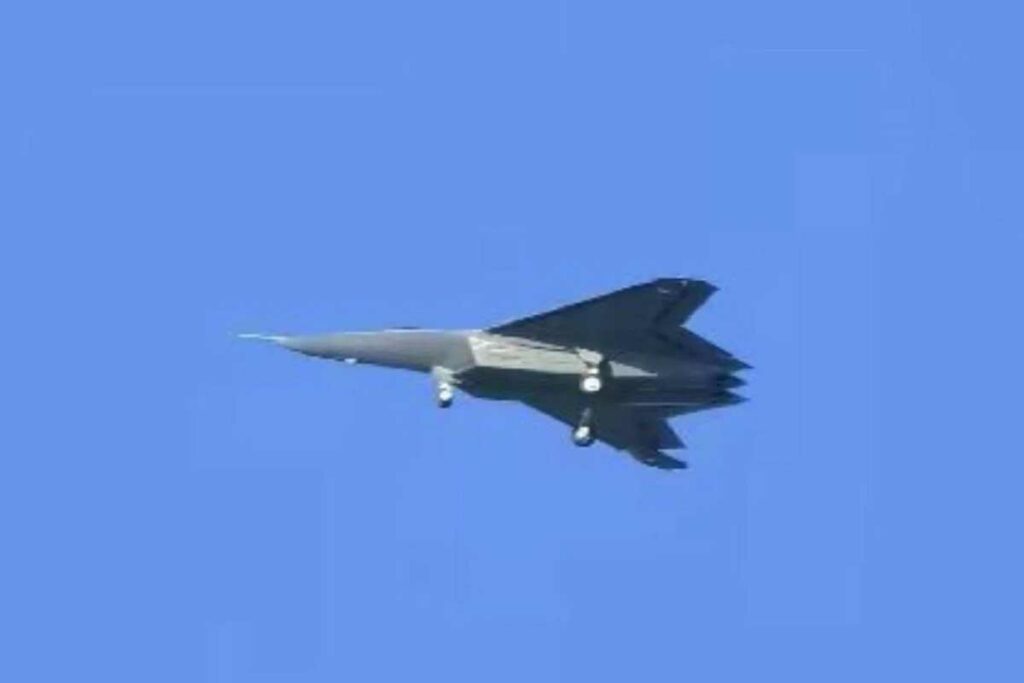
The second aircraft, often referred to as the J-50 and attributed to Shenyang Aircraft Corporation, appears smaller than the J-36, but just as ambitious. Images released in 2025 highlighted a tailless airframe, lines meticulously designed for stealth, and an architecture different from that of the J-20. Analysts see it less as a direct replacement for the J-20 and more as another development path: an aircraft that is likely more agile, still stealthy, and potentially better optimized for certain penetration, interception, or collaborative combat missions.
China’s industrial logic becomes clearer here. The J-20 remains the 5th-generation platform already in service. The J-36 appears to be pushing the limits of range, payload, and tactical command capabilities. The J-50, for its part, could provide a more compact and adaptable option, perhaps closer to a classic air superiority fighter, but with a new architecture. In other words,
China is not planning a linear succession. It is planning high-end diversification.
This approach makes sense in a dense regional context. A very heavy aircraft isn’t the answer to everything. It excels at certain missions, but can be more expensive, more complex, and less suited to certain sorties. Beijing therefore seems to be seeking a complementary pair: a very long-range system and a more agile penetration system. It’s more flexible, and it’s militarily smarter than a single-bet strategy.
The new capabilities being targeted go far beyond simple stealth
Talking about “6th generation” only makes sense if we specify what it entails. It is not just about a more radar-discreet form. Programs in this category generally target several key elements simultaneously: advanced sensor fusion, more integrated electronic warfare, resilient connectivity, drone control, onboard data processing, larger fuel tanks, increased range, and the ability to act as the leader of a swarm of effectors. The loyal wingman is not a marketing gimmick. It is the component that allows for risk dispersion.
If the J-36 or J-50 are indeed designed to control escort drones , China would gain several advantages at once. It could send a drone ahead to detect a threat, jam a radar, fire a munition, serve as a decoy, or relay data without immediately exposing the manned aircraft. It could also more easily overwhelm an enemy defense by multiplying attack vectors and signatures. This is exactly the logic now at the heart of American and European collaborative combat doctrines. Therefore, China’s visible commitment to this approach is therefore by no means insignificant.
The J-36’s larger size also fuels a recurring hypothesis: that of a significantly greater internal payload capacity than that of a standard stealth fighter. This could include long-range air-to-air missiles, compact anti-ship weapons, defense suppression munitions, or additional sensors. As long as Beijing remains silent, caution is warranted. But the physics are simple: more internal volume offers more options, and therefore greater tactical flexibility.
The development of these aircraft reinforces a Chinese air strategy that is already accelerating rapidly
These prototypes did not appear out of nowhere. They are part of a continuous upgrade of the Chinese air force. The Pentagon now estimates that the PLAAF and the Chinese naval aviation together have approximately 3,150 aircraft, including about 1,900 fighters.
The same report highlights the expansion of the J-20 fleet, which Beijing already presents as a major tool for air superiority. Open-source information and recent reports also show that China has increased the J-20’s presence in several brigades, including near the most sensitive coastal areas.
In other words, the J-36 and J-50 are not filling a gap. They are reinforcing an already robust force. China now possesses a spectrum of capabilities that is becoming difficult to ignore: J-10C, J-16, J-20, airborne early warning aircraft, tankers, MALE drones, stealth drones, and new naval platforms. The value of the J-36 and J-50 lies in taking this architecture to the next level, by more closely integrating stealth, endurance, collaborative combat, and deep-strike operations.
For Taiwan, Japan, and U.S. forces in the Pacific, the message is clear. China is working to make any attempt at enemy air superiority near its areas of interest more costly. The farther these aircraft can operate, the more discreetly, and the more they can work with drones, the more they will complicate intervention plans and weigh on allied planning.
The geopolitical consequences primarily affect the Taiwan Strait and the Western Pacific
The primary geopolitical effect is not psychological. It is operational. A larger, stealthier, and longer-endurance fighter expands the area where China can claim to deter or deny access. In the case of the Taiwan Strait, this means a potentially to escort strikes, threaten U.S. refueling and support aircraft, drive allied patrols further out, and maintain more constant pressure. In the case of the second island chain, this means that rear sanctuaries become less secure.
There is also an industrial and diplomatic dimension. In 2025, the United States officially awarded Boeing the contract for the future F-47, the piloted component of the NGAD program, accompanied by drones. China, for its part, has not officially announced anything comparable, but it is leaking enough images to send a clear signal. This fuels the idea that Beijing can at least challenge the U.S. monopoly on the next generation of air combat. Even if the actual timelines remain uncertain, the strategic effect is already evident: U.S. allies must now plan for a China that is no longer merely catching up, but seeking to set its own pace.
We must, however, be frank: seeing a prototype does not mean having a mature combat system. Between a test flight, sensor integration, software stability, connectivity, reliable propulsion, a truly reduced signature, and mass production, the gap is immense.
China has progressed quickly, but it has not abolished the laws of aeronautics. What is reasonable to say today is that Beijing has crossed the threshold of credibility regarding the 6th generation. To say that it will dominate the segment by 2028 would be more of a stretch.
The real issue is no longer whether China is trying, but how quickly it is learning
Perhaps the most important point is this: the J-36 and J-50 are not just aircraft. They are visible proof that China wants to master the transition from stealth fighters to distributed air combat systems. This nuance changes everything. An air force capable of producing advanced airframes is impressive. An air force capable of integrating manned platforms, drones, sensors, data links, and long-range weapons truly shifts the regional balance of power.
The most significant consequence, therefore, is not the appearance of two previously unseen silhouettes in satellite images. It lies in the fact that China now seems confident enough to reveal—even partially—programs that were once kept hidden until the very last moment. This reflects industrial confidence, but also a political calculation. Beijing wants Washington, Taipei, Tokyo, and others to look at these aircraft and accept a simple idea: the skies over the Western Pacific will be more contested tomorrow than they are today, and China fully intends to enter them with more than just a generational lag.
War Wings Daily is an independant magazine.