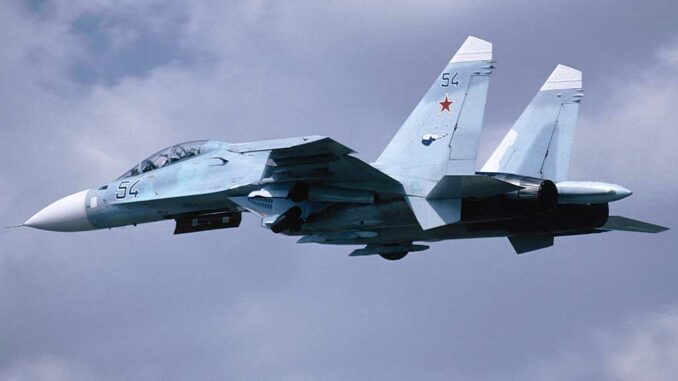
In Kaliningrad, Su-30SM2 and Su-24M aircraft rehearsed strikes against command posts. What this reveals about NATO’s flank.
Summary
In Kaliningrad, Su-30SM2 and Su-24M crews from the Baltic Fleet (Балтийский флот) conducted strike training on ground targets, including underground command posts. Russian communiqués refer to an “условный adversary” (fictitious adversary) and do not mention NATO. But the framing of the exercise, its location, and the type of simulated targets are part of a strategic grammar that is clear to the Alliance: testing a “detect-decide-strike” chain against command nodes, in an area where the density of military resources and the proximity of borders reduce the margin for error. The message is not so much “we are going to do it tomorrow” as “we want you to think about it today.” And this is precisely what fuels tension on the eastern flank: a competition of signals, where training, posture, and communication sometimes count as much as actual capabilities.
The reported fact and what is officially said
The verifiable element on the Russian side is a Baltic naval aviation exercise in the Kaliningrad Oblast. The scenario describes reconnaissance, fire support, and the destruction of “заглубленные” (buried) command posts, as well as concentrations of armored vehicles and personnel. The training bombings were carried out with ОФАБ-250-270 explosive fragmentation bombs on a target field in the east of the oblast. In terms of volume, the communication mentions around 50 sorties, more than 15 aircraft, and more than 100 military personnel involved.
An important point: the Russian sources consulted describe a fictional adversary, not “NATO” explicitly. The interpretation that the target was NATO is one put forward by certain media outlets because Kaliningrad is in direct contact with Alliance countries and command posts are among the priority targets of any modern air campaign. In other words, NATO is not named, but it is the implicit recipient of the message.
The military significance of a strike on a command post
A command post is not just another building. It is a hub where information, orders, and data links converge. Striking this type of target aims to slow down the enemy’s decision-making loop, break down inter-service coordination, and isolate units on the ground.
The command post: a target of time rather than tonnage
From an operational standpoint, it is not physical destruction alone that counts. It is the length of time during which coordination is interrupted: minutes, hours, sometimes an entire day if communications relays, computer systems, and relief teams are impacted. A “sufficient” strike can therefore be one that forces the enemy to switch to degraded modes.
Depth and hardening, a never-ending race
Buried posts exist precisely to survive strikes. The deeper we dig, the harder we make them, the more the attacker has to adjust their methods: penetrating ammunition, angles of attack, repeated passes, or a combination of electronic warfare and diversion. Here, the mention of underground bunkers also serves as a message: “we train on difficult targets,” even if the exercise does not prove that a modern bunker would be neutralized with this weapon profile alone.
The Su-30SM2 and Su-24M duo, a division of roles
The duo presented is consistent with a strike scenario.
The Su-24M, the historic ground attack tool
The Su-24M is a variable-geometry wing tactical bomber designed for all-weather attack, including at low altitude. It is an older aircraft, with survivability that depends heavily on planning, jamming, and the opposing defense environment. In an exercise, it remains useful for rehearsing approach profiles, crew work, navigation, and air-to-ground weapon delivery.
The Su-30SM2, the Swiss Army knife of escort and coordination
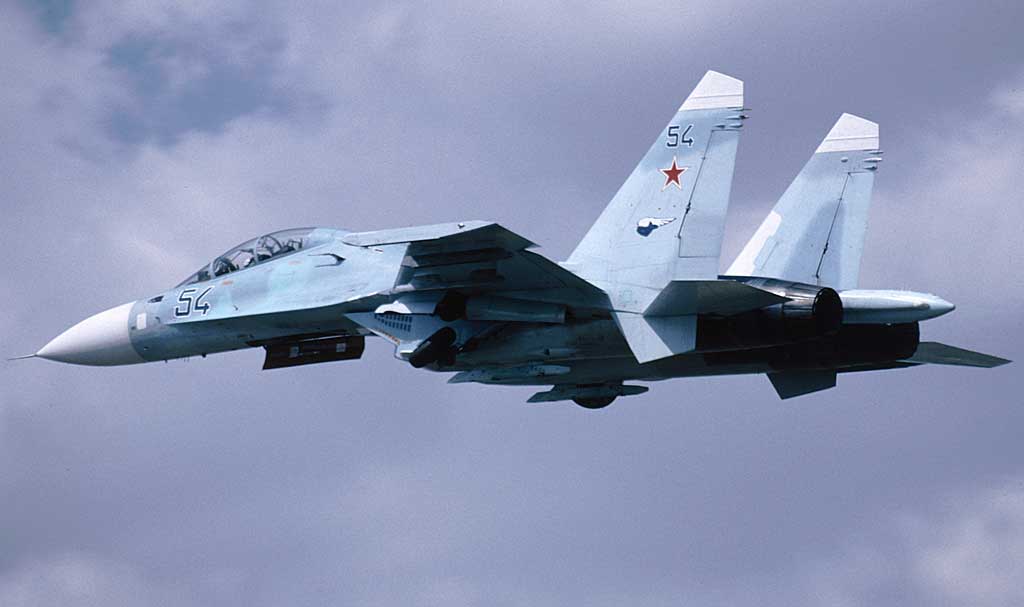
The Su-30SM2 is presented by official Russian communications as a modernization with better sensors, improved avionics, and a reinforced set of countermeasures. In a strike mission, this type of aircraft can provide escort, air-to-air cover, zone designation, coordination with other platforms, and protection of the package against air or surface-to-air threats.
That said, frankly, the “demonstrative” core is not the Su-24M. It is the ability to orchestrate a package and display a complete mission logic, even if the details of the guided weapons or tactical links are not made public.
The ammunition used and what it really tells us
The weapon mentioned, the ОФАБ-250-270, is a 250 kg class bomb, typically used against surface targets: personnel, light vehicles, infrastructure, and depots. Technical data sheets released by industrial players give orders of magnitude: weight of approximately 268 kg, explosive charge of approximately 94 kg, and drop envelope indicated between 500 and 12,000 m (typical values depending on configuration).
Accuracy, a tricky word in military communications
Some communications refer to “precision strikes” when the weaponry cited is, in its most common definition, unguided ammunition. In an exercise context, “accuracy” can simply mean hitting the target area with controlled dispersion, from a defined altitude and speed, on an instrumented polygon.
This is not the same as GPS- or laser-guided munitions against a bunker opening.
The signal sent is therefore less technological than procedural: sequences are repeated, deviations are measured, and crews are validated.
The Kaliningrad theater, a strategic amplifier
Kaliningrad is not a base “like any other.” It is a Russian enclave between Poland and Lithuania, bordering an area where military activity is constantly scrutinized. Its proximity reduces strategic depth and increases the value of warning systems, ground-to-air defenses, and jamming capabilities.
The Suwałki Corridor, a structuring geographical constraint
The Suwałki Corridor (Suwałki Gap) is regularly described as a zone of land vulnerability between Poland and Lithuania, on the shortest route between Belarus and Kaliningrad. According to public sources, the distance “as the crow flies” is around 65 km, with a border area of approximately 100 km depending on how it is measured. This geography automatically increases the sensitivity of the eastern flank: crisis scenarios unfold rapidly there, and time management is more difficult than elsewhere.
NATO’s interpretation, between posture and anti-fragility
The most rational response for NATO is not to overinterpret an exercise, but to treat the event as a reminder: the chain of command and control must remain operational under pressure.
C2 resilience, a priority issue that is not very spectacular
The best response to a threat to a command post is not just more walls. It is the ability to switch quickly: alternative posts, redundant communications, degraded mode procedures, clear delegation, and business continuity training. It is less visible than a surface-to-air system, but it is what prevents a decision-making “black hole.”
Air defense and electronic warfare, a constant duel
A credible strike on a C2 often involves reducing the effectiveness of the enemy’s defenses through saturation, deception, or electronic warfare. Conversely, protecting C2 requires better detection, hardening of links, and preserving a tactical picture that can be exploited even under jamming. This duel is ongoing, and Kaliningrad is a place where each side knows that the other is training.
The communication aspect and the real risk
Let’s be clear: an exercise is not an attack. But a publicized exercise, on a symbolic target, in a contact zone, is a political action. It creates a perception of threat and pushes the adversary to respond with a posture, and thus with a new signal. This loop accelerates tension.
The most serious risk is not “the exercise itself.” It is the density of military activity, the proximity of trajectories, and the temptation to test limits. By aligning signals, we increase the likelihood of an incident, misidentification, or automatic escalation.
The question that matters now
What needs to be monitored is not just the repetition of a strike scenario. It is the evolution of the pace, scale, and level of complexity: more nighttime operations, more multi-axis coordination, more jamming capabilities, and more joint components (land, sea, air). If these parameters increase together, the exercise becomes a marker of posture, not just training.
Ultimately, the episode serves as a reminder of a simple rule: stability on the flank depends less on declarations than on the robustness of crisis prevention and management mechanisms. Bunkers can be hardened. Errors in judgment cannot be “hardened.” And in a space as constrained as the Baltic, discipline, minimal transparency, and operational deconfliction channels remain defenses as concrete as radar or missiles.
Sources
НИА-КАЛИНИНГРАД, “Лётчики Балтийского флота уничтожили заглубленные командные пункты противника,” February 20, 2026.
www1.ru, “Su-24M and Su-30SM2 pilots destroyed simulated enemy command posts with OFAB-250-270 bombs,” February 20, 2026.
Military Aktuell, “Russia: Air Force simulates destruction of NATO command post,” February 23, 2026.
TASS, “Russian Navy aviation practiced … bombing … near Kaliningrad,” July 2, 2024.
NATO, “Strengthening NATO’s eastern flank,” October 23, 2025.
NATO Allied Land Command, “Enhanced Forward Presence (eFP).”
Interfax, “Su-30 fighters to receive new engines in 2025,” November 24, 2024.
RTÉ, “What is the Suwalki Gap and is it NATO’s weak point?”, 21.09.2025.
Yugoimport SDPR, technical data sheet “OFAB 250-270” (PDF).
War Wings Daily is an independant magazine.