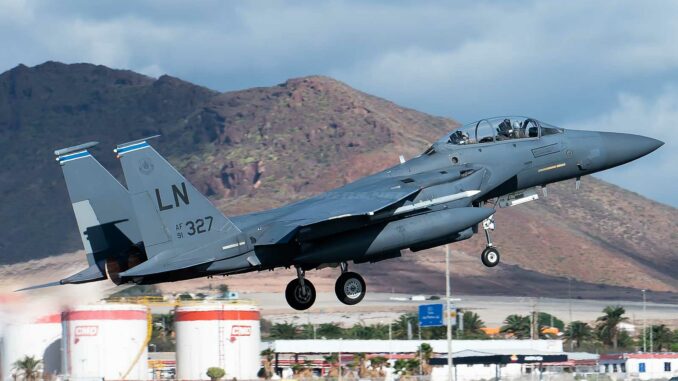
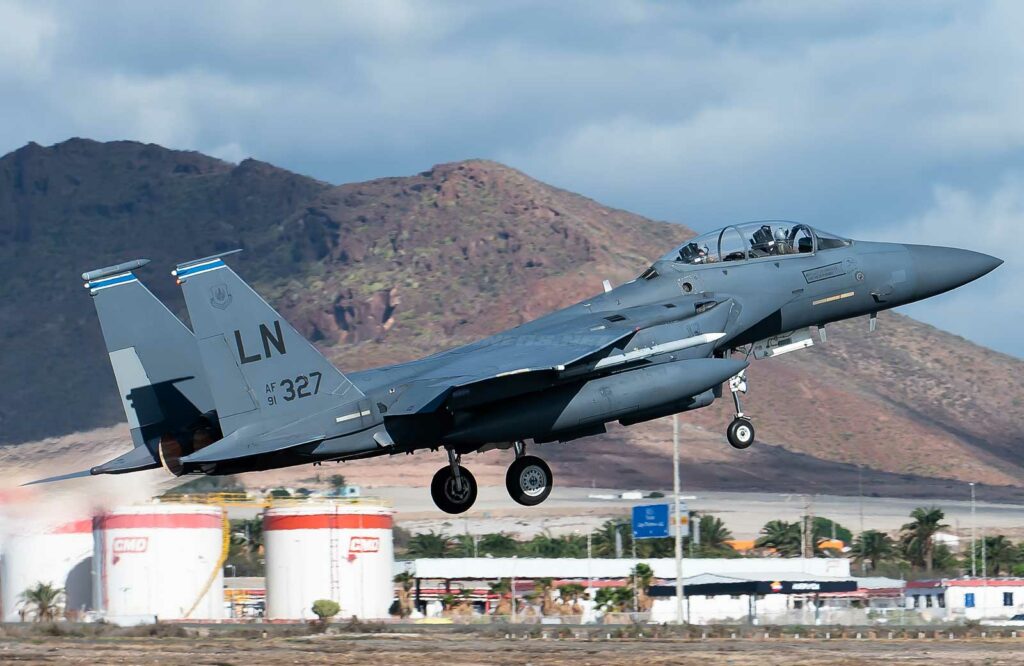
F-15E and F-16 fighters carried out naval strikes in the Strait of Hormuz using new guided bombs. Analysis of a strategic operation that sheds light on current doctrines.
In summary
On March 19, reports emerged of airstrikes carried out by older-generation U.S. fighter jets, likely F-15E Strike Eagles or F-16 Fighting Falcons, against maritime and coastal targets in the Strait of Hormuz. These operations reportedly involved the use of new precision munitions designed to neutralize anti-ship missile installations and Iranian naval capabilities threatening commercial shipping.
This choice may seem paradoxical. Why use non-stealth aircraft when the United States has the F-35? The answer lies in operational logic. Older aircraft remain highly effective for conventional strike missions, especially when air superiority has already been established.
The Strait of Hormuz is a critical chokepoint for global energy trade. Approximately 20% of the world’s oil passes through it every day. The objective of these strikes seems clear: to ensure freedom of navigation, reduce Iranian capabilities, and send a strategic signal. This operation illustrates an often-overlooked reality: in modern warfare, the newest aircraft do not replace older ones; they complement them.
Choosing Older Aircraft for Modern Missions
The use of fighters like the F-15E or the F-16 may come as a surprise. These aircraft entered service in 1989 and 1978, respectively. Yet they remain extremely capable strike platforms.
The main reason is simple: these aircraft have undergone extensive modernization.
Today’s F-15Es are equipped with AN/APG-82 AESA radars, advanced electronic warfare systems, and modern data links. The F-16 Block 70, meanwhile, incorporates sensor capabilities comparable to those of fifth-generation aircraft.
Their main advantage remains their payload capacity.
An F-15E can carry over 10,400 kilograms of ordnance, which is more than an F-35 in stealth configuration. This makes it an ideal platform for massive strikes against hardened targets.
The Economic and Operational Logic
Using an F-35 for all missions would be economically inefficient. The hourly cost of an F-35A often exceeds $33,000, whereas an F-16 can cost less than $10,000 according to Pentagon estimates.
U.S. doctrine is therefore based on a clear principle:
Use the most advanced platforms to penetrate enemy defenses, then use older aircraft for volume strikes.
This approach explains why aircraft considered obsolete remain essential in current operations.
The Complementary Roles of Different Generations
Modern air warfare operates in technological layers.
Stealth aircraft detect and disrupt defenses. Conventional fighters then strike the targets. Drones provide surveillance and secondary strikes.
This complementarity explains why the F-15E and F-16 remain indispensable despite the arrival of the F-35.
The strategic importance of the Strait of Hormuz
The choice of the Strait of Hormuz is no coincidence. It is one of the most sensitive geopolitical points in the world.
This narrow sea lane connects the Persian Gulf to the Indian Ocean. Its minimum width is approximately 33 kilometers, with navigation channels only 3 kilometers wide each.
Every day, between 17 and 20 million barrels of oil pass through this passage.
Any disruption immediately impacts energy markets.
An Area Under Constant Tension
For several years, Iran has been developing capabilities designed to challenge control of this area:
- anti-ship missiles
- sea mines
- naval drones
- armed fast attack craft
These capabilities are intended to create an asymmetric threat against military and commercial vessels.
The U.S. strikes appear to have targeted facilities linked to these capabilities, particularly coastal missile sites.
A Clear Objective: Ensuring Freedom of Navigation
The operations are likely intended to prevent any attempt to block the strait.
A strike on military installations near the maritime zone avoids direct confrontation at sea while neutralizing the threat at its source.
This strategy follows a classic approach to controlling critical sea lanes.
The new munitions used in the strikes
One of the most important aspects of these operations concerns the munitions employed.
The United States notably used the GBU-72 Advanced 5K Penetrator bomb, a 2,270-kilogram guided munition designed to destroy underground infrastructure.
A weapon designed for hardened targets
The GBU-72 uses high-precision GPS guidance. It can penetrate several meters of concrete before exploding.
It bridges the gap between the GBU-28 and the GBU-57 Massive Ordnance Penetrator.
This munition can destroy:
- bunkers
- missile depots
- command centers
- underground facilities
According to available information, these bombs have been used against anti-ship missile sites located near the strait.
The advantage of precision munitions
Guided munitions help reduce collateral damage.
The typical accuracy of a modern GPS-guided bomb is less than 5 meters circular error probability.
This precision allows for strikes on military infrastructure without targeting energy or civilian facilities.
This explains why some strikes targeted military infrastructure while avoiding oil facilities.
The immediate military impact of the strikes
Strikes against naval facilities or missile sites have several operational effects.
The first effect is the reduction of Iranian offensive capabilities in the area.
Destroying missile stockpiles or logistical infrastructure immediately reduces the capacity to cause harm.
The second effect is disruption.
A strike on command centers can slow down enemy operations for several weeks.
The effect on Iranian naval capabilities
The operations would also have targeted fast boats used to harass maritime traffic.
These units are essential to Iranian naval doctrine.
Iran does not seek to compete on the high seas. It favors saturation tactics:
- attacks by fast patrol boats
- explosive drones
- coastal missiles
Neutralizing these assets reduces Iran’s ability to disrupt traffic.
The economic and geopolitical impact
The impact is not limited to the military sphere.
Any operation in the Strait of Hormuz has immediate economic consequences.
Even a temporary disruption can cause oil prices to fluctuate by several dollars per barrel.
Recent tensions have already contributed to a significant rise in energy prices due to risks to maritime traffic.
The message sent to regional actors
These strikes also send a strategic message:
The United States is prepared to use force to maintain access to maritime routes.
This message is directed at:
- Iran
- Gulf partners
- energy markets
- Western allies
A demonstration of military credibility
The use of non-stealth aircraft also sends an implicit message.
It shows that the United States considers the local air threat to be contained.
In other words, they believe they can operate without relying exclusively on stealth aircraft.
This is an indirect indicator of the tactical situation.
A demonstration of a pragmatic air doctrine
These operations illustrate a reality rarely discussed: air warfare is not a competition between generations of aircraft.
It relies on the optimal use of available tools.
A well-equipped F-15E remains an extremely effective strike platform.
A modernized F-16 remains a credible carrier for precision munitions.
The real difference lies in sensors, networks, and munitions.
The Enduring Presence of So-Called Older Aircraft
Many aircraft designed during the Cold War will remain in service until the 2040s.
The reason is simple:
The airframes are robust. Modernizations are less expensive than complete replacements.
This explains why the United States continues to invest in these platforms.
The Transformation of Air Combat Evident in These Strikes
These operations demonstrate that air combat is evolving less through platforms and more through systems.
Guided munitions, sensors, and networks make the difference.
A 1980s-era aircraft equipped with modern munitions can remain decisive.
This is an important lesson.
Modern air superiority relies on systems integration more than on stealth alone.
The strikes in the Strait of Hormuz perfectly illustrate this silent transformation of air combat.
They also show that contemporary wars are fought as much over control of economic flows as over military confrontations.
In this context, controlling a strategic strait is sometimes as valuable as winning an air battle.
Sources
US Central Command operational statements
Reuters – Middle East conflict reporting
Congressional Research Service – Strait of Hormuz strategic importance
US Air Force – GBU-72 program documentation
International Institute for Strategic Studies – Military Balance
Defense News – Precision strike evolution
Jane’s Defence Weekly – US strike doctrine analysis
War Wings Daily is an independant magazine.