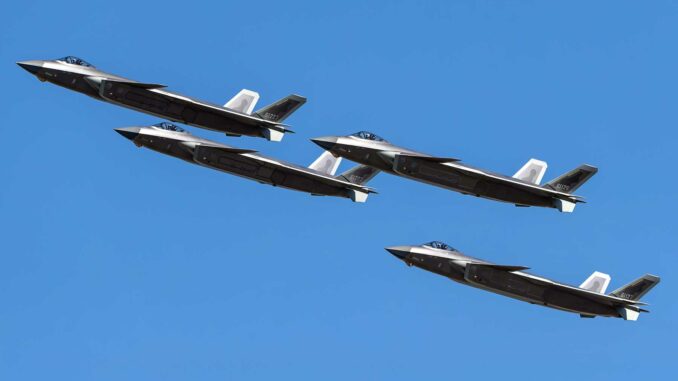
Beijing opens 2026 with drones, J-20s, and networked warfare. Behind the publicity stunt, the PLAAF is refining a mass strategy designed to saturate the skies.
In summary
Let’s be clear from the outset. Open sources confirm that China has launched its 2026 annual training with unmanned systems and J-20s visible from day one. They also confirm that in January, the PLA highlighted a test in which a single operator piloted more than 200 drones using AI and data links. However, they do not yet prove, in black and white, that a massive and already standardized deployment of drone swarms within all J-20 squadrons became routine at the start of the 2026 cycle. What we do see, however, is more interesting: rapid convergence. The PLAAF now combines conventional fighter training, swarm experimentation, electronic warfare, stealth drones, and distributed command. The logic is simple: while the United States maintains a qualitative advantage in certain areas, Beijing is seeking to increase the volume of threats, complicate combat analysis, and drive up the cost of interception for its adversaries.
The starting point deserves clarification
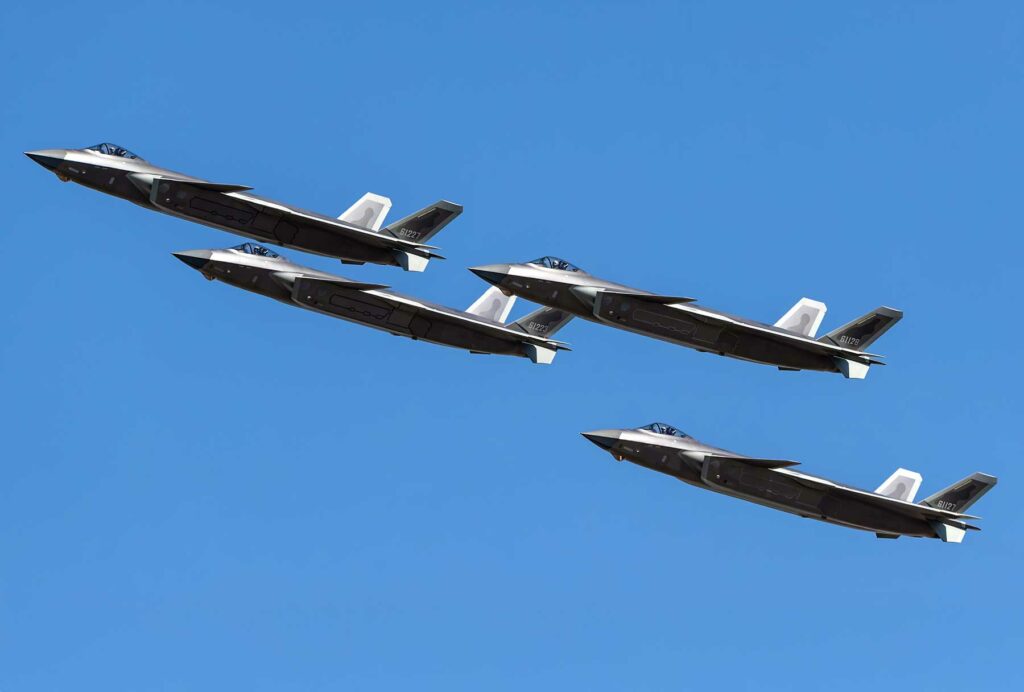
China officially launched its 2026 annual training on January 4. Images relayed by state media show unmanned equipment, J-20s, major naval units, and missile systems from the outset. For aviation, the signal is not insignificant: J-20s were engaged in opposing combat training sessions, with an emphasis on beyond visual range combat, while night refueling and long-duration flights are now presented as routine. This indicates a continuous upgrade, but it is not enough on its own to prove a complete shift to a “swarm” doctrine that is already widespread at the squadron level. That would be getting ahead of the facts.
The other piece of the puzzle arrives on January 23, 2026. On that day, new details are publicly released about Chinese tests of AI-controlled drone swarms. The message is strong: a single soldier would be able to control more than 200 drones, capable of flying in formation, dividing up tasks, and simultaneously conducting reconnaissance, diversion, and strike missions. Here, yes, we are directly touching on the logic of saturation. But we must keep a cool head: this is a demonstration put forward by the Chinese media, not yet public proof of massive operational use in a real air campaign.
The correct interpretation is therefore as follows: the 2026 cycle confirms the priority given to unmanned systems and networked warfare; the January tests show that China wants to give algorithmic volume to this priority; the demonstrations around the J-20 suggest that the stealth fighter is one of the pivots called upon to orchestrate this new density.
Saturation is not a word, it is a method
Airspace saturation does not just mean “sending a lot of drones.” It is a combat technique aimed at overwhelming the enemy’s decision-making chain. A modern defense system must detect, classify, prioritize, assign weapons, fire, and then reassess. If, instead of a few clear targets, it simultaneously receives reconnaissance drones, decoys, attack vectors, jamming emissions, and contradictory leads, its performance automatically declines.
Chinese strategy is increasingly based on this idea of density. It does not necessarily seek to defeat the opponent solely through the superiority of a single aircraft. It seeks to make the sky too crowded, too ambiguous, and too fast for a linear defense. In this context, “mass” is not only physical. It is also informational. An additional target can be a real drone, a decoy drone, a radar echo, a false signal, or a platform that forces the opponent to waste time and ammunition.
The Reuters article published at the end of February on Chinese military drone flights over the South China Sea is revealing. Since August, at least 23 flights have been recorded with falsified transponder signals, making the aircraft appear to be other aircraft, including a British Typhoon. This is not a “swarm” in the traditional sense. But the logic is the same: to sow confusion, lengthen the opponent’s reaction time, and test deception mechanisms in near-real conditions. Here, saturation begins even before the shot is fired.
The role of drone swarms in this logic
The swarm is only useful if it is more than just a flying crowd. The Chinese demonstration in January emphasizes this point. The drones are not presented as machines executing identical orders. They are described as nodes capable of autonomous negotiation. In other words, the group redistributes roles according to the situation.
This is the difference between a bunch of targets and a collaborative system. If one drone falls, another takes its place in the mission. If the signal is jammed, the group retains part of its action logic. If the axis of attack changes, the swarm can reconfigure itself. In the terms put forward by Chinese sources, the devices can switch between reconnaissance, diversion, and strike. This is exactly what makes saturation more difficult to counter: the defense no longer knows only how many targets are coming; it must also understand, very quickly, what function each target performs.
This architecture has another advantage: it compresses the cost/effect ratio. Even without reliable open-source data on the unit cost of these Chinese drones, the idea is clear. Forcing an adversary to use expensive missiles or advanced fighters against a mass of small AI-piloted platforms can create a financially unfavorable exchange. And this type of exchange, repeated, wears down a force faster than a few spectacular strikes.
The J-20 changes role in this environment
It is no longer sufficient to talk about the J-20 as a simple stealth fighter. The aircraft remains a long-range air superiority aircraft, but its value is growing above all as a node for perception, coordination, and command. This is where the Chinese logic becomes serious.
On January 4, the J-20s seen at the start of the 2026 cycle were engaged in combat beyond visual range. This means that the PLAAF continues to work on the core of its traditional mission: early detection, long-range firing, and survival in a dense information bubble. This type of mission is precisely the one that benefits most from an environment saturated with drones. If unmanned platforms advance ahead of the fighter, serving as eyes, decoys, jammers, or relays, the J-20 can maintain its discretion, reduce its exposure, and become the conductor of a distributed tactical package.
The most important thing here is that China does not seem to want to turn the J-20 into a drone truck. It seems to want to make it an air combat hub. The fighter collects, merges, and commands. The drones extend, jam, attract, and penetrate. It is a more ambitious division of labor than a simple demonstration “loyal wingman.”
The specific place of the J-20S
The J-20S, a two-seater version, is central to this shift. Chinese statements relayed in early 2026 about its capabilities are explicit: the aircraft is presented as capable of medium- and long-range air superiority, precision strikes against land and sea targets, electronic warfare, tactical command, and coordinated operations between manned aircraft and drones.
This point is crucial. The second crew member is not a luxury. He responds to a concrete problem: in a saturated battle, piloting a stealth aircraft, managing sensors, monitoring threats, coordinating drones, and maintaining tactical discipline quickly exceeds the cognitive load of a single man. The J-20S therefore offers the PLAAF a more credible platform for managing distributed combat.
We must remain cautious: the fact that an aircraft is designed for this purpose does not prove that the PLAAF is already using it on a large scale in full collaborative combat formations. But the direction taken is clear. The J-20S is not a curiosity. It is an advanced air command tool for the era of escort drones.
The J-20, GJ-11, and J-16D trio sheds light on Chinese doctrine
The most concrete sign of this doctrine appeared publicly in November 2025. For the first time, the PLAAF showed a stealth GJ-11, a J-20, and an J-16D electronic warfare aircraft in formation. This image speaks louder than words because it shows the type of tactical package China wants to build.
The scheme is simple and formidable. The J-16D jams and disrupts defenses. The J-20 maintains a high-level tactical picture, exploits its stealth, and pilots the engagement sequence. The GJ-11, more politically “consumable” than a manned aircraft, can penetrate deeper into the risk zone, conduct armed reconnaissance, designate targets, or carry part of the initial danger.
This is not yet a swarm of 200 drones around a J-20. But it is already a credible model of collaborative air warfare.
The presence of the GJ-11 in this trio is important for another reason: it shows that China is not relying solely on large numbers of small drones. It is also working on the segment of stealth penetration drones. China’s saturation is therefore not uniform. It is stratified: numerous small vectors for density, heavier drones for opening or penetration, and stealth fighters for coordination and selective strikes.
The real limits of China’s mass strategy
It would be too easy to conclude that China has already found the perfect formula. This is not the case. A televised demonstration is not an air campaign against an adversary equipped with electronic warfare, interceptors, jamming, cyberattacks, and physical destruction of communication relays.
The first Achilles’ heel remains the resilience of the links. China claims to be working on swarms capable of continuing the mission even if the connection with the operator is degraded. This is real progress if it works. But the more contested the combat becomes, the greater the risk of link losses, navigation disruptions, data delays, and fratricide. In the laboratory or in demonstrations, autonomy appears to be seamless. In combat, it becomes brutally messy.
The second limitation is organizational. A report by the IISS relayed by Reuters at the end of February concludes that purges and turmoil within the Chinese military are weighing on the chain of command and operational readiness. Even if this effect may be temporary, it counts. An AI-driven saturation doctrine requires not only good drones, but also officers capable of absorbing massive amounts of data, trusting automation, and maintaining very strong tactical discipline. This is more difficult than a parade.
The third limitation is industrial in the broad sense. China has a clear advantage in drone production volume and a robust industrial base. But producing vehicles is only part of the problem. You also have to produce the software, sensors, secure links, mission architectures, procedures, and joint training that go with them. The real battle is not only fought in factories. It is fought in the quality of integration.
China’s gamble is less about the aircraft than the opposing system
The best way to understand the PLAAF‘s strategy is not to reduce it to a race for the “best fighter.” Rather, Beijing is seeking to attack the Western model of air superiority. If the adversary relies on a limited number of high-performance aircraft, expensive missiles, and a highly sophisticated decision-making chain, then China’s response is to complicate every link in that chain: more runways, more angles, more noise, more jamming, more remote sensors, more ambiguous options.
In this context, the J-20 remains a technological symbol, but above all it is becoming a piece of architecture. Its value increases as it can fly or operate in uninhabited areas. This is where China wants to shift the combat: less in a pure duel between fighters, and more in a confrontation between combat ecosystems.
What Beijing is building is therefore not simply an air force “with drones.” It is an air force where drones are used to thicken the fog, stretch the enemy’s defenses, and give stealth fighters new tactical depth. If this logic really matures, the challenge for Washington will not only be to shoot down more drones. It will be to maintain a clear reading of the sky when it is deliberately made unreadable.
Sources
Global Times, Chinese military starts annual training of 2026, participated by unmanned equipment, J-20 stealth fighter, Type 055 destroyer, DF-17 hypersonic missile, January 4, 2026.
South China Morning Post, 1 soldier, 200 drones: China showcases rapid launch and agility in swarm warfare tactics, January 23, 2026.
Reuters, How China is masking drone flights in potential Taiwan rehearsal, February 26, 2026.
FlightGlobal, Inside the PLA’s push for collaborative combat aircraft, late February 2026.
USNI News, China Reveals New J-20 Fifth-gen Fighter Variant Can Strike Maritime Targets, January 14, 2026.
Global Times, PLA Air Force shows GJ-11 stealth drone in flight with J-20, J-16D for first time in a microfilm, November 11, 2025.
FlightGlobal, PLAAF releases footage showing GJ-11 Sharp Sword unmanned combat aircraft flying in formation, November 11, 2025.
U.S. Department of Defense, 2025 Annual Report to Congress: Military and Security Developments Involving the People’s Republic of China, published December 23, 2025.
Reuters, China military purge taking toll on command and readiness, study finds, February 24, 2026.
War Wings Daily is an independant magazine.