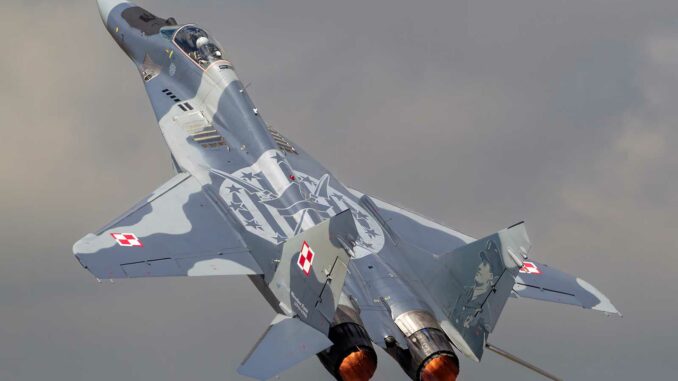
Warsaw is negotiating a barter deal involving MiG-29s in exchange for Ukrainian drone technology. At stake: the timetable, presidential approval, the actual cost, and the message to Moscow.
In summary
Warsaw is discussing with Kyiv the transfer of its last MiG-29s, aircraft that have reached the end of their potential, in exchange for access to Ukrainian technology related to drones and certain missiles. For Ukraine, the interest is immediate: it already operates this type of aircraft and can absorb them more quickly than Western fighters. For Poland, the objective is to avoid maintaining a costly Soviet fleet, while recovering expertise developed under fire: high-speed drone production, jamming resistance, guidance software, and anti-drone defense procedures. The deal is not finalized. It requires political approval at the highest level and has already revealed clear friction between the executive and defense branches. The timing will depend on the condition of the airframes, parts stocks, and legal arrangements, but the strategic signal is clear: the Ukrainian experience is becoming a bargaining chip within the Eastern flank.
Negotiating an unusual barter deal between allies
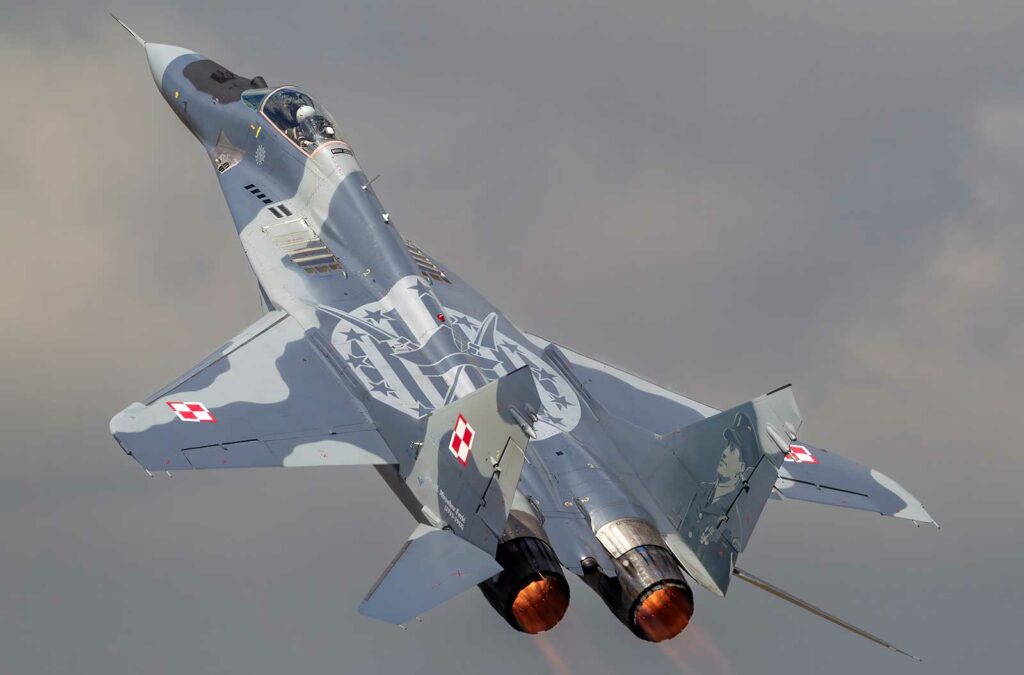
The information is simple on paper, but less so in reality. Poland is discussing the transfer of its last MiG-29s to Ukraine. The order of magnitude cited is around ten aircraft, sometimes presented as a range (8 to 12). However, open inventories suggest that Warsaw still has up to 14 aircraft on the register (11 single-seaters and 3 two-seaters). The difference is not insignificant. It can often be explained by actual availability: between heavy maintenance, cannibalization for parts, and restrictions on airframe and engine potential, a fleet that is “in service” is not necessarily a fleet that is “combat-ready” at all times.
The counterpart is the political element of the issue. Warsaw is not talking about a conventional purchase, but about access to Ukrainian technology related to drones and certain missiles. The idea is brutal but logical: Ukraine has accumulated, in real-world conditions, a level of expertise that few European armies possess. In a barter deal, this expertise has value. And this is precisely what Poland is seeking to capture quickly, without waiting for a slow European program or a saturated American supply chain.
The timetable and the institutional obstacle
In substance, the Polish army has been preparing for the withdrawal of the MiG-29 for years. In form, the timing is now political. According to public statements, a final decision has not been made and approval at the highest level is awaited. This is where the episode of “poor coordination” becomes central.
Several media outlets report that the Polish president was not informed in advance of discussions presented publicly by the Ministry of Defense, before referring to a misunderstanding. This type of sequence is not a communication detail. In a front-line country, transferring fighter jets still in service affects deterrence posture, NATO obligations, and Moscow’s perception. If the executive and defense branches give the impression that they are not speaking with one voice, the cost is immediate: internal controversy, weakening of the narrative vis-à-vis partners, and an informational window of opportunity for Russia.
The actual deadlines will then depend on three highly technical factors. First, the airframe condition and airworthiness certification at the time of transfer. Second, the package of spare parts and tools, without which additional aircraft can become hangar stock. Finally, the logistics of transport and commissioning, which is faster for a type that is already known, but never instantaneous in wartime.
The Polish military calculation behind the withdrawal of the MiG-29
The official reason can be summed up in one sentence: end of potential and no credible prospects for modernization. This is plausible. A Soviet fighter from the 1980s can fly for a long time, but it becomes expensive to maintain, difficult to integrate into a modern air defense system, and vulnerable as soon as parts, test benches, or documentation become scarce or politically sensitive.
Above all, Warsaw has changed scale. The country has modernized or is in the process of modernizing its F-16s, has integrated FA-50s as a transitional solution, and is awaiting the arrival of the F-35As it has ordered to switch to an entirely Western air force. In other words, keeping a small batch of MiG-29s to “fill in the gaps” may cost more than it brings in, since training, maintenance, the parts chain, and operational safety are isolated from the rest of the fleet.
There is also a less obvious operational argument. In the event of a major crisis, the Polish MiG-29 would not be fighting alone. It would be a sensor and a shooter in a NATO network. The more homogeneous and interoperable the fleet, the faster the air defense system works. Removing the MiG-29 also means removing an exception.
Real value for Ukraine and technical limitations
For Ukraine, the benefit is obvious: additional airframes of a type already in service, with pilots and mechanics who are familiar with the product. Integration is faster than with a Western fighter, which requires conversion, simulators, doctrine, and a different weapons chain. In a war of attrition, “time to deployment” is as important a parameter as pure performance.
But we must be realistic. An additional batch of MiG-29s is not a magic wand. The aircraft must be available, their radars and navigation systems must be in good working order, and they must have a steady supply of parts and engines. Ukraine has already learned to make things last, to repair and cannibalize. This works, until the stock of critical components becomes too low. Hence the challenge: a useful transfer often includes “donor” aircraft, batches of tires, landing gear, hydraulic accessories, and engine components. Otherwise, we are delivering promises.
The other limitation is survivability. The MiG-29 remains a capable fighter, but it operates in a sky saturated with ground-to-air defenses, long-range missiles, and jamming. The most valuable performance is not speed, but integration: alerts, situation sharing, and electromagnetic discipline. In other words, it is data link and electronic warfare environment that matter as much as the aircraft itself.
Ukrainian technologies coveted by Warsaw
This is where the barter becomes interesting, because it says something new: Ukraine is no longer just a recipient of aid, it is becoming a supplier of know-how.
The first family of capabilities: the mass production of FPV drones and, above all, the industrialization of components, training, and maintenance chains. The value is not limited to the drone itself. It lies in the ecosystem: standardization, quality control, logistics, and tactical feedback. For Poland, which is rapidly rearming and wants to strengthen its depth, access to processes and ramp-up methods is sometimes worth more than a prototype.
Second category: resistance to jamming and degraded navigation methods. The war has shown that a drone that performs well on paper becomes useless if its links are fragile. The Ukrainians have multiplied pragmatic solutions: redundancy, rapid frequency changes, vision-assisted terminal guidance, and procedures for use adapted to losses. This is a wealth of experience that is difficult to buy off the shelf.
The third, more sensitive category is certain types of missile expertise. Names often circulate in OSINT, but Warsaw officially refers to “selected technologies.” This does not necessarily involve the transfer of complete missiles. It could be documentation, software components, parts, or production and testing methods. In the public imagination, programs such as Neptune or Vilkha-type guided rockets symbolize Ukraine’s growing expertise. In practice, a NATO partner will primarily seek what is exportable, integrable, and compatible with its own industrial chains.
One last, very concrete point: anti-drone defense. Warsaw has recently sent public signals about its willingness to learn, train, and structure a response to intrusions and strikes. Here, Ukraine is three years ahead in terms of procedures, sensors, field integration, and accelerated training.
The implicit budget and industrial issues
A barter deal of this type always raises the same question: how much is it really worth?
If we think in terms of “list price,” a used MiG-29 at the end of its life is not worth as much as a new fighter jet. Its value to Ukraine is primarily operational: one more airframe, more parts, and potentially more flight hours available. For Poland, the value is also negative: maintenance costs, risks of supply chain disruption, and immobilization of specific tools.
The technological counterpart, on the other hand, cannot be easily priced. It can take the form of licenses, co-development, joint ventures, documentation transfers, or the establishment of local production lines. And this is where the Polish context comes into play: Warsaw is investing heavily and is on a path of high military spending. For example, it has signed a contract to modernize its F-16s, valued at $3.8 billion, which gives an idea of the scale of the effort. In this landscape, “paying” with end-of-life aircraft to accelerate drone and anti-drone capabilities can be seen as a rational trade-off.
One constraint remains: export controls, intellectual property, and NATO compatibility. Some of the Ukrainian components incorporate Western components, sometimes under license. Any “technology” transferred will therefore have to be filtered, documented, and legally secured. Otherwise, the barter will turn into a diplomatic headache.
The stance towards Europe and Russia
This issue is as relevant in Moscow as it is in Brussels.
In Moscow, the message is twofold. On the one hand, Poland continues to support Ukraine’s efforts to build up its air capabilities, which has both symbolic and practical value. On the other hand, Warsaw is signaling that it is not disarming: it is replacing, modernizing, and restructuring its air defense around a Western fleet. The transfer of the MiG-29s is therefore not a “gift” that creates a void, but a passing of the baton, from the Polish point of view.
In Brussels and other European capitals, the signal is more uncomfortable. It serves as a reminder that the fastest innovation of the moment does not necessarily come from pan-European programs, but from the battlefield and agile bilateral partnerships. Poland is taking a results-oriented approach: capturing solutions that work, industrializing them, and immediately strengthening its defenses on the eastern flank. This may create tensions with slower industrial approaches, but it is consistent with the geography and perception of the threat.
Finally, the paradox lies in communication. Wanting a “quick” agreement, while publicly revealing that the top levels of government do not have the same level of information, is an unnecessary political risk. If Warsaw wants to turn this trade-off into a success, it will first have to sort out its own decision-making process, then lock in a clear narrative: what is leaving, what is coming back, and how national defense will remain assured during the transition.
The way out
If the deal goes through, it will not, on its own, change the aerial balance of the war. However, it could change something more lasting: the way Europe measures the value of the Ukrainian experience. One more MiG-29 helps today. Technological building blocks and methods, on the other hand, structure armies for the decade ahead. And this is exactly the type of trade that war makes inevitable: exchanging end-of-life equipment for living, imperfect, but proven know-how.
Sources
- Reuters — Poland could give Ukraine MiG jets in swap for drone tech (December 10, 2025)
- The War Zone — Poland’s Last MiG-29 Fulcrums Being Lined Up For Transfer To Ukraine (December 10, 2025)
- Notes from Poland — Poland in talks to transfer MiGs to Ukraine in exchange for drone and missile tech (December 9, 2025)
- Militarnyi — Ukraine and Poland Negotiating Transfer of Remaining MiG-29s (December 2025)
- Hromadske — Miscommunication over plans to transfer MiG aircraft to Ukraine (December 11, 2025)
- Reuters — Poland signs $3.8 billion deal to upgrade F-16 fighter jets (August 13, 2025)
- Lockheed Martin — Poland – F-35 Lightning II Program Overview
- Notes from Poland — Ukraine and Poland sign agreement to cooperate on drone warfare (September 18, 2025)
War Wings Daily is an independant magazine.