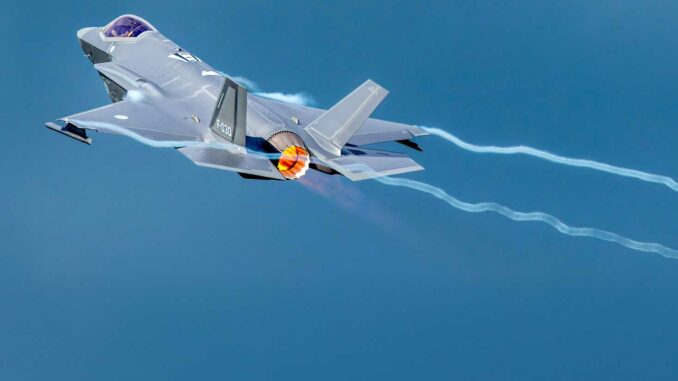
Tornado at the end of its life, NATO nuclear mission, tight schedule: why Berlin opted for the F-35, and what this means for the SCAF.
In summary
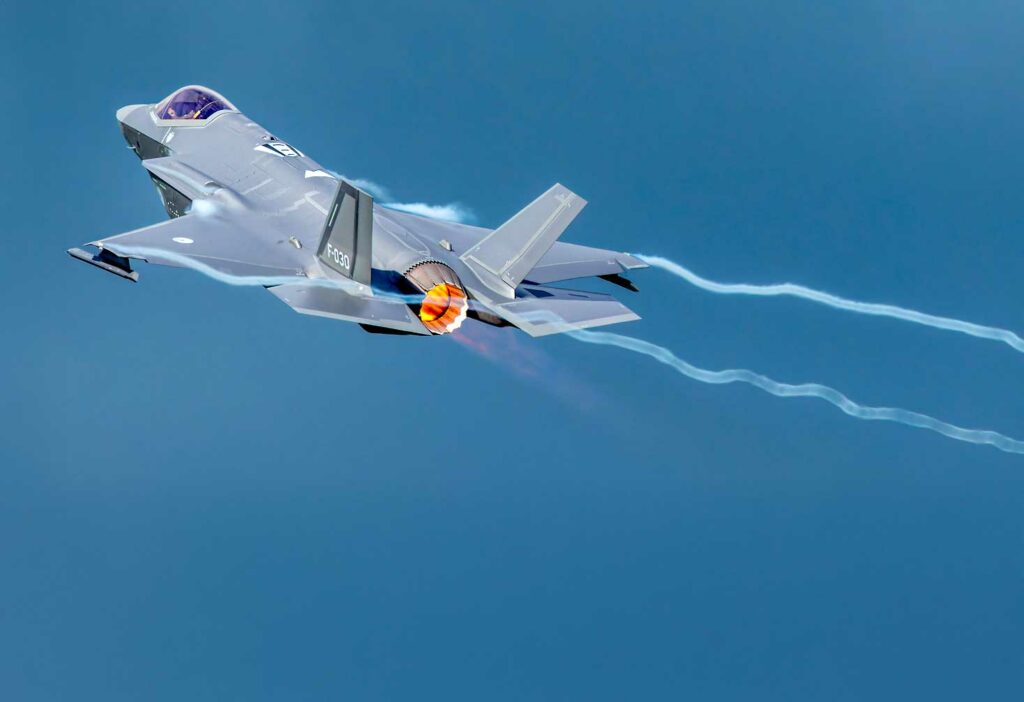
Germany’s acquisition of F-35As is primarily a response to one constraint: maintaining NATO’s nuclear sharing mission after the withdrawal of the Tornados. Berlin has ordered 35 aircraft via a US FMS procedure, for a total of around €10 billion including aircraft, support, and associated weapons. The financing comes from the federal budget, with a key role played by the €100 billion Sondervermögen special fund created after 2022. The debate “why not the Rafale?” boils down to three factors: nuclear certification, scheduling risks, and immediate interoperability with allies who have already switched to the F-35. This choice does not “kill” the SCAF, designed for the 2040 horizon, but it does change the political dynamic: it reduces the short-term operational urgency while hardening the already fragile industrial relations between partners.
The German requirement that made the decision almost binary
Germany had to replace a stubborn fact: its ability to carry out NATO’s nuclear mission relies on one aircraft and one base. The aircraft is the Luftwaffe’s Tornado. The base is Büchel. Under NATO arrangements, American B61 bombs are stored on site under American control, and Germany provides the aircraft, crews, and delivery chain.
However, the Tornados are aging. Officially, the Luftwaffe has about 85 aircraft for operational units and a total fleet of 93 aircraft. The withdrawal window is often mentioned as being between 2025 and 2030, according to transition plans. This time constraint is as important as pure performance: a nuclear mission is validated by procedures, training, inspections, and political credibility. When the aircraft “breaks down” too often, it is not a technical issue, it is an alliance issue.
The logic of the “dual capable aircraft”
For this mission, it is not enough to have a modern fighter. You need an aircraft that is qualified for NATO nuclear carry, with validated integration on the American side (sensors, links, procedures, security). This is where the offer becomes very limited: Germany’s urgency is for a solution that is available, certifiable, and deliverable on time.
The contract and fleet format that structure the bill
Germany has ordered 35 F-35As through a U.S. government-to-government agreement. The U.S. offer notified in 2022 referred to a package valued at $8.4 billion, including aircraft, engines, equipment, training, support, and weaponry. On the German side, the parliamentary vote at the end of 2022 was associated with an order of magnitude of around €10 billion for the entire F-35 package (in the broad sense: acquisition + initial capabilities + associated lots).
This figure is important for understanding the debates. An F-35 bill is not limited to “35 airframes.” It includes spare parts, mission resources, training, simulators, infrastructure, and ammunition. Above all, it carries a high entry cost in order to move quickly.
Financing and the question of “who pays?”
The answer is simple: Germany pays. Not “Europe,” not “NATO.” The NATO nuclear program is a sharing of mission and posture, not a common budget. Berlin is therefore financing the purchase with federal funds. The “Zeitenwende” policy has accelerated this type of decision, notably through the €100 billion special fund created to modernize the Bundeswehr. The F-35 has been presented as one of the flagship projects of this capacity catch-up.
European industrial participation: real but limited
Buying American does not mean “zero European industry.” The F-35 program is global and relies on dispersed supply chains.
In concrete terms, Europe is already participating through sites such as assembly/maintenance in Italy (Cameri) for certain activities, and Germany has created its own anchor points: Rheinmetall and Northrop Grumman have launched an assembly line for fuselage sections (center fuselage) in Weeze. This is a useful industrial spin-off, but it does not transform the purchase into a sovereign program: the system architecture, updates, and part of the software dependency remain American.
The choice of the F-35 over the Rafale, explained bluntly
The question keeps coming up because it touches on a political nerve: why didn’t Berlin favor a European aircraft, even though Germany is co-leading a future European air combat system? The answer lies in three factors, none of which are decorative.
Nuclear certification and the American lock
In the NATO mission, the weapon and some of the procedures are American. The United States retains control over certification and integration standards. The F-35A is designed to become a NATO nuclear carrier (notably with the B61-12), and the certification process is led by the US Air Force, with a direct knock-on effect for allies using the same standard. Conversely, integrating the NATO nuclear mission on a non-American aircraft requires American acceptance, integration, and validation, with obvious political and scheduling risks.
In other words, proposing the Rafale for this specific need meant opening high-risk negotiations on an ultra-sensitive subject, with an uncertain outcome and a schedule that cannot wait.
The timing risk, often underestimated in public debate
A debate about fighter jets can quickly get bogged down in technical specifications. Here, the decisive factor is time. Germany had to come up with a solution before the Tornado reached the end of its operational life, while also transforming a base, a unit, a formation, and support. The F-35 offers a “fast track” already taken by several European allies, with common standards, feedback, and an existing logistics ecosystem.
Even if the Rafale could have been technically adapted to some conventional missions, it did not, without major uncertainty, meet NATO’s nuclear requirements within a tight deadline.
Political and military interoperability, assumed
The F-35 has become a “common language” in NATO: data links, tactical situation sharing, operating procedures, joint training. Berlin has also sent a clear transatlantic signal after 2022: German defense is rearming, and it is doing so in immediate coordination with the United States and neighbors already equipped with the same aircraft. It is as much a choice of coalition as it is a choice of aircraft.
Commissioning and the invisible infrastructure project
The acquisition is not only taking place in the factory. It also takes place in Büchel. Adapting a base designed for the Tornado to a 5th generation fighter requires hangars, secure areas, information systems, simulators, and safety constraints. Several German media outlets have reported an increase in the cost of infrastructure modernization, with amounts approaching €2 billion depending on the scope of the work selected.
The announced schedule is generally as follows: first deliveries starting in 2026 for initial training (particularly in the United States), then gradual arrival in Germany around 2027, followed by ramp-up. This phasing says one thing: Berlin is buying an aircraft, but above all a complete capability, and is rebuilding it almost from scratch.
The message sent to the SCAF, between accelerator and slow poison
The SCAF (FCAS) is aiming for 2040: a system of systems with a new-generation combat aircraft, accompanying drones, combat cloud, and advanced connectivity. In theory, purchasing the F-35 is not incompatible: one covers the capability gap between 2025 and 2040, while the other prepares for the post-2040 period. In practice, Germany’s choice changes the psychology of the program.
The temptation of “plan B” becomes credible
When a partner invests heavily in a high-performance interim solution, it automatically reduces its vulnerability to delays in the future program. This is where the SCAF becomes fragile: if Berlin believes it can hold out for a long time with modernized Eurofighters + F-35s, the incentive to accept difficult industrial compromises diminishes.
Industrial rivalry has not disappeared, it has intensified
Tensions over governance and industrial sharing around the SCAF have been documented for several years. At the end of 2025, public signals once again showed the nervousness surrounding the issue, including in Germany, with pressure from unions and politicians. The risk is not only a delay: it is a deterioration of trust between manufacturers, which ultimately costs more than the initial trade-offs.
The irony of the moment is that the F-35 is often presented as “insurance” against the failure of the SCAF, but the more it becomes a comfortable insurance policy, the more it can weaken the collective discipline needed to bring such a complex European program to fruition.
The strategic consequences for Germany and Europe
This choice has a ripple effect.
Operational and software dependence becomes a serious issue
With the F-35, Germany gains penetration and sensor fusion capabilities, but it also accepts a strong dependence on the American ecosystem (updates, support, standards). This is not necessarily a scandal: it is a trade-off. But it must be stated clearly, because it contrasts with the European discourse on strategic autonomy.
The credibility of NATO’s nuclear capability is strengthened in the short term
From NATO’s perspective, the message is clear: Germany is not leaving the system. It is modernizing the carrier aircraft, maintaining the crews, and ensuring mission continuity. For its Eastern allies, this is a political signal as important as the number of aircraft.
The budgetary interpretation is less flattering than it seems
The F-35 is sometimes sold as a “one-time purchase.” In reality, the bill is spread out: infrastructure, training, weapons, support, and then ownership costs over several decades. And Berlin has even considered the idea of expanding the fleet (there has been talk of eight additional aircraft, or even more, in the media). This shows that the initial format of 35 is a credible minimum for the mission, not necessarily a strategic ceiling.
The final stretch will determine whether the gamble was well calculated
The “F-35 versus Rafale” debate is often emotional. The real test will be concrete. If the transformation of Büchel stays on schedule, if training proceeds smoothly, and if the Luftwaffe achieves robust operational capability before the complete withdrawal of the Tornado, then Berlin will have succeeded in the essential: not creating a hole in a politically explosive mission.
A broader, more European question remains: how can we prevent this choice, which is rational in the short term, from becoming a strategic habit? If the SCAF wants to survive, it will have to quickly prove that it is more than an industrial compromise and that it will provide real operational superiority in the face of the threats of 2040.
The F-35, for its part, will not wait: it will arrive, it will fly, and it will impose its ecosystem logic. It is up to Europe to decide whether it is content to be a customer… or whether it will once again become an architect.
Sources
Reuters, December 14, 2022, “Germany approves 10 billion euro F-35 jet deal with U.S.”
Defense News, December 14, 2022, “Germany clinches $8 billion purchase of 35 F-35 aircraft from the US”
Janes, November 21, 2025, “Build begins on first F-35 for Germany”
Bundeswehr.de, “PA-200 Tornado” fact sheet (fleet size)
DGAP, February 13, 2020, “Germany’s role in NATO’s nuclear sharing”
US Air Force (af.mil), October 6, 2021, F-35A/B61-12 test milestone
Northrop Grumman, August 1, 2023, “Breaking Ground for F-35 Integrated Assembly Line in Germany”
Rheinmetall, July 4, 2023, press release on the F-35 plant in Weeze
Reuters, June 7, 2024, “Germany looking into buying eight additional F-35 jets, source says”
Senate (France), report “2040, the SCAF odyssey”
Reuters, September 26, 2025, “Berlin weighs developing fighter jet without Dassault, says source”
War Wings Daily is an independant magazine.