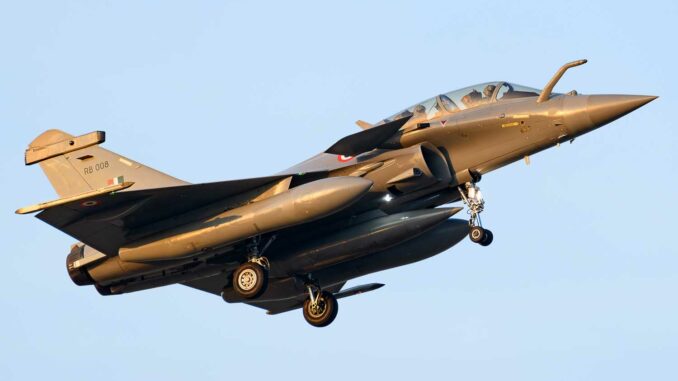
A Rafale contract that had been touted as imminent reportedly fell through on March 28. But India is still moving forward with plans for 114 aircraft, a decisive issue for Dassault.
In Summary
The news from March 28 sends a mixed signal for the Rafale. On one hand, reports published today indicate the collapse of an export contract worth approximately $1.3 billion. At the time of writing, neither Dassault Aviation, nor French authorities, nor major international agencies have publicly confirmed the identity of the client or the precise terms of this setback. We must therefore speak of a reported failure, not yet fully documented. On the other hand, India continues to move forward with the far more significant MRFA program, which aims to acquire 114 Rafales to address a shortage of fighters in the Indian Air Force. The contrast is stark. The first issue raises a question of short-term commercial dynamics. The second touches on the very heart of Dassault’s industrial trajectory, its ramp-up, and the Franco-Indian strategic partnership. The real issue, therefore, is not merely whether a contract has fallen through today, but to assess what this actually means for the Rafale’s future export prospects.
Today’s setback clouds the export outlook
The key development of March 28 is simple to state but more difficult to document rigorously. Reports published today mention the collapse of a Rafale contract valued at approximately $1.3 billion with a client described as Asian. The problem is that, at this time, this information has not been confirmed by an official statement from Dassault Aviation, by the French Ministry of the Armed Forces, or by a Reuters dispatch or equivalent. This calls for caution. In a sector as political as arms exports, many negotiations drag on for a long time without reaching a conclusion, and many unofficial announcements circulate even before a contractual framework is finalized.
We must therefore be frank. Yes, a commercial failure is possible. Yes, it may weigh on current perceptions. But no, we cannot present this matter as a fully established fact if we do not yet know precisely who, how many aircraft, at what stage of negotiations, and for what exact reason the deal would have fallen through. This uncertainty matters. In military aviation, a deal can fall through for budgetary, political, diplomatic, industrial, or interoperability reasons with a dominant ally. And as long as the customer is not identified, any overly assertive causal analysis amounts to speculation.
The Real Impact of a Lost Contract for Dassault Aviation
Even if this setback is confirmed in the coming days, it must be put into proper perspective. In early March, Dassault Aviation reported solid 2025 results. The group recorded €7.4 billion in revenue, €635 million in adjusted operating income, and, most importantly, an order backlog of €46.6 billion, including 220 Rafale and 73 Falcon aircraft.
In 2025, Dassault delivered 26 Rafale and plans to deliver 28 in 2026. In other words, the company is not in a situation where a single contract would jeopardize its immediate financial stability.
That does not mean that failure would be insignificant. A lost contract always comes at a cost. It can slow down perceived commercial momentum. It can provide an opening for competitors, particularly the Gripen, the Eurofighter Typhoon, the F-16V, or the F-35, depending on the market. It may also serve as a reminder that an excellent aircraft is not enough. Fighter jet exports are a matter of financing, offsets, diplomacy, industrial schedules, and strategic alignment. The Rafale performs well. But it remains expensive, politically demanding, and entangled in complex negotiations. That is the nature of the game in this segment.
The Indian program that changes the scale of the debate
The real issue today is not the 1.3 billion contract. The real issue is India. In February, New Delhi gave its political green light to direct negotiations for the acquisition of 114 Rafales under the MRFA program. The amount cited by several authoritative sources is around 3.25 trillion rupees, or approximately 30.2 billion euros. Reuters, for its part, mentioned a military modernization package of about $40 billion, including additional Rafales for the Indian Air Force. We are therefore talking about a scale of magnitude incomparable to the setback reported on March 28.
India’s interest is crystal clear. The Indian Air Force suffers from a chronic shortage of aircraft. Reuters noted in February that its fighter force had fallen to 29 squadrons, far short of the target of 42. Several fleets are aging or nearing the end of their service life, notably older variants of the MiG-29, the Jaguar, and the oldest Mirage 2000s, while the MiG-21s have already been retired. India is therefore seeking an aircraft capable of quickly restoring volume, versatility, and credibility in the face of China and Pakistan. The Rafale fits this bill precisely.
India’s choice of the Rafale is based on operational logic
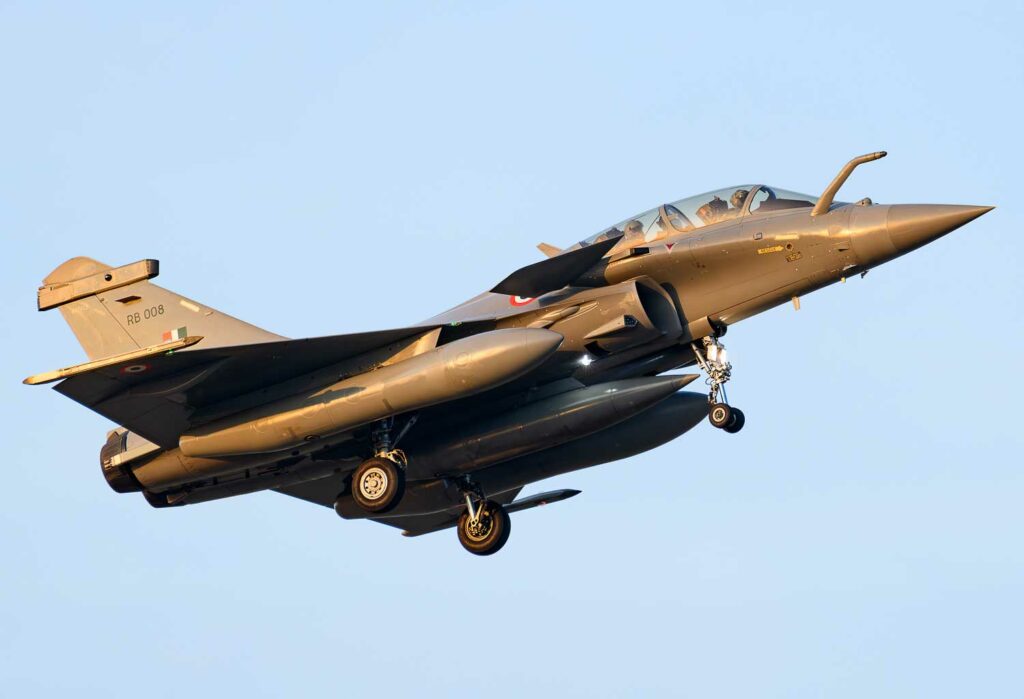
The Rafale is not gaining ground in India solely on the strength of the political relationship between Paris and New Delhi. It is gaining ground because the aircraft has already proven itself locally. India already operates 36 Rafales for the Air Force, and a contract for 26 Rafale Marines for the Navy came into effect in 2025. This point is central. The aircraft is no longer a theoretical gamble for the Indian forces. It is already integrated into their support chain, training, operational doctrine, and operational experience. For a buyer, this changes everything. We’re not starting from scratch.
Technically, the Rafale’s strength lies in its versatility. It is a multi-role fighter capable of air policing, ground attack, deep strike, nuclear deterrence for France, and maritime warfare. It carries the Meteor long-range air-to-air missile, the SCALP cruise missile, the AASM Hammer precision-guided munition, and combines AESA radar, electronic warfare, and data fusion. For India, this means an aircraft capable of performing multiple missions without increasing the number of aircraft types in the fleet. In a context of squadron shortages, this flexibility is of enormous value. A more specialized aircraft can be very good. An aircraft that fulfills multiple roles with a high level of survivability often has greater strategic value.
The MRFA issue, which also hinges on the industry
The sticking point is not so much the aircraft itself as its production method. India wants Make in India. It does not want to simply purchase imported fighters. It wants to assemble, produce, learn, integrate its manufacturers, and retain a degree of sovereignty. Dassault is fully aware of this. In its annual report, the group explains that India’s decision to enter direct negotiations for 114 Rafales reinforces the need for this local initiative, already supported by the acquisition of a majority stake in DRAL and partnerships with Tata Advanced Systems. This is a decisive point.
In other words, the battle is no longer just commercial. It is industrial. India wants to know how many aircraft will be produced locally, at what pace, with what level of technology transfer, and with what commitments regarding costs, availability, and support. Le Monde reported in February that the proposed plan could lead to the local production of at least 90 aircraft. If this structure is confirmed, we won’t just be talking about a sale. We’ll be talking about a long-term industrial foothold, with implications for employment, the supply chain, and Dassault’s future credibility in other emerging markets.
The Immediate Impact on French Export Momentum
In the short term, the psychological impact of today’s setback is real. In defense exports, perception matters. A failed contract always fuels an easy narrative: one of a slowdown, an overly high price, or more aggressive Western competition. Timing also plays a role. The Rafale is coming off several strong years in exports, with Egypt, Greece, Croatia, the United Arab Emirates, Indonesia, and India for the naval version. Any bad news is therefore scrutinized as a potential turning point.
But we must look at the facts objectively. The order book remains massive. Production must ramp up. The first deliveries of Rafale F4s destined for the UAE are expected starting in late 2026. Indonesia is on schedule. The naval program in India is underway. And the Indian MRFA remains by far the biggest open issue. The question is therefore not whether France has lost all export momentum. That would be an overstatement. The question is rather whether Paris and Dassault can convert their political success into sustainable industrial volume and acceptable prices for very large customers.
The strategic signal for France and for Dassault
This moment speaks to two things at once. The first is brutal: arms exports never definitively reward a good product. Every campaign starts almost from scratch.
The second is more favorable to Dassault: the Rafale remains one of the very few Western fighters capable of offering, all at once, an existing user base, true combat versatility, French political autonomy, and a credible promise of local industrial production. This is precisely why the Indian contract remains open and carries significant weight.
If the 1.3 billion euro contract is confirmed as lost, it will be a real commercial setback. But it will not be the final verdict on the Rafale. The verdict will be decided elsewhere, in India, on a deal that could be worth nearly thirty billion euros, sustain years of production, and consolidate the Rafale’s position as a pillar of French exports by the end of the decade. Herein lies the paradox: short-term bad news may dominate the headlines, while the real battle is being fought in a slower, more cumbersome, and more political process. And it is often in these protracted cases that the true trajectory of a fighter jet is decided.
War Wings Daily is an independant magazine.