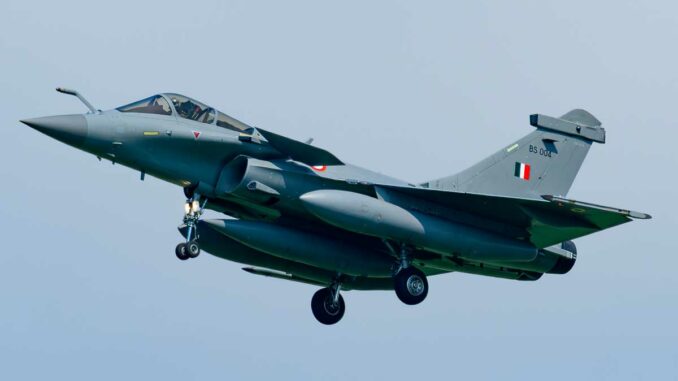
India’s MRFA for 114 Rafale aircraft would target massive local production and an MRO hub. Industrial opportunity, scheduling risk, and a true comparison with the F-35.
Summary
On January 16, several Indian media outlets reported clearer framing around the MRFA program (114 aircraft) in favor of the Dassault Rafale. The salient point is industrial: India would push for the vast majority of manufacturing to take place on its soil, with the ambition of creating a national maintenance, repair, and overhaul (MRO) hub capable of supporting the fleet for decades. For Dassault Aviation, the stakes go beyond a simple sale: it is the possibility of a second global production center and a lasting foothold in the Indian value chain. But the promise comes at a price: transferring capabilities takes time, mobilizes critical suppliers, and can delay deliveries. The timeline mentioned in the press is late for the first “off-the-shelf” aircraft to be delivered, which raises questions about the Indian Air Force’s operational urgency. Compared to the F-35, the comparison is less technological than political and industrial: sovereignty, weapons integration, logistical dependencies, and freedom of use.
The MRFA framework and what “the news of January 16” really changes
The novelty is not the existence of the need. The Indian Air Force (IAF) has been seeking for years to compensate for the erosion of its squadrons and the retirement of older fleets. What is new is the return of a coherent narrative: India no longer wants to simply buy an aircraft, it wants to buy a complete industrial capability, including production, in-service support, and local skills development.
In the information published in mid-January, the Rafale emerges as the “leading candidate” because it ticks two practical boxes. First, it is already in service in India, so the IAF is familiar with its implementation. Second, France has historically accepted more flexible industrial arrangements than Washington on customization, local integration, and support governance.
This shift in focus is significant: the MRFA is becoming as much an industrialization program as an air combat program. If this framework is confirmed politically, it automatically reduces the scope for an offer in which India would remain dependent on highly restricted external support.
The industrial promise and its figures: India wants a massive shift
The striking figure is 80% produced in India. Taken literally, this suggests a transfer of production far beyond simple final assembly. More detailed leaks also mention a step-by-step approach, with a gradually increasing local share, as has been seen in other Indian aeronautical programs.
One point that is often misunderstood is that “80% manufactured locally” does not mean “80% of the value” is localized. Highly critical subsystems (radar, electronic warfare, engines, mission computers, sensitive software) account for a large share of the value, certification, and technological sovereignty. This is precisely where the limitations lie, even in the most ambitious agreements.
According to information published by ThePrint, one possible scenario would be to obtain an initial “turnkey” delivery, followed by local manufacturing with the goal of significant indigenization, but achieved in stages. The same article also mentions a final assembly line capacity in India that would become a second global hub, which is consistent with the idea of a “global” Rafale whose production is no longer strictly French.
The role of support: an MRO hub to ensure availability
The most concrete argument for a military command is not the purchase price of the aircraft. It is the availability rate over 30 years. India wants a domestic MRO hub to shorten heavy maintenance cycles, reduce downtime, and secure parts inventories.
This aspect is credible because there are already industrial milestones in place: partnerships announced for structural components of the Rafale in India, and MRO projects related to the M88 engine. In an MRFA context, these building blocks can be assembled into a complete system: engine workshops, structures, equipment, test benches, training, documentation, and a spare parts chain.
The effects on the industrial chain: opportunity, but inevitable friction
Assembling the Rafale in India at a significant rate involves three simultaneous transformations.
The first is industrial qualification. This requires tools, processes, non-destructive testing, traceability, and above all, human skills. This cannot be “decreed.” Even with strong mobilization, there is a real learning curve.
The second is supplier management. A modern fighter jet involves hundreds of subcontractors. Moving part of the production means revalidating supply chains, securing materials, and avoiding bottlenecks on critical components. The risk is simple: moving too quickly will slow down production, thereby extending the program.
The third is contractual: who is responsible for quality, deadlines, and additional costs? India wants autonomy. Dassault wants to protect its industrial standards and intellectual property. The truth is that a compromise always exists, but it comes at the price of complex governance.
In this equation, one indicator counts: the current production rate and the ability to double it. Dassault has communicated about its recent deliveries and its order book. The pressure is high, because the Rafale has already been ordered by several customers, and the aircraft does not have “infinite” capacity.
Delivery times: the weak point if the IAF has an immediate emergency
This is where the marketing pitch falls apart if it is not carefully controlled. A “localized” MRFA does not speed up the first deliveries; it often slows them down. Local industrialization takes time before it can produce quickly.
ThePrint mentions an architecture where a first batch of aircraft would be delivered “fly-away” before the Indian line takes over, with a schedule that would push back the first deliveries of this batch to the early 2030s if the contract is not signed until 2026-2027. If this window is correct, it means that the IAF is buying a structural solution, but not an immediate fix.
This highlights a tension: the IAF needs mass now, but India wants to build an industrial tool for tomorrow. The adjustment variable is often as follows: buy a first imported batch earlier, then gradually localize. But this choice increases the political cost, as it resembles prolonged dependence.
In any case, the delivery time will be the angle of attack for critics, and a real risk for Dassault if the promise of the “Indian Rafale” is sold as a short-term solution.
What India gains: operational sovereignty and indirect export leverage
India’s interest goes beyond air combat.
First, there is operational sovereignty. Having control over support, training, and some of the spare parts reduces vulnerability in the event of a crisis. Then there is the ecosystem: skilled jobs, upgrading of subcontracting, and transfer of methods.
Then there is a less obvious gain: the ability to become a regional maintenance hub. Many countries operate with modest fleets and suffer from poor support. If India offers competitive MRO, it captures value over time, even for aircraft that are not originally Indian.
Finally, there is compatibility with Make in India: politically, this is a powerful argument. Strategically, it is a means of easing import constraints in a context where India wants to standardize and rationalize a historically heterogeneous fleet.
What Dassault gains: a global showcase and an argument against “all American”
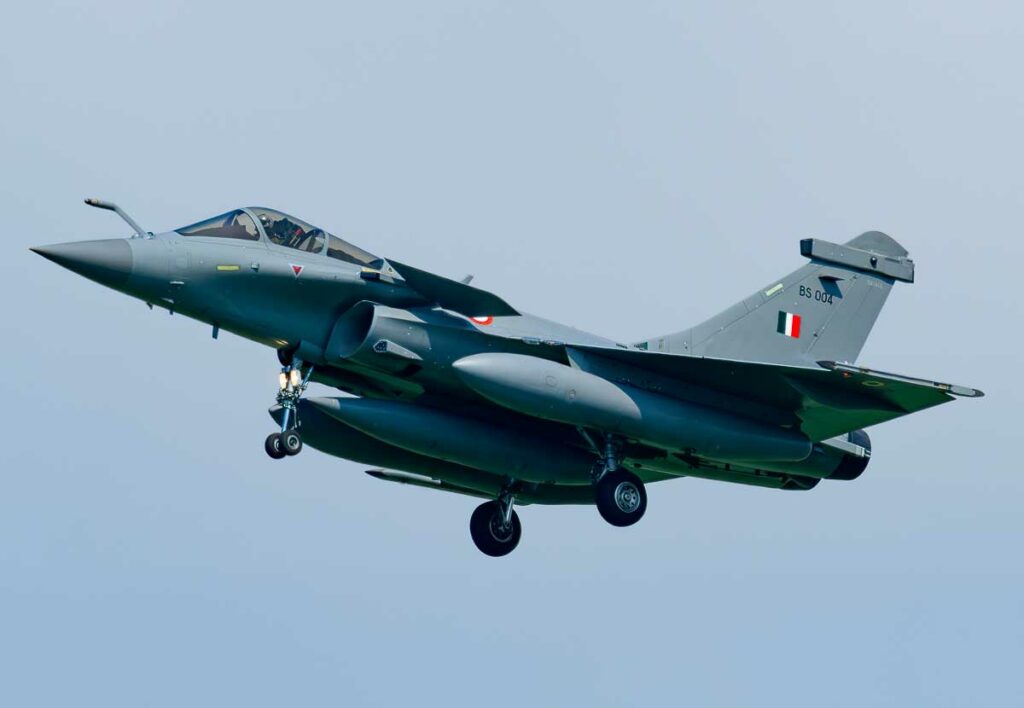
For Dassault, an MRFA for 114 aircraft is not just a big contract. It is a message to the market: the Rafale can be industrialized outside France on a large scale while remaining exportable.
If an Indian production line reaches a credible rate, it will become a buffer for order books. This could help Dassault respond to competing requests without saturating the French production line alone. But this will only work if the quality is up to standard and supplier governance is impeccable.
Commercially, India is also a showcase: a large, non-aligned, demanding country that imposes strict industrial conditions. If the Rafale succeeds there, it will reinforce its status as a “sovereignist-compatible” aircraft. This is a distinct positioning, compared to offers perceived as more politically dependent.
The corollary is that Dassault must accept increased supply chain complexity and reputational risk: any delay or budget overrun in India would reflect on the Rafale’s credibility in other tenders.
Comparison with the F-35: less a question of performance than a question of control
Let’s be clear. The F-35 is a benchmark in stealth and sensor fusion. In certain scenarios, it has an advantage. But India is not choosing an aircraft in a vacuum. It is choosing a system of dependencies.
The F-35 is a highly integrated program with strict rules for support, updates, and software governance. The American approach favors overall system consistency and the protection of critical components. This often translates into less scope for the sovereign integration of local weapons and a strong dependence on American channels for maintenance and upgrades.
Conversely, the Rafale is designed for customers who require adaptations. India has already obtained specific features for its fleet. In an MRFA logic, it wants to go further. The Rafale then becomes a political tool as much as a military tool: buying French means buying a defense relationship where Indian autonomy is more compatible.
The decisive question: industrial and political realism
Is it “realistic” for the Rafale to become the main choice “over the F-35”? Yes, if India confirms that it favors autonomy and industrialization over new-generation stealth. No, if the IAF demands immediate stealth capability and accepts increased dependence.
The likely reality is more sobering: India may seek a two-step path. Massive Rafale purchases to rebuild squadrons and industrialize. And, in the longer term, stealth capability via its national programs, or a foreign opportunity if political conditions change.
The sticking point remains the timeline. A highly localized MRFA is a decade-long strategy. This is rational for the state. It is frustrating for an army that needs aircraft quickly.
The parameters that will determine whether the project succeeds or fails
Three signals will be decisive in the coming months.
The first is the structure of the contract: the proportion of aircraft imported at the outset, the path to localization, penalties for delays, and quality governance.
The second is the reality of support: stocks, test benches, engine capacity, and training levels. An MRO hub announced without logistical depth changes nothing.
The third is the pace. Dassault can announce its ambitions, but the manufacturer will be judged on figures: annual deliveries, ramp-up, and global order book performance.
This deal will not be won with slogans. It will be won with a consistent equation: a Rafale produced in India, maintained in India, delivered on time, and available in squadrons. If any of these lines break, the “MRFA Rafale” promise will turn into a drawn-out program, and the political advantage will evaporate.
Sources
ThePrint, “Rafale deal to be inked in 2026, final assembly line in Nagpur…” (January 14, 2026).
The Economic Times, “Around 80% of 114 Rafale jets to be built in India…” (January 15, 2026).
ETManufacturing (Economic Times), “About 80% of Rafale jets for IAF likely to be manufactured in India” (January 15, 2026).
AeroTime, “Dassault Rafale output lags demand…” (January 8, 2026).
Dassault Aviation, “Deliveries, order intakes, and backlog… as of December 31, 2025” (January 7, 2026).
Reuters, “France’s Dassault and India’s Tata to produce Rafale fuselage in Hyderabad” (June 5, 2025).
Reuters, “India signs $7.4 billion deal to buy 26 Rafale fighter jets” (April 28, 2025).
Times of India, “Safran to set up MRO for Rafale fighter jet engines in Hyderabad by 2026 end” (2025).
AP News, “India retires MiG-21 fighters…” (September 22, 2025).
The War Zone, “Trump Offers India Path To F-35” (February 14, 2025).
War Wings Daily is an independant magazine.