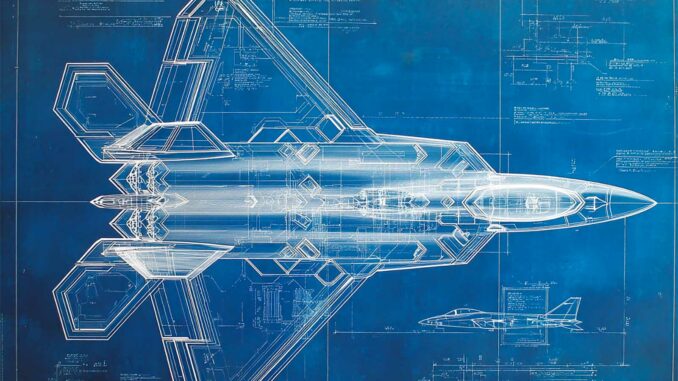
SCAF, GCAP Tempest, NGAD: three visions of the sixth-generation fighter. Alliances, timelines, technologies, and budgets, without any waffling.
Summary
Sixth-generation fighter jets are not just stealthier aircraft. They are designed to be the central hubs of a network of sensors, drones, and long-range weapons. Europe is moving forward with the European SCAF program, but remains weakened by industrial tensions and a slipping schedule. On the other hand, the British GCAP Tempest project is banking on tighter governance and a stated goal of entering service around 2035, at the cost of an assumed technological risk. The United States, for its part, is structuring the American NGAD program as a family of systems, with a visible acceleration since the award of the EMD contract to Boeing in March 2025. Behind the slogans, the difference lies in the architecture (open or closed), the role given to drones, the level of software autonomy, and the ability of states to finance an air war that has become primarily a battle of data.
The disruption imposed by the sixth generation
A modern fighter is no longer just an “aircraft + missiles.” The sixth generation takes this logic to the extreme. The promise is simple to formulate but difficult to keep: survive in a dense A2/AD bubble, strike from a distance, coordinate multiple effectors, and remain relevant despite rapidly evolving threats.
Three trends dominate. First, next-generation stealth. This is not limited to form. It aims at multi-spectral reduction: radar, infrared, electronic emissions, and acoustic signatures at low altitude. Next is connectivity and data fusion: the pilot no longer “sees” a battlefield, but consumes a synthesis produced by distributed sensors. Finally, combat becomes “composable”: a force is assembled by combining a piloted fighter, drones, missiles, decoys, and communication relays.
This change explains why budgets are skyrocketing. We are financing software, tactical cloud computing, computers, resilient data links, and digital test benches, as well as aerodynamics.
The SCAF program and its European promise
The political heart of SCAF is well known: France, Germany, and Spain want to replace the Rafale and Eurofighter around 2040. But SCAF is not “an aircraft.” It embraces the SCAF concept of a system of systems: a piloted New Generation Fighter (NGF), Remote Carriers (drones and effectors), and a Combat Cloud.
From an industrial standpoint, the logic is as clear as it is contentious. Dassault Aviation wants to pilot the NGF, citing its responsibility as architect and its experience. Airbus, which de facto represents two nations (Germany and Spain via the Airbus/Indra ecosystem), refuses to accept a scheme in which its contribution would be perceived as secondary. The result: recurring deadlocks over responsibilities, access to data, and the division of labor.
However, the program has reached an important contractual milestone: the 1B demonstrator phase has been awarded for €3.2 billion, over approximately three and a half years, to cover demonstration and component work. The problem is not “zero progress.” The problem is political and industrial alignment, without which the schedule becomes a slogan.
In terms of the overall budget, we must be frank: the orders of magnitude vary depending on what is included (R&D, industrialization, support). Public estimates mention tens of billions, sometimes a range of €50 to €80 billion over the period, while other estimates and media comments put the figure at around €100 billion for the entire program and its life cycle. This vagueness is not a minor detail: it determines the financing of defense programs and the credibility of an entry into service around 2040.
The French doctrine that complicates everything
France is not buying a “standard European jet.” It requires specific capabilities, including airborne nuclear capability and compatibility with an aircraft carrier.
These constraints shape the aircraft (weight, safety, interfaces, operational envelope). They also fuel the German perception of a program “designed in Paris.” This doctrinal divergence weighs on Franco-German aeronautical cooperation.
The GCAP Tempest project and its aggressive schedule
GCAP was born out of the merger of Tempest (United Kingdom/Italy) and the Japanese F-X program. The triptych is clear: a manned fighter, drones, and a combat cloud. The difference lies elsewhere: the partnership is more compact, and governance aims to limit blockages.
In early 2025, the British Parliament reiterated that the 2035 target is ambitious. Ambitious means risky, not impossible. Meeting the 2035 target means making decisions early, sometimes before certain components are fully mature. It is a program management gamble: accepting excessive risk in R&D to avoid ten years of drift.
In terms of budgets, GCAP communicates less in terms of consolidated “total cost,” but several markers exist. In 2023, the United Kingdom announced a contribution of £656 million to push forward the next phase of technologies. Italy, for its part, has indicated an allocation of around €8.9 billion spread over 25 years, an average of around €350 million per year. In 2025, Japan included approximately ¥112.7 billion (around $800 million) for the GCAP effort in its defense budget. These figures do not represent the “final price,” but they do show the level of political traction.
Offensive and defensive technologies in the spotlight
GCAP emphasizes information superiority and mission autonomy. In concrete terms, this means very wideband AESA radar, passive sensors, high-level electronic warfare, and long-range weapons. The offensive logic is to “shoot before being seen,” but above all to decide before the adversary.
Defensively, the goal is to reduce signature and increase resilience: LPI (Low Probability of Intercept) modes, adaptive jamming, and the ability to operate even when GPS and communications are degraded.
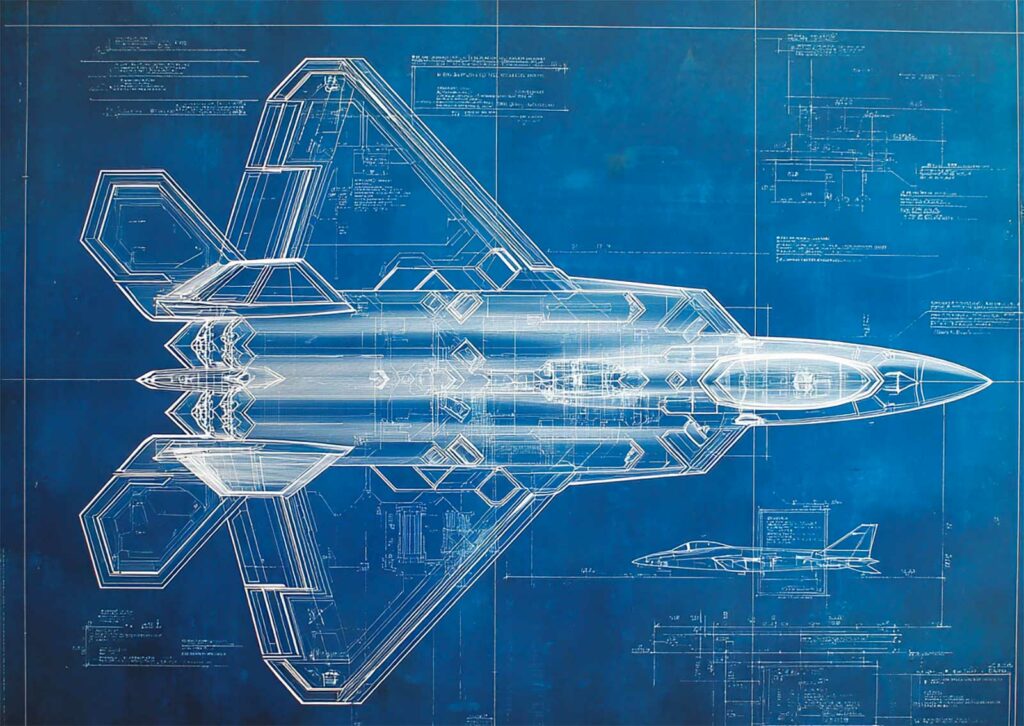
The NGAD program and the American approach to air combat
The American NGAD is the most obvious version of the “system of systems.” The United States wants a piloted air superiority fighter, but also a family of associated drones, often described as CCAs (Collaborative Combat Aircraft). The idea is simple: increase the number of sensors and effectors without increasing the number of pilots.
The most visible shift is political and budgetary. The US Congress and public agencies are documenting very high amounts: the FY2025 budget request for the NGAD platform was $2.75 billion, with projections rising in subsequent years. At the same time, CCA budgets are rising, with the idea of a fleet of up to 1,000 drones and unit cost targets often cited at around $25 to $30 million per drone.
The timeline also clarified one major point: on March 21, 2025, the U.S. Air Force announced that it had awarded Boeing the EMD contract for the NGAD platform, designated F-47. The contract is presented as a structuring milestone, and media estimates suggest an EMD of at least $20 billion. Again, this is not the “total cost.” It is just the beginning.
The budgetary constraint and the risk of the “$300 million fighter”
Let’s be clear. If an NGAD piloted fighter costs close to $250 to $300 million per unit, the volume that can be purchased will shrink.
And if the volume shrinks, operational mass becomes even more dependent on drones. This is not necessarily a problem, but it is a doctrinal change: air superiority becomes a swarm orchestration, not a duel between elite fighters.
This is precisely why the United States is pushing for the open architecture of NGAD: to accelerate the integration of new capabilities without rebuilding the aircraft. Ideally, software and modules are updated, not an entire airframe.
The comparison between SCAF and Tempest, then the rivalry with NGAD
The comparison between SCAF and Tempest can be seen first in governance. SCAF is broader, and therefore more fragile. GCAP is tighter, and therefore faster, but potentially more exposed to early mistakes.
However, the most significant rivalry remains transatlantic. The rivalry between SCAF and NGAD is not a competition between brochures. It is a competition between sovereignty, dependence, and industrial tempo. If NGAD arrives first and imposes its interoperability standards, it will become a technological magnet. Conversely, if Europe masters its combat cloud, drones, and sensors, it will reduce its technological dependence on the United States.
In terms of offensive technologies, NGAD has a head start in terms of maturity in multi-sensor fusion, software pipelines, and large-scale integration of CCA drones. GCAP seeks to compensate for this with an alliance of strong industrial capabilities (BAE Systems, Leonardo, Mitsubishi Heavy Industries) and time pressure. SCAF, for its part, has a solid base of experience on the French side (Rafale, deterrence) but suffers from the risk of industrial fragmentation.
The central role of escort drones
All converge on combat escort drones. The names vary: Remote Carriers, CCAs, loyal wingmen. The function is the same: to extend detection range, saturate defenses, serve as relays, or carry weapons.
The figures give an idea of the scale. The United States is talking about very high fleet targets (up to 1,000 CCAs) and cost targets per drone that are significantly lower than for a piloted fighter. This relative economy opens up a strategy: accepting drone losses to preserve the piloted platform, which changes the risk equation.
Announced budgets and political reality
Budgets are the truth that always catches up with concepts in the end. SCAF has a clear milestone of €3.2 billion for phase 1B, but its full trajectory remains under debate, with estimates ranging from tens of billions to around €100 billion depending on the scope. GCAP has clear but scattered national commitments, with multi-year budgets and a discourse focused on technological effort. NGAD, for its part, has annual budget requests of several billion dollars, backed by an industrial base capable of absorbing large programs in parallel (B-21, missiles, space).
In all three cases, the weak point is not just money. It is the stability of the decision. A sixth-generation program cannot survive a “stop and go” approach. It requires a consistent political course over 10 to 20 years and industrial discipline that has little tolerance for ego wars.
European industrial sovereignty as the ultimate challenge
Behind the acronyms, the question is stark: does Europe want to be a customer or an architect? European industrial sovereignty cannot be proclaimed. It has to be paid for and organized.
If the SCAF fragments, Europe risks a multi-speed landscape: some countries tied to the American ecosystem, others to GCAP, and still others to hybrid solutions. In the short term, this may seem pragmatic. In the long term, it creates dependencies, incompatibilities, and a loss of industrial critical mass.
The irony is that everyone wants a “network-centric” air war, but no one wants to depend on anyone else’s network. Sixth-generation projects are therefore less about aircraft than about choices of industrial civilization.
Sources
Reuters, July 7, 2025, “Paris demands 80% workshare…”
Reuters, November 21, 2025, “Berlin, Paris push companies…”
Reuters, November 25, 2025, “France and Germany step up pressure…”
Reuters, December 16, 2025, “FCAS fighter jet ‘very unlikely’…”
Airbus / Dassault Aviation, joint press release, December 16, 2022, phase 1B contract worth €3.2 billion
French Senate, report “2040, l’odyssée du SCAF” (investment estimates and ranges)
UK Parliament, House of Commons Defence Committee, “Global Combat Air Programme”, January 14, 2025
UK Ministry of Defense (GOV.UK), “Major funding boost…”, April 14, 2023
CRS (Congressional Research Service), IF12805 / PDF, “U.S. Air Force NGAD Fighter”, November 4, 2024 and 2025 updates
U.S. Air Force (af.mil), “Air Force awards contract… NGAD Platform F-47”, March 21, 2025
USNI News, “Report to Congress on NGAD”, November 7, 2024 and January 20, 2025
IISS, “Tempest: Build, buy, or goodbye?”, September 1, 2024
EDR Magazine, “GCAP: an Italian view”, June 11, 2025
IAI (Istituto Affari Internazionali), “The New Partnership… GCAP”, March 13, 2025
War Wings Daily is an independant magazine.