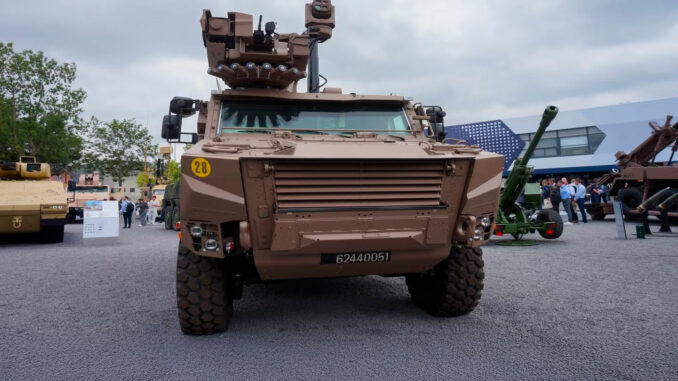
France launches KNDS France’s Serval C-UAV armored vehicle: 30 mm cannon, radar, and RF detection to counter drones from 2028.
The Serval armored vehicle, in its anti-drone version (C-UAV/LAD), combines a remote-controlled 30 mm cannon, 3D radar, and radio frequency sensors to detect and destroy drones. France has ordered 24 units, with the aim of acquiring 48, which will be delivered from 2028. This vehicle joins the program’s many variants, offering a flexible response to evolving light air threats.
A new project to counter light air threats
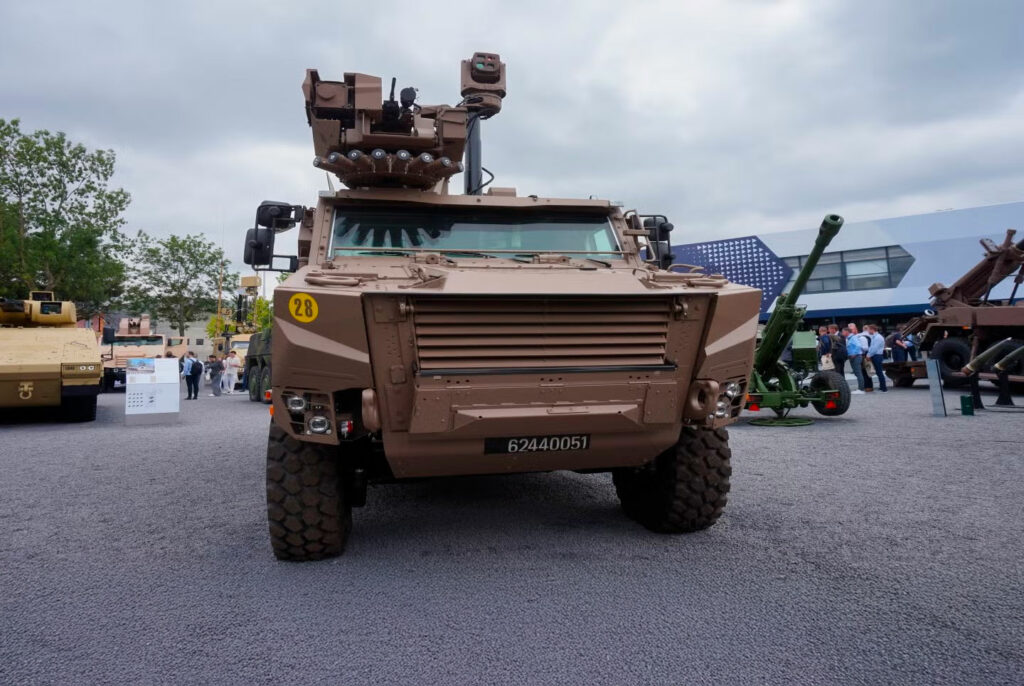
The KNDS France group recently unveiled the “Counter-UAV” version of the Serval armored vehicle, designed to neutralize drone threats.
- This armored vehicle is equipped with an ARX®30 remote-controlled turret, armed with a 30 mm caliber cannon, capable of firing at high rate under high elevation—a configuration suitable for low-altitude flying drones.
- In addition, it features sophisticated detection systems: 3D radar, electro-optical sensors, and radio frequency (RF) detectors. These devices enable the vehicle to automatically identify, track, and engage small aerial targets, which are often difficult to spot.
- The integration of airburst ammunition (explosive fragmentation) adapted to light drones increases the effectiveness of the cannon. The shell explodes at a programmed distance, creating a lethal cloud of fragments, ideal against multiple or low-signature targets.
This vehicle is part of the SCORPION program, which aims to modernize the Army’s armored capabilities. The Serval C-UAV joins a wide range of versions (troop transport, electronic warfare, command post, fire support, etc.).
Orders, schedule, and key figures
The strategic importance of the Serval is illustrated by recent orders:
- In December 2024, the French Defense Procurement Agency (DGA) ordered 530 Serval “SCORPION Support” vehicles. Among them, 24 units are specifically designated “C-UAV/LAD” for anti-drone warfare.
- The legal objective under the military programming law provides for a total of 48 Serval C-UAVs.
- The first deliveries are scheduled for 2028.
The “standard” version of the Serval – a light multi-role 4×4 armored vehicle – has the following characteristics: length approximately 6.7 m, weight ~ 17 tons, crew of 2 + 8 soldiers.
The standard unit cost of a Serval (according to 2021 estimates) is around €1.2 million. This figure may vary depending on the version and onboard equipment.
Why such an armored vehicle: the need for modern anti-drone defense
The conflict in Ukraine has highlighted the threat posed by drones—particularly small UAVs, loitering munitions, and “swarms.” Expensive armored platforms have suffered significant damage from inexpensive but effective devices.
Several characteristics make drones particularly problematic:
- small size, low signature, low-altitude flight, sometimes high speed;
- ability to strike in numbers or swarms, overwhelming traditional defenses;
- very low cost compared to conventional anti-aircraft vehicles or systems.
Faced with these threats, traditional solutions such as surface-to-air missiles (VSHORAD), MANPADS, or heavy artillery systems are often too slow, too expensive, or ill-suited.
The Serval C-UAV responds to this challenge with a complete engagement chain: detection (radar + RF + sensors), identification, tracking, and rapid neutralization via a 30 mm cannon—a “sensor-to-shooter” concept. This approach reduces the time between alert and firing, which is crucial when dealing with fast or swarming drones.
In addition, the use of airburst ammunition improves effectiveness without requiring surgical precision: a well-calibrated shot can neutralize several drones or loitering munitions without point-by-point targeting.
Strategic consequences for the French army
The entry into service of the Serval C-UAV marks a turning point in the army’s ability to defend itself against light, low-altitude aerial threats. Several concrete impacts can be identified:
- Increased protection for convoys, bases, and deployed units: in high-intensity environments, an armored vehicle such as the Serval can serve as a mobile shield, protecting ground forces from drone strikes or loitering munitions.
- Reduced losses and costs: neutralizing a drone at 30 mm is undoubtedly much cheaper than intercepting it with a surface-to-air missile. In addition, an automatic cannon is sufficient, without dramatic supply costs.
- Rapid, automated, and integrated response capability: the system combines detection, identification, and firing—with minimal human intervention, reducing the risk of error or delay.
- Tactical flexibility and modularity: in line with the SCORPION program, the Serval can exist in many variants. The C-UAV thus joins a family of vehicles capable of fulfilling various roles depending on the context.
- Deterrent effect on enemy forces: knowing that an enemy force has armored vehicles capable of automatically responding to drones makes low-signature attacks much less attractive.
Limitations, technical challenges, and delays
However, the project remains subject to uncertainties. Several technical and logistical challenges weigh on the actual effectiveness of the Serval C-UAV:
- The ARX 30 cannon generates significant recoil (~ 650 kg), which places constraints on the structure of the armored vehicle, particularly the roof, to absorb the stress.
- The development of programmable and reliable airburst ammunition is still ongoing. This type of ammunition requires robust electronics, safety systems (to prevent accidental firing), and must be resistant to electromagnetic interference.
- The delivery date—2028—leaves a potentially critical gap: if a conflict breaks out before then, forces will have to make do with older systems that are less suited to drone threats.
- The first 24 armored vehicles ordered are not many: faced with an extended front and a diffuse threat, coverage is likely to be insufficient unless production is accelerated.
Furthermore, although the 30 mm cannon is effective against light drones, it may be less suitable against heavy UAVs, fast loitering munitions, or stealth drones. In these cases, missiles or more sophisticated systems remain relevant.
A future market — export, standardization, European anti-drone warfare
The decision to develop a modular multifunction armored vehicle — and to integrate an anti-drone version — is not only a national issue. Several industrial, strategic, and diplomatic consequences are emerging:
- The DGA (Direction Générale de l’Armement) is preparing a fleet of modernized armored vehicles, but the existence of an exportable vehicle such as the Serval C-UAV could appeal to allies or partners seeking a reliable and affordable anti-drone solution. Several observers have mentioned potential interest in exporting the vehicle.
- The return of medium-caliber (30 mm) self-propelled guns in anti-drone warfare marks a fundamental shift: “missile-only” systems are no longer sufficient. This type of weapon, combined with advanced sensors, could become the norm for close-range defense.
- The integration of the C-UAV version into a joint program between European countries could promote interoperability and the standardization of parts and doctrines—an important issue in an unstable geopolitical context.
- The development of airburst and programmable weapons and ammunition paves the way for a renewal of defense and engagement doctrines: efficiency, speed, and economy are increasingly replacing the paradigm of overwhelming force.
A risky technological and strategic gamble
The introduction of the Serval C-UAV armored vehicle represents a turning point. By combining automated detection, a 30 mm cannon, and airburst ammunition, France is investing in a pragmatic and modern approach to anti-drone warfare. This choice could prove relevant in the face of asymmetric threats—reconnaissance drones, low-cost UAVs, swarms.
But this gamble carries risks. Success depends heavily on the reliability of the ammunition, the effectiveness of the sensors, the robustness of the system against electromagnetic interference, and the speed of delivery. With only 24 vehicles ordered and the first deliveries scheduled for 2028, time is running out.
Above all, when faced with heavier, faster, silent, or stealthy drones, the capabilities of the 30 mm cannon may reach their limits. It will probably be necessary to combine the Serval C-UAV with other means—missiles, electronic warfare, defense drones—to achieve truly reliable protection.
As it stands, the Serval C-UAV represents a compromise—between agility, modularity, cost, and effectiveness—but this compromise will have to prove itself in the field, in a context where threats are constantly evolving.
Sources
National Interest – “France Just Unveiled a Powerful New Counter-Drone System”
KNDS France – Official press releases on the Serval Counter-UAV
Army Recognition – Technical analyses of the Serval LAD and the SCORPION program
Defense Leaders – Presentation of the Serval Counter-UAV and industrial data
Forces Operations Blog – Articles on the development of the ARX30 cannon, airburst ammunition, and technical constraints
DGA (Direction Générale de l’Armement) – Public information on Serval orders and the LPM
Wikipedia (VBMR-L Serval) – General technical data and estimated costs
Projet13 – General information on the VBMR-L Serval
Defence Arabia – Description of the “Dronised Function Kits”
The Defense Post – Details on airburst ammunition and the capabilities of the ARX30 turret
War Wings Daily is an independant magazine.