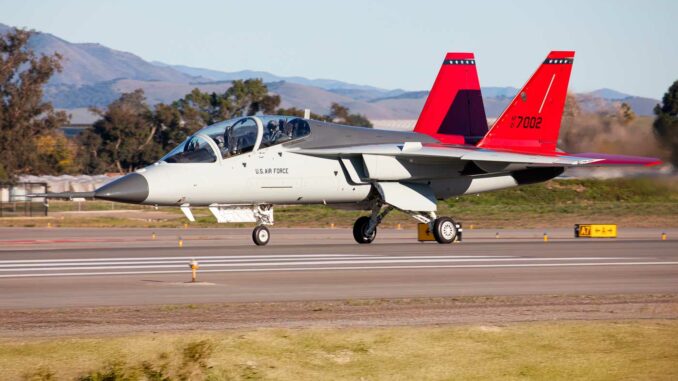
Safety, size diversity, testing, and delays: why the ACES 5 seat in the T-7A Red Hawk became the breaking point for the program.
In summary
The Boeing-Saab T-7A Red Hawk was supposed to modernize US Air Force pilot training. But its survival system, centered on the ACES 5 ejection seat, shifted the focus of the debate: an aircraft may be promising, but it will never be accepted if emergency evacuation is not certified for everyone. The USAF imposed a wider range of sizes and weights than in the past to reflect actual recruitment, including more women. Tests highlighted the risk of trauma, particularly when the parachute opens: sudden acceleration, neck strain, and possible concussions. This finding led to delays, additional tests, and modifications to components such as the drogue chute. In 2025, key tests show progress, but certification remains a red line. This case highlights a reality: on a training aircraft, safety dictates the schedule. It also dictates the final industrial bill.
The T-7A Red Hawk program caught up by its safety requirements
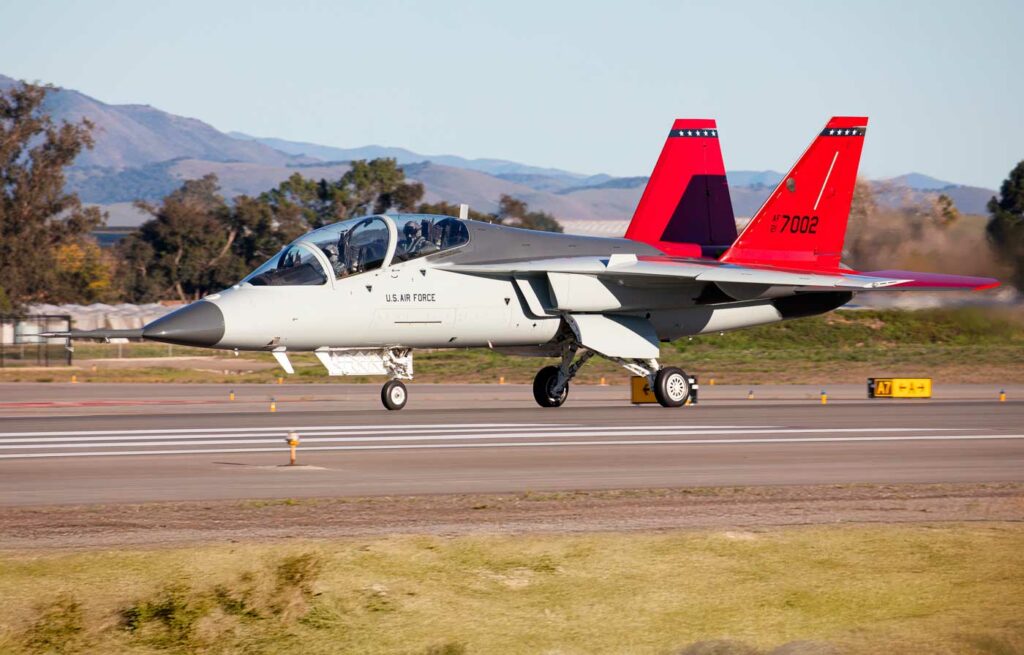
On paper, the T-7A Red Hawk ticks all the boxes for a modern trainer: digital architecture, maintenance designed from the outset, and the promise of replacing the aging T-38 Talons. In reality, industrial dynamics and the military schedule have collided on one specific point: the ejection system.
The logic is relentless. A training aircraft is not evaluated solely on its performance. It is judged on its ability to survive a rare but critical scenario: a serious incident at low altitude, at intermediate speed, with a pilot in training. Where a fighter jet can “tolerate” different risk margins (because operational use requires compromises), a trainer must be demonstrative, repeatable, certifiable, and politically acceptable.
What makes the issue so inflammatory is that it touches on the human body, the right to fly, and the social issue of recruitment. The USAF no longer wants a system “optimized” for a historical body type. It wants a standard that is valid for the actual population of its pilots today.
The request that changes everything: expanding the size range
The break is here: the US Air Force has requested much broader compatibility in size and weight than the old references, which were based on data from the 1960s. The often-cited threshold for modern requirements around ACES 5 illustrates the scale: 47–111 kg (103–245 lb). This range aims to cover lighter and smaller profiles, but also heavier ones, with equipment (helmet, vest, survival gear, etc.).
The implicit message is clear: if ejection is not safe for a significant portion of the workforce, the aircraft is not acceptable. And as the USAF is also seeking to expand its recruitment pool, the issue automatically includes more women, who are more often found in the lower weight/size segments that were poorly accounted for in the old standard.
The ACES 5 seat transformed into a technical-medical “trial”
The seat is not just a “rocket chair.” It is a complete chain: extraction (canopy, trajectory), stabilization, deceleration, then parachute deployment. The slightest link in the chain can create a peak force, and that peak force translates into injury.
The heart of the controversy stems from one observation: during test campaigns, engineers identified scenarios where the safety envelope was not maintained, particularly for certain sizes and speeds. The wording that caused a reaction was: risk of concussion or neck trauma when the parachute opens. In other words: the pilot survives, but may be seriously injured, which is unacceptable for a training aircraft, and even more so if this risk is concentrated on a certain segment of the population.
The critical moment: parachute deployment as a “whiplash”
The parachute deployment phase is an aerodynamic shock.
Vertical and horizontal speed, seat stability, head position, body restraint—everything counts. Even with a modern system, an overly “aggressive” opening can cause sudden acceleration and neck flexion. In reports and the trade press, this sequence is cited as a plausible trigger for the injuries observed, particularly for lighter profiles.
One technical detail often comes up: stabilization before opening. Historically, a small stabilization parachute helps to “calm” the trajectory before the main parachute opens. However, the USAF has sought to consolidate performance at lower speeds, an area where aerodynamics and stability behave differently.
The role of the drogue chute and low-speed testing
This is where the drogue chute becomes a central figure in the case. A technical release from the Air Force Research Laboratory explains that this device has long been designed for ejections above 250 kt, or approximately 463 km/h (250 knots), before deployment of the main parachute. The teams wanted to collect data and validate performance at lower speeds, precisely where a training aircraft is more likely to need to eject (approach, circuit, training maneuvers). The very fact that targeted tests had to be restarted says something: the “all weather, all profile” envelope was not trivial to achieve.
Program freeze and the mechanics of delays
When an ejection system fails to obtain airworthiness certification, everything else comes to a standstill. Test flights sometimes continue on non-dependent items, but the path to production and squadron training comes to a halt. This is one of the reasons why the T-7A has seen its schedule slip, with public rebasing and milestone delays.
One figure sums up the industrial impact: Aviation Week explained that the selection and integration of the new seat contributed to a 2.5-year delay in the establishment of the first squadron and significant losses for Boeing on a fixed-price contract. This is not an accounting detail: it is proof that the “small” survival subsystem can cost more than a large piece of structure because it affects the right to fly.
More positive signals for 2025, but not a “happy ending”
In 2025, several articles report successful evacuation tests, including high-speed sled/ejection tests, which are presented as important milestones. This is good news, as it indicates that the correction trajectory is credible. But it is not a free pass. Tests validating a portion of the envelope are not enough: compliance must be demonstrated across the range of profiles, at representative speeds and altitudes, with an acceptable level of risk for certification and training use.
The human dimension that prevents the problem from being “minimized”
Let’s be clear: ejection will always be violent. The medical literature on ejections reports significant injury rates, even as technology advances. But the stated goal of the modern seat is precisely to reduce major injuries, not just to prevent fatalities. Medical publications list the types of recurring injuries (spine, limbs, head) and show why military aviation invests so much in seat and parachute kinematics.
What makes the T-7A case politically explosive is the idea of a risk that varies according to size.
If the system is “generally good” but penalizes lighter individuals, the issue is no longer just technical. It becomes institutional: who has the right to be a pilot without accepting an increased risk?
2025 scenarios: what the USAF is really watching
Public discussion often revolves around a date of entry into service. Some recent sources mention a target of IOC 2027, after a series of production and qualification adjustments. Here again, the figure is less important than what it hides: the USAF wants proof. Not promises.
The fundamental question: modernization that depends on a “non-negotiable” detail
The T-7A is not the first program to discover that a survival subsystem can redraw the entire schedule. But it is a textbook case, because the initial requirement (more diverse templates, high security, digital integration) is exactly what a modern army demands.
The result, in 2025, looks like a lesson in methodology. The USAF cannot “override” this without undermining its safety doctrine and recruitment efforts. Boeing and Collins cannot “sell” an incremental improvement if the demonstration is not indisputable. And pilots will not accept a training aircraft that imposes compromises reminiscent of decades past.
What is at stake now is simple: either the seat and parachute sequence architecture achieves proven robustness across the entire range, or the program will continue to operate under pressure, regardless of the number of successful tests announced.
Sources
Air Force Research Laboratory – “Air Force tests Ejection Seat Drogue Chute for T-7A Red Hawk”
Aviation Week – “Fast-Tracked U.S. Air Force T-7A Slowed By Ejection Seat Issues”
Air & Space Forces Magazine – “T-7 Making Progress on New Ejection Seat…”
The War Zone (TWZ) – “New Details About T-7A Red Hawk Jet Trainer Ejection System Woes Emerge”
FlightGlobal – “Troubled T-7A takes step forward with successful sled ejection test”
RTX / Collins Aerospace – ACES 5 presentation (features, injury reduction objectives)
PubMed – “Injuries associated with the use of ejection seats” (review of ejection-related injuries)
War Wings Daily is an independant magazine.