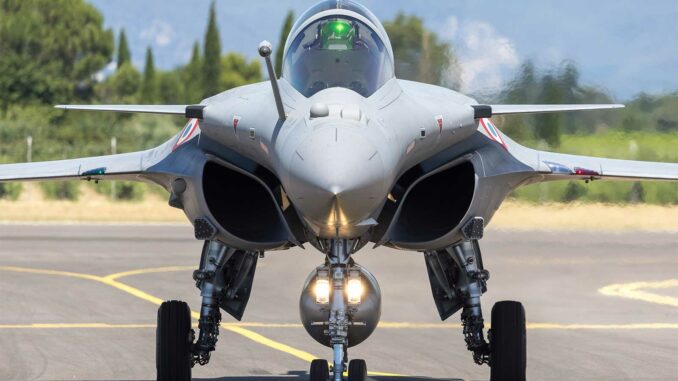
The 2026 budget mentions 286 Rafale aircraft, compared to 225 today. Is this just a publicity stunt or a real turning point? Production rates, deadlines, costs, and industrial challenges for Dassault.
In summary
The French draft budget for 2026 has sent shockwaves through the industry: documents refer to a target of 286 Rafale aircraft, whereas the known trajectory is for 225 aircraft. The government was quick to clarify the situation. The DGA explained that 286 refers to a “target program” and cumulative deliveries, not an immediate order for 61 aircraft. At the same time, the 2026 budget confirms a net increase in appropriations: €57.15 billion excluding pensions within the scope of the LPM, and an increase of €6.67 billion compared to 2025. The Senate details a massive 2026 order plan, including two Rafales, four SAMP/T NGs, and two Saab GlobalEyes to replace the AWACS. The crux of the matter is this: even without the “order of 61,” operational pressure and NATO tensions are pushing for increased air power, which gives Dassault industrial and political leverage… while reminding us that production remains constrained by the supply chain and exports.
The figure of 286 and the administrative reality behind the announcement
The raw information circulated as follows: France is “aiming” for a fleet of 286 combat aircraft, up from 225, to meet new NATO and national requirements. Specifically, this refers to the Rafale, the core of the French combat component.
But the nuance is key. Following press articles and international coverage, the DGA, through Emmanuel Chiva, told members of parliament that the operational target remains 225 and that the figure of 286 corresponds to cumulative deliveries, not an immediate order for 61 aircraft. He added that in the event of an increase of 61 aircraft, a compatible production program would be required, “which is not the case today.” In other words, the figure existed in the documents, but it does not in itself constitute an industrial “go-ahead.”
This clarification does not make the subject any less interesting. Rather, it says this: the government is politically testing an option, observing reactions, and keeping the door open. This is a classic method when an army format becomes too narrow, but funding is not secured.
The budgetary mechanics of 2026 and the real scope for ordering
The 2026 finance bill is part of the 2024-2030 Military Planning Law and provides for a very significant increase. The Senate estimates the appropriations within the scope of the LPM (excluding pensions) at €57.15 billion in 2026, an increase of €6.67 billion compared to the initial 2025 finance bill. For the “Defense” mission in the broad sense, payment appropriations would reach €66.7 billion, an increase of €6.78 billion (+11.3%).
These amounts do not automatically mean “more Rafale” aircraft. They primarily mean “more orders” in the broad sense, with a catch-up in stocks, air defense, sensors, drones, space, and deterrence.
The Senate also mentions an order volume of €44 billion planned for 2026, with a list that clarifies the priorities: two Rafales, two Swedish Saab GlobalEyes to replace the AWACS, four SAMP/T NG, as well as batches of ammunition (including AASM) and other programs.
The message is clear: even without a “massive” order for Rafale, France is strengthening the depth of its air system, especially surveillance and ground-to-air defense. This is consistent with NATO pressure on integrated air defense and the drone/missile threat observed since 2022.
Operational needs bring the air force format back to the table
Why is this debate back now? Because the format is no longer comfortable.
France must maintain several lines at the same time: permanent security posture, NATO contribution, airborne deterrence, overseas presence, ad hoc operations, and high-intensity training. However, a fleet of 225 fighters is already “full” on paper and “stretched” in reality, between availability, maintenance, and upgrading to standard.
Added to this are recent factors: sales of used Rafales to partners, attrition losses (including an accident mentioned in 2024 in several press reports), and the knock-on effect of exports on the industrial workload.
This is precisely what the DGA’s statement means: “two additional Rafales” are planned between now and 2030 to compensate for attrition. This is not a revolution, but a logic of maintaining the format.
Industrial time: how many months to “make” 61 Rafales
If we assume a theoretical additional order of 61 Rafales, the question becomes: how long will it take?
The answer depends on one key factor: the production rate available after fulfilling export orders and the French plan already underway. Dassault and the trade press describe a gradual ramp-up: production targets 3 Rafale aircraft per month in 2026, then 4 per month from 2028-2029, with a longer-term target of 5 per month. In an October 2025 press kit, Dassault also indicates that production rates must increase and mentions a target of 4 aircraft per month, with a significant backlog remaining.
Two simple scenarios help to understand this.
The “net available capacity” scenario
If, for the sake of simplicity, we imagine a production line capable of producing 3 aircraft per month “for France” (without export competition), 61 aircraft would represent approximately 20 to 21 months of production. At four per month, this falls to around 15 to 16 months. These figures are attractive… and misleading, because they ignore the reality of an export order book, critical parts, and supplier uncertainties.
The realistic “global order book” scenario
The reality is that France does not “take” a dedicated line. It shares capacity with export customers and supply chain constraints. Reuters reported again in 2025 that Dassault was ramping up production while experiencing supply constraints, and mentioned a global order book that included Rafale aircraft. An article in L’Usine Nouvelle in January 2026 also pointed out that deliveries were progressing, but that the pace remained a challenge.
So even if an additional order came in, the effect on the fleet would be spread out. We’re talking years, not quarters. This is precisely why the government is avoiding promising “61 more” without a finalized industrial plan.
The budget, the cost, and the question we’re avoiding: how much would it really cost?
Public documents do not give a simple unit price, because a Rafale is paid for in terms of aircraft + support + weapons + infrastructure + training. The orders of magnitude put forward by certain press sources on a “61 aircraft” assumption are in the region of several billion euros. But a serious calculation must include:
- the upgrade to F5 standard and sensor/link developments,
- maintenance and parts,
- simulators and training,
- ammunition stockpiles, which become the real bottleneck in high-intensity situations.
The Senate provides a useful indication, even without mentioning the “Rafale price”: the priority for 2026 is overall capability, with structural orders (GlobalEye, SAMP/T NG, ammunition). This means that the government’s decision is not to “buy aircraft” but to “buy a system.” One more aircraft without missiles, without availability, and without intelligence does not change the balance of power.
The link with fighter jet development and the risk of disruption
The most interesting angle is the effect on the future.
France is financing the Rafale as a current capability, but also as an industrial bridge to the 6th generation fighter. The Senate highlights a very concrete point: the need to continue the development and refinement of the Rafale, particularly around a more powerful engine, and calls for a rapid agreement between the DGA and Safran on the funding of research credits, deemed essential to maintain skills and prepare for the engine of the future.
The message is clear: if France does not invest in critical components (engine, sensors, electronic warfare, software), it will be in a weakened position when the next technological leap occurs. At the same time, the FCAS/SCAF program remains politically fragile, and Reuters reported in February 2026 that there were still strong industrial tensions between Dassault Aviation and Airbus over the sharing of work and property rights.
In this context, an additional domestic order for the Rafale plays a stabilizing role. It secures the workload, maintains the teams, and reduces the risk of an industrial “air pocket.” It also gives Dassault leverage in European negotiations, because the company can demonstrate domestic and export traction.
The benefit and risk for Dassault: leverage, but not a blank check
For Dassault, even a clarification that “61 is not on the table right now” is not neutral.
The obvious benefit: the government confirms that the Rafale remains central and that it can raise its ambitions if the context becomes more difficult. This reinforces the visibility of the group, already buoyed by exports. Reuters indicated an increase in sales and a solid order book in 2025, while noting that the supply chain remains a constraint.
The less visible benefit is that the public debate on “286” places ramp-up at the heart of industrial policy. This may help to gain support for subcontractors, tooling investments, and component security.
The risk is simple: if political demand for the format accelerates faster than actual capacity, Dassault will find itself under impossible pressure. A promise of a fleet without rapid deliveries creates frustration, followed by debate about alternative purchases. This is exactly what the DGA sought to avoid by pointing out that “compatible” production does not currently exist for 61 additional aircraft.
NATO requirements and the “system” logic behind the figure 286
The NATO context is pushing for a strengthening of the whole: fighter, ground-to-air defense, surveillance, and command. However, the French tool must also replace aging capabilities, hence the announced order for GlobalEye, and densify air defense with SAMP/T NG.
In this logic, the question “286 or 225” becomes almost a smokescreen. The real issue is: does France want an air force capable of sustained high-intensity operations, with mass reserves, stocks, and robust availability? If so, the aircraft is only one link in the chain, and the 2026 decisions already show a clear direction: sensors, air defense, ammunition, modernization, and skills maintenance.
The figure 286 therefore remains a political marker. It says that France is looking beyond the strict maintenance of format. But industrial reality imposes a cold truth: air power cannot be decreed, it must be built, maintained, and financed over ten years.
Sources
- Senate, Finance Bill for 2026, report “Defense: Equipment for the Armed Forces” (2026 figures, orders, LPM trajectory)
- AeroTime, “France rules out 61 more Rafale jets…” (DGA clarification, target 225, 286 in cumulative deliveries)
- The Defense Post, “France Clarifies Rafale Jet Expansion…” (target maintained at 225)
- Air-Cosmos, “Dassault Aviation passes the 300 Rafale production milestone” (production rates for 2026 then 2028-29, option of 5/month mentioned)
- Dassault Aviation, press kit “Delivery of the 300th Rafale” (remaining order book, ramp-up)
- Reuters, Dassault Aviation results 2024/2025 (sales, order book, supply chain constraints)
- Reuters, February 2026, FCAS/SCAF tensions (Dassault/Airbus industrial issues, risks of fragmentation)
War Wings Daily is an independant magazine.