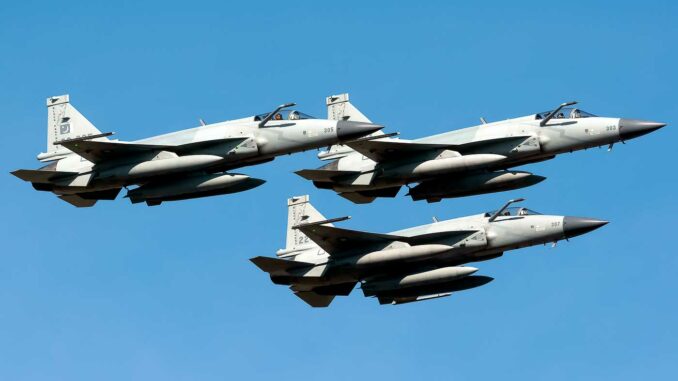
The Pakistani-Chinese JF-17 is reportedly being offered to Saudi Arabia to settle debts. This unusual agreement has significant military implications.
Summary
Consistent reports indicate that the JF-17 Thunder could be offered to Saudi Arabia as part of a debt repayment mechanism involving Pakistan and, in the background, China. The idea is simple in principle, but fraught with consequences: converting financial debt into turnkey military capability.
This scenario, unusual for Riyadh, raises several questions. Why accept a light fighter jet when the Royal Saudi Air Force already operates heavy Western fleets? What is the actual amount of the debt involved? And how could such an aircraft fit into an air force structured around the F-15, Eurofighter, and Tornado?
Behind this possible agreement lies a shift in the balance of power: budgetary pressures, diversification of suppliers, strategic rapprochement with Islamabad and Beijing, and the search for less costly solutions for certain missions. The JF-17 would not be a replacement, but a supplementary tool, revealing a broader evolution in Saudi arms policy.
The origin of a rumor circulating in strategic circles
The information does not come from an official announcement, but from regional industrial and diplomatic sources. It refers to a Pakistani proposal to deliver JF-17 Thunder aircraft to Riyadh as partial compensation for financial claims held by Saudi Arabia against Pakistan.
For several years, Riyadh has been supporting Islamabad with loans, oil payment facilities, and deposits with the Pakistani central bank. The amounts mentioned publicly vary, but the most common estimates place Saudi exposure at between $5 billion and $7 billion (approximately €4.6 billion to €6.4 billion). Converting part of this debt into military deliveries would allow Pakistan to ease its cash flow without immediate disbursement.
Why such an agreement is being considered
Acute financial constraints in Pakistan
Pakistan is going through a period of sustained economic tension. Its balance of payments is fragile and its budgetary margins are limited. The JF-17 program, developed jointly with China, is one of the few military products that the country can export without being entirely dependent on Western licenses.
Offering aircraft as partial payment for debt amounts to monetizing an existing industrial asset, while supporting the national aerospace ecosystem.
A diplomatic opportunity for Riyadh
For Saudi Arabia, accepting compensation in kind may seem counterintuitive. But it offers several advantages:
– recovering part of the value of a risky debt,
– strengthening a strategic Muslim partner,
– testing an alternative arms supply chain without a massive commitment.
This type of agreement remains rare, but it is not unprecedented in the history of international military relations.
Why the JF-17 and not another aircraft
A light, flexible, and inexpensive fighter
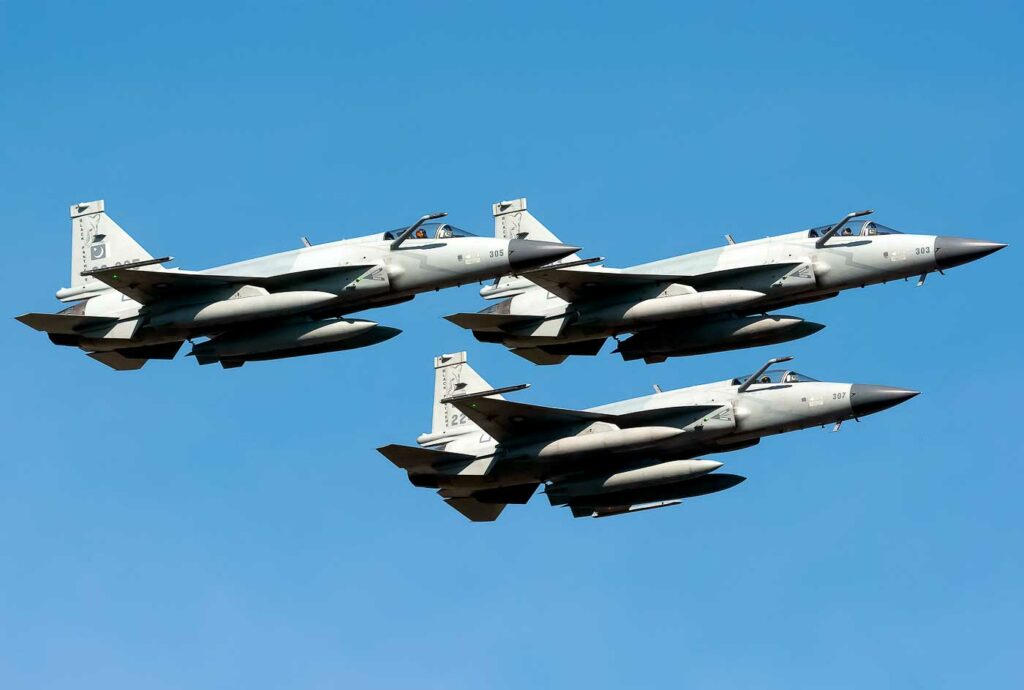
The JF-17 Thunder is a light, single-engine fighter aircraft designed to be economical to purchase and operate. Its unit cost is generally estimated at between $25 and $30 million (€23 to €28 million), depending on the version and avionics.
Its flight hour cost is well below the standards of Western heavy fighters, a key point for routine missions.
A politically “unconditional” platform
Unlike American or European aircraft, the JF-17 is delivered without strict Western political constraints. Neither Washington nor Brussels can block its use or upgrades. For Riyadh, which faces recurring pressure over the use of its equipment, this freedom is a selling point.
Sufficient technology for secondary missions
The JF-17 is not intended to compete with an F-15SA or a Eurofighter Typhoon in high-intensity combat. However, it is suitable for air policing, light support, regional deterrence, and advanced training missions.
The implied amount of the proposed compensation
Based on an average price of €27 million per aircraft, a batch of 24 aircraft would represent approximately €650 million. Even a batch of 48 aircraft would remain below €1.3 billion.
This means that the JF-17 would only settle a limited fraction of the debt, but would provide visible, tangible, and politically valuable compensation for both parties.
It is likely that the agreement, if finalized, would also include:
– pilot training,
– initial stocks of parts,
– air-to-air and air-to-ground weapons,
– logistical support over several years.
Complex integration into the Royal Saudi Air Force
An already highly heterogeneous fleet
The Royal Saudi Air Force operates F-15SAs, Eurofighter Typhoons, and Tornado IDSs. Adding a Pakistani-Chinese light fighter would introduce a new logistics chain with different standards.
This would entail indirect costs: specific training, separate maintenance, and adapted operating doctrines.
A peripheral but targeted role
The JF-17 would not be integrated into the core of Saudi Arabia’s deterrence posture. However, it could be deployed to secondary bases to relieve heavy fleets of less demanding missions.
This approach would allow the most expensive aircraft to be reserved for critical scenarios.
The Chinese dimension: discreet but central
Even if the agreement were formally concluded with Pakistan, China is omnipresent. The JF-17 uses key Chinese components, particularly in avionics and weaponry.
For Beijing, seeing its light fighter enter service in Saudi Arabia would be a major symbolic breakthrough in a country historically anchored in the Western camp.
Without direct confrontation, China would thus extend its industrial and strategic footprint in the Middle East.
The operational limitations of the JF-17 for Riyadh
We must remain clear-headed. The JF-17 has clear limitations:
– lower payload,
– shorter range than heavy fighters,
– limited survivability against modern defenses.
It does not alter the regional military balance on its own. Its value is economic and political rather than strategic.
A broader signal about the evolution of Saudi arms policy
This possible agreement reveals a fundamental trend. Saudi Arabia is seeking to diversify its suppliers, reduce its exposure to Western political decisions, and optimize its military spending.
Accepting a fighter jet as partial payment for debt would be a pragmatic, almost accounting-like gesture, a far cry from the spectacular large-scale contracts of the past.
This choice does not signify a strategic shift, but rather an opportunistic adaptation to a more constrained environment.
When debt becomes an instrument of power
If the JF-17 were to actually join the Saudi inventory, it should not be seen as a doctrinal revolution. Rather, it would be a symptom of a world where sovereign debt, budgetary constraints, and geopolitical balances are so intertwined that a fighter jet becomes a tool for financial compensation.
If confirmed, this type of agreement could inspire other countries in difficulty. And it would remind us of an often-forgotten reality: armament is not only a matter of military strategy, but also of debt management, liquidity, and influence.
Sources
– Pakistan Ministry of Defense, aerospace industry reports
– SIPRI, arms transfers and bilateral financial relations
– IISS, Military Balance
– Regional strategic analyses on Pakistan-Saudi Arabia cooperation
– Specialized publications on the JF-17 Thunder program
War Wings Daily is an independant magazine.