Low availability, aging fleets, weakened SCAF: the Luftwaffe is paying for years of underinvestment and contradictory industrial choices.
Summary
The issue of the low availability of German combat and transport aircraft has become one of the symbols of the Bundeswehr’s structural difficulties. Since the late 2010s, official reports and press investigations have documented availability rates that fall well short of NATO targets: in 2017, only 39 of the 128 Eurofighter Typhoons and 26 of the 93 Tornados were operational, while only 3 of the 15 A400Ms could be deployed. These figures reflect a simple reality: German combat aviation has long been a force that exists more “on paper” than in reality.
The causes are well known: obsolescence of the oldest fleets, industrial difficulties with recent programs such as the Airbus A400M, insufficient spare parts stocks, poor support contracts, and bureaucratic red tape. The consequences have a direct impact on Germany’s ability to fulfill its NATO commitments, particularly NATO air policing and Quick Reaction Alert missions in Europe. Despite the announcement of the Zeitenwende and a special fund of €100 billion, progress remains slow. The choice of the F-35, the continuation of the Eurofighter program, and uncertainty surrounding the SCAF raise doubts: will Germany be able to emerge from this availability crisis in the long term, or will it remain dependent on emergency solutions and fragmented fleets?
The reality of operational readiness under pressure
The situation of the Luftwaffe became a topic of public debate in 2017-2018. The “Bericht zur materiellen Einsatzbereitschaft,” the official report on the status of the main weapons systems, revealed the extent of the problem. For 2017, out of a total of 128 Eurofighters, 81 were theoretically available, but only 39 were actually “einsatzbereit,” i.e., ready for operational deployment. This represents approximately 48% material availability, far from the target of around 70% set as a benchmark.
The older Tornado fleet appears even more fragile: only 26 out of 93 aircraft are considered available for missions, even though this type of aircraft remains indispensable for NATO’s nuclear sharing role. The projection tool is also in difficulty: during the same period, only 3 out of 15 A400Ms were operational, and sometimes even fewer according to other assessments, which severely limits strategic and tactical transport capabilities.
These figures go beyond the scope of a specific controversy. They are confirmed by several parliamentary reports, by the Bundestag’s Commissioner for the Armed Forces, and by analyses from institutes such as the IISS and transatlantic think tanks. These studies estimate that Germany’s availability problems are not an isolated case, but that they are particularly acute in this country, to the point of “casting doubt on Germany’s credibility as a military partner” within NATO.
From 2019-2021, the Ministry of Defense is highlighting an average availability rate of around 70% for all systems, with a slightly positive trend for the Eurofighter and the A400M. But these averages hide significant disparities: some platforms remain well below this figure, and, more importantly, these percentages do not always reflect the number of aircraft that are actually “combat ready,” armed, equipped with all their systems, and manned by qualified crews. Press investigations have shown that, for Eurofighters, the difference between ‘airworthy’ and “fit for NATO missions” can be considerable.
The technical and industrial causes of fleet obsolescence
Fleet obsolescence is not limited to the age of the aircraft. It combines aging, technological complexity, and industrial support deficiencies. The Tornado fleet illustrates the first factor: designed in the 1970s and commissioned in the 1980s, it is approaching the end of its structural life. Maintenance costs are skyrocketing, parts are becoming scarce, and avionics equipment is struggling to keep up with the latest NATO standards. A report in 2015 already cited less than half of Tornado aircraft as fully combat-ready, a trend that has since been confirmed.
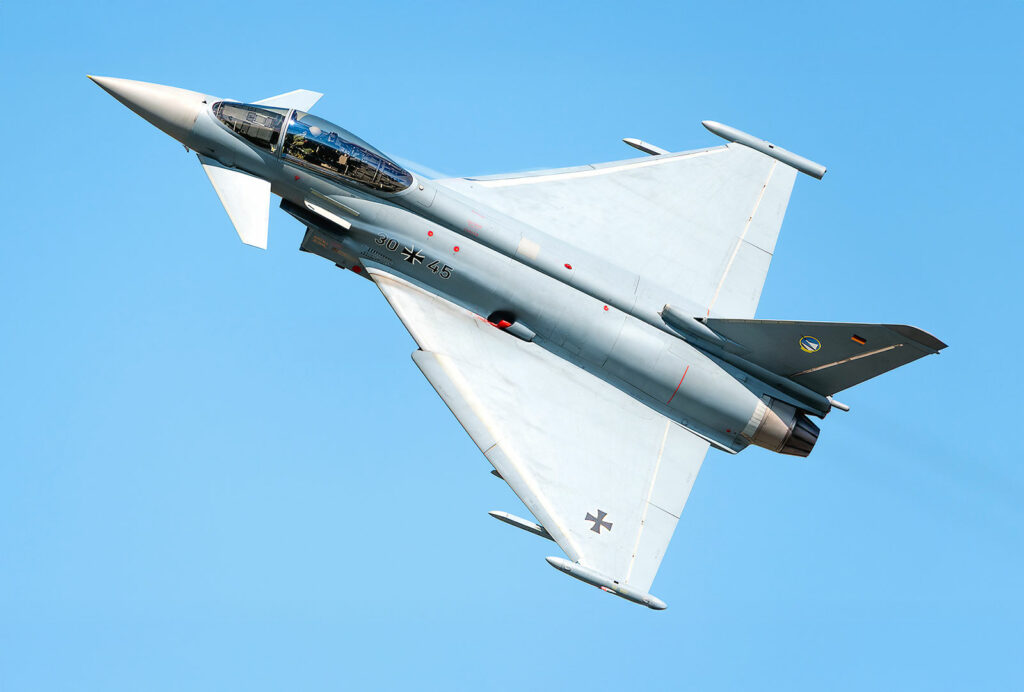
The Eurofighter suffers less from its age than from the complexity of its support system. The most symbolic case remains the episode in 2018, when the German press revealed that a problem with the self-protection system (DASS) – a coolant leak in the wing tip nacelles – drastically limited the number of aircraft fit for combat. Without this system, the aircraft can fly for training, but cannot be deployed on NATO missions. At that time, sources reported that only four Eurofighters were actually combat-ready, despite a theoretical fleet of 128 aircraft.
The case of the Airbus A400M reveals another facet of the problem: that of a technologically ambitious program that was delivered late, with capacity limitations and insufficient initial support. The German A400Ms have suffered from technical failures, retrofitting operations, and temporary restrictions on use, to the point that Berlin has refused certain deliveries until the defects were corrected. When only a handful of aircraft are actually available, the slightest breakdown or heavy maintenance throws the entire fleet off balance.
In the background, the 2019 report on equipment availability highlights a key problem: the lack, for years, of sufficient stocks of spare parts and a “war stock” sized for a high-intensity conflict. The ministry had to start building up a 30-day stock of spare parts and assemblies for high-readiness units, a sign that it was starting from a very low base. This chronic shortage explains why simple components—such as the grease nipple in the DASS cooling system—can ground a large part of the fleet for months.
Added to this is the complexity of multinational programs. Eurofighter and A400M involve several countries, with fragmented supply chains, responsibilities shared between industry and governments, and slow certification processes. Every modification or improvement results in delays, additional costs, and long periods of downtime. As long as support contracts are not truly performance-oriented—with performance-based logistics mechanisms—it is not always in the manufacturer’s interest to maximize the actual availability of fleets.
Operational limitations in the face of NATO commitments
This low availability is not an abstract issue of Excel spreadsheets. It directly affects Germany’s ability to fulfill its role within NATO. The Quick Reaction Alert (QRA) requires each country to be able to scramble armed fighter jets within minutes to intercept any suspicious aircraft approaching its airspace. In Germany, this mission is carried out from bases such as Wittmund (QRA North) and Neuburg (QRA South), with Eurofighters on permanent alert.
As long as the number of aircraft available for this alert remains sufficient, the system holds up. But when the fleet actually capable of combat is reduced to a dozen aircraft or less, any overload – a major exercise, NATO operation, or international crisis – can overwhelm the Luftwaffe’s capacity. Investigations revealing that only four Eurofighters were fully armed and equipped for NATO missions have highlighted this paradox: on paper, Berlin declares squadrons available to the Alliance; in practice, the tool quickly becomes strained as soon as it is required to go beyond routine operations.
Participation in NATO’s air policing over the Baltic states is a good illustration of this tension. Germany has regularly taken over from Lielvarde in Latvia, with Eurofighter detachments tasked with patrolling and intercepting Russian aircraft approaching NATO airspace. These detachments have carried out dozens of early warning missions, sometimes in a context of high Russian activity. Each rotation mobilizes a limited number of aircraft, but requires high availability, robust logistics, and intensively trained crews. When the overall fleet suffers from a lack of availability, each external mission places an additional strain on an already undersized fleet.
Beyond interceptions, there is the issue of flight hours and training. Studies by think tanks such as RAND show that many European air forces only maintain about half of their fleets in a fully mission-capable state, due to high maintenance costs, difficulties in recruiting technicians, and saturated logistics chains. In this context, increasing the number of aircraft types (Tornado, Eurofighter, then F-35) without resolving support issues amounts to dispersing human and financial resources instead of concentrating them.
Finally, on the political front, reports highlighting that “less than a third” of Germany’s key equipment is fully operational have fueled criticism, particularly in Washington. Experts from the Atlantic Council and the IISS have no hesitation in describing Germany’s military readiness as “abysmal” and seeing it as a vulnerability for the Alliance, particularly in relation to Russia. The Luftwaffe, supposed to be a pillar of air defense in Central Europe, appears to be a weaker link than expected.
Reforms underway: special fund, new contracts, and F-35s
Faced with this situation, Berlin has gradually recognized the scale of the crisis. Even before 2022, the Ministry of Defense had launched the “Agenda Nutzung” to better manage availability, digitize fleet monitoring, and strengthen parts inventory. But the real political turning point came after the invasion of Ukraine: Chancellor Olaf Scholz announced the Zeitenwende, with a special fund of €100 billion to modernize the Bundeswehr and a commitment to reach—and then exceed—2% of GDP spent on defense.
In aviation, this break with the past has resulted in several decisions. First, the signing of more demanding support contracts, with a focus on performance: the Eurofighter benefits from “performance-based logistics” agreements which, according to industry and ministry documents, have made it possible to temporarily increase its weekly availability to over 80%. Recent ministry reports highlight average air availability rates of around 65% for combat and transport aircraft, which is still insufficient but marks an improvement over the most critical years.
Next, the choice of capabilities. In 2022, Berlin confirmed the purchase of 35 F-35As to replace some of the Tornados in the nuclear sharing role. In 2025, the German press and Reuters reported on plans to purchase 15 additional F-35s, potentially bringing the fleet to 50 aircraft. The stated objective is to quickly secure a modern capability that is interoperable with the United States, without waiting for the hypothetical arrival of a new-generation European fighter aircraft.
At the same time, Germany continues to invest in the Eurofighter (notably through the Quadriga project) to replace older aircraft and develop electronic warfare capabilities. On paper, this combination of F-35s and Eurofighters should reduce the obsolescence of the fleets and provide a more robust basis for availability. In reality, it further complicates the logistics architecture: new standards, new training, new parts inventories.
Above all, despite increased budgets, the latest reports emphasize that the goal of truly transforming availability remains far from being achieved. In 2025, a Reuters report notes that German ground forces are only about 50% ready, that the promised “transformation” is stalling, and that gaps in manpower, air defense systems, and artillery remain glaring. The situation of the Luftwaffe is improving, but the risk of a “capability gap” persists at least until the F-35s are effectively commissioned and support for the A400Ms stabilizes.
The political and industrial consequences for the SCAF
The Luftwaffe’s availability crisis also has indirect consequences for major European programs, foremost among which is the SCAF (Future Combat Air System / FCAS). The official objective of this Franco-German-Spanish program is to develop, by 2040, a new-generation air combat system combining stealth aircraft, escort drones, and a combat cloud.
In an ideal scenario, SCAF would enable Germany to streamline its fleets by gradually replacing the Tornado and then part of the Eurofighter with a single system designed to be more available and easier to support. But the reality is more complex. On the one hand, the industrial difficulties of the SCAF – disagreements over the division of tasks between Dassault and Airbus, disputes over intellectual property – have already led to several delays in key milestones. On the other hand, Germany’s massive purchase of F-35s is changing the game.
The more Berlin invests in a long-term F-35 fleet, the less pressure there will be to quickly develop a new European fighter jet. Analysts are now openly considering the scenario of SCAF being reduced to a “combat cloud” and cooperation building blocks, with each country ultimately developing its own aircraft or turning to existing solutions such as the F-35 or GCAP (a program led by the United Kingdom, Italy, and Japan).
For the Luftwaffe, this scenario would mean the perpetuation, or even worsening, of the problem of fleet fragmentation: modernized Eurofighters, American F-35s, perhaps a future SCAF aircraft or another European solution. The more types there are, the more complex the support chain becomes, and the more average availability tends to deteriorate, especially if operating budgets do not keep pace with the increase in inventory.
At the political level, Germany’s inability to offer a truly available force structured around European systems also weakens the argument for European “strategic autonomy.” As long as Germany depends on the F-35 for nuclear deterrence and struggles to maintain its Eurofighters or A400Ms at the required level of availability, calls for air defense based on European solutions will have a hard time convincing, especially among Central and Eastern European allies who demand above all tangible and rapidly deployable capabilities.
Lessons to be learned for the Luftwaffe and for Europe
The Luftwaffe’s availability crisis is not just a German national problem. It epitomizes, in an exaggerated way, the dilemmas facing European air forces: aging fleets, delayed replacement programs, long-standing budget shortfalls, complex industrial governance, and the difficulty of reconciling political ambitions with technical constraints.
For the Luftwaffe, three lessons emerge. First, treat availability as a strategic capability in itself, on a par with stealth or weapon range. An aircraft that cannot take off is not an “asset in reserve”; it is a vulnerability. Second, simplify the platform portfolio as much as possible and invest heavily in parts, workshops, and maintenance skills, rather than just in the initial acquisition. Finally, place each capability choice (F-35, Eurofighter, SCAF) on a clear trajectory, with a schedule for phasing out older systems and a coherent support strategy.
For Europe, the lesson is broader. Credible air defense does not depend solely on the number of latest-generation aircraft, but on the ability to maintain, day after day, a core of truly usable assets. As long as actual availability remains unclear, as long as reports highlight fleets that are two-thirds unavailable, the discourse on European defense will remain fragile. The Luftwaffe has begun to correct the situation; the question now is whether this correction will be sufficiently profound and lasting to transform a structural weakness into a real asset for NATO and for future European air combat architectures.
Sources
- Reports “Bericht zur materiellen Einsatzbereitschaft der Hauptwaffensysteme der Bundeswehr” (2017–2021), Bundesministerium der Verteidigung.
- Articles on the availability of the Eurofighter, Tornado, and A400M: Business Insider, Der Spiegel, Zeit Online, UK Defense Journal (2018).
- Analyses on the readiness of the Bundeswehr: IISS, Atlantic Council, War on the Rocks.
- Studies on European air forces: RAND, RUSI.
- F-35 purchase decisions and tensions surrounding the SCAF/FCAS: Reuters, Defense News, Breaking Defense.
War Wings Daily is an independant magazine.