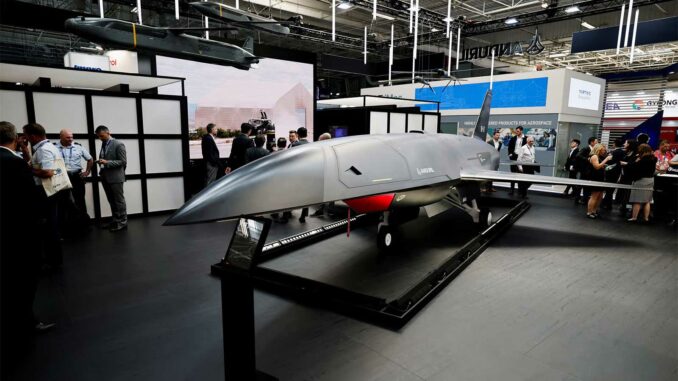
The United States is accelerating the CCA program. With the “Loyal Wingman,” the U.S. Air Force is seeking scale, autonomy, and a solution to the cost of the F-47.
In summary
The CCA program is entering a decisive phase. The US Air Force no longer treats the Loyal Wingman as an experimental concept, but as a component destined to shape its future air power. The two aircraft selected for the initial increment—General Atomics’ YFQ-42A Dark Merlin and Anduril’s YFQ-44A Fury—have recently achieved new milestones in autonomous testing, while the service is simultaneously pushing forward with weapons integration, open architecture, and industrial ramp-up. The official goal remains ambitious: at least 1,000 collaborative combat drones. This volume is no small matter. It responds to a simple equation: the future 6th-generation fighter, now designated F-47, will be too costly to deploy en masse on its own. CCAs must therefore provide depth, survivability, and a form of affordable mass. The gamble is strategic. It could transform aerial warfare. It could also reveal the limits of true autonomy, rapid production, and human-machine integration.
The CCA is no longer a demonstrator, but a cornerstone of U.S. strategy
The Collaborative Combat Aircraft is not a conventional drone. It is neither a simple ISR aircraft, nor a loitering munition, nor a light reconnaissance drone. The CCA is designed as a semi-autonomous or autonomous combat aircraft, capable of operating alongside 5th- and 6th-generation piloted fighters. Its role can encompass escort, electronic warfare, sensor relay, weapons carriage, air-to-air attack, certain air-to-ground missions, and battlefield saturation. In short, the “faithful teammate” drone is intended to expand the human pilot’s tactical range without incurring the cost or political vulnerability of a second manned aircraft.
The key point is that the U.S. Air Force is no longer talking about a few dozen units intended for doctrinal testing. It officially aims for at least 1,000 CCA. This target was publicly stated as early as 2023, then reaffirmed in the service’s official communications in 2024. This changes everything. At this level, it is no longer a matter of marginal innovation. It is an attempt to overhaul the U.S. air battle order.
The Fury and the Dark Merlin Finally Bring the Program to Life
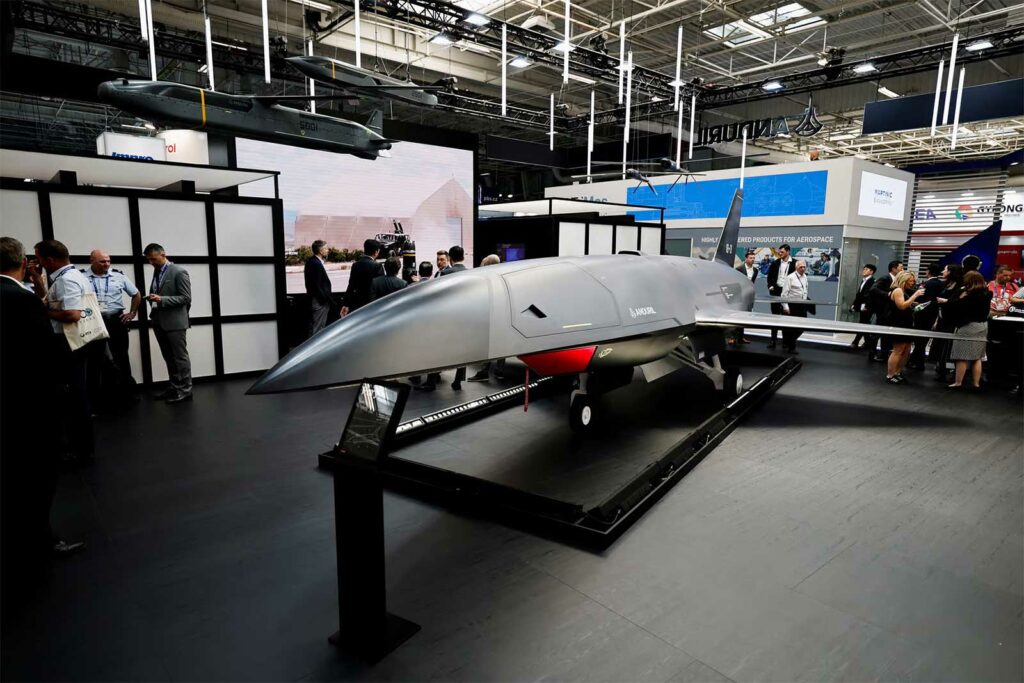
The first major milestone of this pivotal year is that the two selected platforms are no longer abstract concepts. General Atomics’ YFQ-42A and Anduril’s YFQ-44A received their official designations in January 2025.
The “Y” denotes production-representative test aircraft. The ‘F’ refers to the fighter mission. The “Q” designates an unmanned aircraft. This may seem symbolic. In reality, it is a strong institutional marker: the Air Force treats them as future combat systems, not as secondary auxiliary drones.
The second key development is the visible progress in testing. General Atomics reported that the YFQ-42A Dark Merlin delivered the first successful CCA flight for the U.S. Air Force in August 2025, followed by the first operational flight with mission autonomy software in February 2026. On the Anduril side, the YFQ-44A Fury reached a similar milestone with a flight during which the aircraft took off, autonomously reached a predefined waypoint, and then executed mission tasks using software modules from Shield AI Hivemind and Anduril Lattice. The message is crystal clear: the competition is as much about the software as it is about the airframe.
However, one point regarding the timeline needs correction. The new publicly documented milestones do not date from the “last 48 hours” as of March 14, 2026. The available official announcements focus primarily on the period from February 12 to 27, 2026. This does not change the underlying dynamics, but it is important to remain accurate.
Mission endurance becomes the true center of gravity
Public debate often stops at the drone’s form. This is a mistake. The airframe matters, of course. Stealth, infrared signature, payload, flight endurance, and speed remain decisive. But the heart of the program lies elsewhere: in the software, in mission management, and in the ability to make different systems work together under tactical stress. The U.S. Air Force stated this plainly in February 2026 by emphasizing a modular, open, and software-centric approach.
This choice addresses a structural challenge. A useful “Loyal Wingman” cannot rely on heavy, constant remote control. In a contested environment, communications links can be jammed, degraded, or destroyed. The drone must therefore be able to manage mission segments on its own: navigation, maintaining formation, adjusting flight paths, executing tactical orders, and even deploying payloads within authorized parameters. It is this mission autonomy that makes the concept viable against China. Without it, the CCA becomes an expensive and fragile appendage. With it, it becomes a force multiplier.
The F-47 accounts for much of the current acceleration
The CCA is not moving forward alone. It is advancing because the U.S. Air Force approved the development of the F-47 in March 2025, entrusting the project to Boeing under the NGAD program. The service presents it as the world’s first 6th-generation fighter. But behind the political rhetoric lies a very harsh budgetary constraint: such an aircraft will be extraordinarily costly to develop, produce, maintain, and deploy. This automatically pushes the Air Force toward a mixed architecture, in which the piloted fighter serves as a command and penetration node, while the CCA provides tactical mass, jamming, sensor relay, and additional payload.
The budget figures confirm this logic. In Document R-1 of the 2026 presidential budget, the F-47 line item appears at $2.424 billion in total funding for fiscal year 2026, or approximately €2.23 billion at the current exchange rate, while the Collaborative Combat Aircraft line stands at $789.365 million, or approximately €727 million. The F-47 thus absorbs significantly more resources from the RDT&E line, but the CCA remains sufficiently funded to become a volume program rather than a mere technological add-on.
The promise of “affordable mass” makes sense, but it has its limits
The official U.S. narrative is based on a simple idea: replacing some of the lost mass with drones that are less expensive than piloted fighters. On paper, this makes sense. A collaborative combat drone has no ejection seat, no comprehensive pilot survival system, nor even all the political and human redundancies of a manned aircraft. It may be easier to accept in high-risk zones. It can also be produced more quickly if the industrial supply chain keeps up. This is what the Air Force calls affordable mass—in other words, a combat mass that is more financially sustainable.
But let’s be honest: this promise isn’t automatic. A CCA equipped with extended range, credible survivability, modern sensors, resilient connectivity, and a robust software architecture won’t be “cheap” in the conventional sense. It will be less expensive than an F-47. That doesn’t mean it will be inexpensive. The real benefit comes from the cost-effectiveness and the ability to spread risk. A drone can serve as an advanced scout, radar decoy, missile carrier, or jammer without exposing a pilot. This logic transforms the operational economics of air combat, even if each aircraft remains technologically advanced.
Weapons integration shows the Air Force wants to move beyond the lab
Another sign of maturity lies in the weapons integration tests. In late February 2026, the U.S. Air Force announced that the program had entered a new phase of testing with inert payloads on the YFQ-44A. The goal is to validate external payload carriage, safety, structural behavior, and aerodynamics before proceeding to more advanced stages. This is a standard but revealing sequence: the program is now seeking to prove that it can actually carry tactical payloads, and not just fly autonomously.
This development is crucial. A “Loyal Wingman” without a payload remains a remote sensor or an autonomy demonstrator. A “Loyal Wingman” capable of carrying missiles, electronic warfare pods, or specialized payloads changes the dynamics of an air superiority mission. An F-35 or F-47 could then manage multiple forward effectors, saturate the enemy, open firing windows, or maintain its own stealth by delegating certain actions remotely. It is precisely this distributed combat model that the Air Force is seeking to build.
The real challenge will be industrial before it is doctrinal
From a doctrinal standpoint, the logic of CCA is now quite clear.
From an industrial standpoint, it remains much more uncertain. Manufacturing 1,000 collaborative combat drones by 2030 would require a very rapid ramp-up, a robust supply chain, continuously updated software, and accelerated certification. Yet the U.S. aerospace industry remains under strain regarding engines, materials, digital supply chains, and skilled recruitment. Strategic enthusiasm does not eliminate these constraints.
There is also a standardization issue. The Air Force is pushing for an open architecture to avoid lock-in with a single supplier. This is wise. But the more open the architecture, the more demanding the integration becomes. Interoperability must be ensured between airframes, software, sensors, data links, and payloads. This work is technically feasible. It is also time-consuming, costly, and vulnerable to bureaucratic decisions. The risk here is not spectacular failure. It is slowness.
The year 2026 could set the model for the next decade
The term “pivotal year” is not an exaggeration. It is accurate. The CCA now has its reference aircraft, its first credible flight milestones, an established budgetary commitment, and a clear strategic framework with the F-47. What is at stake now is no longer the theoretical demonstration of the concept. It is its operational implementation: weapons, mission endurance, human-machine integration, production rate, and doctrine of use.
The real question, therefore, is no longer whether the “Loyal Wingman” will exist. It will exist. The pertinent question is a tougher one: will it be a reliable multiplier of American air power, or an ambitious program slowed down by software complexity, actual costs, and industrial friction? This is where the military value of the Collaborative Combat Aircraft will be determined. And this is also where the U.S. Air Force risks learning a classic lesson: in combat aviation, a good idea is never enough. It must still be produced, integrated, and made to survive in the real world.
Sources
U.S. Air Force, April 24, 2024, Air Force exercises two Collaborative Combat Aircraft option awards.
U.S. Air Force, March 21, 2025, Air Force Awards Contract for Next Generation Air Dominance Platform, F-47.
U.S. Air Force, February 12, 2026, Air Force validates open architecture, expands Collaborative Combat Aircraft ecosystem.
U.S. Air Force, February 25, 2026, Collaborative Combat Aircraft program progresses through deliberate weapons integration testing.
General Atomics Aeronautical Systems, February 23, 2026, GA-ASI Announces YFQ-42A Dark Merlin.
Anduril, February 2026, YFQ-44A Flies with Mission Autonomy Software from Anduril & Shield AI.
Department of Defense, FY 2026 President’s Budget, Exhibit R-1, lines F-47 and Collaborative Combat Aircraft.
War Wings Daily is an independant magazine.