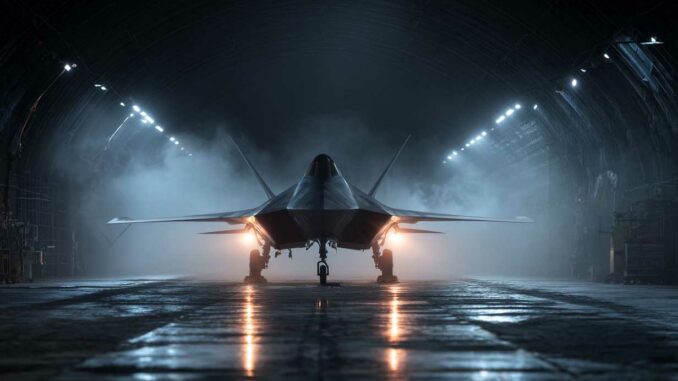
The U.S. Air Force’s 2026 budget reveals a difficult trade-off between the NGAD and CCA drones, which lie at the heart of a new air superiority doctrine.
In summary
The idea that the NGAD is slipping in the U.S. priority list is neither entirely true nor entirely false. Above all, it describes a turning point. During the initial budget deliberations for 2026, the U.S. Air Force clearly doubted its ability to simultaneously fund a very expensive 6th-generation fighter, CCA drones, nuclear modernization, the B-21, and the rest of its fleet. Frank Kendall acknowledged this in hindsight: in the first version of the budget, the NGAD was not financially viable. But the trajectory shifted in the spring of 2025 with the awarding of the F-47 program—the name given to the NGAD’s piloted platform—to Boeing. The budget version formalized thereafter did indeed maintain a massive effort on the NGAD, while confirming a deeper truth: the USAF is now banking on a hybrid architecture where the piloted aircraft is no longer the sole center of gravity. The real shift, therefore, does not pit NGAD against CCA. It redefines their operational hierarchy.
The false narrative of an abandoned NGAD
Presenting the 2026 budget as a virtual death sentence for the NGAD would be an overstatement. On the contrary, available official documents show that the U.S. Air Force ultimately preserved the program. The Department of the Air Force released a FY2026 budget request of $249.5 billion, of which $209.6 billion is allocated to the U.S. Air Force alone. Within this budget, the official presentation allocates $4.3 billion to the development of the F-47 and the Collaborative Combat Aircraft. Then, in the more detailed breakdown of the budget request, the Air Force specified an allocation of approximately $807 million for the CCAs and around $3.5 billion for the F-47. The program has therefore not disappeared. It has been saved politically and financially.
What was actually called into question was its affordability—that is, its long-term financial sustainability. Frank Kendall publicly explained that, in the first draft of the 2026 budget prepared before the change in administration, the Air Force considered itself unable to afford the NGAD. He even indicated that the program would require, over five years, tens of billions of additional dollars. In other words, the doubt did not concern the strategic utility of a 6th-generation fighter, but its ability to survive within a budget saturated by other priorities. This is an important distinction. It completely changes the interpretation of the situation.
The Overwhelming Weight of the US Air Force’s Other Priorities
The NGAD does not operate in a budgetary vacuum. The US Air Force must simultaneously fund the ramp-up of the B-21 Raider, the modernization of two legs of the nuclear triad, the LRSO missile, the Sentinel program, the partial renewal of tanker aircraft, the modernization of the F-35A, the purchase of F-15EXs, long-range munitions requirements, and the refurbishment of an aging fleet. The official budget document also notes that the USAF’s 2026 R&D&E budget amounts to $46.4 billion, a very high figure that reflects the accumulation of major programs requiring simultaneous funding.
This is where the debate becomes frank. The U.S. Air Force no longer has the leeway it had in the 1990s. It must balance absolute quality against affordable scale. Yet the NGAD was designed to confront China in an extremely contested environment, with requirements for stealth, range, connectivity, and survivability that automatically drive costs sky-high. Frank Kendall noted as early as 2022 that a manned aircraft of this type could cost several hundred million dollars per unit. At this level, the problem is no longer merely technical. It becomes structural. A fleet that is too small of extremely high-performance aircraft could lose the war of attrition before even demonstrating its theoretical superiority.
The Doctrinal Shift Toward CCAs
The decisive change is not only reflected in the figures. It is evident in the doctrine. Collaborative Combat Aircraft are no longer a marginal addition. They are becoming a pillar of future U.S. combat aviation. The USAF has confirmed an FY2026 budget of $807 million to accelerate their development, support autonomy, and refine employment concepts. The service has already selected Anduril and General Atomics for Increment 1, with a clearly stated ambition: to have the first systems operational before the end of the decade.
The USAF’s reasoning is crystal clear. An UCAV is not intended to replace a piloted fighter in every respect. It must support it, absorb risk, expand firepower, carry sensors, jam signals, serve as a scout, or even as a decoy. The benefit is twofold. First, the drone allows for the saturation of a defended airspace without immediately exposing a pilot. Second, it costs significantly less. Kendall cited a target price of $25 to $30 million per aircraft for certain UCAVs, which is about ten times less than the price of a new-generation piloted fighter. Even if this figure is only indicative, the order of magnitude is sufficient to understand the budgetary logic.
The New Equation Between Sophistication and Volume
The USAF’s true priority is therefore not to choose between manned aircraft and autonomous drones. It is to recalibrate the balance between the two. For decades, U.S. air power has been based on the idea that a small number of exceptional platforms could dominate a less advanced adversary.
This logic remains valid against regional powers. It becomes more fragile when facing China, which now combines volume, long-range missiles, electronic warfare, multi-layered ground-to-air defenses, and modern combat aviation. In this context, a very expensive piloted platform is no longer sufficient on its own. It must be at the heart of a distributed system.
The projected figures for CCA highlight the scale of the shift. The USAF has already mentioned an initial batch of 100 to 150 drones by 2029, as part of a vision for a global force that could grow to 1,000 to 2,000 aircraft. These orders of magnitude speak for themselves. Quantity is once again central. This is not a return to the past. It is a modern adaptation to high-intensity warfare. The United States is not abandoning sophistication. It is attempting to make it sustainable through autonomous mass.
The NGAD as an orchestrator rather than a soloist
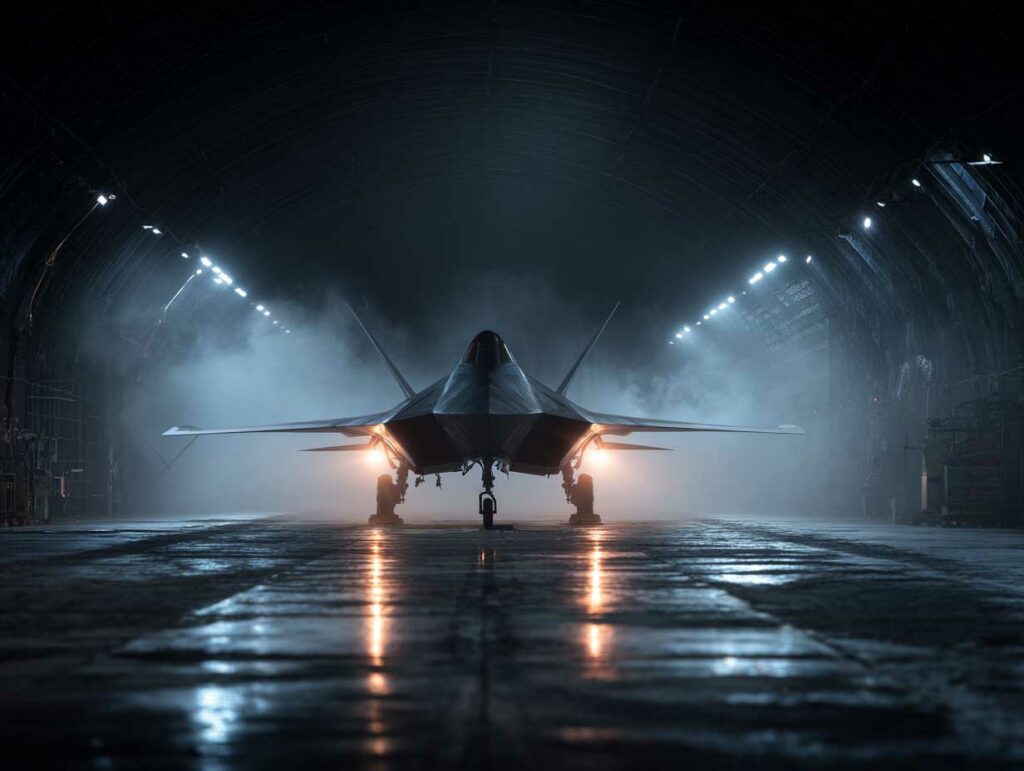
The F-47 program nevertheless retains a decisive role. The official announcement on March 21, 2025, should not be underestimated. By selecting Boeing for Engineering and Manufacturing Development, the U.S. Air Force has clearly indicated that it still wants a piloted 6th-generation fighter. Chief of Staff David Allvin emphasized a platform offering greater range, greater stealth, better availability, and greater adaptability than 5th-generation fighters. The stated goal is also to acquire 185 aircraft or more. We are therefore not dealing with a mere political demonstrator. We are facing a genuine fleet ambition.
But the role of the NGAD has changed. It is no longer conceived as the sole American response to future air superiority. It is becoming the central hub of a broader architecture. Its role is to penetrate as far as possible into the enemy’s airspace, survive there, coordinate effects, and then delegate part of the risk and tactical burden to less expensive platforms. This is a profound shift. Under this logic, the piloted aircraft remains the brain, but it ceases to be the sole armed force.
The Signal Sent to the U.S. Industry
The budget debate surrounding the NGAD also speaks volumes about the U.S. industrial base. Boeing has won an EMD contract worth over $20 billion to develop the F-47. For the aircraft manufacturer, which has been weakened industrially and financially in other segments, this is a strategic rebuilding program. For Washington, it is as much an industrial gamble as a military one. But this gamble comes with an opportunity cost. Every billion spent on the NGAD is a billion that won’t go to other priorities, unless the overall budget is increased very significantly. That is exactly what has made the issue so contentious.
The message sent to manufacturers is, moreover, ambiguous. On the one hand, the Pentagon confirms that it still wants high-tech platforms. On the other, it is strongly pushing for cheaper systems that can be produced more quickly and are more easily upgradeable. This could favor new entrants, particularly in the fields of drones, autonomy, embedded software, and distributed sensors. The industrial center of gravity could therefore shift partially from the traditional major prime contractors toward a broader, more agile, and more digital ecosystem.
The Geopolitical Impact of China
This budget trade-off is not merely an accounting dispute. It responds to a specific geopolitical constraint: China’s rise to power. The Department of the Air Force states in black and white that China is the defining challenge shaping its 2026 budget request. The problem posed by Beijing is not merely qualitative. It is also quantitative. The United States understands that it cannot sustain itself indefinitely with a combat aviation force that is too scarce, too expensive, and too difficult to replenish in a prolonged conflict in the Indo-Pacific.
The increased reliance on UCAVs directly addresses this challenge. In a vast theater, facing considerable distances, vulnerable bases, and missile stocks that must be preserved, autonomous drones offer valuable flexibility. They can be pre-positioned, expended more easily than a piloted aircraft, deployed in large numbers, and integrated into a swarm combat strategy. This does not render the NGAD useless. It prevents it from becoming an untouchable gem, too rare to be truly decisive.
The Strategic Lesson of the 2026 Budget
The 2026 budget does not signal the abandonment of the NGAD. It signals something more interesting: the end of an illusion. This illusion was the belief that an extraordinarily capable piloted platform could, on its own, meet the challenges of an air war against a peer adversary. The USAF ultimately retained the F-47, but at the same time validated another principle: future air superiority will depend on a balance between technological excellence and force density.
This is where the subject becomes fascinating for Europeans, for China, and for all industry players. U.S. air power is not abandoning the technological pinnacle. It is recognizing that this pinnacle, without a less costly supporting architecture, risks becoming budgetarily unsustainable. The real turning point, therefore, is not the cancellation of the NGAD. It is its relative demotion as the sole solution. The future belongs less to the lone fighter than to the human-machine team, and above all to the ability to produce enough smart assets to sustain a long war.
Sources
Department of the Air Force, Air Force President’s Budget Request FY26
Department of the Air Force, FY26 PB Rollout Brief
U.S. Air Force, Air Force Awards Contract for Next Generation Air Dominance Platform, F-47, March 21, 2025
U.S. Air Force, Statement by Chief of Staff Gen. David Allvin on the USAF NGAD Contract Award
War Department, Background Briefing on FY 2026 Defense Budget, June 26, 2025
Air & Space Forces Magazine, How the 2026 Budget Shapes the Future Air Force Fighter Fleet, June 26, 2025
Air & Space Forces Magazine, Former Air Force Secretary Didn’t Include NGAD in 2026 Budget
Defense News, Did the Trump administration move too quickly to commit to the F-47?, April 9, 2025
Defense News, General: 8% cuts ‘painful,’ but could bring fresh funds for Air Force, February 26, 2025
Defense One, State of the Air Force 2025
CSIS, Updating Augustine’s Law: Fighter Aircraft Cost Growth in the Age of AI and Autonomy
Aerospace America, 2026 will test U.S. Air Force’s bet on drone wingmen, January 14, 2026
War Wings Daily is an independant magazine.