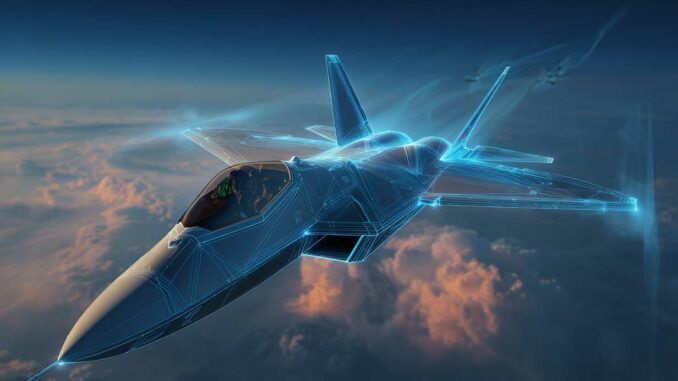
The SCAF is entering a critical phase. Tensions between Dassault and Airbus, Phase 1B, France’s Plan B, costs, and the role of drones: these are the issues France must resolve.
In summary
The SCAF remains officially alive, but it is no longer merely in a zone of uncertainty. It has entered a political, industrial, and doctrinal crisis. Phase 1B, launched in late 2022 at a cost of 3.2 billion euros, was intended to prepare the demonstrators for the future European air combat system. In practice, it has mainly confirmed the depth of the conflict between Dassault Aviation and Airbus over control of the manned fighter, the division of labor, and ownership of critical technological components. In early March 2026, Éric Trappier publicly warned that the project was “dead” if Airbus persisted in its current approach. At the same time, France is bolstering its military presence in the Mediterranean and the Middle East, underscoring an obvious fact: Paris needs a credible, rapidly deployable, and sovereign combat aviation capability. Hence the resurgence of a long-taboo debate: a French Plan B, centered on the Rafale F5, a stealth combat drone, and an architecture that is more national than truly European.
The SCAF is not just an aircraft, but a complete combat system
The Future Air Combat System is not merely the successor to the Rafale or the Eurofighter. It is a set of interconnected components: a next-generation fighter jet, escort drones known as Remote Carriers, a Combat Cloud for networking, as well as sensors, engines, and data fusion architectures. The political objective stated since 2017 is clear: to provide France, Germany, and Spain with a European system capable of entering service around 2040. Airbus notes that the program is structured around technological pillars, each under the responsibility of a lead contractor. Dassault is officially the prime contractor for the New Generation Fighter, that is, the heart of the system: the manned aircraft.
This is precisely where the crisis lies. In a program of this magnitude, the question is not merely who manufactures what. It concerns industrial leadership. Who decides on technical trade-offs? Who bears the risk? Who makes the call when national interests diverge? In theory, the answer was simple: the lead nation for the aircraft pillar takes the lead. In practice, this hierarchy has never been fully accepted by everyone.
Phase 1B was meant to secure the demonstrators, not reignite the industrial war
Phase 1B was announced in December 2022 by the French DGA on behalf of the three nations. It is valued at 3.2 billion euros and covers approximately three and a half years of work. Its role is to extend Phase 1A, consolidate the program’s architecture, and prepare the flight demonstrators planned for subsequent stages, with milestones targeted around 2028–2029 for the first flight demonstrations.
Airbus has presented this phase as the bridge to the future development phase.
In other words, Phase 1B does not yet involve the manufacture of the operational system. It is a phase of advanced studies, technological maturation, integration, risk reduction, and preparation of the demonstrators. It serves to verify that the core components can actually work together. However, when manufacturers are already at odds at this stage, it sends a stark signal: if the stakeholders cannot reach an agreement even before large-scale industrialization begins, the process will become even more costly, slower, and more contentious.
French parliamentary documents, moreover, reiterated in 2024 and 2025 that Phase 1B was coming to an end and that discussions on Phase 2 were to begin thereafter. It is precisely this transition that is now becoming the breaking point. If the partners cannot agree on the governance of the aircraft pillar and on the actual sharing of power, it will be difficult to properly launch the next phase.
Tensions between Dassault and Airbus center on power, responsibility, and intellectual property
The conflict has never been purely about finances. It pits two visions of the program against each other. Dassault believes that a fighter jet cannot be developed under a loose co-leadership structure. For the French manufacturer, there must be a clearly identified prime contractor, responsible for design choices and capable of ensuring overall consistency. Éric Trappier further hardened this stance in early March 2026, explaining that the project would be “dead” if Airbus continued on its current course. Reuters reports that he estimates a fighter could be developed by Dassault for less than 50 billion euros under a separate framework.
On the other side, Airbus refuses to be reduced to a subcontractor on the central pillar. Guillaume Faury publicly stated in February 2026 that Airbus was capable, if necessary, of developing a fighter on its own. He even raised the possibility of two separate or semi-convergent aircraft if the political compromise failed. This amounts to saying that the strategic unity of the SCAF is no longer taken for granted, even by its main industrial promoters.
Behind this debate lie three very concrete issues. First, the division of labor: who controls stealth technology, flight controls, system architecture, and critical interfaces? Next, intellectual property: no manufacturer is willing to open up its most sensitive components without limits. Finally, national return on investment: Berlin and Madrid are providing funding and therefore demand visible stakes; Paris points out that it possesses comprehensive experience with a sovereign fighter aircraft, which changes the nature of the discussion.
France’s Plan B is taking on an increasingly clear shape
Plan B is no longer an abstract rumor. It is beginning to resemble a coherent architecture. Its foundation would be the Rafale F5, expected around 2030, accompanied by a stealth combat drone derived from the nEUROn legacy. The Military Programming Law has officially confirmed the development of the F5 standard during the 2024–2030 period, specifying that it will include an escort drone. In October 2024, the Ministry of the Armed Forces also indicated that the Rafale F5, accompanied by its stealth combat drone, would have enhanced capabilities for contested environments.
This Plan B would therefore rest on three pillars. First, extending the Rafale’s service life and expanding the range of variants. Second, adding a French or largely domestically produced loyal wingman drone. Finally, gradually developing the network, electronic warfare, data fusion, and weapons systems that were intended for the SCAF. This is not a perfect replacement for the tri-national program. Rather, it is a sovereign alternative—more realistic in the short term, more politically controllable, and less vulnerable to veto by foreign partners.
Is this credible? Yes, from a basic industrial standpoint. France knows how to design a fighter jet, a radar, avionics, a military engine with Safran, missiles with MBDA, and an experimental stealth drone already existed with nEUROn. What France cannot do for free, however, is painlessly absorb the full cost of a Rafale successor while also funding deterrence, military space programs, a next-generation aircraft carrier, ammunition, ground-to-air defense, and mass production ramp-up. That is the real limit.
State financial support would be almost inevitable
If Dassault were to move toward a broader French solution, the government would automatically be at the center. Not because the company would be unable to invest, but because no fighter jet in this category is launched with private funding. Initial studies, technological risks, certification, potential nuclear integration, testing, mission systems, and production volumes require a solid and sustainable government contract. This is already true for the SCAF. It would be even more true for a program refocused on French sovereignty.
The question, therefore, is not whether the government should pay. It would pay. The real question is: would it spend its money more effectively? In a stalled cooperative effort, public funds finance delays, unnecessary compromises, and cumbersome governance structures. In a national framework, it finances greater sovereignty and coherence, but at the cost of a more concentrated budgetary effort and a heavier export risk if European partners pull away. The choice is not between cost and free. It is between two ways of spending a lot.
The drone argument does not condemn the manned fighter, but it changes its role
To say that a program like SCAF would be counterproductive because there are many different types of drones is a tempting idea, but it is too simplistic. Yes, drones are changing aerial warfare. Yes, they allow certain missions to be scaled up at lower cost. Yes, they better absorb attrition. But they do not yet completely replace a manned fighter jet for air superiority, complex penetration, tactical decision-making in a cluttered environment, nuclear certification, or the political management of escalation.
On the other hand, drones are profoundly changing the right industrial response. The future likely no longer boils down to a single, exquisite, extremely expensive fighter jet produced in too small a number. The most robust model is instead a layered system: a high-performance manned aircraft, produced in smaller numbers; disposable or reusable escort drones; robust connectivity; and the ability to produce quickly. From this perspective, France’s Plan B may even seem more modern than a SCAF that has become too politically burdensome. It would be less of a “major European program” and more of a “truly deliverable operational system.”
The Mediterranean commitment serves as a reminder that Paris cannot wait indefinitely
The debate is not theoretical. In March 2026, France reinforced its presence in the Near and Middle East and redeployed its carrier strike group to the Mediterranean amid high regional tensions.
Reuters reports the deployment of nearly a dozen ships and France’s determination to protect freedom of navigation and its allies. This sudden return to operational constraints speaks to one simple fact: France cannot build its military credibility on a program that remains bogged down.
For Paris, the eastern Mediterranean, the Levant, the Red Sea, the Persian Gulf, and the African interior form a continuum of crisis. In this region, there is a need for available aircraft, integrable drones, short decision-making chains, and genuine political autonomy. The SCAF was intended to serve this objective. If its governance produces the opposite, then it ceases to be a tool of power and becomes a source of paralysis. This is exactly what Dassault is suggesting more and more openly.
The real issue is no longer just European; it is strategic
The SCAF is not legally doomed. Officially, Phase 1B continues. But politically, the program is no longer shielded by diplomatic niceties. The taboo has been broken. Airbus is open to the idea of a separate solution. Dassault is threatening to walk away. French parliamentary documents note that the transition to Phase 2 was imminent. And France, on the ground, is once again facing immediate defense needs.
What happens next will depend less on official communication than on a very difficult decision: to accept a program that is truly led, with a clear chain of command, or to acknowledge that a major trinational compromise produces too little, too slowly. From that point on, the French Plan B will cease to be a tactical threat. It will become industrial policy.
Sources
Reuters, March 4, 2026, “Dassault CEO says FCAS fighter project ‘dead’ if Airbus refuses to cooperate”
Reuters, February 20, 2026, “Airbus capable of developing a fighter jet alone, CEO says, as FCAS spat deepens”
Reuters, July 30, 2025, “Airbus presses Dassault for decision following fighter tensions”
Reuters, July 7, 2025, “Paris demands 80% workshare in Franco-German fighter jet, says source”
Airbus, press release of December 16, 2022 on Phase 1B of the FCAS/SCAF, amounting to €3.2 billion and schedule for demonstrators
Dassault Aviation, Annual Report 2022, award of the Phase 1B contract and role as prime contractor on the NGF
Senate, work on the 2024-2030 Military Planning Law, mention of the Rafale F5 and the escort drone derived from nEUROn
Ministry of the Armed Forces, October 14, 2024, and June 17, 2025, industry notifications and presentation of the Rafale F5 with stealth combat drone
National Assembly, information report and 2024–2025 minutes on the completion of Phase 1B and the expected start of Phase 2
Reuters, March 9, 2026, reinforcement of French military forces in the Mediterranean and the Middle East
War Wings Daily is an independant magazine.