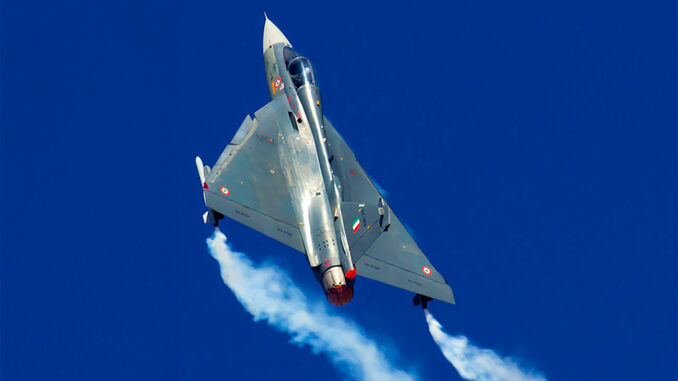
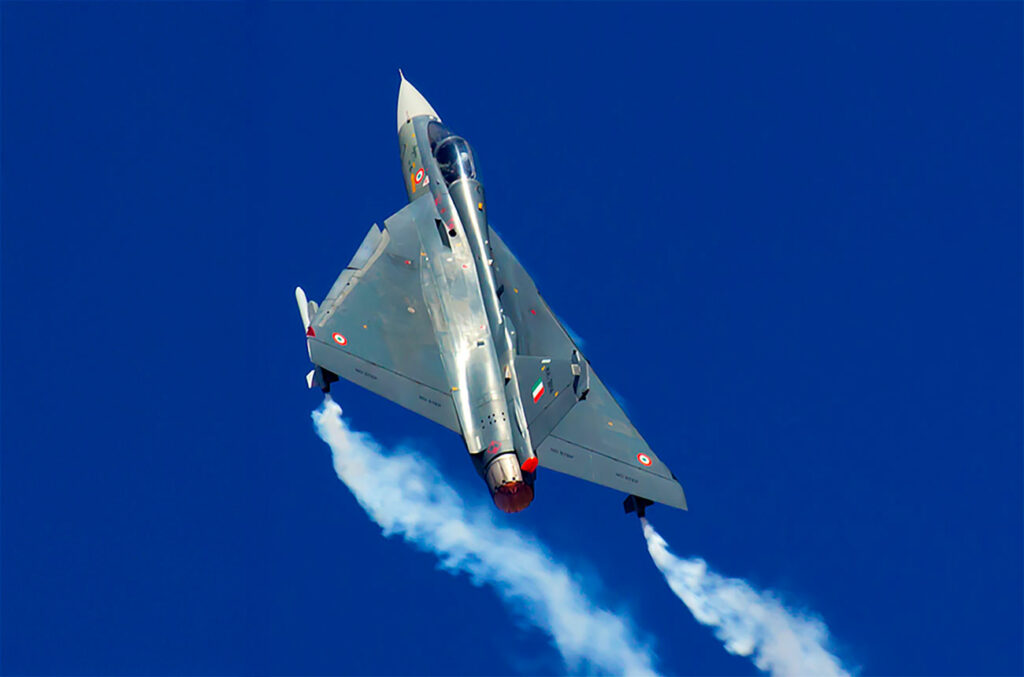
The fatal crash of a Tejas at the Dubai Airshow weakens HAL, calls into question the delivery schedule to the Indian Air Force, and puts the Armenian project on hold.
Summary
The crash of a HAL Tejas demonstrator during a presentation at the Dubai Airshow 2025 has suddenly brought the Indian light fighter program back into the spotlight. The accident, which claimed the life of an Indian Air Force pilot, comes at a time when Hindustan Aeronautics Ltd. (HAL) was signing contracts for more than 180 aircraft for India and hoping to establish the Tejas on the export market. New Delhi and HAL described the event as an “isolated occurrence” and announced a full technical investigation. On the surface, the delivery schedule remains unchanged. In reality, the slightest delay in expert assessments or technical modifications could weigh heavily on an assembly line that is just getting up to speed. The effect on exports is immediate: Armenia has suspended negotiations for the acquisition of Tejas, putting Israeli avionics manufacturers involved in radar and electronic warfare in a difficult position.
A recap of the facts and the first official reactions
On November 21, 2025, a single-seat Tejas crashed during an aerobatic demonstration in Dubai, after a low-altitude maneuver followed by a loss of control and an almost vertical impact. The pilot, an experienced Indian Air Force officer, was killed instantly. Videos show the aircraft appearing to respond normally until the final seconds, leaving open the question of pilot error, a flight control problem, or a sudden mechanical failure.
HAL quickly issued a statement referring to an “isolated occurrence” caused by “exceptional circumstances” and insisted that the accident did not call into question the overall safety of the Tejas fleet or the operation of its assembly lines. The company said that its business, finances, and deliveries “will not be affected.”
In the hours that followed, the stock market reacted more sharply: HAL shares lost up to 8.5% during trading before stabilizing, a sign of real doubt about the risk to the company’s image and the confidence of export customers. On the operational front, the Indian Air Force has launched a court of inquiry, with the participation of HAL and General Electric, the Tejas’ engine manufacturer. Until this inquiry has reached its conclusions, it is unlikely that New Delhi will publicly change its stance on the aircraft.
The Tejas’ place in India’s air strategy
To understand the potential impact of this crash, it is important to remember the role of the Tejas in the modernization of the Indian fleet. Designed as a light multi-role fighter, the Tejas is intended to replace aging MiG-21s and secure part of the fighter volume needed to counter China and Pakistan.
In total, the Indian Air Force has ordered 40 Tejas Mk1s, followed by 83 Tejas Mk-1As equipped with active antenna radar, BVR capabilities, and in-flight refueling. In September 2025, New Delhi signed a second contract for 97 additional Mk-1As, bringing the number of fighters of this version intended for the Indian forces to 180, for a total of approximately 66,500 crore Indian rupees (more than €7 billion at the current exchange rate).
In other words, India has made the Tejas its flagship program to reduce its dependence on Russian and Western aircraft. The program focuses on multiple strategic issues: territorial protection, industrial skills development, and the credibility of the Indian aerospace industry in the export market. It is precisely this threefold objective that the accident in Dubai has undermined, not technically at this stage, but in terms of perception and confidence.
The real impact on production and delivery schedule
Officially, HAL assures that the crash will have no impact on current or future deliveries. However, the Tejas program is just emerging from a long period of accumulated delays. The first 40 Mk1 aircraft, initially expected in 2011, were not completed until 2024. Deliveries of the 83 Mk-1As, which were to be spread out until 2029, are already behind schedule, mainly due to the availability of F404 engines supplied by GE Aerospace.
The ramp-up remains a delicate exercise. In early 2025, the Indian authorities announced a target of 16 to 24 Tejas Mk-1A aircraft delivered per year from the 2025-2026 financial year, once the production rate and engine flow had stabilized. In practice, the plan remains dependent on many factors: subcontracting, logistics, flight testing, and the availability of test pilots.
The accident in Dubai adds an additional constraint. Even if the investigation concludes that it was pilot error, the Indian authorities will be pressured to review demonstration procedures, flight envelopes, and even certain software parameters of the flight controls. Each modification will have to be tested, validated, and then integrated into aircraft in production or already delivered. This process does not necessarily block the production line, but it can slow down the release of “combat-ready” aircraft for the Indian Air Force, especially if retrofits prove necessary.
The main risk is therefore not a halt in production, but a series of minor delays which, when added together, will push back the full availability of the Tejas squadrons by several months, at a time when New Delhi is counting on these aircraft to replace fleets that are reaching the end of their service life.
The Armenian freeze: a warning sign for exports
The most immediate effect of the crash is on exports. A few days after the accident, Armenia announced the suspension of its negotiations for the acquisition of Tejas Mk-1A, a project valued at around $1.2 billion (approximately €1.1 billion).
For Yerevan, this freeze does not necessarily mean a definitive break, but it does reflect a real concern. The country, caught between Turkey and Azerbaijan, needs to rapidly modernize its air defense. By turning to the Tejas, Armenia was seeking a compromise between cost, multi-role performance, and political balance vis-à-vis Russia and the West.
The crash changes the situation in the short term. In a context of high regional tension, no government can afford to justify the purchase of an aircraft that has just been involved in a failed demonstration, publicized by viral videos. Even if the cause turns out to be non-technical, the political risk is considered too high to sign now.
Beyond the Armenian case, it is the credibility of India’s export strategy that is affected. The Tejas was supposed to be the showcase for a military “Make in India” capable of winning markets in the Global South, in competition with Chinese, Korean, and Western offerings. The first fatal crash with high international visibility weakens this narrative, at a time when HAL was hoping to turn the Tejas into a best-seller in the light fighter segment.
The structuring role of Israeli suppliers in the dossier
The Armenian freeze does not only affect India. The Tejas project for Yerevan was based on an advanced configuration with AESA radar and electronic warfare suite supplied by Elta Systems, a subsidiary of Israel Aerospace Industries. Armenian and Israeli sources mention significant amounts for this equipment, which is integrated into the airframe produced by HAL.
For Israeli industry, the deal represents a double setback. First, financially, since the suspension of discussions blocks a potential order for radars, electronic warfare systems, and mission software. Second, politically, as Israel seeks to consolidate its position as a key supplier of sensors and avionics for medium-sized fighter fleets, including those produced by partners such as India.
The episode highlights the complexity of the value chains of modern fighter programs. A crash at an air show in Dubai affects not only HAL and the Indian Air Force: it also has repercussions for foreign subcontractors who bear no responsibility for the accident but find themselves associated, in the public eye, with a program that is presented as “risky.”
What the accident reveals about India’s aeronautical credibility
From a strictly technical standpoint, it is too early to conclude that there is a design flaw in the Tejas. The aircraft has accumulated thousands of flight hours in operational service and testing, and the Indian Air Force has not reported a series of comparable incidents. It would therefore be excessive to bury the program on the basis of a single crash, however spectacular it may be.
On the other hand, the event reveals the fragility of a program that carries disproportionate expectations. The Tejas must simultaneously modernize the Indian fleet, consolidate an industrial base that is moving upmarket, reassure foreign partners, and maintain a political narrative of strategic autonomy. The slightest accident then becomes a test of overall credibility.
The official reaction, which was to describe the accident as “isolated” even before the detailed findings of the investigation were known, shows the pressure HAL is under. In the short term, this stance limits the damage to the stock market and politically. In the medium term, it will force India to be technically transparent if the investigation reveals a software defect, a flight envelope limitation, or a maintenance issue. Current and future export customers will demand quantified answers: accident rate per 100,000 flight hours, additional test volumes, and concrete modifications to the production standard.
For the Indian Air Force, the issue is more operational than symbolic. As long as Tejas Mk-1A deliveries remain limited, the impact of an accident can still be absorbed in fleet planning. But if the ramp-up to 16–24 aircraft per year is confirmed, lingering doubts about the aircraft could destabilize the construction of the order of battle for the 2030s.
The Dubai crash thus acts as a wake-up call. It shows that India has joined the club of nations that design and export their own fighter jets, with all the risks to image, liability, and industrial dependencies that this entails. The way in which New Delhi and HAL manage the aftermath of the accident, backed up by figures, will say a lot about the real maturity of the Indian aerospace ecosystem.
Sources:
– Reuters, “India’s Tejas jet-maker HAL calls Dubai crash an isolated occurrence,” November 24, 2025
– Times of India, “HAL falls 8.5% intraday after Tejas crash,” November 24, 2025
– The War Zone, “Fatal Crash Of India’s Tejas Light Fighter Mars Dubai Airshow,” November 21, 2025
– Wikipedia, “HAL Tejas,” updated in February and September 2025
– The Jerusalem Post / news.am, articles on Armenia’s suspension of Tejas negotiations and the impact on Israeli suppliers
– Defence Security Asia, “Armenia suspends its USD 1.2 billion Tejas Mk-1A acquisition talks following the fatal Dubai Airshow 2025 crash,” November 24, 2025
War Wings Daily is an independant magazine.