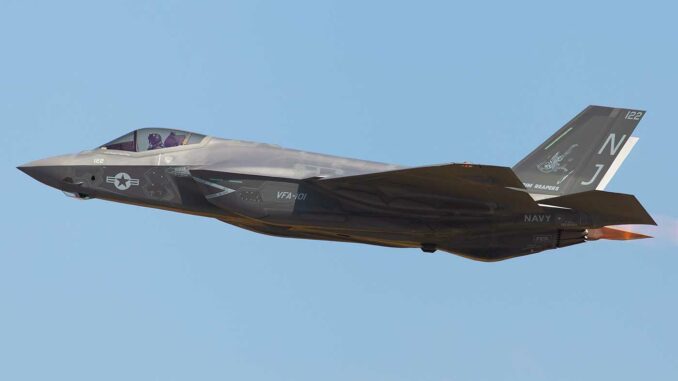
The U.S. Air Force’s 2026 roadmap confirms a gradual increase in F-35s and a targeted reduction in F-22s to prepare for the arrival of the NGAD F-47 fighter around 2030.
In summary
The US Air Force’s 2026 fighter aircraft roadmap reflects a pragmatic strategy. The objective is clear: to maintain US air superiority while preparing for the transition to the next generation. The plan calls for a measured expansion of the F-35 Lightning II fleet, which is expected to reach 344 aircraft by 2026, while phasing out certain F-22 Raptors deemed too costly to modernize. The U.S. Air Force intends to retain approximately 134 modernized Raptors while awaiting the arrival of the future NGAD fighter, now designated F-47, expected in the early 2030s.
This approach is based on budgetary and technological trade-offs. It aims to avoid a “capability gap” vis-à-vis China while funding next-generation programs. The strategy rests on three pillars: modernizing existing aircraft, limiting operational maintenance costs, and preparing for the integration of sixth-generation aircraft operating alongside combat drones. This roadmap reveals a U.S. military forced to make difficult choices to remain technologically dominant.
The transition strategy to the next generation of fighters
Planning for U.S. fighter fleets is based on a simple principle: avoiding any capability gap between generations of aircraft. The U.S. Air Force must therefore manage three timeframes simultaneously: the current operational reality, the modernization of the current generation, and the arrival of sixth-generation systems.
The 2026 planning document confirms this logic. The U.S. Air Force is not seeking rapid growth in the number of aircraft but rather a qualitative evolution of its fleet. This approach reflects a doctrinal shift: technological quality now takes precedence over quantity.
This strategy is also dictated by budgetary constraints. The total cost of the NGAD, B-21 Raider, and existing fleet modernization programs amounts to hundreds of billions of dollars over several decades. The development of the F-47 alone could cost more than $20 billion for the initial engineering phase.
The roadmap is also part of a strategy of strategic rivalry with China. The U.S. Air Force considers that maintaining a credible fleet of fifth-generation fighters remains essential until the sixth generation becomes operational.
The Gradual Rise of the F-35 as the Backbone of the Fleet
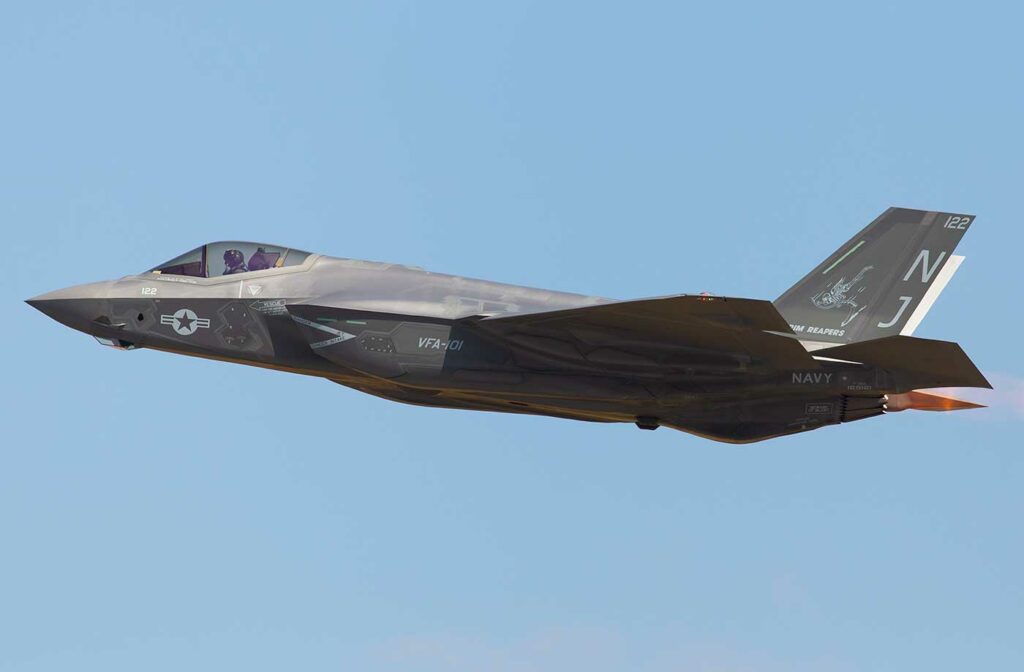
The F-35A is gradually becoming the US Air Force’s primary tactical aircraft. Plans call for a base fleet of 344 aircraft by 2026, with a gradual increase in subsequent years.
This moderate growth is due to several factors:
The overall cost of the program
The unit cost of an F-35A is currently estimated at around $80 million (approximately €74 million), but its operational maintenance costs remain high. The Pentagon is therefore seeking to balance acquisitions with budgetary constraints.
The gradual maturation of capabilities
The F-35 continues to evolve through successive software blocks. These updates enhance its capabilities in data fusion, electronic warfare, and weapons employment. This approach allows for spreading out investments while gradually improving the platform.
The central role in network-centric warfare
The F-35 is no longer just a fighter jet. It has become a tactical communication hub capable of sharing data with satellites, drones, and other aircraft. This capability explains why the U.S. Air Force favors slow but steady growth over rapid expansion.
This strategy reflects a strong conviction: future air superiority will depend more on connectivity than on the sheer number of aircraft.
The Targeted Reduction of the F-22 to Streamline the Fleet
The F-22 Raptor remains one of the world’s best air superiority fighters. However, the U.S. Air Force plans to retire certain aircraft, particularly the Block 20 training versions, which are deemed too costly to modernize.
Modernizing these aircraft could cost approximately $3.5 billion, leading the U.S. Air Force to prioritize their retirement over their upgrade.
The rationale is purely economic and operational.
Maintenance costs
The F-22 is an extremely high-performance aircraft but also very costly to maintain. Its outdated computer architecture makes certain upgrades complex.
Maintaining a More Homogeneous Fleet
By retaining approximately 134 modernized Raptors, the U.S. Air Force aims to maintain a more technologically consistent fleet. This consistency simplifies maintenance, pilot training, and logistics.
The role as a technological bridge
The retained F-22s are intended to serve as a transition platform to the NGAD generation. They will continue to be used for air superiority missions until they are gradually replaced in the 2030s.
This decision illustrates a major shift: the military now accepts phasing out capabilities that are still effective in order to fund future technologies.
The Technological Challenge of the F-47 and the NGAD Program
The future F-47 is the cornerstone of the U.S. long-term air strategy. This program is not limited to a single aircraft but encompasses a complete combat system.
The NGAD is based on a concept called the “family of systems.” It includes:
- a sixth-generation piloted fighter
- escort drones
- distributed sensors
- advanced communication systems
The U.S. Air Force plans to acquire approximately 185 F-47s and more than 1,000 escort drones known as Collaborative Combat Aircraft.
Expected characteristics
Although details remain classified, several elements are known:
- a range exceeding 1,850 kilometers
- a speed exceeding Mach 2
- cooperation with autonomous drones
These capabilities are intended to enable operations in highly contested environments, particularly in the Indo-Pacific region.
The development timeline
The first flight is planned for around 2028, with entry into operational service in the early 2030s.
This timeline explains why the U.S. Air Force must retain its F-22s and F-35s longer than expected.
A doctrinal revolution
The NGAD marks a doctrinal shift. Future air combat will be collaborative.
Manned aircraft will act as conductors of mixed formations comprising drones and sensors.
This evolution transforms the pilot’s role, shifting from a simple platform operator to a tactical commander.
The Budgetary Dilemma Between Quantity and Sophistication
U.S. strategy reveals a classic tension: should quantity or quality be prioritized?
China is producing fighters at a rapid pace, notably the J-20. Faced with this rise in capability, some experts believe the United States should rapidly increase its fleet size.
Others defend the current approach. In their view, U.S. superiority rests on technological advantage rather than sheer numbers.
This tension explains the current strategy:
- slow growth of the F-35
- phasing out the less-capable F-22s
- massive investment in sixth-generation aircraft
This approach reflects budgetary realities. Resources do not allow for the simultaneous funding of all priorities.
The U.S. Air Force is therefore making a clear choice: to invest in the technologies that will define future conflicts rather than maximize current capabilities.
Maintaining Operational Credibility in the Face of Threats
The 2026 roadmap is not just about industrial planning. It also addresses an immediate strategic necessity.
The U.S. Air Force must maintain a credible capability against the Chinese and Russian air forces. This means retaining a core fleet of aircraft capable of air superiority missions.
The modernized F-22s and F-35s must fulfill this mission.
The logic is simple: the NGAD will not arrive soon enough to compensate for a potential decline in current capabilities. The U.S. military must therefore manage a critical transition period.
This situation echoes previous transitions between generations of aircraft. Each time, the military has had to extend the service life of existing platforms.
The difference today lies in the speed of technological change. Artificial intelligence, distributed sensors, and networked warfare are accelerating the obsolescence of systems.
The strategic signal sent by this roadmap
This plan sends several messages.
First, the United States acknowledges that air superiority can no longer be taken for granted. It must be maintained through constant investment.
Second, it demonstrates a commitment to budgetary discipline. The era of massive fleets appears to be over. The future rests on smaller but technologically superior forces.
Finally, this roadmap indicates that the transition to the sixth generation will be gradual. The F-35 and F-22 will remain essential for at least a decade.
This situation highlights a reality rarely discussed: military technological revolutions take time. Between the decision to develop a system and its operational deployment, fifteen to twenty years may elapse.
The real issue, therefore, is not merely the arrival of the F-47. It concerns the U.S. Air Force’s ability to manage this interim period wisely without undermining its credibility.
The real challenge lies here: successfully executing a major technological transition without creating temporary vulnerabilities.
Sources
Air & Space Forces Magazine – Air Force Fighter Roadmap (2025)
US Air Force – NGAD program statements
Defense News – Future force design discussions
Reuters – NGAD contract announcement
Le Monde – F-47 NGAD Program
US Air Force acquisition planning documents
Congressional defense hearings (2025-2026)
Aviation Week fleet modernization analysis
War Wings Daily is an independant magazine.